Inheritance tax in Costa Rica is essentially non-existent, making the country attractive for expats and foreign residents.
Both residents and non-residents can inherit property or money without paying tax on the inheritance itself.
This article covers:
- What is the maximum inheritance without tax?
- What is the tax paid by a person who inherits money or property of a person who has died?
- What are the tax implications of owning property in Costa Rica?
- Who is disqualified from inheriting under a will?
Key Takeaways:
- Inheritance itself is tax-free in Costa Rica.
- Property transfer triggers a 1.5% transfer tax on the registered property value.
- Annual property tax is low, at around 0.25% of the official property value.
- Cash, bank accounts, and movable assets are not taxed at the point of inheritance.
My contact details are hello@adamfayed.com and WhatsApp +44-7393-450-837 if you have any questions.
The information in this article is for general guidance only. It does not constitute financial, legal, or tax advice, and is not a recommendation or solicitation to invest. Some facts may have changed since the time of writing.

What are the inheritance laws in Costa Rica?
Inheritance laws in Costa Rica are governed by the Civil Code, which follows a structured system to protect family members.
Key points include:
- The law mandates forced heirship, meaning spouses, children, and sometimes parents cannot be entirely disinherited.
- The order of inheritance prioritizes descendants (children and grandchildren), then ascendants (parents), followed by siblings, and lastly more distant relatives.
- Wills are allowed but cannot violate the minimum forced portions for heirs.
For expats, it’s important to note that foreign wills may need validation in Costa Rica to be recognized, particularly if property or bank accounts are involved.
How Much is Inheritance Tax in Costa Rica?
Whether you are a resident or non-resident, inheritance itself is not subject to income tax in Costa Rica. However, other taxes may apply according to the type of inherited asset.
- Property: May incur property transfer tax when sold or registered.
- Bank accounts or investments: Generally, no tax is levied at inheritance, but income generated afterward may be taxable.
This makes Costa Rica relatively attractive for expats planning to pass assets to heirs.
What is the maximum amount you can inherit without paying tax in Costa Rica?
There is no maximum amount exempted, as inheritance itself is not directly taxed in Costa Rica. Instead, there are minor administrative fees based on the type of asset, such as real estate or bank accounts.
However, some related taxes, like property transfer tax or capital gains tax on real estate, may apply when inherited assets are sold or transferred.
Expats should plan carefully to avoid unexpected costs.
Who is not allowed to inherit from parents?
Heirs who commit serious offenses against the deceased or their family, interfere with a will, fail to support the deceased, or formally renounce the inheritance are not allowed to inherit in Costa Rica.
Certain heirs can also be declared unworthy to inherit under Article 523 of the Civil Code for specific serious acts, or they may formally renounce their inheritance.
Those generally excluded from inheritance include:
- Individuals who kill, attempt to kill, injure, or commit serious offenses against the deceased or their close family, including assaults on honor or memory.
- Anyone who falsely accuses or testifies against the deceased in legal proceedings.
- Heirs who refuse or fail to provide legally required support to the deceased.
- Heirs who interfere with a will through fraud, coercion, theft, or force.
- Heirs who formally renounce the inheritance.
Expats should consult a local attorney to ensure compliance with these rules and avoid disputes among family members.
What tax is paid on inherited money?
Since there is no inheritance tax in Costa Rica, inherited money is not taxed at the point of transfer.
This applies to cash, bank accounts, stocks, or other financial assets.
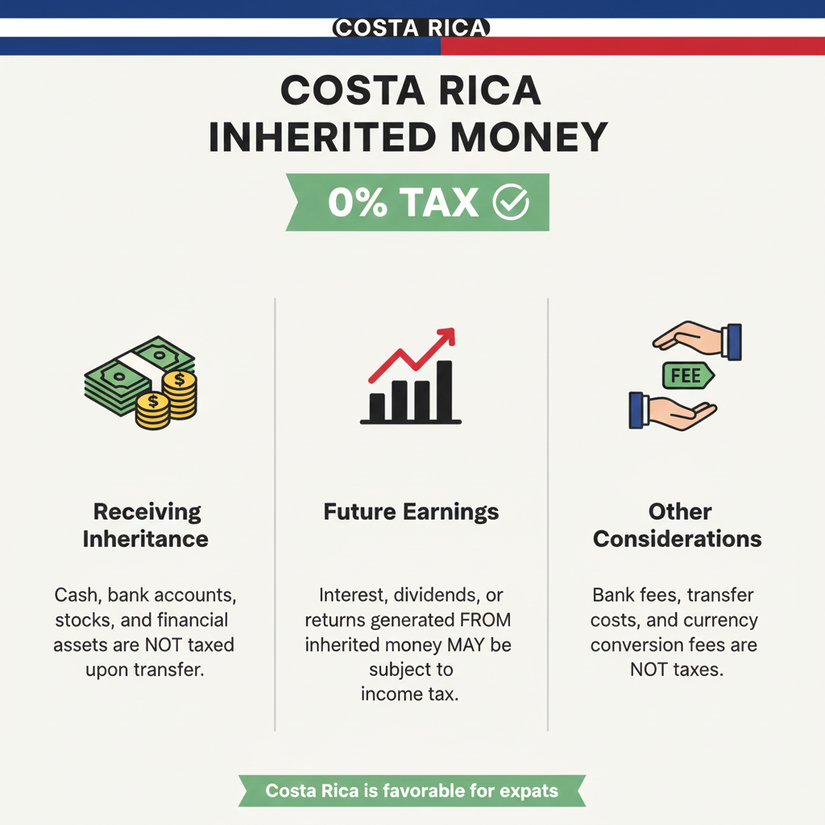
However, you may need to consider:
- Income tax on future earnings: Any interest, dividends, or returns generated from the inherited money may be subject to Costa Rican income tax.
- Bank fees or transfer costs: Moving funds into Costa Rica or converting currencies can involve administrative fees, though these are not taxes.
Overall, receiving inherited money itself is tax-free, making Costa Rica favorable for expats and non-residents in terms of cash inheritance.
How does property tax work in Costa Rica?
Property tax in Costa Rica is calculated on the registered value of real estate and is usually quite low.
- Rates are typically 0.25% of the property’s official value per year.
- Owners receive annual statements and pay taxes to the municipal office.
- Non-residents inheriting property are also subject to the same rates, making ongoing costs predictable.
This tax is separate from any transfer tax or capital gains tax that may apply.
What is the property transfer tax in Costa Rica?
When inherited property changes ownership, Costa Rica charges a property transfer tax of 1.5% of the property’s registered value, payable once at the time of registration in the National Registry.
Key points:
- The 1.5% transfer tax applies to all real estate transactions, including inheritance.
- Registration with the Costa Rica National Registry (Registro Nacional) is required to record the new owner.
- Additional costs such as notary or legal fees may apply, but the tax itself is relatively modest compared to other countries, making property inheritance low-cost for expats.
Planning for Inherited Real Estate in Costa Rica
While Costa Rica’s inheritance framework keeps taxes minimal, real estate inheritance comes with practical considerations that can affect cost, liquidity, and long-term management.
Planning ahead ensures heirs fully benefit from tax-free transfers while minimizing administrative hurdles.
Key considerations include:
- Title verification and registration
Transferring inherited property requires updating the National Registry. Ensuring the title is clear and all municipal obligations are settled prevents delays and avoids disputes among heirs. - Joint ownership vs sole ownership
Expats inheriting property with siblings or co-heirs must decide whether to hold it jointly or split ownership. Joint ownership can simplify probate but may complicate future sale decisions. - Property use and income
Renting inherited property generates local income, which may be subject to Costa Rican income tax. Planning whether the property will be lived in, rented, or sold affects ongoing costs and reporting obligations. - Managing annual property tax and maintenance
Though the 0.25% property tax is low, combining it with maintenance and municipal fees can create a recurring cost. Anticipating these expenses is crucial for non-resident heirs who may not live in Costa Rica. - Cross-border considerations
Expats must consider how property inheritance interacts with their home-country laws, including reporting requirements, potential foreign tax credits, and asset management from abroad.
By focusing on administration, ownership structure, and income planning, expats can maximize the benefits of Costa Rica’s favorable inheritance rules while avoiding delays, disputes, or unexpected costs.
In this way, property inheritance becomes not just tax-efficient, but also strategically managed for the long term.
Conclusion
Costa Rica’s lack of a formal inheritance tax makes it highly attractive for expats looking to pass on assets efficiently.
While cash and investments remain tax-free, inheriting property does involve predictable costs.
Understanding the country’s inheritance laws, including forced heirship and rules under Article 523, helps prevent legal disputes and ensures a smooth transfer of wealth.
Proper planning and local legal guidance can make inheritance in Costa Rica straightforward and cost-effective for both residents and non-residents.
FAQs
What country has the highest inheritance tax?
Japan has the highest inheritance tax in the world, with rates reaching up to 55% for large estates.
What is the non-resident tax in Costa Rica?
Non-residents may be subject to income tax on Costa Rican-sourced income, but there is no inheritance tax specifically for non-residents.
Inherited assets such as property or bank accounts may trigger minor administrative taxes.
What is the 183 day rule in Costa Rica?
The 183-day rule determines tax residency in Costa Rica.
Anyone living in the country for 183 days or more in a calendar year is considered a tax resident, which affects income tax obligations but does not change inheritance tax, as inheritance itself is generally exempt.