Foreigners who inherit in Canada must follow provincial rules on wills, probate, and property transfer, which can affect timing, taxes, and legal obligations.
Understanding the inheritance law in Canada is essential for navigating these processes and avoiding costly mistakes.
This article covers:
- Do non-residents pay inheritance tax?
- How does inheritance work in Canada without a will?
- Can a non-citizen inherit?
Key Takeaways:
- Foreigners can inherit in Canada, but probate and legal steps must be followed.
- Canada has no inheritance tax, but capital gains may apply on inherited assets.
- Non-residents inheriting property may face additional legal and tax requirements.
- Intestacy rules govern inheritance when there is no valid will.
My contact details are hello@adamfayed.com and WhatsApp +44-7393-450-837 if you have any questions.
The information in this article is for general guidance only. It does not constitute financial, legal, or tax advice, and is not a recommendation or solicitation to invest. Some facts may have changed since the time of writing.

What are the inheritance laws in Canada for foreigners?
Inheritance laws in Canada are governed primarily at the provincial level, with each province having specific rules regarding wills, intestacy (when no will exists), and probate.
Foreigners can inherit Canadian assets, but they may need to navigate:
- Probate requirements: Estates generally must go through probate to confirm the validity of a will.
- Property ownership restrictions: While most provinces allow foreigners to own property, some require extra documentation for land transfer.
- Tax considerations: Although Canada does not levy a federal inheritance tax, certain provincial taxes or capital gains taxes may apply to non-residents.
Can a non-citizen inherit in Canada?
Yes, a non-citizen can inherit in Canada.
There are no laws preventing non-citizens from receiving assets through a valid will.
Can a non-resident inherit property in Canada?
Non-residents can inherit Canadian property, but capital gains tax apply and certain legal rules must be followed.
- Capital gains tax: Any sale of inherited property is subject to Canadian capital gains tax, calculated as if the property were sold at fair market value at the date of death.
- Certificate of Appointment of Estate Trustee: The executor or estate trustee must obtain this certificate from the court to legally transfer the property to beneficiaries. Non-resident heirs may need the estate trustee to handle this on their behalf.
- Mortgages and liens: Any outstanding debts, liens, or mortgages on the property must be resolved before ownership can be transferred.
How long does it take to get inheritance money in Canada?
Most beneficiaries receive inheritance money in Canada within 6 to 12 months, although complex estates can take significantly longer.
The exact timeline depends on the estate’s structure, whether a valid will exists, and whether probate or tax issues arise:
- Simple estates with a will: Usually 6–12 months once probate, debts, and tax filings are completed.
- Estates without a will or with disputes: Often 1–2 years or longer, due to court appointments, claims, or litigation.
- Non-resident beneficiaries: Delays may occur because of international banking checks, tax clearance certificates, and cross-border probate requirements.
Is there inheritance tax in Canada for non-residents?
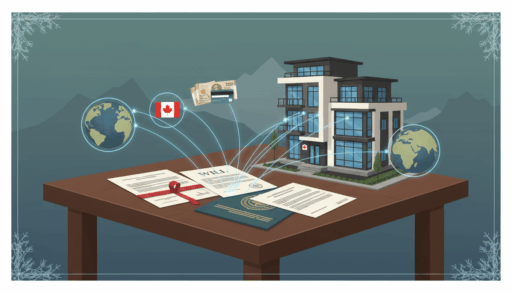
Canada does not charge inheritance tax, even for non-residents.
That said, inheriting from a Canadian estate can still trigger other taxes and estate-level charges that foreigners should be aware of:
- Deemed disposition tax: When the deceased passes, Canada treats most assets as if they were sold at fair market value, which can trigger capital gains tax payable by the estate.
- Non-resident withholding tax: Non-resident beneficiaries may be subject to withholding on certain types of Canadian-source income, such as rental income or dividends.
- Provincial probate fees: These fees vary by province and are paid out of the estate before assets are distributed to beneficiaries.
Who gets inheritance if no will in Canada?
If someone dies without a will in Canada, their spouse or common-law partner and children are the primary heirs under provincial intestacy laws, with other relatives inheriting only if no immediate family exists.
A spouse or common-law partner typically receives the largest share or the entire estate, depending on the province and whether children exist.
Children inherit next, followed by parents, siblings, and then more distant relatives.
Although the exact division varies by province, the order of inheritance follows a consistent legal hierarchy across Canada.
Who inherits if a beneficiary dies in Canada?
If a beneficiary dies before the person who made the will, the inheritance is redistributed according to the terms of the will or Canadian intestacy laws.
In practice:
- The inheritance may pass to the deceased beneficiary’s descendants if this is clearly stated in the will.
- If no alternate or substitute beneficiary is named, the gift usually returns to the estate and is distributed under the will or, if necessary, provincial intestacy rules.
Why Canada Is Easier for Foreign Heirs Than the UK, US, and Europe
Canada is widely regarded as one of the most foreign-friendly inheritance jurisdictions because it combines clear succession rules, zero inheritance tax, and relatively predictable probate procedures for non-residents.
No inheritance tax at beneficiary level
Unlike the UK and most of Europe, Canada does not impose an inheritance or estate tax on beneficiaries.
There is no equivalent to UK inheritance tax or EU succession-based estate taxes.
Instead, taxation is handled at the estate level through a deemed disposition of assets at death, which simplifies outcomes for foreign heirs and avoids surprise tax bills tied to heir residency.
No forced heirship rules
In contrast to many European countries such as Germany, France, Spain, and Portugal, Canada does not impose forced heirship.
Testators are generally free to distribute assets as they wish, subject only to limited family-support claims in certain provinces.
This makes estate planning far more flexible for international families and reduces the risk of statutory overrides.
Nationality and residency are irrelevant
Canada does not distinguish between citizens, residents, and foreigners when determining inheritance rights.
Foreign heirs inherit under the same legal framework as Canadians, unlike the US where non-resident aliens face complex estate tax exposure, or the UK where domicile rules can trigger worldwide taxation.
More predictable probate than the UK and EU
While probate is required in Canada, the process is generally more standardized and less fragmented than in Europe, where multiple legal systems and succession regulations can apply to the same estate.
In the UK, probate delays and estate-tax clearance often extend timelines significantly for foreign beneficiaries.
Canada’s province-based system is comparatively easier to navigate with proper documentation.
No estate tax traps for non-resident heirs
The United States imposes federal estate tax on US-situs assets owned by non-residents with a very low exemption threshold, making it one of the most punitive systems for foreign heirs.
Canada avoids this entirely, making it a safer jurisdiction for cross-border families holding property or investments.
Overall, Canada’s inheritance framework prioritizes administrative clarity over punitive taxation or rigid succession rules.
For foreign heirs, this results in fewer legal barriers, lower tax uncertainty, and a smoother transfer of assets compared with the UK, the US, and most European jurisdictions.
Conclusion
Canada’s inheritance framework is generally accessible to foreigners, but outcomes depend heavily on provincial rules, estate planning, and tax compliance.
For non-residents in particular, issues such as probate, property transfers, and cross-border tax exposure can complicate what might otherwise be a straightforward inheritance.
Careful planning and timely legal guidance can help ensure Canadian assets are transferred efficiently and in line with the deceased’s intentions.
FAQs
How much money can you inherit in Canada without paying taxes?
Canada does not have a federal inheritance tax.
Beneficiaries can inherit any amount, but the estate may owe capital gains taxes on appreciated assets.
Who is not allowed to inherit from parents?
Canadian law generally allows all family members to inherit unless explicitly disinherited in a will.
However:
-Certain legal challenges may arise if the will is contested.
-A court can also limit inheritance if the deceased owed debts or did not provide adequate support to dependents in provinces with family maintenance laws.
How much money can be legally given to a family member as a gift in Canada?
There is no legal limit on the amount of money a person can gift to a family member in Canada.
However:
-Large gifts may be subject to scrutiny if they affect estate planning or taxes.
-Non-residents should be aware of potential Canadian withholding taxes if gifting income-generating assets.