Tax residency in Mauritius is generally established by meeting the country's statutory tax residency tests, most commonly the 183-day rule.
Mauritius tax residency can determine how an individual's income is taxed, eligibility for benefits under double tax treaties, and overall international tax planning.
This article covers:
- How to become a Mauritius tax resident?
- How can you get residency in Mauritius?
- How does tax residency status affect the taxation of individuals?
- What are the benefits of becoming a tax resident in Mauritius?
Key Takeaways:
- Mauritius tax residency is generally determined by statutory residency tests rather than simply holding a residence permit.
- Foreign professionals, investors, retirees, and self-employed individuals may qualify for Mauritius tax residency.
- Tax residency in Mauritius does not automatically terminate tax residency in another jurisdiction.
- Tax residency affects tax obligations, treaty benefits, and cross-border wealth planning.
My contact details are hello@adamfayed.com and WhatsApp +44-7393-450-837 if you have any questions.
The information in this article is not tax advice and may have changed since the time of writing. I can connect you with expert tax support for your specific situation, as we have business interests in Mauritius, including relationships with locally licensed advisors.
How to become a tax resident of Mauritius?
An individual generally becomes a tax resident of Mauritius by satisfying one of the country's statutory physical presence tests during the relevant income year.
In many cases, individuals who relocate under qualifying residence permits also meet these requirements, although immigration status alone does not automatically establish tax residency.
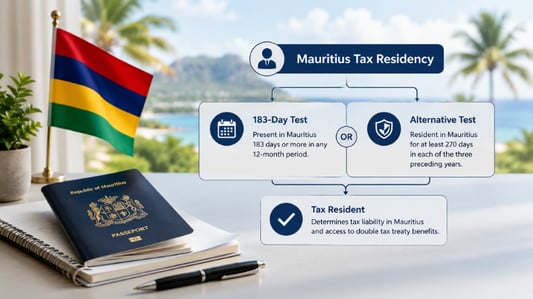
Under Mauritius tax law, an individual is generally considered a resident for tax purposes if they:
- Spend 183 days or more in Mauritius during an income year; or
- Spend 270 days or more in Mauritius over the current and previous two income years, including at least 30 days in the current income year.
These rules are designed to identify individuals whose personal and economic connections to Mauritius are sufficiently established to justify tax residency.
For many expatriates, qualifying under the 183-day rule is the most straightforward approach.
Others who travel frequently between countries may satisfy the alternative three-year test instead.
Immigration residency does not automatically create tax residency
A common misconception is that receiving a residence permit automatically makes someone a Mauritius tax resident.
While residence permits often facilitate tax residency, the two concepts serve different legal purposes.
For example:
- A person may hold an Occupation Permit but spend insufficient time in Mauritius to satisfy the tax residency tests.
- Conversely, someone may meet the statutory day-count requirements even if they entered Mauritius under another qualifying immigration status.
As a result, both immigration status and physical presence should be considered when planning to establish tax residency.
Tax Residence Certificate
Individuals who qualify as Mauritius tax residents may apply for a Tax Residence Certificate (TRC) issued by the Mauritius Revenue Authority.
A TRC serves as official evidence of Mauritius tax residency and is commonly required when claiming benefits under double taxation agreements with other countries.
Financial institutions, foreign tax authorities, and investment structures may also request a valid TRC when determining treaty eligibility.
Applicants are generally required to provide supporting documentation demonstrating that they satisfy the applicable residency requirements.
How do you qualify for residency in Mauritius?
Foreign nationals can qualify for residency in Mauritius through permits for professionals, investors, self-employed individuals, retirees, permanent residents, and certain long-term visitors.
Although these residence permits do not automatically create tax residency, they often provide the basis for meeting the country's tax residency requirements.
Eligible spouses and dependent children may accompany qualifying residence permit holders, provided they meet the applicable dependant visa or residence permit requirements.
The most common residency options include the following:
Occupation Permit (Professional)
The Professional Occupation Permit allows foreign nationals to live and work in Mauritius after securing qualifying employment with a Mauritian employer.
Occupation Permit (Investor)
The Investor Occupation Permit is available to eligible foreign investors establishing or investing in businesses in Mauritius.
It allows investors to reside in Mauritius while managing their business.
Occupation Permit (Self-Employed)
The Self-Employed Occupation Permit allows eligible individuals to establish and operate their own business or professional practice in Mauritius.
Permanent Residence Permit
The Permanent Residence Permit allows eligible foreign nationals to live in Mauritius indefinitely without needing to renew temporary residence permits.
Eligible retirees may obtain a Retired Non-Citizen Permit by meeting the applicable age and financial requirements.
Premium Visa
The Premium Visa allows eligible remote workers, retirees, and long-stay visitors to remain in Mauritius for extended periods.
Why is it important to determine whether a person is a resident for tax purposes?
Determining tax residency matters because it establishes which country has the primary right to tax an individual's income.
Knowing which country has the primary taxing right helps determine whether tax treaty benefits are available, and which tax filing and reporting obligations apply.
For example, a Mauritius tax resident may qualify for benefits under one of Mauritius' double taxation agreements when receiving income from another country.
Conversely, someone who remains tax resident elsewhere may continue to owe taxes in that jurisdiction even after relocating.
Determining tax residency is important for:
- Identifying whether worldwide or locally sourced income is taxable.
- Claiming relief from double taxation under applicable tax treaties.
- Understanding reporting and tax filing obligations.
- Planning international investments and business structures.
- Avoiding unexpected tax liabilities when relocating.
Because every country applies its own residency rules, individuals with international connections should assess their tax residency position before moving assets or changing residence.
Am I still a tax resident if I live abroad?
Yes, you may still be considered a tax resident of Mauritius even if you live abroad, provided you continue to satisfy Mauritius' tax residency rules for the relevant income year.
At the same time, living or working in another country may also make you tax resident there under that country's domestic tax laws.
As a result, some individuals can be treated as tax residents of two countries simultaneously until any applicable tax treaty determines which country has the primary taxing rights.
For example:
- A British citizen living overseas may still qualify as a UK tax resident under the Statutory Residence Test if sufficient ties to the United Kingdom remain.
- A South African expatriate may continue to be tax resident if they remain ordinarily resident despite working abroad.
- US citizens generally remain subject to US federal taxation regardless of where they live because the United States primarily taxes based on citizenship rather than residence.
What taxes do you pay in Mauritius?
Mauritius tax residents are generally subject to personal income tax on taxable income, while certain taxes that exist in many other countries, such as capital gains tax and inheritance tax, are generally not imposed.
The principal taxes include the following.
Personal income tax
Mauritius generally applies a progressive income tax system, with qualifying income taxed at rates provided under the Income Tax Act.
Employment income, business income, rental income, pensions, and certain investment income may all be taxable depending on the individual's circumstances.
Dividend income
Dividends received from Mauritian companies are generally exempt from income tax for individuals, subject to the applicable tax rules.
Interest income
Interest income may be taxable depending on its source and the applicable exemptions under Mauritian tax law.
Rental income
Income derived from renting property in Mauritius is generally taxable after allowable deductions.
Capital gains
Mauritius generally does not impose a separate capital gains tax on the sale of investments or property.
Inheritance and estate taxes
Mauritius generally does not levy inheritance tax or estate tax.
Value Added Tax (VAT)
VAT applies to many goods and services supplied in Mauritius, although it is generally borne by consumers rather than representing a direct personal tax.
What are the tax advantages of Mauritius?
Mauritius' principal tax benefits include no capital gains tax, no inheritance or estate tax, competitive income tax rates, and access to an extensive network of double taxation agreements.
Mauritius has concluded 45 double taxation agreements with countries across Africa, Asia, Europe, the Middle East, and the Americas, with additional treaties under negotiation.
These advantages have made Mauritius an attractive jurisdiction for expatriates, international investors, retirees, and business owners.
However, the actual tax outcome depends on an individual's overall residency position, the source of income, and the tax rules of other countries involved.
What is the difference between tax residency and domicile?
Tax residency determines where an individual is taxed, while domicile refers to that person's permanent legal home.
Tax residency is generally determined under a country's residency rules, such as physical presence or other statutory tests.
Domicile, by contrast, is usually based on an individual's long-term intentions and enduring personal connections rather than the amount of time spent in a country.
As a result, an individual may be:
- Tax resident in Mauritius.
- Domiciled in another country.
- A citizen of a third country.
This distinction becomes particularly important for estate planning, succession, inheritance laws, and certain tax rules in jurisdictions that continue to recognize domicile as a separate legal concept.
Simply becoming a Mauritius tax resident does not necessarily change an individual's domicile.
Common Mistakes When Establishing Mauritius Tax Residency
People seeking Mauritius tax residency can mistakenly assume that immigration status alone is sufficient, overlook the statutory residency tests, or fail to consider home-country tax rules and applicable tax treaties.
These misunderstandings can reduce or even eliminate the intended tax benefits.
Assuming a residence permit automatically creates tax residency
Residence permits provide legal immigration status but do not automatically satisfy Mauritius' tax residency rules.
Ignoring the physical presence requirements
Individuals must still satisfy the applicable statutory residency tests, including the required number of days spent in Mauritius where relevant.
Forgetting home-country tax rules
Many countries continue to treat individuals as tax residents after they relocate if sufficient connections remain.
Overlooking tax treaties
Double taxation agreements may determine which country has primary taxing rights when dual residency arises.
Assuming all foreign taxes disappear
Becoming a Mauritius tax resident does not automatically eliminate tax obligations in other jurisdictions, particularly where foreign income, citizenship-based taxation, or anti-avoidance rules apply.
Failing to obtain a Tax Residence Certificate
Individuals claiming benefits under a double taxation agreement may need to obtain a Mauritius Tax Residence Certificate as evidence of their tax residency.
Without one, accessing certain treaty benefits may be more difficult.
Conclusion
Establishing Mauritius tax residency determines how Mauritius treats an individual for tax purposes, but it does not automatically determine tax residency elsewhere.
Different countries apply their own residency rules, meaning the same individual may be regarded as tax resident in more than one jurisdiction at the same time.
Understanding how those competing residency rules, and any applicable tax treaties, interact is often what ultimately determines the practical value of Mauritius tax residency.
FAQs
Why is Mauritius considered a tax haven?
Mauritius is considered a tax haven by some because it offers competitive income tax rates, no capital gains tax, no inheritance tax, and an extensive network of double taxation agreements.
Which country is best for tax residency?
Jurisdictions such as the United Arab Emirates, Monaco, Singapore, Mauritius, and Switzerland are among the most attractive due to their favorable tax regimes, but the best choice is based on an individual's income, assets, nationality, and home-country tax rules.
Does Mauritius have a tax treaty with the US?
No. Mauritius and the United States do not currently have a comprehensive double taxation agreement covering income taxes.
As a result, US citizens and residents relocating to Mauritius generally remain subject to US tax rules, including ongoing federal tax filing obligations where applicable.
Can I have multiple tax residencies?
Yes. An individual may simultaneously qualify as a tax resident in more than one country if the domestic tax laws of multiple jurisdictions are satisfied.
Related Articles:
- Golden Visa in Mauritius: US$1M Residency-by-Investment Guide
- Mauritius Retirement Visa Guide: Residence Permit for a Retired Non-Citizen
- Mauritius Residency by Investment: Long-Term Residency for Families
- EU countries with low taxes – do they exist?
- Alternatives to Dubai for low-tax residency for foreigners
- Turkey Introduces 20-Year Foreign Income Tax Break for New Residents
- No Death Tax Countries