The availability of international economic opportunities plays a crucial role in determining the middle class’s potential to achieve wealth.
In this blog I will list some of my top Quora answers for the last few days.
If you want me to answer any questions on Quora or Youtube, don’t hesitate to contact me.
Are the opportunities for the middle class to get rich increasing or decreasing?
Source: Quora
It depends on how you look at it. The problem is, for decades the education system, mentality of parents and general society has been focused on the industrial economy.
So:

- Go to school and do well. Just listen to the teacher, remember facts and play to the test
- Go to university and get a good job
- Find a graduate scheme
- Get some professional qualifications
- Climb the ladder and become a manger or even executive
- Stay in the same company, or at least profession, for 40 years.
- Retire on a good pension
That formula can still work. There are still countless jobs, and career path, which requires that.
I am also not saying that university or professional qualifications are a bad thing.
If you can learn how to learn, then that is a huge advantage in life.
Getting a decent job, moreover, can also stand you in good stead if you want to start your own business.
The point is though, the world has changed. The biggest change has been technology.
Now there are loads of middle-class jobs we don’t need anymore. That has harmed plenty of people.
But by the same token, the number of self-made millionaires has gone up, and it is now far easier to make big money.
I was reading that 35% of self-made millionaires are now estimated to be in their 20s and 30s.
Technology has played a big part in this. The number of YouTubers, online business owners and affiliate marketers who are making a lot of money are just a few examples of these trends.
People can now be global without being rich on day 1. The internet, moreover, doesn’t care as much about your university, nationality or those traditional things.
The person who has 1 million Instagram followers doesn’t need to justify their education as much as before.
Therefore, it is a changing world. I have personally seen people fall, or rise, far higher and lower, in the last 5 years than previously.
The days of gradually seeing rising income into your 50s and 60s has ended in some industries.
Now you can see much more extreme rises and falls, due to technology.
If you see this as a threat or opportunity depends on your mentality.
In the 1970s, 1980s or even 1990s/2000s you often needed millions to get exposure.
We all heard about big brands paying millions for superbowl or World Cup access:
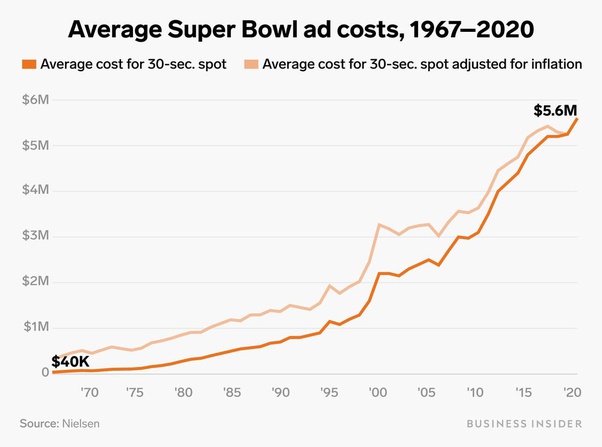
Now there are some people who get free, or cheap, exposure from their phones.
Some influencers, even single person businesses, can get as much exposure as big brands. Others see this as a threat and a winner take all situation.
I don’t see this as winner takes all, but the inequality between people will grow.
Pre-covid, traveling and doing business globally, has been easier for decades compared to the 1970s when the Cold War was occurring.
My conclusion, therefore, would be that the opportunities have increased, but most people aren’t proactive enough to try to take them or are worried about getting out of their comfort zone.
An opportunity also doesn’t mean that everybody will succeed, first time they try something new out.
The opportunity to do things in the conventional way has gotten much more difficult.
How can I invest my savings during the COVID-19 pandemic?
Source: Quora
The reality is the fundamentals of investing don’t change as much as people think. Some things do change, but many things stay the same.
In fact, 2020 has shown, once again, that some of those fundamentals are in tact.
For years people were suggesting that government bonds are now pointless because they pay less than before.
Then March 2020 came along, and short-term government bonds outperformed all other asset classes during the worst of the crisis.
That gave people a chance to rebalance. So, whilst the S&P500 has done about 5% this year, people that rebalanced their portfolios could have gotten much more.
Therefore, keep to the fundamentals, which are
- Be long-term
- Be in both stocks and bonds “forever”
- Rebalance from one asset class to the other
- Don’t panic during market crashes
- Don’t get too excited during the boom times
- Switch off the news media. Numbers 4 and 5 are much more difficult to do if you are always consuming sensationalist stuff.
- Don’t be emotional about money and investing
- Never confuse a decline with a loss
- Be exceptionally sceptical of anybody who says this time is different. They say that during every crash, or indeed bull market
- Be an investor and not a speculator
- Have your investment portfolio aligned to your age. So when you are younger, be more focused on stock indexes. As you approach middle age, bonds become progressively more important
- Reinvest dividends
The only thing that the crisis has changed, perhaps, is interest rates for the next decade.
Interest rates have been close to 0% for over 12 years. They were briefly rising, especially in the US, in 2018–2019.
Now they look like they will stay low for 5 years+. Therefore, the long-term difference between saving and investing money will only grow.
Saving has never beaten investing long-term, but historically, the banks have paid above inflation.
These days, in comparison, people will need to take a direct loss to inflation if they save money.
Graphs like this used to show the difference between saving and investing long-term:
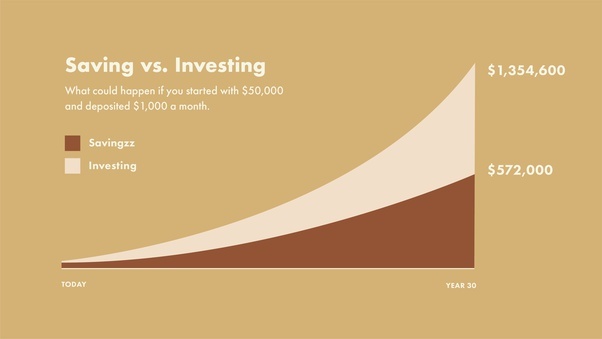
In the future graphs like these could become even more extreme, if the US, EU and UK have 20-30 years of 0% interest rates like Japan has gone through.
To become successful, do you need to work 15+ hours each day?
Source: Quora
You don’t need to work 15+ hours a day to be successful. I know plenty of successful people who work less, and also people who work even more hours, and yet aren’t successful.
Working hard is good.
What is more important though is:
- Working smart. Leveraging time, technology and other people as an example. No matter how hard you work, you will never be able to outwork a machine. Likewise, no matter how much you invest as a 60 year old, it is unlikely you will be wealthier than the 60 year old who started investing small amounts at 18.
- Not burning out. There is no point in working 15 hours a day if you give up after a few years. Better to work sustainably.
- Focus, persistence and determination. It is silly to work hard on one project and then give up to work equally hard on another project, and do that for over 10 years. Sometimes you need to focus on one, two or three things.
- Taking advantage of any luck that is afforded to you, instead of being complacent
- Being less emotional. Many people are willing to cut off their noses to spite their face. Many people will actually say no to success due to emotional reasons. You hear people admit that as matters of principle they aren’t willing to do certain things
- Being wiling to do what others won’t
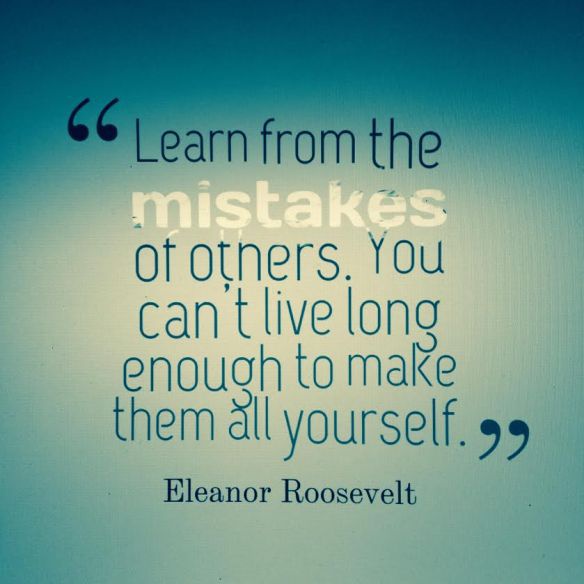
- Reading and learning a lot. This way you can learn from the mistakes of others. This quote says it all:
If you think about something, there will always be at least a small number of people who can outwork you.
There will also always be people who can buy time (individual people’s time and technology’s).
Some billionaires, indirectly, have billions of hours of time, as they have used these leveraging techniques.
That doesn’t mean that working hard isn’t important. The harder you work, especially in your early career, matters.
If you are a 26 year old who has worked 80–100 hours a week, you have the same experience as the average 30 or 32 year old.
That initial advantage over peers can compound with time. The point is though, working hard is only one aspect of success.
As an entrepreneur, what makes you roll your eyes every time you hear it?
Source: Quora
Firstly, the word entrepreneur is overused. It is better if somebody else calls you that, rather than calling yourself it.
Let’s just say business owner instead. The things that make me roll my eyes are the following assumptions:
- It is all about the idea. In fact, it is about the execution.
- People care about your reputation. Unless you are Amazon, Coca Cola or somebody of that status, you don’t even have a reputation. Most businesses have one major problem…….obscurity. Being unknown by almost everybody is much worse than being known by millions and hated by 90% of them. Look at some social media followers. Some are hated on Facebook or YouTube. It doesn’t stop them though.
- Only do what you love. The market doesn’t care about your passions. People care about their passions. I have ran out of the number of successful business owners that don’t love what they do. Yet there has been this fad of what I would call “business politically correct thinking”. What I mean by that is people saying things which are politically expedient, and often not true. Another example is only sell what you love. In my network I know a world class alcohol salesman who…..doesn’t like the taste of alcohol! The same can be seen in some other domains. Agassi is one of the legends of the tennis world. In his book, he admitted that he hated tennis. It didn’t stop him.
4. It’s not about you. In many industries, smaller businesses were slow to adapt to the internet. Many still are. Countless still come out with words like “business is best done face-to-face” despite evidence to the contrary. There is a simple reason for that. If they have a preference for something, they often assume everybody else does too.
Another thing would be venture capital money. Perhaps due to the success of shows like Dragons Den and Shark Tank, many younger business owners leave business school and try to get funding for their big idea.
Sometimes it works out. However, more often than not, I have seen far more success from people who keep it simple.
By keep it simple I mean getting a job first. Then getting good at it over 5, 10+ years.
After that, starting a business. Starting small, with low fixed costs, and building it up.
Those kinds of business owners often know how to do core tasks, from book keeping to marketing.
Many business owners, especially those that think it is all about the idea, hate tasks like that.
Yet businesses live and die from cashflow…..the money coming in and out. It is a fantasy that you can create a great product or service, and suddenly and magically from word of mouth, it will go big.
There are millions of businesses that have gone bust with great products and services.
There are equally poor, or average, products and services, that thrive, even in the long-term.
Why is it important to start saving for retirement in your 20s?
Source: Quora
Saving for retirement isn’t important, but investing for it is. I guess that is what you meant anyway.
There is one reason that has always been the same, and then there is one new reason.
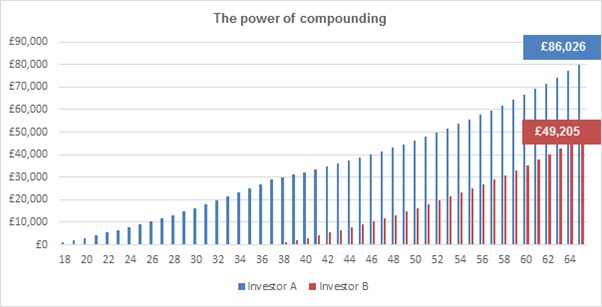
Compounding makes getting wealthy in investing easier, if you start sooner.
You can get more, for less, by starting in your teens or 20s:
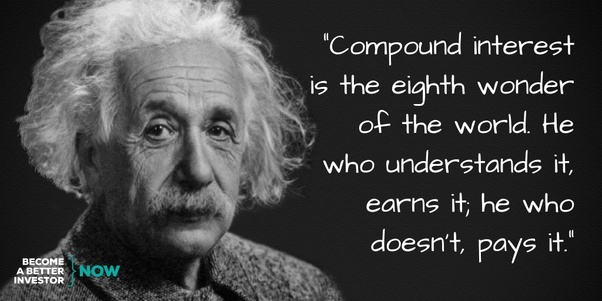
That has always been the case though. Einstein called it the 8th wonder of the world:
Many of the “everyday millionaires” that exist didn’t do anything special in their 20s and 30s.
They simply invested consistently for decades like this person 96-Year-Old Secretary Quietly Amasses Fortune, Then Donates $8.2 Million (Published 2018) and this Janitor – A janitor secretly amassed an $8 million fortune and left most of it to his library and hospital.
What has changed is the concept of retirement. Before, investing meant locking yourself in until 65.
Then once you are 65, you could sell off your investments for an income – an annuity.
These days, retirement can mean 90 for those who are fit enough to keep working, or it could mean 40.
It has became easier to get access to your investments and retire in cheaper places.
Therefore, not only does investing at a younger age give you more options and security, but it also allows you to lead an unconventional life if that is what you want.
In comparison, if you leave it too late, there is only a few options.
Most of those options involve people needing to find passive income streams.
Some people can do that, but it is a small percentage of the general population.
Why is an unconventional approach good for investing?
Source: Quora
It depends how you define unconventional. I would make a distinction between actions and words.
The following things are considered conventional, or at least somewhat mainstream, advice
- Be diversified
- Never time the markets
- Don’t panic during crashes
- Don’t get too excited in the good times
- Don’t stock pick or speculate with 90%-100% of your portfolio.
- Don’t try to watch the news and think you can see trends.
- Watch your spending habits so you can invest more in the first place
- Don’t trade too often. Rebalance at most.
- Not letting our emotions get the better of us. Often we are subconsciously emotional as well. For example, studies have shown we are more likely to buy Amazon shares if we live near the warehouse, as the familiarity makes us feel more comfortable. Yet we don’t actively think we are buying Amazon stocks due to that emotion.
- Not thinking this time is different every time there is an event like 9/11, covid or 2008. People get drawn into stories too easily.
These might be conventional pieces of advice. Yet how many people do I know that have kept to this through thick and thin for decades?
I know very few. I know plenty who managed to do it for 1, 2, 5 or even 10 years.
I have seldom met a person who has managed to do it for 10, 20 or 30 years.
Perhaps the reason is to do with human nature. It is natural to get afraid during the bad times, be overconfident or fearful.
Therefore, the money is in doing what others won’t do, not knowing something that others won’t do.
It is like in business, the money is in the execution, not the idea. Everybody has million dollar ideas.
Even homeless people do. The key is executing ideas for the long-term, not just having ideas.
The same is true in investing. The money is in being unconventional in terms of our actions, not words.
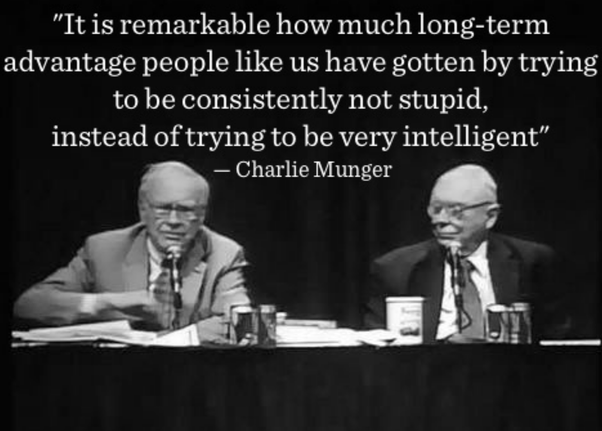
Slow and steady can win the investing race, but few people find it exciting.
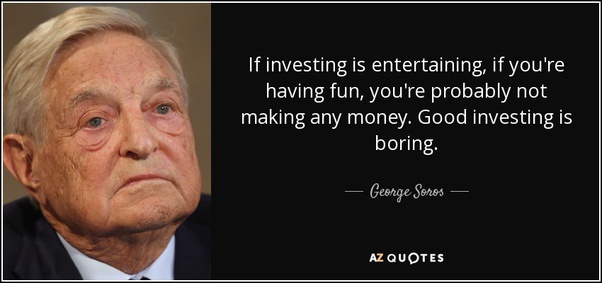
Yet it is profitable as Soros’ says below:
So, unconventional can be good, if it is directly towards the right actions.
It gets negative when people try to be too smart for their own good.
Some of the people I know that are obsessed with unconventional approaches often spend so much time “researching” and trying to be smart, that they never execute.