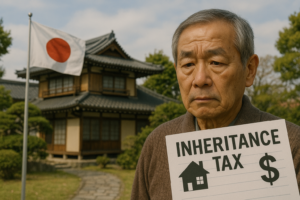
La herencia en Japón sigue un sistema legal estructurado conforme al Código Civil japonés, que determina quién tiene derecho a los bienes y obligaciones tras el fallecimiento. Tanto el
Both Japanese citizens and foreign residents with property in Japan must adhere to these rules, with the family registry playing a central role in verifying legal heirs.
Understanding what is the inheritance rule in Japan is essential—especially for high net worth individuals and families with assets in the country.
Este artículo trata:
- Japanese inheritance law for foreigners
- What is the inheritance exemption in Japan?
- What is inheritance tax in Japan?
- Do children inherit parents’ debt in Japan?
- How do wills work in Japan?
Principales conclusiones:
- Statutory heirs (spouse, children, parents, siblings) are entitled to minimum shares even if will says otherwise.
- Inheritance tax range from 10% to 55%, with progressive brackets that can heavily impact large estates.
- Estate planning tools like gifting, insurance, and real estate structuring can help preserve wealth.
- Debts are inherited too, unless heirs formally reject or limit their acceptance in court.
Mis datos de contacto son hello@adamfayed.com y WhatsApp +44-7393-450-837 si tiene alguna pregunta. También ofrecemos soluciones de estructuración a medida adaptadas a su situación.
La información contenida en este artículo es meramente orientativa, no constituye asesoramiento financiero, jurídico o fiscal y puede haber cambiado desde el momento de su redacción.

How Inheritance Works in Japan
In Japan, inheritance is governed by the Japanese Civil Code, which outlines a clear structure for how assets and obligations are passed on after someone passes away.
The law applies to both Japanese nationals and foreign residents with assets in Japan.
One of the most important documents in Japanese succession is the koseki tohon—the official family registry.
This document records births, deaths, marriages, divorces, and legal relationships, and is required to prove who the legal heirs are.
Without it, heirs cannot claim property, access bank accounts, or initiate the inheritance process. Even foreign heirs may be asked to present equivalent documents from their home country for verification.
Japanese Line of Succession
Under the Civil Code, Japan follows a strict legal heir hierarchy, especially when no will is present.
How does inheritance work in Japan? Here’s how with respect to hierarchy:
- Cónyuge: The spouse is always entitled to inherit, but shares the estate with other heirs depending on the situation.
- Niños: If there are children, they share the estate equally with the surviving spouse.
- Padres: If the deceased has no children, the surviving parents (or grandparents, if parents are deceased) inherit alongside the spouse.
- Hermanos: If there are no children or surviving parents, the deceased’s siblings become heirs along with the spouse.
This fixed order means that even if you intend to pass everything to a specific family member, it may not be legally possible unless a properly executed will is in place.
Exclusion from Inheritance
You can’t entirely disinherit legal heirs.
Under Japan inheritance law, spouses, children, and parents (if no children are alive) are considered statutory heirs, which means they have a right to inherit a portion of the deceased’s estate, even if the will specifies otherwise.
This is a critical concept for high net worth individuals, as a Japanese will can’t override this legal protection for close relatives.
For example, even if you prefer to leave all of your wealth to charity or a distant relative, you cannot completely exclude your spouse or children unless they agree to it or explicitly waive their right to inherit.
Minimum Guaranteed Shares to Certain Family Members
The concept of reserved portions ensures that certain family members receive a minimum share of your estate.
These portions are legally defined and cannot be altered by the testator’s wishes, unless specific circumstances apply.
The reserved portion is typically calculated as follows:
- Cónyuge: If there are children, the spouse inherits 1/2 of the estate alongside the children. If no children are present, the spouse inherits 2/3 of the estate.
- Niños: Children inherit equally. For example, if a deceased individual has one spouse and two children, the estate is divided as 1/2 to the spouse and 1/2 divided equally between the two children. If there’s only one child, that child would inherit the remaining 1/2 of the estate after the spouse’s share.
- Padres: If there are no children, the spouse inherits 2/3 of the inheritance, and the surviving parents inherit the other 1/3. In the absence of a spouse, the parents would inherit the entire estate.
- Hermanos: If no children or parents survive, siblings may inherit, but only in the absence of a surviving spouse. Siblings are last in the hierarchy of legal heirs.
These minimum guaranteed shares ensure that your close family members are financially provided for, regardless of how much wealth you wish to leave them.
If you attempt to allocate all of your wealth to a non-family member, your statutory heirs can challenge the will in court and demand their reserved portion, making it important to consider these protections when crafting your estate plan.
Does Japan have inheritance tax?
Japan inheritance tax is progressive for beneficiaries, meaning the more an individual inherits, the higher the tax rate they pay.
This can be especially significant for foreigners with substantial assets in Japan or Japanese nationals with global assets passed on to heirs residing in Japan.
What is the inheritance tax bracket in Japan?
As of 2025, Japan’s inheritance tax rates range from 10% to 55%, which remain among the más alto del mundo.
En fiscal is calculated per heir, not on the total estate, and the brackets are based on the value each heir receives after applying applicable deductions and exemptions.
Here is a simplified overview of the progressive tax brackets (in Japanese yen, after basic deductions), as per PwC:
| Inherited Amount per Heir (after deductions) | Tax Rate |
| Up to ¥10 million | 10% |
| ¥10M to ¥30 million | 15% |
| ¥30M to ¥50 million | 20% |
| ¥50M to ¥100 million | 30% |
| ¥100M to ¥200 million | 40% |
| ¥200M to ¥300 million | 45% |
| ¥300M to ¥600 million | 50% |
| Over ¥600 million | 55% |
The steep curve in tax rates means that individuals inheriting very large estates could be taxed at the top end of the bracket—55%, minus the applicable deduction.
For instance, if a child inherits ¥700 million after deductions, the taxable portion–since it’s over ¥600 million–is taxed at 55%, while the earlier portions are taxed incrementally according to each bracket.
This results in a significant tax burden, which is why strategic inheritance planning is essential for wealthy families.
What is the exemption for inheritance tax in Japan?
Inheritance tax exemptions in Japan range from ¥36 million to well over ¥160 million, based on the number of heirs and whether a surviving spouse is involved.
✅ Spouse exemption
Spouses benefit from one of the most generous exemptions under Japan inheritance law, on top of the basic exemption. A surviving spouse can inherit either:
- The legally entitled share, or
- ¥160 million,
whichever is greater—tax-free.
This means that in many cases, a surviving spouse may inherit a large portion of the estate without paying any inheritance tax, depending on how the estate is divided.
✅ Child exemptions
Children and other heirs are eligible for a basic exemption calculated as :¥30 million + ¥6 million × number of statutory heirs.
So, if an estate has one spouse and two children, the total exemption amount would be: ¥30 million + (¥6 million × 3 heirs) = ¥48 million
This amount is deducted before calculating the taxable portion of the estate.
After applying this exemption, progressive tax rates (10–55%) are then applied to the remaining amount per heir.
How to minimize taxes on inherited money?
Japan also allows for pre-inheritance gifting, which can be a strategic way to reduce future inheritance taxes.
The most common methods are:
1. Annual Gift Tax Exclusion
Individuals can gift up to ¥1.1 million per year per recipient tax-free. Over time, this allows wealthy individuals to transfer substantial wealth to their heirs without triggering gift taxes.
2. Special Educational Fund Gifts
Gifting up to ¥15 million per child or grandchild (aged younger than 30 years of age) for education-related expenses can also be exempt from gift tax under certain conditions. The education funds tax exemption report must be submitted.
3. Real Estate and Life Insurance Structuring
With the help of legal and tax advisors, high net worth individuals often reorganize ownership of assets—such as holding property in the spouse’s name or purchasing life insurance with heirs as beneficiaries—to optimize tax treatment at the time of death.
Can You Inherit Debt in Japan?
If you’re a legal heir under Japanese inheritance law, you automatically inherit both the assets and debts of the deceased unless you take formal action.
However, Japan provides three legal choices for heirs:
1. Simple Acceptance
This means you accept everything—assets and liabilities alike. Once accepted, you’re legally obligated to repay the debts, even if they exceed the value of the assets.
2. Qualified/Limited Acceptance
This allows you to accept the inheritance only up to the value of the assets. In other words, if the debts are greater than what you inherited, you’re not required to cover the difference out of your own pocket.
This option is only available if all heirs agree and must be declared in family court within three months of learning about the inheritance.
3. Renunciation
You can completely reject the inheritance, avoiding both assets and debts. Like limited acceptance, this must be done within three months and filed with the family court.
Can you avoid inheriting debt?
If no action is taken within the three-month window, the law assumes simple acceptance, and the heir becomes fully liable for the deceased’s debts.
That’s why consulting with a legal expert as soon as possible after a family member’s death is crucial—especially if you suspect they had unpaid liabilities.
How do you write a will in Japan?
In Japan, a valid will must follow strict statutory formalities under Japanese inheritance law. In practice, this means you must use one of three legally recognized formats, each with specific execution requirements. Otherwise, the will can be declared invalid.
At a high level, Japanese will-making is form-driven and technical, not flexible. The most commonly used will options son:
1. Holographic Will
- Handwritten by the testator (the person making the will)
- Must include the date, full name, and signature
- Since 2019, only the main body of the will must be handwritten; supporting documents (like asset lists) can be typed
- Must be submitted to family court after death for probate
- No notarization required, but risks include being lost, damaged, or contested
2. Notarized Will
- Drafted by a public notary in the presence of two witnesses
- Safely stored by the notary and does not require court probate
- More secure and harder to contest
- Strongly recommended for those with significant assets, complicated family situations, or non-Japanese heirs
3. Sealed and notarized instrument
- Signed by the testator and the testator’s seal affixed both to the will and to the closure
- At least two witnesses required
- Notary also should sign it and affix his/her seal.
- Less commonly used form of the will
What are the requirements for Japan will?
To ensure that your will is recognized as valid under Japanese inheritance law, the following conditions must be met:
- The testator must be at least 15 years old
- The testator must have mental capacity at the time of writing
- The will must be in one of the legally recognized formats (as outlined above)
- It must clearly identify heirs and assets, especially in cases involving foreign property or bank accounts
Important Considerations for Foreigners
If you’re a foreigner living in Japan, or you own property or other assets in Japan, you can:
- Write a will under Japanese law, or
- Use a will from your home country, as long as it meets Japan’s private international law standards
However, to avoid delays, double taxation, or legal disputes, it is highly recommended to draft a separate Japanese will covering assets located in Japan.
This can be coordinated with wills in other jurisdictions through proper estate planning with a gestor de patrimonios or advisor.
Can A Foreigner Inherit Property in Japan?
Yes, even if you are a non-Japanese national vivir en el extranjero, you can still legally inherit property or assets in Japan.
Under Japanese inheritance law, there is no citizenship requirement for heirs if:
- You are named as a beneficiary in a valid will, or
- You qualify as a statutory heir under Japanese law (e.g., spouse, child, parent, sibling)
Preguntas frecuentes
¿Cuál es el importe máximo que puede heredar sin pagar impuestos?
In Japan, inheritance tax is triggered only if the total estate exceeds the basic exemption, which is: ¥30 million + ¥6 million × number of statutory heirs.
If the estate value falls below this threshold, no inheritance tax is payable.
Who is the next of kin in Japan?
Next of kin follows Japan’s statutory heir hierarchy:
• Spouse (always inherits)
• Children (first priority)
• Parents (if no children)
• Siblings (if no children or parents)
Distribution percentages depend on which category applies.
Is $100,000 a good inheritance?
From a Japanese tax perspective, USD 100,000 (roughly ¥15 million, depending on FX) would not trigger inheritance tax on its own, provided the total estate remains below the exemption threshold.
Whether it is good varies based on personal financial context, but tax-wise, it is generally modest under Japanese standards.
How much inheritance are you allowed?
There is no cap on how much you can inherit in Japan.
However, inheritance tax rates are progressive, ranging from 10% to 55%, applied to each heir’s taxable share after exemptions and deductions.
What is the 10 year rule for inheritance tax in Japan?
The 10-year rule refers to Japan’s look-back period for lifetime gifts.
As of recent reforms, gifts made within 7 years before death (phasing toward 10 years under expanded reforms) may be added back into the estate for inheritance tax calculation purposes.
This limits last-minute tax planning through gifting.
¿Le duele la indecisión financiera?

Adam es un autor reconocido internacionalmente en temas financieros, con más de 830 millones de respuestas en Quora, un libro muy vendido en Amazon y colaborador de Forbes.