En artículos anteriores he hablado de las mejores inversiones para expatriados, y cómo hacerse rico invirtiendo.
Pero, ¿qué opciones existen para sus inversiones y cuáles son los aspectos positivos y negativos de cada una?
Ese es el tema de este artículo. Al final del artículo, concluimos con una sencilla pregunta: ¿cuál es el resultado final y funciona la inversión DIY?
Si quieres invertir y estás confuso con todas las opciones que hay, puedes ponerte en contacto conmigo utilizando este formulario, o utilice la función de chat que aparece a continuación.
Inversión:
Definición - El proceso de poner dinero a trabajar para obtener beneficios de él se conocería como un ‘Inversión’.
Se puede invertir en proyectos empresariales, en la compra de distintos tipos de activos, etc. También se puede hablar de inversión cuando se invierte dinero en algo ahora para que pueda ser beneficioso en el futuro.
En la terminología relacionada con las finanzas, se consideraría Inversión la compra de un activo que generará beneficios en el futuro, generalmente mediante la venta del activo adquirido a un precio superior.
Dado que la inversión es un acto que genera beneficios, en muchos casos también conlleva cierto riesgo. Hoy en día existen distintos tipos de oportunidades de inversión a disposición de los particulares. Algunos ejemplos de tipos generales de inversión son:
- Efectivo
- Bonos
- Acciones
- Fondos de inversión
- Fondos indexados
- Fondos cotizados
- Inmobiliario
Efectivo - Se puede invertir dinero en efectivo en un banco como depósito y obtener beneficios en forma de intereses. Los intereses obtenidos de los bancos pueden ser de dos tipos, a saber, interés simple e interés compuesto.
Sin embargo, el dinero en efectivo tiene importantes riesgos de tipo de cambio y de inflación. De hecho, hoy en día está garantizado perder dinero con efectivo en la mayoría de los países.
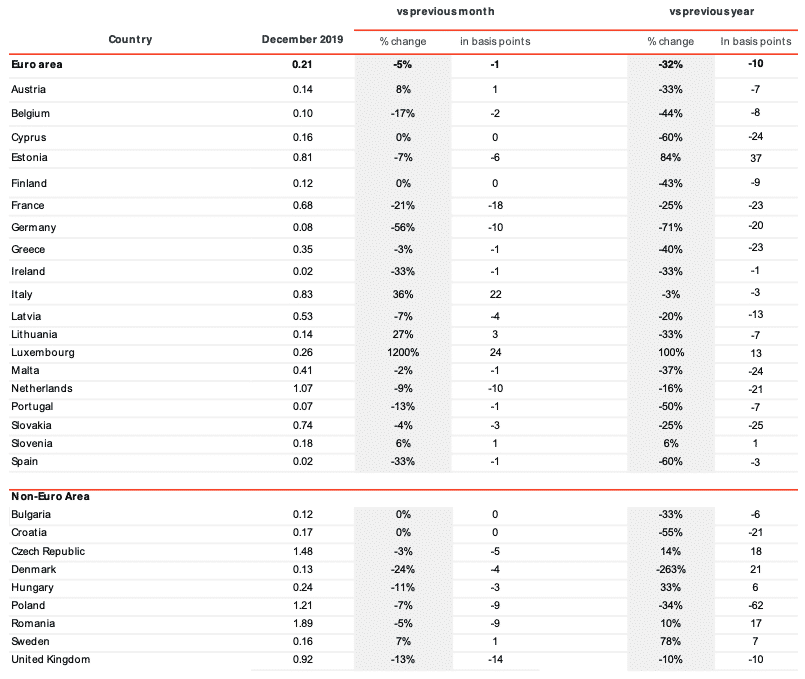
El siguiente gráfico muestra que los tipos de interés bancarios están por debajo de la inflación en la mayoría de los países desarrollados.
En los mercados emergentes, las devaluaciones monetarias han sido un gran problema, y la mayoría de los depositantes han obtenido tipos de interés negativos en términos de USD en los últimos 10 años.
Inmobiliaria - Comprar una propiedad inmobiliaria para uso propio se consideraría una compra para beneficio propio, mientras que comprar una propiedad inmobiliaria para venderla a un precio más alto o alquilarla se consideraría una inversión. Las inversiones inmobiliarias pueden considerarse uno de los métodos de inversión más ventajosos.
Sin embargo, los bienes inmuebles tienen varias desventajas:
- Es un activo ilíquido que no se puede vender fácilmente
- Ahora está muy gravado en muchos países
- El apalancamiento (deuda/hipoteca) es un arma de doble filo. Es arriesgado, pero también ofrece la posibilidad de obtener beneficios.
- Con la excepción de unos pocos inversores inmobiliarios profesionales, la mayoría de los arrendadores "hágalo usted mismo" luchan por batir a los mercados bursátiles a largo plazo.
Para muchas personas, invertir en REITS y pagarés de préstamo tiene más sentido.
Elimina muchos de los problemas y riesgos de la inversión inmobiliaria, si se hace bien.
Acciones - Las acciones, también conocidas como títulos de renta variable, son una fracción de la propiedad de una empresa. Las unidades de las acciones se denominan Acciones. Cuando una persona compra/invierte en acciones de una empresa, está invirtiendo/comprando una pequeña proporción de ese país. Las personas que compran acciones reciben un pago en forma de dividendos cuando la empresa obtiene beneficios. Si el valor de las acciones aumenta, la persona que las posee puede venderlas y obtener un beneficio conocido como Plusvalía.
Si la empresa quiebra y trata de liquidar los fondos, el accionista (persona que posee una acción) recibiría la cantidad equivalente a su participación, una vez que la empresa haya saldado las deudas (si las hubiera). Las acciones implican un riesgo, ya que el precio puede subir o bajar.
Las acciones individuales son arriesgadas, ya que incluso grandes empresas como Lehman pueden quebrar.
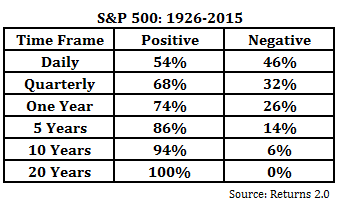
Sin embargo, comprar el mercado en su conjunto (por ejemplo, fondos indexados) o un conjunto de valores (como los fondos de inversión) no es arriesgado si los mantiene a largo plazo. Más adelante hablaremos de estas inversiones.
Un inversor a largo plazo nunca ha perdido dinero en el S&P500, por ejemplo:
Bonos - Los bonos son instrumentos financieros de deuda emitidos generalmente por un gobierno o una empresa a un particular. Los bonos suelen devengar un interés fijo por la inversión realizada. Hoy en día también existen intereses variables y flotantes. Los gobiernos o las empresas suelen utilizar los fondos reunidos con la ayuda de los bonos para realizar operaciones financieras, cubrir gastos, llevar a cabo diversos proyectos, etc.
Los tipos de los bonos dependen de los tipos de interés y, por este motivo, mucha gente invierte en bonos cuando los bancos suben los tipos de interés.
Fondos de inversión - Los fondos de inversión son los tipos de fondos de inversión que reúnen fondos de muchos inversores y los ponen en común para comprar valores. Los fondos de inversión son gestionados por gestores de cartera que asignan y distribuyen los fondos en diversas acciones, bonos y valores. Los particulares pueden invertir una cantidad tan baja como $1.000 y, sin embargo, ser capaces de diversificar su inversión donde se invierte 100 acciones diferentes que están presentes dentro de una cartera.
Los fondos de inversión están diseñados de forma que reproduzcan el rendimiento de los índices subyacentes, como el S&P 500. Algunos fondos de inversión pueden ser de gestión activa, en los que los gestores de cartera comprueban cuidadosamente la asignación de los fondos. Algunos fondos de inversión pueden ser de gestión activa, en los que los gestores de cartera controlan y asignan cuidadosamente los fondos.
Se sabe que los fondos de inversión tienen mayores costes, como comisiones anuales de gestión, gastos, etc. Esto suele reducir el número de rendimientos obtenidos. Las operaciones de compra y venta suelen realizarse después del cierre del mercado, ya que se valoran al final de la jornada bursátil.
Fondos cotizados - Los fondos cotizados en bolsa, también conocidos como ETF, son los tipos de instrumentos financieros que pueden negociarse a lo largo del día, todo lo demás es casi similar a los fondos de inversión. Los ETF pueden negociarse en bolsa. Debido a la amplia cobertura que ofrecen y a la facilidad de negociación, los ETF son una de las oportunidades de inversión más populares.
Además, existen otros tipos de oportunidades de inversión, como materias primas, futuros, opciones, criptomonedas, fondos de cobertura, etc.
Los ETF indexados son muy parecidos a los fondos indexados, pero son más líquidos.
Dónde realizar una inversión de $100.000 o 100.000 £:
Si usted es una persona que había ganado una buena cantidad de dinero y quiere invertir y obtener más beneficios de ella, a menudo habría pensado en “¿dónde invertir un $100.000 o £ 100.000?”. Esta es la pregunta más común que surgirá en la mente de las personas si quieren obtener beneficios de su dinero duramente ganado.
Si no se invierte correctamente, también existe la posibilidad de que una persona pierda el dinero que ha ganado, y cualquiera no estaría contento por tener pérdidas sobre una gran cantidad de dinero como esa. Incluso existe la posibilidad de perder la mayor parte del dinero invertido, si es posible, incluso todo el dinero, si no se hace de una manera adecuada.
Por lo tanto, echemos un vistazo a las oportunidades de inversión altamente beneficiosas, con la ayuda de las cuales cualquier persona puede ser capaz de maximizar sus beneficios.
Invertir en Bolsa:
La opción de inversión más importante que hay que tener en cuenta a la hora de invertir una cantidad tan elevada de dinero es ‘Invertir en Bolsa’. Con esa cantidad de dinero, una persona puede diversificar su cartera exponiéndose a casi todos los sectores e industrias del mundo. También se sabe que las acciones son una de las mejores oportunidades de inversión para proporcionar mejores rendimientos a una persona.
El proceso de invertir en acciones puede ser bastante complejo y requiere mucha atención por parte del inversor. El mejor proceso para invertir en acciones es el siguiente:
Comprar acciones individuales - Es uno de los métodos más arriesgados.
Si es usted un inversor agresivo y está dispuesto a asumir riesgos y a tomar algunas precauciones, invertir en valores individuales puede resultarle ventajoso.
Para ello, el inversor debe tener una idea perfecta de lo que está haciendo o, de lo contrario, acabará invirtiendo en miles de valores individuales, con lo que su nivel de diversificación será bajo.
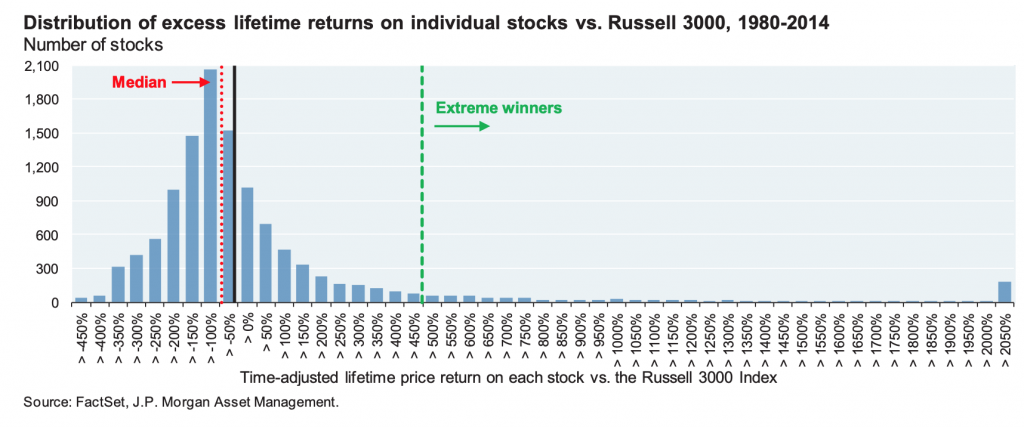
En realidad, muy pocos lo consiguen. Menos del 2% baten al mercado a largo plazo con la selección de valores.
Las razones son sencillas. Nadie tiene una bola de cristal y unos pocos ganadores extremos (como Amazon y Netflix recientemente) son una pequeña minoría de valores:
Además, si intentas batir al mercado durante 2 años, o incluso 5, tienes posibilidades.
Pero sus posibilidades de batir al S&P500 a lo largo de 40 años como inversor DIY se acercan a 0%.
Invertir en ETF y fondos de inversión - Los fondos de inversión y los ETF también son instrumentos financieros ventajosos. No son más que acciones diversificadas disponibles en un paquete en el que una persona puede invertir.
La compra de un ETF o un fondo de inversión garantiza una diversificación instantánea. La diferencia está en cómo se combinan, gestionan y venden.
Los ETF suelen ser fondos de gestión pasiva, lo que significa que el inversor no tendría que molestarse en perder su tiempo para gestionarlos.
Por lo general, los ETF siguen e igualan el rendimiento de un índice. Por ejemplo, acciones que invierten en oro, el S&P 500, etc. Las personas pueden incluso elegir el tipo de inversión que desean realizar con la ayuda de éstos. Por ejemplo, si una persona desea invertir únicamente en empresas socialmente responsables, puede hacerlo con la ayuda de los ETF.
Los Fondos de Inversión, aunque son fondos gestionados activamente, que están diversificados por gestores de cartera. Los fondos de inversión suelen conllevar más gastos, ya que otra persona tiene que gestionar los fondos. Las acciones que se eligen pueden basarse en las opciones de inversión personales del gestor del fondo.
Se sabe que el rendimiento de los fondos de inversión es menor que el de los ETF. Se puede hacer una estrategia con fondos de inversión. sin embargo, las opciones son limitadas.
Esto no significa que los fondos de inversión sean peores en comparación con los ETF, sino que también presentan algunas ventajas exquisitas. La ideología general aquí es mantener las comisiones lo más bajas posible y los fondos de inversión implican más costes.
Préstamos entre particulares (préstamos P2P):
Las inversiones realizadas en préstamos P2P pueden lograr rendimientos muy rentables, pero son demasiado arriesgadas para la mayoría de los inversores.
Son una forma de inversión pasiva y pueden ser útiles también para otras personas. Los rendimientos obtenidos con la ayuda de la inversión P2P pueden oscilar entre 5% y 10%. En algunos casos, la persona puede incluso ser capaz de generar rendimientos de hasta 12%.
Las plataformas de préstamos P2P ofrecen préstamos a las personas imponiéndoles una determinada cantidad de intereses sobre el dinero que han tomado. Por lo general, esta cantidad se cobra semanal, mensual o trimestralmente, dependiendo de la plataforma.
Sin embargo, lo que hay que tener en cuenta es que “donde hay demanda, se requiere oferta”, del mismo modo, donde se presta dinero, también se requiere pedir dinero prestado.
Esto crea una oportunidad para que los inversores presten dinero a las personas que lo necesitan (con la ayuda de estas plataformas de préstamos P2P). Al prestar la cantidad necesaria, los inversores obtienen depósitos mensuales y trimestrales en función del método de recaudación de fondos de la plataforma.
Por ejemplo, si realizas una inversión de $100.000 prestándolo a 100 personas en forma de $1.000 durante un periodo de tres meses. Digamos que el interés es de 5%. Entonces puedes llegar a ganar una cantidad de $5.000 durante 3 meses. Esto podría convertirse en $10.000 si el tipo de interés es de 10%. Además, te quedará la satisfacción personal de haber podido utilizar ese dinero para ayudar a alguien.
Algunas de las mejores plataformas de préstamos P2P disponibles en el mundo son ‘Prosperar’ y ‘Lending Club’.
Debido a los riesgos que entraña, la mayoría de la gente no debería invertir un alto porcentaje de su dinero en bienes inmuebles.
Invertir en el sector inmobiliario:
Como hemos comentado al principio del artículo, invertir en bienes inmuebles puede ser muy beneficioso, especialmente si una persona aplica una estrategia de comprar y mantener la propiedad que posee. Hay tres tipos de oportunidades de inversión inmobiliaria que pueden ser muy beneficiosas para una persona. Son las siguientes ‘Inmobiliario tradicional’, ‘REITs’, y ‘Financiación colectiva’.
Inmobiliaria tradicional - El sector inmobiliario tradicional es la forma general de invertir en bienes inmuebles, en la que una persona compra una propiedad y obtiene beneficios de ella vendiéndola después de renovarla, vendiéndola después de conservarla durante cierto tiempo o alquilándola. El proceso de flipping (hacer reformas y vender) no se consideraría tan beneficioso como las otras dos opciones. Sobre todo, comprar una propiedad y alquilarla puede ser más beneficioso para una persona.
Invertir en la ciudad natal de una persona puede ser bueno, ya que puede comprar una propiedad excelente con $100.000 o 100.000 libras. Si el valor de la propiedad es superior, compre una propiedad pagando la entrada. Los ingresos por alquiler de esa propiedad deberían bastar para las cuotas del préstamo y una vez completado con el préstamo la persona posee una propiedad en la que puede residir. Si el valor de la propiedad sube, puede venderla; si el valor de la propiedad permanece igual o baja, puede alquilarla o residir en ella.
Las inversiones en propiedades inmobiliarias internacionales también pueden reportar beneficios. Sin embargo, la persona tendría que viajar con frecuencia a la ubicación de su propiedad o contratar a un gestor inmobiliario local. Se sabe que las inversiones inmobiliarias internacionales ofrecen rendimientos de hasta 8% - 12%.
REITs - Los fondos de inversión inmobiliaria (REIT) son los ETF del sector inmobiliario. Proporcionan una cartera inmobiliaria diversificada, es decir, diferentes tipos de propiedades en distintas zonas. El control sobre los activos puede ser limitado, pero a largo plazo son propensos a proporcionar más beneficios. Sin embargo, existe la posibilidad de vender la participación respectiva de la persona cuando lo desee.
Crowdfunding - También conocido como crowdfunding inmobiliario, el crowdfunding consiste en recaudar dinero para un proyecto inmobiliario comercial dirigiéndose a un grupo de inversores. Esto se hace generalmente inversores a pequeña escala para financiar proyectos más grandes. Se puede invertir desde $5.000 euros. Con una cantidad tan alta como $100.000 o £100.000, se puede acceder a la exposición entre los mayores acuerdos inmobiliarios.
Antes de hacer una inversión en Property Crowdfunding, es mejor tener una buena cantidad de conocimientos sobre la inversión inmobiliaria, o de lo contrario puede convertirse en una situación compleja para un individuo.
Cuentas de jubilación:
Invertir en cuentas de jubilación puede ser muy beneficioso para las personas cuando envejecen. Tener algo de dinero a buen recaudo puede ser ventajoso para una persona si desea tener una vida mejor después de jubilarse. Es más una necesidad que una elección.
Las personas pueden ahorrar dinero depositando en varios tipos de cuentas de jubilación, como por ejemplo ‘Cuenta ’401(k)’, ‘Cuenta de jubilación individual (IRA)’, etc. Hoy en día, las cuentas de jubilación ofrecen muchas ventajas a las personas.
Si ya tiene una cuenta de jubilación y es una cuenta fiscalmente eficiente, puede empezar a invertir una parte de la cantidad de $100.000 o 100.000 £ o toda ella dependiendo de su estrategia de jubilación. Muchas cuentas como ‘401 (k)’, ‘403 (b)’, ‘Roth’, ‘IRA’, etc., son eficientes desde el punto de vista fiscal y ayudan a las personas a ahorrar dinero de los impuestos (que pueden ascender a miles de dólares).
Otras opciones de inversión destacables:
Además de éstas, existen otros tipos de oportunidades de inversión lucrativas que ayudan a las personas a obtener más beneficios de sus inversiones. Algunas de las menciones honoríficas son:
- Invierta en un plan de ahorro universitario para que sus hijos no tengan que preocuparse por ingresar en una universidad para cursar estudios. Hay cuentas disponibles que tienen ofertas lucrativas y son eficientes desde el punto de vista fiscal.
- Inversiones privadas
Conclusión: ¿cuál es el resultado final?
Para la mayoría de las personas, si están suficientemente orientadas al largo plazo, tener una estrategia bursátil de comprar y mantener liquidez funciona.
Aparte de eso:
- Si usted es un inversor que tiene una cantidad posterior de conocimientos en los mercados de valores y es un inversor experimentado, puede invertir por su cuenta. Sin embargo, esto sólo se aplica a un máximo de 2%-10% de personas. Según el artículo siguiente, la mayoría de la gente fracasa en la inversión DIY debido a la falta de conocimiento y no controlar las emociones.
- Si es usted un inversor con una experiencia mínima o nula en el mercado de valores, puede contar con la ayuda de un buen asesor financiero.
- Aunque tenga muchos conocimientos, pero esté ocupado, tiene sentido externalizar sus inversiones.
¿Qué ofrece a los inversores?
- Realizamos inversiones y asignamos activos creando una cartera diversificada
- Ofrecemos oportunidades de inversión a las que usted mismo no puede acceder a menos que sea multimillonario, a precios reducidos
- Todas nuestras inversiones son transferibles
- Somos fuertes en el nicho de los expatriados.
Lecturas complementarias
¿Funciona realmente la inversión "hágalo usted mismo"?