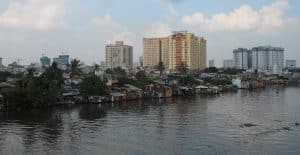
Vietnam is a fast-growing market. This has attracted attention. How about buying real estate in Vietnam? This article will list some reasons why you shouldn’t buy it.
Often times, especially for expats, more portable, low-cost and convenient assets exist than direct property.
Mis datos de contacto son hello@adamfayed.com y WhatsApp +44-7393-450-837 si tiene alguna pregunta.
La información contenida en este artículo es meramente orientativa. No constituye asesoramiento financiero, jurídico o fiscal, ni una recomendación o solicitud de inversión. Algunos hechos pueden haber cambiado desde el momento de su redacción.
Vietnam
Officially called as ‘Socialist Republic of Vietnam’, Vietnam is a southeast Asian country that is widely known for its war with the USA, cuisine, historical cities, culture, and many more things.

The capital city of Vietnam is Hanoi, the national language is ‘Vietnamese’ and the current population of Vietnam as of 2020 is 97 million (15th most populous country).
The land area of Vietnam comprises 3,260 km, while the coastline consists of 3,260 km.
There are many cultures and religions that can found in Vietnam while some of the major religions being Local Tradition (Folk), Buddhism, Christianity, Hoahaoism, etc.
The currency of Vietnam is ‘Vietnamese dong’ and is represented as ‘VND’. By the time of writing this article, the rate of one dong is equivalent to somewhere around 0.000043 USD, making it one of the top ten weakest currencies in the world.
¿Qué es el sector inmobiliario?
Real Estate is the class of properties or assets that include land or any other construction that is attached to it.
There are usually five types of real estate properties, which are ‘Commercial’, ‘Residential’, ‘Industrial’, ‘Raw Land’, and ‘Special Use’.
Residential Real Estate properties are the type of properties that are used only for residential purposes. Some examples include houses, condos, townhouses, duplexes, and many more.
Commercial Real Estate refers to the type of properties that are mainly used for business purposes. Some examples are apartment complexes, hospitals, restaurants, stores, movie theatres, gas stations, etc.
Industrial Real Estate is the type of real estate property involved in real estate activities such as manufacturing, production, distribution, storage, factories, warehouses, power plants, and others.
Finally, the real estate property for special use is the property used by the public like cemeteries, libraries, parks, schools, religious places, and others.
Investment in Real Estate
Investments can be made in a real estate property in two different methods. Either you can buy a property, or you can invest in it with the help of an investment trust known as a REIT (Real Estate Investment Trust).
By owning a property, you either live there or use it for the specific purpose you wish for. Or else you can rent out a property, by which you can be able to obtain profits in the form of rents.
On the other hand, you can also opt for flipping, which means buying land and renovating/constructing a building on the land and selling it for a better price.
While investing in a REIT, people can directly buy the shares of a REIT with the help of a stock exchange.
There is yet another form of investment that can be made in real estate properties which is known as investing in ‘Mortgage-Backed Securities’.
However, after the housing bubble of 2007-2008, this form of investment has gained a lot of bad reputation and also involves a certain amount of risk.
Taxation in Vietnam
Let’s have a brief look at the taxation in Vietnam and after that, we’ll discuss how these taxes may have an impact on real estate investors.
Impuesto de sociedades
The corporate income tax (CIT) rate in Vietnam is generally 20%, but for entities operating in gas-related and oil-related businesses, the rate can go up to 32% to 50%.
For the companies that are involved in business activities related to mineral resources (precious gems and metals) in any way, the CIT rate is 40% or 50% based on the location.
Under certain criteria, the CIT is collected under a reduced tax rate of 10%, 15%, or 17% upon satisfying the conditions.
Permanent establishments of foreign enterprises are subject to corporate taxation, which are as follows.
- Branches, Operating Offices, Factories, Workshops, Oil Fields, Gas Fields, Natural Resource Mines, Mines, etc.
- Building Locations, Construction Sites, Projects related to Installation or Assembly.
- An Establishment that provides services with the help of its employees or other individuals.
- Agents for Foreign Enterprises.
- An individual considered as a representative of a foreign enterprise, who has the authority for signing contracts with the name of the enterprise or has the ability to provide goods and services on behalf of the enterprise.
Foreign enterprises in Vietnam having their PEs located there would have to pay taxes on their taxable income.
The VAT is applicable to corporate entities that may vary between 0%, 5%, or 10%, while 10% is considered as the standard rate.
There is a natural resources tax that varies between 1% and 40% depending on the type of natural resources that are being exploited.
Branches of companies or enterprises are also subject to the same rate as the CIT rate.
Tax on Individuals
Tax residents in Vietnam are subject to taxation on their worldwide income.
People who have been living for a period of 183 days or more in a calendar year or within 12 consecutive months from the date of their arrival would be considered as a tax resident in Vietnam.
The tax residents are subject to tax rates on their employment income that range between 5% to 35% on the basis of their taxable income bracket.
On the other hand, they are subject to tax rates varying from 0.5% to 20% depending on the type of income. The business income is taxed at rates between 0.5% to 5%.
As for the non-residents, the tax rate for employment income is a flat 20% and the business income varies between 1% to 5% depending on the type of business.
The sale of shares or capital assignment is taxed at a rate of 0.1% and the interest income is taxed at a rate of 5%. The income for an inheritance, gifts, prizes, etc., is taxed at a rate of 10%.
For both residents and non-residents alike, a 2% tax rate is applicable to the sale of real estate properties.
Social Insurance contributions are applicable to residents as well as foreign individuals working in Vietnam. This has to be contributed by both the employer and the employee at different levels.
Employers would have to contribute 17.5%, out of which 3% is for sickness & maternity, 0.5% is for diseases and accidents, and 14% for retirement (or death). Employees would have to contribute 8%, which is only for retirement.
Health Insurance contributions are also applicable to residents and non-residents, while the employers have to contribute 3% and employees must contribute 1.5%.
Both the employers and employees must contribute 1% each for unemployment insurance contributions, which is only for the residents.
Real Estate in Vietnam
Vietnam didn’t provide the opportunity for foreign investors to make an investment in Vietnamese real estate until 2015.
However, things have changed since then and now foreign investors that have a visa valid for a minimum of three months can own a property in Vietnam.
People who are considered non-residents can’t just go ahead and own a property in Vietnam unless they are of Vietnamese origin and have returned to the country from overseas after a long time.
Foreign investors can only buy a lease for a property, which is valid for a period of 50 years. After that specific period, they can be able to extend it for a period of another 50 years.
This lease would allow a foreign investor to have all the property-related rights that an actual resident of Vietnam would have after purchasing a property.
This real estate property that has been acquired by a non-resident can be rented out by them, given out on a sublease, sold for a profit, used as collateral, donated, or provided to their heirs.
Generally, a real estate property would comprise any type of real property such as a house, villa, condo, apartment, townhouse, etc.
Unless the limit does not exceed 30% of the units in the case of a condominium complex or 250 land properties per administrative unit, non-residents can buy any number of properties they want to buy.
The properties located in a subdivision having an authorized project are the only properties made available to be purchased by foreign individuals.
Most of these properties are condominium complexes or resorts, which are being constructed and marketed especially for foreign investors.
Usually, these properties come under the category of luxury and have a hefty price, but by searching thoroughly, a person can find a property that is having a value under $100,000.
As most of the properties are located in resorts and are having on-site management, foreign individuals can have a vacation in the purchased unit and when they are not there, they can rent it out.
One interesting aspect of buying a real estate property in Vietnam is that the properties located in some parts of the country are expected to have an increase of 10% in the price annually.
Adding to that, the properties in Vietnam also have the potential for earning 7% more than the current rental prices every year.
There is an availability of various properties in Ho Chi Minh City and Hanoi, which are recently constructed or under construction. There are some smaller projects in resort areas located in or near the areas of Da Nang, Hoi An, Nha Trang, and Vung Tau.
To get your hands on such real estate properties, investors should be ready to pay a hefty price. In other regions of the country, the prices of real estate properties are low compared to the above-mentioned properties.
Aspectos a tener en cuenta
There are certain things that are to be considered while making an investment in the real estate properties of Vietnam.
First of all, real estate laws have been introduced recently in Vietnam. Therefore, it would take some time to create laws that will be advantageous to the people.
For instance, the existing laws state that the foreign investors who want to buy a property with a 50-year lease would have to extend it after completion. However, there is no specific terms of a law that establish this.
There are some other doubts related to owning property in Vietnam. For example, once after buying a property, it is not known whether it can be sold to another foreigner.
If sold to a foreigner by a foreigner, it is not known if the lease would start from the beginning and be for 50 years or will continue from the time that the property has already been in the possession.
These doubts need clarification, and in certain cases, they can affect the value of the property.
Just owning a property won’t make an individual become eligible for a long-stay visa. People who own properties could be able to stay in the country until having a valid visa, yet they would have to make regular visa trips.
The fees and taxes that are linked with purchases of properties are comparatively low. This comprises of a 0.5% stamp duty, a notary fee equivalent to $50 along with 0.06% of the value of the property exceeding 1 billion VND.
Along with these, there is a personal income tax charge of 0.5% while purchasing the land. This can be 0.65% if there exists a real property on the land.
Why shouldn’t you invest in Vietnamese Real Estate
We have discussed various aspects related to Vietnam, Taxation in Vietnam, Real Estate in Vietnam, etc. Now, let us come to the main topic for today, which will discuss ‘Why isn’t it good to invest in Vietnamese Real Estate’.
Given below are some of the major risks involved while making an investment in Vietnamese Real Estate.
Let us say that you bought a property and after a few years, someone comes and says that it is not yours anymore. Feeling weird, right? That is the exact situation of investing in real estate in Vietnam.
Even though there is a significant amount of development in the real estate sector in Vietnam, we strongly suggest not to make an investment in Vietnam.
Most people suggest that the process of investing in Vietnam has been made easy since 2015, however, they won’t make you familiar with the entire situation.
Once you decide to make an investment and approach a real estate project developer, they will slowly break down the bad news for you.
We have already discussed the limitations while buying land as a foreigner. Moreover, the people who buy a property won’t be actually owning the whole real estate property actually.
Unlike in most countries where people can build whatever they want in their land, Vietnam doesn’t allow people (foreigners) to do so. The rights for land will be packaged into a contract that determines what can you do with your land.
Despite the location of the property, whenever a buyer approaches a real estate broker, the brokers always say that the property is located in a very good location.
Adding to that they boast that the specific property is perfectly suitable for a good lifestyle and comes along with a wide range of benefits related to the property. By listening to these words, most buyers become convinced to buy such property.
There are some important questions that a buyer should ask before just buying off a property. They are:
- Are the property sellers having the authority to sell the specific real estate property to the buyers while abiding by the current laws?
- What are the required documents that a buyer should request for enquiring purposes other than the Preliminary Title Report (PR) and marketing materials?
Usually, most properties don’t meet the first requirement. This is because most of the properties won’t be able to satisfy the prevailing laws related to real estate.
There are some minimum conditions for a property to become eligible to be sold to an investor, including
- Completion of the project.
- Financial arrangements being actively managed by the financing entity.
- Off-the-plan sale contract’s sample is approved.
Some property sellers want to speed up this process and try to sell the property before even the property is able to meet such conditions. By doing so, a person who buys such property will breach the prevailing laws unintentionally.
As for the second question, the details are as follows. It is mandatory to provide the legal status of the project.
In some cases, to promote their reputation and brand, the project developers allow buyers to review/investigate the legal documents of the project. However, these developers won’t allow buyers to have a copy of those legal documents. Moreover, in some other cases, these documents are hard to get a look at.
The majority of the risks occur when the buyers purchase properties that are not yet fully developed or don’t have access to the legal documents. In such circumstances, there are some solutions for the buyers given below.
- cancel the contract and ask for a refund of the payment from the project developers.
- Wait for meeting up with the specific set of conditions before signing the sale and purchase agreement of the real estate. This specific time for this waiting period can be endless.
- Make adjustments to the contract so that it can be in favor of the buyers. This can be done by adjusting things such as the ratio of advance, terms of payment, interest rate, etc.
- Report the specific situation to the relevant authorities, so that they can get involved and take the necessary action.
- Finally, a buyer can initiate a lawsuit against the developers of the project.
If the buyers won’t be able to take any necessary precautions, it would cost them a lot. Some solutions mentioned above might require a lot of time and effort making it a little bit inconvenient.
As for our suggestion on this aspect, it is better to make sure that both the questions described have been perfectly answered.
It should also be taken into consideration that no developer would be allowed to collect payment before these steps and is prohibited to do so.
Based on various reasons, the functions of a property might not be understandable by the buyers/investors. Some developers might not declare the actual functionality of their real estate property units or provide misleading information.
The functionality of the properties is categorized into different purposes and are based on various factors like these:
- The ownership of projects: the project developer can either be an enterprise owned by a non-resident or a local company. Depending on the ownership, the functionality of the property and other features like restrictions, limits, etc., would be determined.
- The method: according to which, the developer acquires the land use rights certificate. This would help to determine whether the project is being allocated or is on a lease.
- Objective of projects: the main objective, whether it is for resettlement or compensation purposes.
- Functions of projects: whether the project is being developed for residential purposes, mixed-use, or any other purpose.
- Non-Residents: Final thing that is to be considered is whether or not a foreign individual can be able to buy the specific real estate property.
Foreign individuals who designate their properties as residential can lease out their property for commercial purposes. Enterprises owned by foreign individuals will only be allowed to accommodate their staff in Vietnam.
The functionality of a real estate property is very essential for obtaining profits, mitigating risks, transferring or assigning the benefits/obligations, and finally the ability to invest in the property legally.
Buyers should be aware of the differences between the specific conditions to buy properties and the condition for acquiring a pink book as a foreigner to become a part of any property transaction in Vietnam.
A pink book is nothing but the type of legal document that a foreigner should secure while buying real estate in Vietnam, which is considered as proof of ownership.
Another risk is about assigning the sales & purchase agreement previous to the issuance of a pink book to the foreign investors.
There are some financial obligations as well that have to consider before purchasing a property in Vietnam as a non-resident. These include the fees, charges, pink book issuance, etc.
Some of the fees and charges that a person would have to consider while investing in a Vietnamese real estate property as a foreigner are as follows.
- Broker commission fees: 1.5% to 2% of the selling price, which can also be negotiated between the sellers and the real estate broker in Vietnam.
- Legal services: equivalent to $2,500 to $8,000
- Notary fees: less than or equal to an amount equivalent to $400.
- Licensing fees: 0.05% of the selling price.
- Income tax: 2% to 4% of the selling price.
Another major risk is related to foreign exchange, which can vary while being converted to VND and can result in a loss for a property having high value.
Not only will the people have to face difficulties while buying a property, but they would also have to face inconvenience while selling the property and remitting their funds back into their home country.
Conclusión
While there are some advantages to making an investment in the real estate of Vietnam, the disadvantages outweigh them. By considering all the above-mentioned risky factors, you might get an idea about what we are saying.
There are some other countries like Cambodia, Malaysia, Philippines, etc., which offer investment options without such types of inconvenient rules and regulations.
Moreover, there are. few other lucrative forms of investments that you can get to know by availing of the expert financial services related to stocks, ETFs, bonds, and other financial instruments.
¿Le duele la indecisión financiera?

Adam es un autor reconocido internacionalmente en temas financieros, con más de 830 millones de respuestas en Quora, un libro muy vendido en Amazon y colaborador de Forbes.