Pensions provide guaranteed lifetime income, 401(k)s rely on contributions and investment growth, and annuities offer flexible or guaranteed payouts.
Comparing pensions, 401(k)s, and annuities makes it easier to determine the best fit for your retirement.
Este artículo trata:
- How does a 401(k) plan differ from a pension or annuity?
- What is the main purpose of a 401(k) retirement account?
- ¿Cuál es la finalidad principal de una renta vitalicia?
- What is the main purpose of a pension fund?
- Should I combine retirement plans?
Principales conclusiones:
- Pensions provide predictable, employer-backed income for life.
- Annuities reduce the risk of outliving savings with flexible or guaranteed payouts.
- 401(k)s offer control and growth potential but no guaranteed income.
- Combining retirement accounts can balance security, flexibility, and growth.
Mis datos de contacto son hello@adamfayed.com y WhatsApp +44-7393-450-837 si tiene alguna pregunta.
La información contenida en este artículo es meramente orientativa. No constituye asesoramiento financiero, jurídico o fiscal, ni una recomendación o solicitud de inversión. Algunos hechos pueden haber cambiado desde el momento de su redacción.

Is a 401k Considered a Pension or Annuity?
A 401(k) is neither a traditional pensión nor a pure annuity.
Unlike a pension, which provides guaranteed lifetime income, a 401(k) is a defined-contribution retirement account available mainly in the United States, where your savings depend on contributions and investment performance.
Similarly, while anualidades can generate guaranteed income, a 401(k) does not automatically provide this unless you convert it into an annuity at retirement.
Pensions and annuities, on the other hand, are more widely available internationally, though their rules and structures may vary by country.
What is the Difference Between a 401k, a Pension, and an Annuity?
The main structural difference is that a 401(k) is a defined-contribution account, a pension is a defined-benefit plan, and an annuity is an insurance product designed for retirement income.
| Característica | 401(k) | Pensión | Anualidad |
| Tipo | Defined contribution | Defined benefit | Insurance product |
| Income | Depends on contributions & investment returns | Guaranteed by employer | Can provide guaranteed income |
| Funding | Employee + sometimes employer | Employer-funded | Individual or employer-funded |
| Flexibilidad | Alta | Bajo | Moderado |
| Riesgo | Investment risk on account holder | Risk on employer | Risk varies by type |
In short, pensions offer predictable lifetime income, annuities provide flexible or guaranteed payouts, and 401(k)s rely on your contributions and market performance.
What is the Objective of Annuity?
The main objective of an annuity is to provide a predictable stream of retirement income while managing the risk of outliving your ahorro.
Annuities convert a lump sum into scheduled payments, which can be tailored to your retirement timeline and income needs.
They are designed for financial stability, especially for retirees who want security regardless of market fluctuations.
What is the Purpose of a Pension?
The purpose of a pension is to guarantee stable, employer-backed income for life after retirement.
Pensions calculate benefits based on salary and years of service, giving retirees predictable financial security.
They simplify planificación de la jubilación by removing the responsibility of investment management from the individual.
What is the Purpose of a 401k?
The purpose of a 401(k) is to enable employees to save and invest for retirement in a tax-advantaged way.
Contributions grow tax-deferred, and many employers offer matching contributions, increasing the potential retirement fund.
Unlike pensions, a 401(k) relies on the account holder’s contributions and investment decisions, giving more control but also more responsibility.
How to Generate Retirement Income from a 401k, Pension, and Annuity?
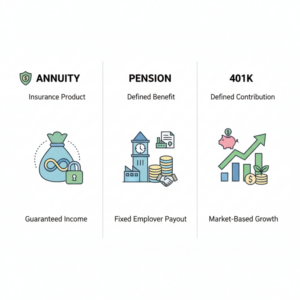
Retirement income is generated from a 401(k) through personal withdrawals, from a pension via guaranteed monthly payments, and from an annuity through scheduled payouts.
- 401(k): Withdrawals during retirement, either as lump sums or regular distributions. Some 401(k)s can be converted into annuities for guaranteed income.
- Pension: Regular monthly payments, typically for life, based on your tenure and salary.
- Anualidad: Scheduled payouts based on the type chosen—fixed, variable, or indexed annuities.
What are the Pros of an Annuity, Pension, and 401k?
The main advantages are that annuities provide flexible guaranteed income, pensions ensure lifelong financial security, and 401(k)s allow growth through investment control.
- Anualidad: Offers structured payments that can match your retirement needs and timing, helping manage financial risk. Certain annuity types allow income adjustments for inflation or market performance.
- Pension: Guarantees predictable, employer-backed income for life, giving retirees peace of mind. Minimal personal management is required, which reduces stress and planning effort.
- 401(k): Lets you grow retirement savings through investment choices and adjust your strategy over time. Employer matching contributions and tax-deferred growth can significantly increase your overall wealth.
What are the Cons of a 401k, Pension, and Annuity?
The main drawbacks are that annuities can be costly and inflexible, pensions depend on the employer and offer limited control, and 401(k)s carry investment risk and no guaranteed income.
- Anualidad: Annuities often come with high fees and surrender charges, which can reduce the overall return. They can also be complex, with confusing terms and conditions that make it difficult to compare options. Limited liquidity means accessing your funds early may incur penalties or restrictions.
- Pension: Pensions offer little flexibility, as benefits are typically fixed and cannot be adjusted to suit changing financial needs. They depend on the employer’s financial health, so underfunded plans may pose a risk. Additionally, some pensions may not fully adjust for inflation, which can erode purchasing power over time.
- 401(k): 401(k)s place investment risk on the account holder, meaning market downturns can reduce retirement savings. They require ongoing personal management, including choosing investments and monitoring performance. Without converting to an annuity, a 401(k) does not guarantee lifetime income, leaving retirees responsible for managing withdrawals carefully.
What are the Tax Implications of Annuities, 401k, and Pension?
The main tax implications are that annuities, 401(k)s, and pensions grow tax-deferred, but withdrawals are generally taxed as ordinary income unless contributed with after-tax dollars.
- Annuities: Earnings grow tax-deferred until you withdraw them. Withdrawals are taxed as ordinary income, except for portions funded with after-tax contributions, which are tax-free. This makes annuities useful for deferring taxes, but early withdrawals may incur penalties.
- 401(k): Traditional 401(k) contributions reduce your taxable income in the year they are made, and earnings grow tax-deferred. Withdrawals in retirement are taxed as ordinary income. Roth 401(k)s, however, are funded with after-tax dollars, allowing for tax-free growth and tax-free withdrawals in retirement.
- Pension: Pension benefits are generally taxed as ordinary income when distributed. Since contributions are usually made pre-tax by the employer, retirees must plan for the tax impact of monthly payments. Some pension plans may offer partial tax advantages depending on state rules or prior after-tax contributions.
Who is Best Suited for an Annuity, 401k, or Pension?
Annuities suit retirees with limited savings or uncertain income sources, 401(k)s suit those with time to grow investments and some financial flexibility, and pensions suit those with stable employer-backed benefits and predictable expenses.
- Annuities provide structured income to cover essential expenses for retirees who may not have other reliable income streams.
- 401(k)s allow employees to manage and grow their retirement savings, ideal for those who can tolerate market risk or anticipate large withdrawals.
- Pensions offer steady monthly income, perfect for retirees relying on predictable cash flow with minimal need for investment management.
What Makes for a Good Retirement Plan?
A good retirement plan balances income security, investment growth, and flexibility for unexpected expenses.
It ensures essential living costs are covered through reliable income sources, such as pensions or annuities, while allowing other funds, like 401(k)s, to grow and adapt to market opportunities.
Strong plans also account for taxes, inflation, and personal goals, giving retirees confidence that they can maintain their lifestyle throughout retirement.
Is It Best to Combine Retirement Accounts?
Yes. Using a mix of retirement accounts like a 401(k), annuity, and pension, can be beneficial, but it’s not a blanket approach.
Combining accounts may balance growth potential with guaranteed income, helping cover essential expenses while keeping assets invested for the future.
However, multiple accounts can add complexity, with different tax rules, withdrawal requirements, and payout structures.
The key is aligning each account with your overall retirement strategy, ensuring both stability and flexibility without unnecessary complication.
Conclusión
Successful retirement planning balances different account types to meet both known expenses and unexpected financial challenges.
Health care costs, lifestyle changes, and market fluctuations can affect your retirement, so reviewing your plan and adjusting contributions or allocations is essential.
Working with a gestor de patrimonios o asesor financiero can help tailor your strategy, optimize asset allocation, and ensure your retirement remains secure, adaptable, and aligned with your personal goals.
Preguntas frecuentes
¿Cuáles son los tres tipos de cuentas de jubilación?
The three main types are 401(k)s (defined contribution), pensions (defined benefit), and annuities (insurance-based retirement income).
Is a 401k basically a pension?
No. A 401(k) depends on contributions and investment performance, while a pension provides guaranteed lifetime income.
Is a 401k or Roth IRA better?
A 401(k) is better for higher contributions and employer matching, while a Cuenta IRA Roth is better for tax-free income in retirement.
The better choice depends on whether you benefit more from upfront tax deductions now or tax-free withdrawals later.
Why is it important to have a good retirement plan?
A good retirement plan ensures financial security, protects against outliving your savings, and allows you to maintain your lifestyle after retirement.
¿Le duele la indecisión financiera?

Adam es un autor reconocido internacionalmente en temas financieros, con más de 830 millones de respuestas en Quora, un libro muy vendido en Amazon y colaborador de Forbes.