Panamá es muy atractiva para los jubilados porque no grava los ingresos por jubilación, lo que permite a los expatriados disfrutar de sus pensiones, ahorros o seguridad social sin fuertes deducciones.
Other popular destinations include Costa Rica, Malaysia, and the Philippines, offering a combination of tax benefits, lifestyle advantages, and expat-friendly services.
Este artículo trata:
- What country has the lowest taxes for retirees?
- What type of income is not taxable?
- ¿Cuál es el país más fiscalmente favorable para los expatriados?
Principales conclusiones:
- Certain countries allow 100% tax-free retirement income for expats.
- Social security and foreign pensions may be taxed depending on local rules and treaties.
- Planning in a tax-friendly country helps maximize savings and reduce stress.
- Lifestyle, healthcare, and cost of living should also guide country selection, not just taxes.
Mis datos de contacto son hello@adamfayed.com y WhatsApp +44-7393-450-837 si tiene alguna pregunta.
La información contenida en este artículo es meramente orientativa. No constituye asesoramiento financiero, jurídico o fiscal, ni una recomendación o solicitud de inversión. Algunos hechos pueden haber cambiado desde el momento de su redacción.

What is considered a retirement income?
Retirement income generally refers to any regular or lump-sum payments received after leaving active employment such as pension and ingresos por inversiones, intended to support living expenses during retirement.
- Pensiones – Employer or government-funded retirement plans paid periodically.
- Social security benefits – Government retirement benefits, such as US Social Security or similar programs abroad.
- Annuities and retirement savings distributions – Payments from personal retirement accounts, 401(k)s, Cuentas individuales, or other deferred savings plans.
- Investment income earmarked for retirement – Interest, dividendos, or capital gains from investments that are used to support retirement living.
Different countries may classify retirement income differently, and exemptions from taxation often apply only to foreign-sourced retirement income or to residents under specific programs.
It’s important for expats to check local rules and tax treaties before mudanzas al extranjero.
What income is exempt from tax?
En muchos tax-friendly retirement destinations, foreign-sourced income such as pensions, social security, anualidades, and investment returns is often exempt from local taxation.
Algunos ejemplos son:
- Local public pensions in Singapore are generally exempt from tax even if remitted.
- Qualified retirement benefits such as SSS or GSIS pensions in the Philippines may be exempt from taxation.
- Annuity payouts and retirement account distributions are often exempt under local rules in certain jurisdictions.
- Some countries exempt capital gains on foreign investments earned outside their borders.
Exemptions depend on local legislation and residency requirements. Retirees should confirm the rules for each country and consult any relevant tax treaties to ensure full compliance and optimize benefits
¿Cuál es el país más favorable fiscalmente para los jubilados?
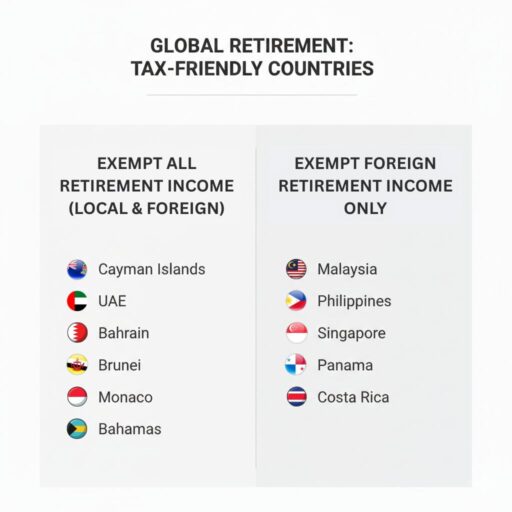
The most países con fiscalidad favorable for retirees are those that either exempt all retirement income or at least fully exempt foreign-sourced pensiones such as Cayman Islands, Bahamas, Malaysia, and Philippines.
Countries That Exempt Both Local and Foreign Retirement Income
- Islas Caimán – Retirement income from any source is fully tax-free for residents, with no requirement for foreign or local source. However, residency typically requires property purchase or significant investment.
- EAU – Personal income tax simply does not exist, making the UAE a fully tax‑free jurisdiction for individual retirement income, though indirect taxes like VAT still apply to consumption. Residency (typically established through a residence visa and physical presence) is required to enjoy local tax benefits.
- Bahréin – Both locally earned pensions and foreign retirement income are exempt from tax for residents. Residency is required to benefit from this exemption, often via work or investment.
- Brunei – All retirement income, whether earned locally or abroad, is untaxed for residents. Permanent residents automatically qualify for this exemption.
- Mónaco – Residents are not taxed on personal income, including retirement income from local or foreign sources. Strict residency rules apply, typically requiring property purchase or financial proof.
- Bahamas– Residents do not pay tax on any personal income, including pensions or social security, whether sourced locally or abroad. Residency requires living in the country for at least 183 days a year.
Countries That Exempt Only Foreign Retirement Income
- Malasia – Under the Malaysia My Second Home (MM2H) program, foreign pensions, social security, and investment income are exempt from Malaysian tax if the income was previously taxed abroad. Local-sourced retirement income remains taxable.
- Filipinas – Foreign pensions are generally not taxed under the country’s territorial tax system. Locally sourced pensions are taxable unless they qualify for exemption, such as SSS/GSIS benefits or qualified retirement plans meeting age and service requirements.
- Singapur – Foreign-sourced retirement income is generally not taxed, regardless of residency. Only Singapore-sourced income is taxable, but most foreign pensions and local public pensions remain exempt even if remitted.
- Panamá – Residents do not pay tax on foreign‑sourced pensions, Social Security, or annuities. Tax exemption applies once a resident qualifies for tax residency, which Pensionado visa holders often achieve. Local‑sourced income is still taxable.
- Costa Rica – Foreign pensions are fully exempt, but local pensions and other Costa Rica–sourced income are taxable. Residents automatically benefit, while non-residents are only taxed on local income.
Some jurisdictions (e.g., UAE, Cayman Islands, Monaco) are fully tax‑free on all personal income, not just retirement income, but typically require strict residency, property ownership, or investment thresholds.
Others (e.g., Singapore, Malaysia, the Philippines) use territorial tax systems, meaning foreign-sourced retirement income may be exempt only if specific conditions are met, such as remittance rules or qualifying visa status.
Tax treaties, particularly with the US, can affect how pensions, Social Security, and retirement accounts are taxed, so US citizens should review treaty provisions carefully to avoid double taxation.
What Other Taxes Affect Expats With Tax-Free Retirement Income?
Expats with tax-free retirement income still pay other taxes, including property, consumption, herencia, and local fees.
Key considerations include:
- Property taxes: Owning a home abroad may trigger annual property taxes, which vary widely by country and municipality.
- Consumption taxes and VAT: Everyday purchases, utilities, and services may carry local sales or value-added taxes.
- Inheritance or estate taxes: Some countries impose taxes on assets passed to heirs, even if income is untaxed.
- Municipal or local fees: Community charges, garbage collection, or local service fees can add up over time.
Being aware of these additional costs helps retirees plan realistically, ensuring that a tax-free retirement income still supports a comfortable lifestyle.
Where is the best place for expats to retire?
Panama is one of the best places for expats to retire, offering 100% tax exemption on foreign retirement income along with affordable living, good healthcare, and a comfortable lifestyle.
Otras opciones destacadas son:
- Costa Rica – No tax on foreign pensions, excellent healthcare, stable politics, and a peaceful environment with natural beauty.
- Malasia – MM2H program allows tax-free foreign income, affordable living, quality private healthcare, and modern urban conveniences.
- Portugal – Mediterranean lifestyle, safety, high quality of life, and easy access to other EU countries, with relatively favorable tax treatment for retirees.
- Filipinas – Tax-free foreign pensions, English-friendly environment, tropical climate, and relatively low cost of living.
- España – Strong healthcare system, vibrant culture, and long-term residency options, though foreign pensions may be partially taxed.
- Nueva Zelanda – Low crime, political stability, temperate climate, and excellent public healthcare, making it ideal for safety-conscious retirees.
This way, retirees can weigh tax advantages alongside lifestyle, safety, and healthcare when choosing a retirement destination.
¿Merece la pena pagar a un asesor financiero para que gestione una pensión?
Paying a asesor financiero can be worthwhile, especially for retirees with international income, multiple pensions, or complex investments.
An experienced advisor helps optimize tax efficiency, navigate cross-border regulations, and create a sustainable withdrawal strategy to ensure your retirement funds last.
For expats retiring in tax-friendly countries, advisors can also clarify local rules, advise on remittance strategies, and help avoid unexpected tax liabilities.
While fees vary, the guidance can save money, reduce stress, and provide peace of mind, making it a strategic investment for long-term financial security.
Choosing the right advisor: Look for credentials, transparent fees, and clear communication, while avoiding promises of guaranteed returns or vague cross-border expertise.
Conclusión
Retiring in a country that doesn’t tax retirement income can significantly stretch your savings, but taxes are only one piece of the puzzle.
Long-term comfort and security also depend on healthcare quality, political stability, cost of living, and how easily you can integrate into local communities.
Smart retirees plan for flexibility: maintaining access to familiar financial systems, considering dual-income or diversified assets, and choosing destinations where lifestyle, climate, and legal clarity align with their priorities.
By thinking beyond taxes and balancing financial, personal, and practical factors, expats can create a retirement that is not just financially efficient, but sustainable and fulfilling for years to come.
Preguntas frecuentes
Which country is 100% tax free?
The UAE stands out as a true 100% tax‑free jurisdiction for individual income and retirement income.
It is similar to the Cayman Islands, and is distinct from programs like Panama’s foreign income exemption or Malaysia’s MM2H territorial rules, which come with conditions.
What countries do not tax US social security benefits for retirees?
Common examples include Panama, Costa Rica, and Mexico, where foreign pensions and Social Security are typically not taxed under local tax law.
Some retirement destinations generally do not tax US Social Security benefits at the local level, often because they either use territorial tax systems or have specific rules exempting foreign‑sourced retirement income.
What is the most tax-efficient way to save for retirement?
Maximizing contributions to tax-advantaged retirement accounts, investing in foreign pension plans, and planning residency in a low-tax country can minimize taxation.
Can I refuse to pay income tax in the UK?
No. UK residents are legally required to pay income tax on worldwide income.
Tax planning can minimize liability but cannot completely eliminate it if you are a resident.
¿Le duele la indecisión financiera?

Adam es un autor reconocido internacionalmente en temas financieros, con más de 830 millones de respuestas en Quora, un libro muy vendido en Amazon y colaborador de Forbes.