Bielorrusia está estudiando un programa de Pasaporte por Inversión que podría ofrecer a los inversores extranjeros una vía rápida para obtener la ciudadanía.
Still in draft form, the program promises a quicker alternative to the traditional 7-year residency path, making it especially attractive for high-net-worth individuals.
Este artículo trata:
- Can I get Belarus citizenship by investment?
- Does Belarus give permanent residency?
- Belarus residency and citizenship by investment comparison
- Does Belarus recognize dual citizenship?
Principales conclusiones:
- Citizenship in Belarus is mainly via naturalization, marriage, or government approval.
- The CBI program is still in development with no official launch date.
- Economic challenges make foreign investment a priority.
- Dual citizenship is generally prohibited in Belarus.
Mis datos de contacto son hello@adamfayed.com y WhatsApp +44-7393-450-837 si tiene alguna pregunta.
La información contenida en este artículo es meramente orientativa. No constituye asesoramiento financiero, jurídico o fiscal, ni una recomendación o solicitud de inversión. Algunos hechos pueden haber cambiado desde el momento de su redacción.

Does Belarus give citizenship to foreigners?
Belarus currently allows foreigners to obtain citizenship under its 2002 citizenship law, but only through naturalización, matrimonio, or special government approval.
Proposed amendments under the draft CBI program would allow foreigners to acquire citizenship through investment.
The proposed changes were reportedly discussed during an expert council meeting, signaling that the country is actively exploring ways to attract foreign capital.
If passed, the amendments could formalize investment-based citizenship in Belarus.
While the exact investment thresholds and eligibility criteria are not yet public, the program is expected to target high-net-worth individuals seeking a fast-track path to Belarusian citizenship.
Investors should note that the program is yet to be finalized, so no applications can be submitted at this stage.
When is the Belarusian CBI expected to launch?
The Belarusian Citizenship by Investment program does not yet have an official launch date.
Discussions in Belarus’s expert council suggest that the program could be introduced by mid to late 2026, pending legislative approval and the establishment of regulatory frameworks.
Investors should monitor updates closely, as early planning may provide advantages once the program is finalized.
Is it easy to get PR in Belarus?
No, obtaining permanent residency (PR) in Belarus is not easy.
The process is generally lengthy and bureaucratic, requiring foreigners to reside in the country continuously for at least 7 years before they can qualify for citizenship through naturalization.
For investors following the proposed CBI program, this highlights the appeal of a fast-track route.
Unlike traditional PR, the CBI could potentially provide citizenship without years of residency, offering a quicker path for HNWIs.
How do you qualify for Belarus investor visa?
You can qualify for a Belarus investor visa by making a qualifying investment of at least 15,000 basic units (roughly US $200,000) and fulfilling financial and legal requirements.
Under the current investor residence framework in Belarus, foreign nationals can obtain residence through investment by:
- Making a minimum investment of 15,000 basic units (approximately US $200,000) in permitted options such as establishing or investing in a business, acquiring intellectual property rights, or participating in public‑private partnerships.
- Submitting comprehensive documentation, including proof of investment, a valid passport, and a clean criminal record.
- Meeting Belarusian legal and regulatory requirements, which are reviewed by the Citizenship and Migration Department.
This investor route leads to permanent residency, not citizenship.
To qualify for naturalization, an investor typically needs to maintain residency and meet legal criteria (including at least 7 years of permanent residence).
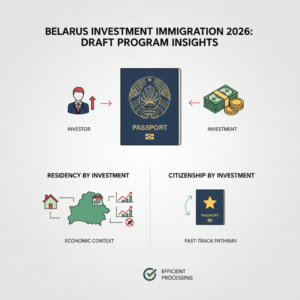
Belarus Residency by Investment vs Citizenship by Investment
Residencia por inversión (RBI) lets you live and work in Belarus, while citizenship by investment provides full citizenship and a Belarusian passport.
Understanding these pathways is essential for investors evaluating their options:
Belarus Investor Residence
What it offers:
- Right to live, work, and conduct business in Belarus.
- Pathway to permanent residency and eventual naturalization after at least 7 years.
Pros:
- Easier to obtain than citizenship.
- Lower investment threshold compared with proposed CBI.
- Allows investors to establish businesses and integrate locally.
Contras:
- Does not provide a passport or voting rights.
- Requires long-term residence to qualify for citizenship.
- Limited international mobility benefits.
Belarus Passport by Investment (CBI)
What it offers:
- Full Belarusian citizenship including a passport, voting rights, and access to government services.
- Faster route to citizenship without years of residency.
Pros:
- Immediate citizenship and passport for investor and family.
- Greater mobility and legal security internationally.
- Attractive for high-net-worth individuals seeking a fast-track option.
Contras:
- Program not yet finalized; details, including investment thresholds, are pending.
- Potentially higher investment requirement than RBI.
- Belarus does not formally allow dual citizenship, which may require renouncing another nationality.
Does Belarus allow dual citizenship?
Belarus does not formally allow dual citizenship.
Foreigners who acquire Belarusian citizenship may be required to renounce their previous nationality, although enforcement can vary.
Investors should seek expert legal guidance before pursuing citizenship to understand implications for their home country.
How strong is a Belarus passport?
A Belarusian passport offers moderate global mobility compared with many countries, with access that is stronger than some but limited compared with the world’s most powerful passports.
- Belarus ranked 60th globally in 2025–2026, with holders able to enter 79 destinations without a prior visa or with visa‑on‑arrival privileges, according to the Henley Passport Index.
- Arton Capital’s Passport Index, which uses a broader definition of mobility including eVisas, often ranks Belarus slightly higher (currently at 55), citing access to more destinations in some updates.
- Belarus ranks 123rd globally with a total score of 56, reflecting modest mobility, limited doble nacionalidad rights, and constrained perception and freedom metrics relative to other nationalities, as per the Nomad Passport Index.
Some aggregators produce varied rankings because they include different categories of entry (e.g., eVisas or temporary permits).
In practical terms, Belarusian citizens can travel fairly freely within the Commonwealth of Independent States and select countries in Asia, Latin America, and the Middle East.
However, visa requirements remain in place for most Western and Schengen‑area destinations, limiting wider mobility compared with top‑tier passports.
How Belarus’ Economic Situation Shapes Its Citizenship by Investment Proposal
Belarus’ economic challenges are a key reason the government is considering a Citizenship by Investment program (CIP).
En Banco Mundial projects GDP growth to slow to 1.3% in 2026, limited by labor shortages, structural dependence on Russia’s economy, and ongoing Western sanctions.
Inflation is expected to remain elevated at 6.2%, while the current account deficit is projected to improve slightly to 1.2% of GDP.
Sanctions have forced Belarus to reroute trade primarily through Russia, making foreign investment increasingly critical.
Against this backdrop, the draft CBI program is designed to attract capital and skilled investors, supporting economic growth and offsetting some of the pressures from sanctions and slow domestic expansion.
Conclusión
The draft Belarusian CBI program signals a subtle but significant shift in how Belarus views global capital and talent: the government is moving from reactive economic management to strategic attraction of foreign investment through citizenship incentives.
Beyond the numbers or residency timelines, the scheme reflects a broader trend in geopolitically constrained economies, using mobility and citizenship as a tool to diversify economic influence, secure new skill sets, and strengthen international connections.
For prospective investors, this underscores a key consideration: acquiring citizenship in Belarus—or any emerging CBI market—is as much about positioning oneself within a long-term economic and geopolitical landscape as it is about immediate legal status or travel benefits.
The decision to pursue a Belarusian passport may open doors to untapped markets, partnerships, or financial strategies that are invisible in standard residency or planificación de inversiones.
Ultimately, the Belarusian CBI is not just a financial opportunity.
It is a strategic lever for forward-looking investors who want to align mobility, wealth, and influence with a country navigating sanctions, regional dependencies, and economic recalibration.
Timing, insight, and informed planning will likely determine who benefits most once the program rolls out.
Preguntas frecuentes
What are the different types of passports in Belarus?
Belarus issues:
-Ordinary passport: For citizens’ travel abroad.
-Service passport: For government or military personnel on official duty.
-Diplomatic passport: For diplomats and high-ranking officials.
A citizenship by investment passport would fall under the ordinary passport category.
What is the C category visa in Belarus?
The C category visa is a short-term visa that allows entry for up to 90 days within a 180-day period.
It is typically issued for tourism, business, or short-term visits.
How many years does it take to get Belarus citizenship?
For most foreigners, obtaining Belarusian citizenship through naturalization typically requires 7 years of continuous residence, fluency in Belarusian or Russian, and evidence of integration into local society.
¿Le duele la indecisión financiera?

Adam es un autor reconocido internacionalmente en temas financieros, con más de 830 millones de respuestas en Quora, un libro muy vendido en Amazon y colaborador de Forbes.