En el podcast de hoy hablaré de algunos de los artículos periodísticos que más me han llamado la atención en los últimos días, entre ellos:
- El Nikkei 225 japonés roza los 30.000 puntos por primera vez en tres décadas. Esto fue algo que mencioné anteriormente, y que fue recogido por el Noticias en el sitio web de Japón hace unos meses.
- La subida del precio del petróleo y de los mercados y divisas “de riesgo
- Los malos resultados económicos del Reino Unido en 2019
¿Qué tienen en común estas historias?
Para dar crédito a los autores, he copiado los artículos originales y los he enlazado a continuación
El índice bursátil japonés Nikkei 225 tocó los 30.000 yenes por primera vez desde agosto de 1990, gracias a los indicios de que la recuperación económica se mantiene intacta en Japón y a los avances del plan de estímulo estadounidense.
El indicador subió hasta 1,6% el lunes, dando un paso más en la escalada hacia sus niveles de la era de la burbuja. La subida sigue a los recientes máximos históricos del índice Topix, que alcanzó su punto más alto en casi tres décadas. Aunque la renta variable mundial ha alcanzado nuevas cotas en los últimos meses, el Nikkei 225 aún necesita ganar casi otros 30% para superar su récord de 38.915,87 yenes. Este récord se alcanzó en la última sesión bursátil de 1989, antes de que el índice perdiera más de la mitad de su valor en tres años tras el estallido de la burbuja económica.
La breve ruptura de los 30.000 demuestra que “todo tipo de inversores se están lanzando a comprar renta variable japonesa con una visión totalmente alcista”, afirmó Shoji Hirakawa, estratega jefe mundial de Tokai Tokyo Research Institute Co.
En los datos anunciados el lunes, el producto interior bruto de Japón creció un 12,7% anualizado con respecto al trimestre anterior en los tres meses transcurridos hasta diciembre, ya que las exportaciones siguieron recuperándose, las empresas empezaron a invertir de nuevo y el estímulo gubernamental impulsó el gasto de los consumidores a pesar del coronavirus. El S&P 500 cerró la semana pasada en máximos históricos antes de un fin de semana de tres días, sumando más de 1% en la semana, ya que los inversores estaban atentos a las señales de que Washington está avanzando con un proyecto de ley de gastos.
Al igual que el Promedio Industrial Dow Jones, el Nikkei 225 es un índice ponderado por precios. Los dos valores más ponderados, Fast Retailing Co., operador de Uniqlo, y SoftBank Group Corp. representan casi 19% del indicador y, como tales, tienen un impacto desmesurado en sus movimientos. Ambos valores han subido el año pasado, beneficiándose de la pandemia y el segundo de las recompras récord de Masayoshi Son.
La ponderación de precios del índice ha suscitado críticas a lo largo de los años por no reflejar con exactitud el estado del mercado de renta variable japonés, o por ser “un índice de los Picapiedra de la época del ábaco”, en palabras de un crítico.
También destaca por la ausencia de algunos de los valores más importantes de Japón, como el gigante de los videojuegos Nintendo Co. y el especialista en automatización robótica Keyence Corp. El Nikkei 500, un indicador que incluye a estas dos empresas, superó su máximo de la era de la burbuja en septiembre y ha seguido batiendo nuevos récords desde entonces.
- Los datos del Gobierno publicados el lunes mostraron que la economía japonesa creció un 12,7% anualizado entre octubre y diciembre del año pasado. La lectura preliminar del producto interior bruto del cuarto trimestre fue superior a la estimación media de los economistas de un aumento de 9,5%, según Reuters.
- Los mercados de China, Hong Kong, Taiwán y Estados Unidos permanecen cerrados el lunes por vacaciones.
SINGAPUR - Las bolsas de Asia-Pacífico subieron el lunes por la mañana, con varios mercados del norte de Asia cerrados por las vacaciones del Año Nuevo Lunar.
El Kospi surcoreano lideró las ganancias en la región al subir 1,35%.
En Japón, el Nikkei 225 subió 1,09% en las primeras operaciones, mientras que el índice Topix ganó 0,82%.
Los datos del Gobierno publicados el lunes mostraron que la economía japonesa creció un 12,7% anualizado entre octubre y diciembre del año pasado. La lectura preliminar del producto interior bruto del cuarto trimestre fue superior a la estimación media de los economistas de un aumento de 9,5%, según Reuters.
En Australia, las acciones subieron, y el S&P/ASX 200 subió un 0,9%.
El índice MSCI más amplio de acciones de Asia-Pacífico cotizó un 0,37% al alza.
Los mercados de China, Hong Kong, Taiwán y Estados Unidos permanecen cerrados el lunes por vacaciones.
Sube el precio del petróleo
Los precios del petróleo subieron por la mañana en Asia, con los futuros del crudo Brent subiendo 1,22% hasta $63,19 por barril. Los futuros del crudo estadounidense subieron 1,66% hasta $60,46 por barril.
El índice del dólar estadounidense, que mide la cotización del billete verde frente a una cesta de divisas, se situó en 90,43, tras caer a principios de mes desde los 91,2 puntos.
El yen japonés cotizaba a 105,03 por dólar, por debajo de los niveles de 104,8 frente al billete verde registrados la semana pasada. El dólar australiano se situó en $0,7762 tras su subida de la semana pasada desde niveles inferiores a $0,772.
LONDRES, 5 feb (Reuters) - La libra esterlina subió el viernes frente al dólar y el euro después de que el Banco de Inglaterra evitara por ahora los tipos de interés por debajo de cero, con lo que la libra se encamina a su cuarta semana de ganancias frente al dólar.
Centrándose en las perspectivas de un repunte tras el cierre, el BOE dio a los prestamistas británicos al menos seis meses de respiro antes de que los tipos de interés negativos sean una posibilidad.
El subgobernador del Banco de Inglaterra, Ben Broadbent, dijo el viernes que era razonable que el BoE diera a los bancos al menos seis meses para prepararse para la posible introducción de tipos de interés negativos.
“La fuerte insinuación del Banco de Inglaterra de que los tipos negativos no se utilizarían en esta fase del ciclo económico desencadenó una importante revalorización de la curva del mercado monetario británico y de la libra esterlina”, afirmó Petr Krpata, director de divisas para EMEA de ING, en una nota a clientes.
La libra esterlina subía 0,2% a $1,3695 frente al dólar a las 1026 GMT, ganando más de un centavo frente al billete verde desde la reunión del BOE del jueves. GBP
También alcanzó su nivel más alto frente al euro desde mayo de 2020 en 87,38 en las primeras operaciones, antes de estabilizarse en 87,45 frente a la moneda única. EURGBP=D3
Adrian Schmidt, jefe de estrategia de divisas de Continuum Economics, dijo que la fortaleza de la libra esta semana fue una respuesta a un aumento “excesivo” en los rendimientos del Reino Unido, con los rendimientos de los gilts a diez años subiendo a sus niveles más altos desde marzo de 2020. GB10YT=RR
“En cualquier caso, la libra ya estaba generosamente valorada en relación con los niveles de rendimiento anteriores. Aunque podemos ver un caso de ganancias frente al euro, la subida frente a la mayoría de las demás divisas parece excesiva.”
Los mercados monetarios adelantaron seis meses las expectativas de una bajada de tipos, hasta febrero de 2022, antes de reducirlas hasta diciembre de 2021. Antes de las declaraciones del BOE, se apostaba por una bajada de tipos por debajo de cero en agosto de 2021. BOEWATCH
Las cifras del prestamista hipotecario Halifax mostraron el viernes que los precios de la vivienda británica cayeron el mes pasado por primera vez desde mayo, llevando la tasa anual de aumento a su nivel más débil desde agosto.
4. La economía británica sufrió una caída anual récord en 2020 - BBC
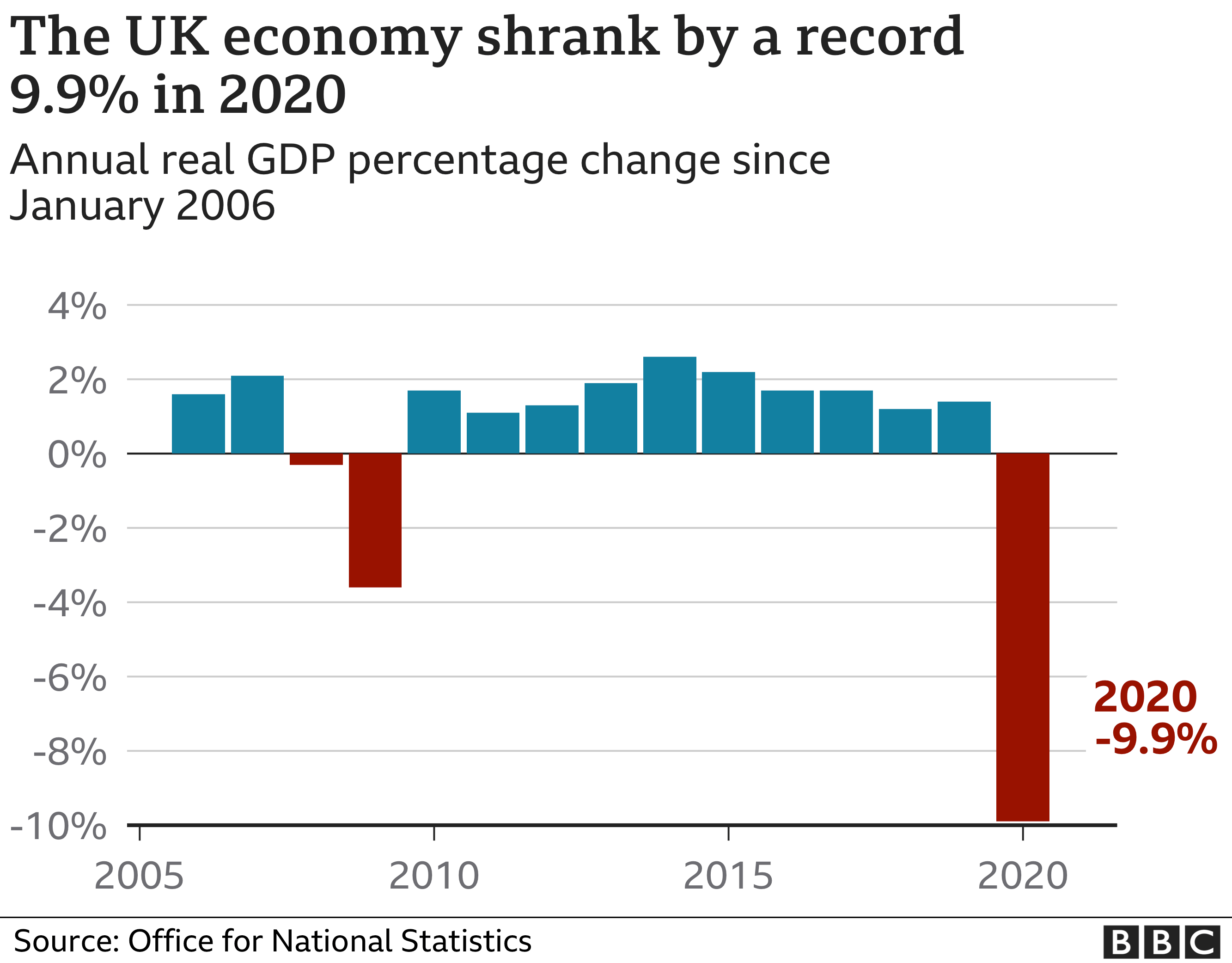
La economía británica se contrajo el año pasado la cifra récord de 9,9%, debido a que las restricciones impuestas por el coronavirus afectaron a la producción, según muestran las cifras oficiales.
La contracción en 2020 “fue más del doble que la anterior mayor caída anual registrada”, dijo la Oficina de Estadísticas Nacionales (ONS).
Sin embargo, la economía parece dispuesta a evitar una doble recesión tras la recuperación del crecimiento a finales de año.
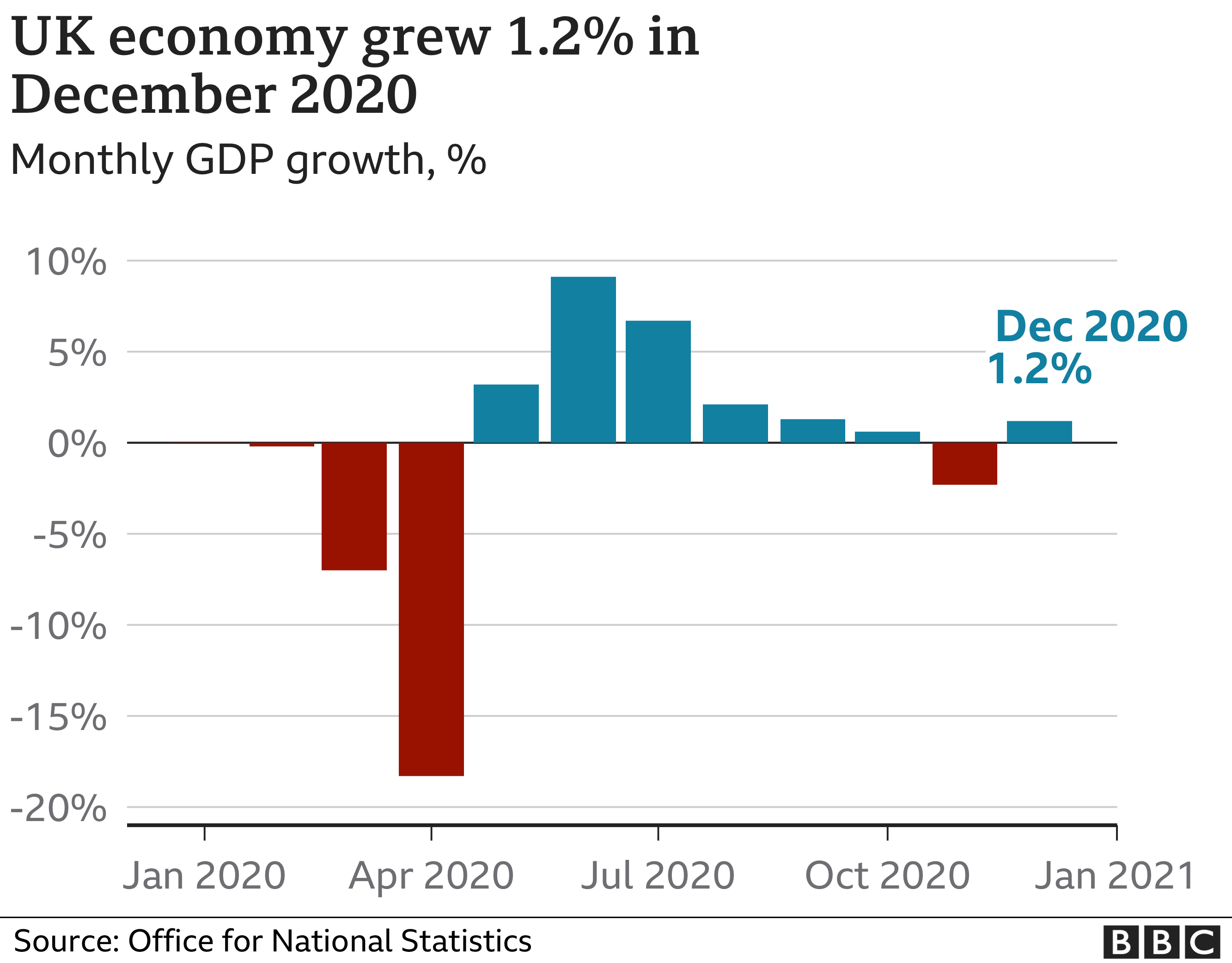
En diciembre, la economía creció 1,2%, tras contraerse 2,3% en noviembre, al suavizarse algunas restricciones.
La hostelería, la venta de coches y las peluquerías recuperaron parte del terreno perdido, según la ONS.
El crecimiento significó que en el trimestre de octubre a diciembre la economía creció 1%. Como resultado, se espera que el Reino Unido evite lo que podría haber sido su primera doble recesión desde la década de 1970.
Una doble recesión es cuando la economía se recupera brevemente de la recesión, para volver a hundirse rápidamente. Una recesión se define generalmente como dos trimestres consecutivos en los que la economía se contrae.
Según Jonathan Athow, estadístico nacional adjunto de la ONS: “El aumento de las pruebas y rastreos de Covid-19 también impulsó la producción. La economía siguió creciendo en el conjunto del cuarto trimestre, a pesar de las restricciones adicionales [de cierre] de noviembre.”
El PIB se midió por primera vez tras la Segunda Guerra Mundial, y nunca antes había caído más de 4,1% en un año. Sin embargo, el Banco de Inglaterra elabora modelos del PIB que se remontan a siglos atrás, y la contracción de 2020 podría ser la peor desde 1709.
Suren Thiru, responsable de economía de las Cámaras de Comercio Británicas, declaró: “A pesar de evitar una doble recesión, con la producción aún muy por debajo de los niveles anteriores a la pandemia en medio de la confirmación de que 2020 fue un año históricamente sombrío para la economía del Reino Unido, hay poco que alegrarse en los últimos datos.”
Los cuatro sectores económicos analizados por la ONS registraron un descenso de la producción, siendo la mayor caída la del sector de la construcción, que se contrajo un 12,5%.
El Canciller Rishi Sunak declaró a la BBC: “Las cifras de hoy muestran que el año pasado nuestra economía sufrió una sacudida importante, y también algunos signos de resistencia durante el invierno.
“Lo que está claro es que ahora mismo muchas familias y empresas están pasando dificultades. Por eso hemos puesto en marcha un plan integral de empleo para ayudar a la gente a superar esta crisis, y expondremos la siguiente fase de nuestra respuesta económica en nuestro Presupuesto de principios de marzo.”
Pero la canciller en la sombra, Anneliese Dodds, declaró: “Estas cifras confirman que el Reino Unido no sólo ha tenido el peor número de víctimas mortales de Europa, sino que estamos sufriendo la peor crisis económica de todas las grandes economías.
“Las empresas no pueden esperar más. El canciller tiene que presentar ya un plan para asegurar la economía en los próximos meses, con ayudas que vayan de la mano de restricciones sanitarias.”
Sin embargo, Sunak afirma que las comparaciones económicas internacionales no son necesariamente un criterio útil.
“Calculamos el PIB de forma distinta a casi todos los demás. Y si se corrige esa diferencia o se considera de una forma más cómoda con el PIB nominal, lo que se encuentra, como han señalado el Banco de Inglaterra y la ONS, es que nuestros resultados están muy en línea y son comparables a los de otros países”.”
Los economistas afirman que, dado que se espera que las restricciones de Covid-19 se mantengan hasta principios de la primavera, el golpe a la economía continuará durante los próximos meses.
“Prevemos un fuerte descenso de la actividad durante el primer trimestre del año”, declaró Kemar Whyte, economista jefe del Instituto Nacional de Investigación Económica y Social. “No obstante, el crecimiento repuntará a partir del segundo trimestre, a medida que disminuyan las restricciones gracias al éxito del programa de vacunación”.”

Como se esperaba, la economía se estabilizó en el último trimestre de 2020. Pero la última serie de estadísticas confirma la magnitud del golpe sufrido durante todo el año pasado.
Se ha evitado una vuelta técnica a la recesión, ya que la economía volvió a crecer a finales del año pasado. Pero lo cierto es que la economía está volviendo a caer en lo que va de los tres primeros meses de 2021, debido a los duros cierres nacionales, así como a algunas repercusiones del aumento de las barreras comerciales con la Unión Europea.
El canciller y el Banco de Inglaterra prestarán mucha más atención a lo que está ocurriendo en estos momentos. El nuevo bloqueo ha vuelto a golpear considerablemente el crecimiento, pero no tan fuerte como el pasado mes de abril.
Las empresas y los hogares permanecen a la espera, listos para desatar el crecimiento reprimido cuando se reabra la economía.
Aunque la vacuna acabará desbloqueando ese crecimiento, el momento exacto es aún incierto, y el Gobierno sigue sometido a presiones para mantener importantes sumas en ayudas económicas.

‘Resorte en espiral’
La contracción del año pasado es más pronunciada que la de casi cualquier otra gran economía, aunque España sufrió un descenso de 11%.
Gran Bretaña ha registrado el mayor número de muertes por coronavirus de Europa y se encuentra entre los países del mundo con mayor número de fallecimientos por habitante.
Los economistas atribuyen gran parte del daño a la economía británica a su gran dependencia del sector servicios, que sufrió especialmente durante el año a causa del cierre patronal.
Sin embargo, Gran Bretaña ha vacunado hasta ahora a muchas más personas que otros países europeos, lo que aumenta las perspectivas de recuperación de su economía a finales de este año.
Este posible repunte rápido llevó al economista jefe del Banco de Inglaterra a describir la economía como un “resorte en espiral” listo para liberar grandes cantidades de “energía financiera reprimida”.
Andy Haldane afirmó el jueves que la confianza de los consumidores se recuperaría gracias al programa de vacunas, y que la economía funcionaría “a toda máquina” en primavera.
Sunak declaró a la BBC: “Hay motivos para un optimismo prudente, porque la implantación de la vacuna va muy bien.
“El primer ministro establecerá una hoja de ruta para salir de las restricciones en las próximas semanas y meses. Será la semana del 22 de febrero, y está relacionado con que basemos nuestra hoja de ruta en la mejor evidencia posible de datos.”
¿Le duele la indecisión financiera? ¿Quiere invertir con Adam?

Adam es un autor reconocido internacionalmente en temas financieros, con más de 230 millones de respuestas en Quora.com y un libro muy vendido en Amazon.
Lecturas complementarias
En el artículo siguiente hablé de:
- ¿Es posible ser rico con un patrimonio neto bajo?
- ¿Por qué se disparan los valores tecnológicos? ¿Estamos asistiendo a otra burbuja?
- ¿Es cierto que la gente finge que le apasiona algo cuando lo que importa es el dinero?
- ¿Habría sido Steve Jobs más rico que Jeff Bezos si estuviera vivo hoy?
Para saber más, haga clic a continuación: