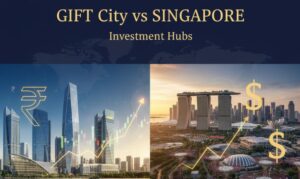
Between GIFT City and Singapore, the difference lies in positioning, with GIFT City offering aggressive tax holidays and lower setup costs, while Singapore offers global reputation, treaty access, and strong regulatory credibility.
The right choice reflects whether your priority is cost-efficient structuring within India’s IFSC framework or operating from a globally established financial hub with deep capital markets.
Este artículo trata:
- What are the benefits of investing through GIFT City?
- Is investing in Singapore a good idea?
- What is Singapore ranking as financial center?
- What is the rank of GIFT City in the world?
Principales conclusiones:
- GIFT City = aggressive tax incentives + lower cost base
- Singapore = global credibility + treaty strength + stability
- GIFT City is ideal for India-focused structures seeking regulatory efficiency and tax incentives.
- Singapore fits international funds, family offices, and cross-border investors.
Mis datos de contacto son hello@adamfayed.com y WhatsApp +44-7393-450-837 si tiene alguna pregunta. También ofrecemos soluciones de estructuración a medida adaptadas a su situación.
La información contenida en este artículo es meramente orientativa, no constituye asesoramiento financiero, jurídico o fiscal y puede haber cambiado desde el momento de su redacción.

What is GIFT City and how to invest?
Ciudad GIFT (Gujarat International Finance Tec-City) is India’s first operational International Financial Services Centre (IFSC), structured to function as an offshore-style financial zone within India.
It was created to compete with established hubs such as Singapore by offering tax incentives and a unified regulatory regime tailored to cross-border finance.
Investing in GIFT City typically involves setting up a regulated IFSC vehicle rather than simply deploying capital passively.
Common routes include:
- Setting up an IFSC company or LLP
- Establishing a fund (AIF, family office structure, or PMS)
- Opening a banking or insurance/reinsurance unit
- Investing in securities via GIFT IFSC exchanges
In contrast, Singapore provides a more mature and globally integrated platform where investors can either establish operating entities or allocate capital through existing financial institutions.
How to invest in Singapore
Puede invest in Singapore by incorporating a company, establishing a regulated fund structure, setting up a family office, or deploying capital through licensed financial institutions.
Unlike GIFT City’s incentive-driven IFSC model, Singapore operates as a fully developed financial ecosystem with established banking depth, global market access, and longstanding regulatory credibility.
Investors typically choose one of the following routes:
1. Incorporate a company: Set up a private limited company to operate locally or hold inversiones.
2. Establish a fund structure: Use a Variable Capital Company (VCC) for regulated fund operations.
3. Set up a family office: Create single or multi-family offices to gestionar el patrimonio eficientemente.
4. Invest via financial institutions: Deploy capital through local banks, brokerage platforms, or licensed fund managers.
While GIFT City emphasizes structural tax efficiency within a designated financial zone, Singapore emphasizes legal certainty, treaty access, and seamless cross-border capital movement.
Singapore’s legal system, based on English common law, further strengthens enforceability and investor confidence.
Which regulatory authority oversees GIFT City?
GIFT City is regulated by the International Financial Services Centres Authority (IFSCA).
IFSCA acts as a unified regulator covering:
This single-regulator model simplifies licensing compared to India’s domestic multi-regulator framework.
Who is the regulatory authority of Singapore?
Singapore’s financial sector is regulated by the Monetary Authority of Singapore (MAS).
MAS functions as:
- Central bank
- Financial regulator
- Supervisory authority for banks, insurers, and fund managers
It is globally respected for transparency, prudence, and regulatory clarity.
MAS is also known for maintaining strict compliance standards, robust anti-money laundering enforcement, and a stable monetary policy framework that reinforces Singapore’s reputation as a trusted international financial hub.
Can foreigners invest in Singapore or GIFT City?
Yes, foreigners are legally permitted to invest in both Singapore and GIFT City, but the entry frameworks operate differently.
In Singapore, foreigners can own 100% of a company, establish regulated fund structures, open bank accounts subject to compliance checks, and invest in most clases de activos.
The legal framework does not impose general foreign ownership restrictions, though certain sectors and landed residential property have limitations.
In GIFT City, foreign investors can participate through IFSC-approved entities and structures.
Activities must fall within permitted financial services categories, and licensing or registration is typically required depending on the activity type.
Transactions are conducted within the IFSC regulatory perimeter rather than the broader domestic Indian regime.
What are the tax advantages of Singapore vs GIFT City?
GIFT City offers up to 100% corporate tax exemption for 10 consecutive years, while Singapore maintains a competitive 17% corporate tax rate with no capital gains tax and an extensive treaty network.
GIFT City tax advantages:
- 100% tax exemption for 10 consecutive years out of 15
- No GST on IFSC transactions
- No securities transaction tax (STT)
- No dividend distribution tax
- Capital gains benefits on certain transactions
Singapore tax advantages:
- Corporate tax capped at 17%
- Partial tax exemptions for startups
- Sin impuesto sobre plusvalías
- Extensive double tax treaty network
- Territorial tax system (foreign-sourced income exemptions under conditions)
GIFT City offers stronger short-term tax holidays, while Singapore offers long-term predictability and global treaty access.
What are the risks of doing business in Singapore vs GIFT City?
Singapore carries higher operating and compliance costs, while GIFT City carries greater regulatory and ecosystem development risk.
Risks in Singapore:
- Higher operating costs (rent, salaries, compliance)
- Increasing regulatory scrutiny (AML and substance requirements)
- Competitive market saturation
- Talent cost inflation
Risks in GIFT City:
- Regulatory framework still evolving
- Limited ecosystem compared to mature financial hubs
- Currency exposure (USD-denominated structures vs INR considerations)
- Dependency on India’s broader economic and policy environment
Singapore offers institutional stability but at a premium cost, whereas GIFT City presents growth-stage opportunity alongside policy and execution risk.
How much does it cost to set up a business in Singapore vs GIFT City?
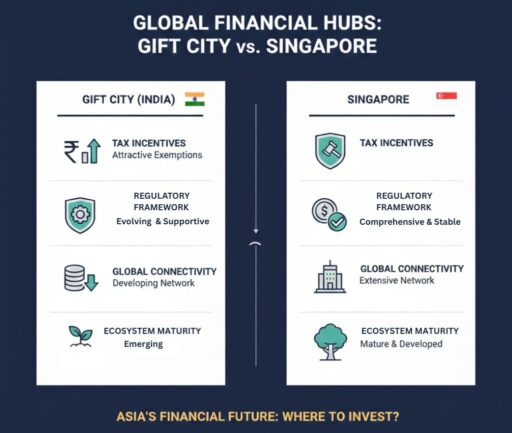
Setting up a business costs around USD 1,100–2,900 in Singapore for a private limited company. In GIFT City, IFSC registration and licensing fees start from USD 2,500–10,000, based on the entity type and activity.
Singapur:
- ACRA government incorporation fees: SGD 315 (~USD 230)
- Typical first‑year full setup (director, secretary, registered address): SGD 1,500–4,000 (~USD 1,100–2,900)
- Office and compliance costs: additional, depending on size and requirements
GIFT City (IFSC estimates):
- IFSC application & registration fees: USD ~2,500–10,000+ depending on license class
- Recurring regulatory fees: USD ~2,000+ annually for many categories
- Office space and operational expenses: varies by setup and scale
Singapore’s costs are predictable and geared toward global credibility, whereas GIFT City offers flexibility with costs tied to the type of financial activity and regulatory approvals.
GIFT City vs Singapore Side-by-Side Comparison
| Factor | Ciudad GIFT | Singapur |
| Global Financial Hub Ranking | ~43rd–46th globally (Global Financial Centers Index) | Consistently top 4 globally |
| Regulator | IFSCA | MAS |
| Corporate Tax | 0% (10-year window) | 17% headline |
| Impuesto sobre plusvalías | Exempt on qualifying IFSC transactions | Ninguno |
| Double Tax Treaties | Limited via India | Extensive global network |
| Setup Cost | Baja | Más alto |
| Ecosystem Depth | Desarrollando | Highly mature |
| Political Stability | Moderate–high political stability, India-linked | Very high |
| Ease of Doing Business | Improving | Among world’s best |
Case Studies: When to Choose GIFT City vs Singapore
Choosing between GIFT City and Singapore often comes down to the investor’s capital strategy, geographic focus, and tolerance for policy evolution.
While Singapore provides institutional depth and global connectivity, GIFT City offers targeted incentives and alignment with India’s growth trajectory.
Scenario 1: Cross-Border Fund Launch
A USD-denominated fund aiming at both Indian and global investors may favor Singapore if treaty access, legal predictability, and deep capital markets are priorities.
Conversely, GIFT City can be ideal for India-focused structures seeking short-term tax holidays and regulatory efficiency, particularly for IFSC-qualified funds.
Scenario 2: Family Office or Wealth Structuring
International family offices benefit from Singapore’s long-term stability, no capital gains tax, and established professional ecosystem.
GIFT City can suit family offices aiming for India-linked investments with cost-efficient structures, though regulatory processes may still evolve.
Scenario 3: Financial Services Units and Fintech Ventures
Startups or banks seeking to pilot innovative financial products might leverage GIFT City’s incentives and subsidized infrastructure, taking calculated policy risk.
Singapore offers mature infrastructure and easier international scaling, but at a higher cost.
Future Outlook Consideration
GIFT City remains an emerging hub, with growth potential tied to India’s economic policies and IFSC expansion.
Singapore’s position is globally established, offering predictable regulatory and operational conditions.
Strategic investors often treat the two not as substitutes but as complementary tools, selecting each based on timing, risk appetite, and market focus.
Conclusión
The divide between GIFT City and Singapore is ultimately about maturity versus momentum.
Singapore offers institutional depth, global connectivity, and regulatory certainty that lowers structural risk for international capital.
GIFT City offers targeted incentives and strategic alignment with India’s growth trajectory, but within a framework still proving itself at scale.
Sophisticated investors often treat them not as substitutes, but as tools selecting each jurisdiction based on capital strategy, geographic focus, and tolerance for policy and ecosystem evolution.
Preguntas frecuentes
What is Singapore’s weakness?
Singapore’s main weaknesses are its high operating costs, including labor and rent, and its dependence on global trade cycles.
Additionally, strict regulatory oversight and rising pressures from global tax alignment can increase compliance burdens for businesses.
What is the FTC incentive in Singapore?
FTC typically refers to Foreign Tax Credit, which allows Singapore tax residents to offset foreign taxes paid against Singapore tax liabilities under certain conditions, reducing double taxation exposure.
What are the Big 4 companies in the GIFT City?
The Big 4 accounting firms operating in GIFT City are Deloitte, PwC, EY, and KPMG, providing audit, tax advisory, and other services within the IFSC framework.
Can we buy a house in GIFT City?
Yes, residential property can be purchased in GIFT City, but it is primarily a financial and commercial hub.
Property transactions follow Indian real estate laws, and foreign ownership is subject to India’s FEMA regulations, making it less of a residential investment destination compared to Singapore.
¿Le duele la indecisión financiera?

Adam es un autor reconocido internacionalmente en temas financieros, con más de 830 millones de respuestas en Quora, un libro muy vendido en Amazon y colaborador de Forbes.