Switzerland, home to one of the world’s most sophisticated private banking sectors, hosts external asset managers (EAMs) who independently manage investments and wealth for private and institutional clients.
Choosing the right EAM involves evaluating their experience, investment philosophy, and performance.
These managers operate outside traditional banks, providing tailored investment solutions while fully complying with Swiss financial regulations.
Este artículo trata:
- What do external asset managers do?
- Who regulates asset managers in Switzerland?
- How are asset managers regulated?
Principales conclusiones:
- Swiss external asset managers provide bespoke investment solutions beyond traditional banking.
- FINMA regulates EAMs, ensuring compliance and client protection.
- Swiss EAMs earn CHF 107,000–380,000, rising with experience and portfolio size.
- Choosing the right manager requires evaluating experience, fees, services, and transparency.
Mis datos de contacto son hello@adamfayed.com y WhatsApp +44-7393-450-837 si tiene alguna pregunta. También ofrecemos soluciones de estructuración a medida adaptadas a su situación.
La información contenida en este artículo es meramente orientativa, no constituye asesoramiento financiero, jurídico o fiscal y puede haber cambiado desde el momento de su redacción.

Who are Swiss External Asset Managers?
Swiss external asset managers (EAMs) are independent professionals or firms operating within Switzerland’s highly regulated financial sector, managing inversiones for both Swiss residents and international clients.
Unlike in-house private bankers at Swiss banks, these managers provide personalized estrategias de inversión that often include access to Switzerland’s exclusive private banking networks and cross-border financial expertise.
Swiss EAMs typically offer:
- Portfolio management tailored to Swiss and global markets
- Planificación financiera that accounts for Swiss tax structures and cross-border regulations
- Wealth preservation strategies, leveraging Switzerland’s stable economy and strong legal protections
How are Asset Managers Regulated in Switzerland?
In Switzerland, all external asset managers Regulado por la Autoridad Suiza de Supervisión de los Mercados Financieros (FINMA)
Any EAM that manages client assets or provides investment advice must be registered with FINMA and comply with its strict rules.
These regulations cover compliance procedures, risk management, anti-money laundering measures, and transparent client reporting.
The framework is designed to protect clients, maintain market integrity, and uphold Switzerland’s global reputation as a stable and trustworthy financial center.
How Much Does an Asset Manager Make in Switzerland?
Suiza external asset managers earn between CHF 107,000 and CHF 380,000 per year, with most professionals falling in the CHF 107,000–205,000 range based on experience, client portfolio size, and firm scale.
Entry-level managers typically earn around CHF 107,000–130,000, while senior managers or those managing large or international client portfolios can reach CHF 300,000–380,000, often supplemented by performance-based bonuses.
Compensation may also include profit-sharing or fees tied to assets under management, reflecting Switzerland’s high-value banca privada environment.
Overall, asset management remains one of the higher-paid finance roles in Switzerland, reflecting both the expertise required and the country’s complex regulatory framework.
Who is the Largest Swiss Asset Manager?
UBS Asset Management is the largest asset manager headquartered in Switzerland, with assets under management far above any other Swiss provider.
Según la Swiss Asset Management Study 2025, UBS Asset Management had roughly CHF 527 billion in assets under management as of 2024.
Following UBS, other major Swiss asset managers include:
- Zürcher Kantonalbank (including Swisscanto) with around CHF 297 billion AUM
- Pictet Asset Management with about CHF 233 billion AUM
Both play significant roles in the domestic market.
UBS’ dominant position has been reinforced by the merger of Credit Suisse’s asset management business into UBS Asset Management, further consolidating its leadership in Swiss institutional and private gestión de patrimonios.
These firms serve a mix of local and international clients and reflect Switzerland’s status as a key global financial center with deep expertise in managing substantial portfolios across multiple asset classes.
How to Choose an Asset Manager?
When choosing a Swiss asset manager, start by ensuring they are registered with FINMA and meet the country’s regulatory standards.
Selecting the right manager also involves evaluating experience, fees, services, and transparency.
Entre los factores clave que hay que tener en cuenta figuran:
1. Regulation: Confirm the manager is FINMA-registered and compliant with Swiss financial laws.
2. Experience: Look for proven expertise managing portfolios similar to yours, especially in Swiss and cross-border markets.
3. Tasas: Compare fixed management fees and performance-based incentives to ensure cost-effectiveness.
4. Services: Check whether they offer investment strategy, Swiss tax planning, or succession planning.
5. Transparency: Ensure the manager provides clear reporting and regular communication with clients.
Is an Asset Manager Worth It in Switzerland?
Hiring an external asset manager in Switzerland is worthwhile for clients with complex or high-value portfolios, cross-border investments, or specific financial goals.
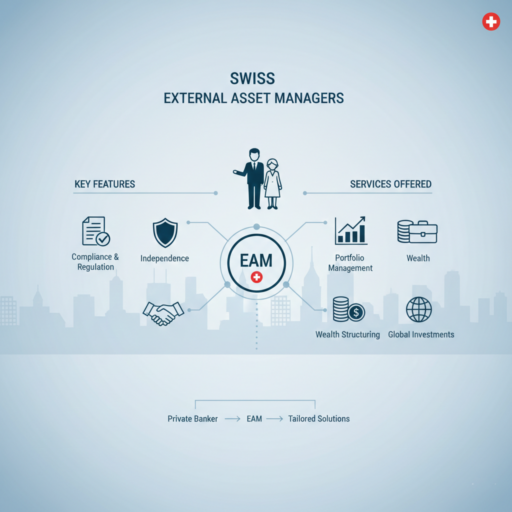
Swiss EAMs provide expertise in navigating local regulations, tax optimization, and international investment opportunities that may be difficult for individual investors to access.
While fees can be significant, they are often offset by professional risk management, portfolio diversificación, and access to exclusive private banking networks.
For clients who prefer a hands-off approach, a skilled EAM can provide peace of mind, personalized strategies, and the potential for long-term wealth growth.
Choosing the right manager ensures not only financial performance but also compliance with Switzerland’s stringent regulatory and reporting standards.
What are the Biggest Challenges Facing the Asset Management Industry?
Regulatory compliance is one of the most significant challenges for Swiss asset managers. The industry must constantly adapt to evolving FINMA regulations, anti-money laundering requirements, and global tax rules.
Market volatility and global economic uncertainty also put pressure on investment performance, requiring managers to develop resilient portfolios.
Competition has intensified with the rise of fintech solutions and robo-advisors, pushing traditional EAMs to innovate and offer more personalized services.
Additionally, attracting and retaining skilled professionals remains difficult in a competitive labor market, while high-net-worth clients increasingly expect transparency, tailored strategies, and regular reporting.
Comparing Swiss EAMs vs. In-House Private Bankers
In Switzerland, clients often face a choice between external asset managers and traditional in-house private bankers.
The decision can shape the flexibility, specialization, and strategic focus of their wealth management approach.
Scope of Advice:
EAMs provide truly independent advice across multiple banks and investment products, which can benefit clients with complex or cross-border portfolios. Private bankers, while experienced, are typically limited to their bank’s proprietary products.
Specialization:
Many Swiss EAMs focus on niche strategies, such as sustainable investments, alternative assets, or international tax optimization, offering access to specialized opportunities not always available through in-house teams.
Client Alignment:
EAMs often structure their fees to align with client outcomes, with transparent arrangements that directly link compensation to portfolio performance.
Private banks may have bundled services that combine banking and investment management, which can obscure the exact cost of advice.
Ideal Clients:
- EAMs: Individuals or families with diverse, international portfolios who prioritize independence and specialized strategies.
- Private Bankers: Clients who prefer convenience, integrated banking, and local expertise without seeking cross-institution flexibility.
Conclusión
Switzerland’s external asset management sector remains a cornerstone of the country’s global financial prominence, balancing tradition with innovation.
Success in this market requires not just expertise in investments, but the ability to navigate complex regulations, client expectations, and evolving technology.
For clients, the real value of a Swiss EAM lies in tailored solutions that integrate wealth preservation, cross-border insight, and access to exclusive opportunities—benefits that extend beyond simple portfolio growth.
As the industry adapts to rising competition and regulatory demands, choosing the right manager becomes both a strategic and financial decision, highlighting the enduring importance of professional guidance in managing significant wealth.
Preguntas frecuentes
Who is regulated by FINMA?
All licensed banks, insurance companies, and external asset managers operating in Switzerland are regulated by FINMA to ensure compliance and client protection.
What are the 5 core components of asset management?
The five core components are: portfolio construction, investment strategy, risk management, performance monitoring, and client reporting.
What industries are growing in Switzerland?
Finance, technology, pharmaceuticals, and sustainable investments are among the fastest‑growing sectors in Switzerland, driven by innovation, digitalization, and international demand.
Pharmaceuticals and life sciences remain a key growth driver, contributing a large share of exports and continuing to expand due to strong R&D and global demand for biotech and MedTech products.
Which Switzerland city is known for its banking and financial services industry?
Zurich is Switzerland’s largest financial hub, serving as the country’s primary center for banking, asset management, and insurance.
The city hosts the Swiss Stock Exchange (SIX), headquarters of major private banks like UBS and Credit Suisse, and numerous international financial institutions, making it the heart of Switzerland’s finance and investment industry.
What is the finance capital of Switzerland?
Zurich is considered the finance capital of Switzerland, while Geneva also plays a significant role in international banking and asset management.
¿Le duele la indecisión financiera?

Adam es un autor reconocido internacionalmente en temas financieros, con más de 830 millones de respuestas en Quora, un libro muy vendido en Amazon y colaborador de Forbes.