Many South Africans are pursuing a second passport in countries such as Canada, Ireland, and Portugal, or Caribbean programs like Dominica to gain more travel freedom, security, and global mobility.
Obtaining a second citizenship allows you to retain your South African citizenship while gaining the rights to live, work, and invest in the country of your new nationality.
Este artículo trata:
- Do South Africans need permission for dual citizenship?
- Which country do South Africans immigrate to the most?
- What is the easiest 2nd passport to get?
- Do I have to pay taxes if I have dual citizenship?
- What are the challenges of dual citizenship?
Principales conclusiones:
- South Africans can hold dual citizenship but must apply for permission to retain it.
- Popular destinations include Australia, Portugal, Canada, and the UK.
- Citizenship-by-investment and descent programs are the fastest ways to a second passport.
- Dual citizenship offers travel freedom and security but may involve taxes and legal responsibilities.
Mis datos de contacto son hello@adamfayed.com y WhatsApp +44-7393-450-837 si tiene alguna pregunta.
For digital nomad or residence visas that require income, assets, or qualifying investments, we can help structure suitable investment solutions that may align with those requirements, depending on your circumstances.
La información contenida en este artículo es meramente orientativa. No constituye asesoramiento financiero, jurídico o fiscal, ni una recomendación o solicitud de inversión. Algunos hechos pueden haber cambiado desde el momento de su redacción.

Can a South African have two citizenships?
Yes, South Africans can hold doble nacionalidad under South African law, specifically the South African Citizenship Act 1995 (as amended), but there are important rules to follow.
Citizens must apply to the Ministerio del Interior for permission before acquiring another nationality.
If a South African acquires a foreign citizenship without this approval, they automatically lose their South African citizenship.
Holding dual citizenship legally allows South Africans to enjoy the benefits of two countries such as travel flexibility, work opportunities, and property ownership while maintaining full rights and responsibilities under South African law.
Where do most South Africans immigrate to?
Most South Africans emigrate to countries such as the United Kingdom, Australia, the United States, New Zealand, and Canada for better employment prospects, safety, and quality of life.
Según SA People News migrant stock estimates, UK‑born South Africans total around 245,000+, Australia hosts about 213,000+, the United States has around 161,000+, and New Zealand exceeds 101,000+ South African expats as of 2024.
These countries are popular not only for their strong economies but also for their established South African communities, which make integration easier.
Additionally, each destination offers clear pathways to permanent residency or citizenship, making long-term relocation a viable option for many.
What to Consider When Choosing a Second Citizenship
Una buena segunda ciudadanía should enhance travel freedom, financial flexibility, and personal security while aligning with your long-term goals.
When South Africans pursue a second citizenship, it’s important to evaluate more than just speed or cost.
Entre los factores clave que hay que tener en cuenta figuran:
- Viajes sin visado - A pasaporte en vigor allows South Africans to travel to more countries without needing a visa. EU, Caribbean, and some Asian passports offer significant global mobility.
- Residency and Citizenship Requirements – Some countries require years of residency before citizenship, while others offer fast-track options through investment or descent. Consider what fits your lifestyle and willingness to relocate.
- Implicaciones fiscales – Certain countries tax worldwide income, while others have low or no personal taxes. Understanding how dual citizenship affects your tax obligations is essential.
- Economic and Political Stability – Citizenship in a stable country ensures long-term security for you and your family. Political unrest or economic uncertainty can reduce the practical value of a second passport.
- Family and Inheritance Benefits – Some citizenships allow children and spouses to automatically benefit, increasing the value of the passport for your family’s future.
- Cost and Investment Requirements – Citizenship-by-investment programs vary widely in cost, from affordable Caribbean programs to more expensive European options. Budget realistically for application, legal, and residency expenses.
By carefully weighing these factors, South Africans can choose a second citizenship that provides maximum benefits in mobility, security, and lifestyle opportunities, rather than just a fast or cheap option.
How to have a second passport?
South Africans can obtain a second passport through descent, naturalization, investment programs, or marriage/family connections, based on eligibility.
1. Ciudadanía por descendencia – Claim citizenship if you have parents or grandparents from another country.
2. Naturalización – Live in a country for the required period before applying for citizenship.
3. Investment programs – Make qualifying investments to gain citizenship, often faster than residency routes.
4. Marriage or family reunification – Some countries allow spouses of citizens to apply after a defined period.
Each route has specific eligibility requirements, timelines, and documentation procedures.
Which country is best for second citizenship for South Africans?
The best second citizenship options for South Africans are Dominica, St. Kitts & Nevis, Grenada, Malta, Ireland, Italy, Portugal, Canada, Spain, Argentina, Uruguay, and Brazil, offering pathways through investment, ancestry, marriage, or residency.
Choosing the right option is based on speed, cost, personal connections, and mobility goals. Here’s an overview:
Investment-Based Citizenship Programs
| País | Key Requirement(s) | Tiempo de procesamiento | Visa-Free Access | Notas |
| Dominica | $200,000+ donation to Economic Diversification Fund or approved real estate | 3–6 months | 130+ countries | No physical residency required |
| San Cristóbal y Nieves | $250,000 donation or real estate investment | 3–6 months | 140+ countries | Fast-track, family included |
| Granada | $235,000 government fund or real estate investment | 3–6 months | 140+ countries | Eligible for U.S. E-2 investor visa |
Ancestry/Descent-Based Citizenship
| País | Key Requirement(s) | Tiempo de procesamiento | Visa-Free Access | Notas |
| Irlanda | Parent or grandparent of Irish descent | 3-12 meses | 170+ countries | Grants full EU rights, no residency required |
| Italia | Proof of Italian ancestry | 6–12 months | 170+ countries | No residency required if applying abroad |
| Polonia | Prueba de ascendencia polaca | 6–12 months | 170+ countries | Citizenship by descent recognized, no residency required |
Residency / Naturalization-Based Citizenship
| País | Key Requirement(s) | Tiempo de procesamiento | Visa-Free Access | Notas |
| Portugal | Legal residency for 5 years (Golden Visa optional) | 5 años | 170+ countries | Family members included |
| España | Legal residency 10 years (2 years for Ibero-American ties) | 2–10 years | 170+ countries | Long-term residency required |
| Canadá | Permanent residency 3 years within 5-year period | 3–5 years | 170+ countries | Family can apply too |
| Argentina | Legal residency 2 years | 2 years | 160+ countries | Affordable, no investment required |
| Uruguay | Legal residency 3–5 years | 3–5 years | 150+ countries | Straightforward naturalization |
| Brasil | Legal residency 4 years (1 year if married or parent) | 1–4 years | 160+ countries | Strong regional passport |
| Paraguay | Temporary residency followed by 3 years of permanent residency | 3 years | 140+ countries | Simple naturalization with flexible residency requirements |
What is the easiest country to obtain dual citizenship?
The easiest countries for South Africans to get dual citizenship are Dominica, Saint Kitts and Nevis, Paraguay, Uruguay, and Ireland, due to their fast processing, minimal residency requirements, and straightforward eligibility.
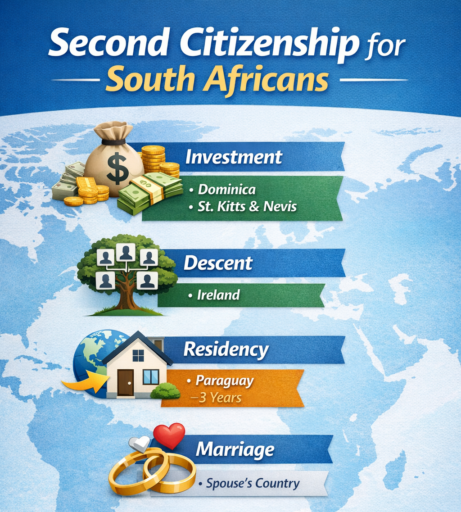
- Dominica – Citizenship-by-investment in a few months with no residency requirement.
- San Cristóbal y Nieves – Quick citizenship through investment; families included.
- Paraguay – Citizenship after 3 years of permanent residency.
- Uruguay – Citizenship after 3–5 years of legal residency.
- Irlanda – Citizenship through descent via the Foreign Births Register, no residency required.
For those specifically seeking low-cost investment options, emerging programs in São Tomé and Príncipe, Nauru, y Vanuatu provide affordable citizenship, but they often offer fewer visa-free travel benefits than the countries listed above.
Do dual citizens have to pay taxes in both countries?
Dual citizens are potentially liable for taxes in both countries, but tax treaties and exemptions often prevent doble imposición.
- South Africans must report worldwide income, though treaties with other countries can reduce or eliminate double taxation.
- Dual citizens often use legal tax planning strategies to ensure the same income is not taxed twice.
- Consulting a tax advisor is essential to understand all liabilities in both countries.
Being aware of these obligations prevents penalties and ensures full compliance with international tax rules
What are the disadvantages of having a dual passport?
For South Africans, holding dual citizenship can create financial, legal, and practical challenges that require careful planning and awareness.
- Tax obligations – Dual citizens may need to report income and pay taxes in both countries, depending on local laws. Failure to comply with either jurisdiction can result in penalties or interest charges. Proper planning with a tax advisor is essential to avoid double taxation.
- Servicio militar – Some countries require compulsory military service for citizens, including dual nationals. This can create obligations or conflicts if both countries enforce service requirements simultaneously.
- Legal complications – Dual citizens must obey the laws of both countries, which can lead to complex legal situations, especially if laws conflict. Issues can arise in areas like inheritance, propiedad, or civil liability.
- Diplomatic issues – Traveling on a dual passport may sometimes cause complications if the two countries have strained relations. Additionally, dual citizens may face restrictions in government jobs, visas, or diplomatic protections abroad.
Conclusión
Acquiring a second citizenship is not just a legal process; it is a strategic tool that shapes your long-term options and resilience.
South Africans should evaluate each opportunity not only for speed or cost but for how it fits into personal, professional, and family plans over decades.
Careful planning around residency, taxes, and legal obligations is essential to avoid pitfalls that can undermine the value of dual citizenship.
In the end, the most successful approach is deliberate and forward-looking, choosing a path that strengthens your global position while maintaining clarity, security, and flexibility for the future.
Preguntas frecuentes
Can a South African citizen hold 3 citizenship from another country?
Yes, a South African can hold three or more citizenships, provided the other countries allow it.
South African law no longer automatically revokes citizenship for acquiring additional nationalities, but you must comply with the rules of each country involved.
What contributes to a strong passport?
A strong passport provides wide visa-free access, global recognition, and reliable international protection.
Political stability and minimal travel restrictions also increase its practical value for global mobility.
What are the 5 strongest passports?
Typically, Japan, Singapore, Germany, South Korea, and Italy are considered the strongest passports in terms of visa-free travel, offering holders access to around 170 to 180+ countries without a visa or with visa-on-arrival.
Which passport is the weakest?
Afghanistan and Iraq are some of the weakest passports, offering very limited visa-free access.
Citizens of these countries face strict visa requirements and can travel to only a small number of destinations without prior approval.
¿Le duele la indecisión financiera?

Adam es un autor reconocido internacionalmente en temas financieros, con más de 830 millones de respuestas en Quora, un libro muy vendido en Amazon y colaborador de Forbes.