The retirement visa in Mauritius, known officially as the Residence Permit for a Retired Non-Citizen, allows foreign nationals to live in the country long-term after retirement.
This permit provides a straightforward way for retirees to enjoy the island’s tropical lifestyle, favorable taxes, and modern amenities.
Este artículo trata:
- How long is a Mauritius visa valid?
- What are the requirements for a retirement visa in Mauritius?
- What is the cost of a Mauritius visa?
- How long does it take to get a retirement visa?
- What is it like to retire in Mauritius?
- What are the disadvantages of living in Mauritius?
Principales conclusiones:
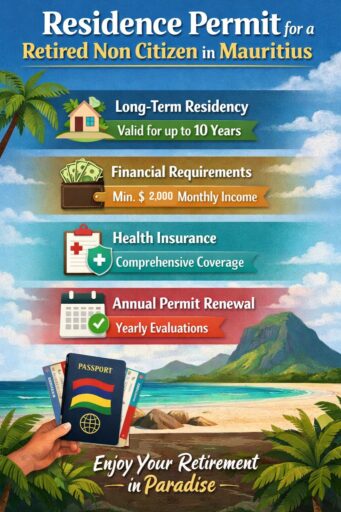
- The Non-Citizen Retired Permit can be issued for up to 10 years and is renewable with continued financial compliance.
- Applicants must be 50+, with proof of income, health coverage, and a clean police record.
- Comfortable retirement generally requires USD 2,000–3,000 per month or USD 100,000–150,000 in savings.
- Mauritius offers stability, modern healthcare, scenic beaches, and favorable tax treatment.
Mis datos de contacto son hello@adamfayed.com y WhatsApp +44-7393-450-837 si tiene alguna pregunta.
Para los visados de nómada digital o de residencia que requieran ingresos, activos o inversiones cualificadas, podemos ayudarle a estructurar soluciones de inversión adecuadas que puedan ajustarse a esos requisitos, en función de sus circunstancias.
La información contenida en este artículo es meramente orientativa, no constituye asesoramiento financiero, jurídico o fiscal y puede haber cambiado desde el momento de su redacción.

What is a retirement visa in Mauritius and how does it work?
Mauritius offers a retirement visa with an official name of Residence Permit for a Retired Non‑Citizen.
This permit is governed by Mauritius’s Immigration Act (specifically Section 9B), which allows a non‑citizen retiree to apply through the Board of Investment to the Passport and Immigration Office for long‑term residency as a retiree.
The retirement permit provides legal long-term residency, giving retirees the right to live in Mauritius, maintain a bank account, and invest in businesses without being employed.
It does not allow gainful employment, but retirees can hold investments or own a business provided they do not draw a salary or employment benefits.
The permit is typically issued for an initial period and can be renewed as long as the holder continues to meet the government’s conditions.
Este visado de jubilación has made Mauritius a popular option for long‑term retirement stays, offering a structured legal basis for retirees who want to live, and in some cases invest, in the country for an extended period.
Who is eligible for a retirement visa?
Applicants are eligible for a Mauritius retirement visa if they are a retired non-Mauritian citizen, at least 50 years old, and can demonstrate financial self-sufficiency.
The permit can be renewed provided the retiree continues to meet the financial and reporting criteria.
Eligible retirees must demonstrate financial self‑sufficiency by transferring around USD 2,000 (or equivalent) into a Mauritian bank account, equivalent to roughly USD 24,000 annually.
These annual transfers must be evidenced to the relevant authorities (such as the Economic Development Board) each year as part of the ongoing eligibility review.
The source of retirement income must be stable and verifiable, such as a pension or annuity, to support their living expenses in Mauritius.
Eligibility also requires compliance with legal and health standards, including having valid health insurance and a clean police record, to ensure long-term residency can be safely maintained.
How long is a Mauritius retirement visa valid?
The retirement visa in Mauritius is typically granted for up to 10 years on initial approval.
Renewals are available as long as the retiree continues to comply with the regulations set by the Mauritius government.
This long-term validity gives retirees the confidence to plan their lives, settle in, and integrate into the local community.
How to get a retirement visa for Mauritius?
To get a Residence Permit for a Retired Non-Citizen, applicants must apply through the Mauritius Passport and Immigration Office or an authorized agent.
Steps to apply:
1. Check eligibility – Ensure you are at least 50 years old and meet the minimum financial requirements for monthly or annual fund transfers.
2. Prepare documents – Gather your valid passport, proof of income or pensión, bank statements, seguro de enfermedad, and police clearance certificate.
3. Submit application – Apply online or through an authorized agent, providing all required documents and completing the official forms.
4. Pay fees – Include the application and processing fees as required by the Immigration Office.
5. Await approval – The authorities review your financial, legal, and health records before granting approval.
6. Receive the permit in Mauritius – After approval, you typically travel to Mauritius (or may already be there on a long-stay visa) to receive the residence permit, which is stamped or issued in your passport, allowing long-term residency.
What documents do I need for a Mauritius retirement visa?
One of the key documents for a retirement visa in Mauritius is proof of income or pension, such as pension statements, annuity certificates, bank statements showing regular pension deposits, or retirement fund statements, to confirm that the applicant can support themselves while living in the country.
Other important documents include a police clearance certificate, health insurance coverage, a valid passport, and a completed visa application form.
Ensuring that all documents are accurate, up to date, and officially translated into English or French, if necessary, helps streamline the application process and avoid delays.
Providing complete and properly prepared documents also increases the likelihood of a smooth approval.
How much is a retirement visa in Mauritius?
The cost of a retirement visa in Mauritius is typically in the range of about USD 1,000–1,500+ for government‑mandated fees and related charges.
In addition to the base government fee, applicants should budget for ancillary application costs such as passport translation/notarization, police clearance processing, and medical tests.
These can vary depending on your home country and how documents are prepared.
If you choose to work with an immigration agent or legal specialist, professional service fees can also add to your total cost.
Algunos immigration information portals note that, from December 2025, a non‑refundable USD 50 application fee applies to all residence and occupational permit applications (including retirement), which would be in addition to the standard permit cost.
Finally, although not a visa fee per se, retirees must also meet the financial transfer requirement (e.g., at least USD 2,000 per month or USD 24,000 per year into a Mauritian bank account) to qualify.
The costs related to establishing and operating that account should be factored into the overall retirement relocation budget.
How long does it take to get a Mauritius retirement visa?
Processing times for a retirement visa in Mauritius can vary, but applicants should generally expect the application to take around 4–8 weeks from submission to decision.
This time frame depends on how complete and accurate your supporting documents are, as incomplete applications can take longer to review or be returned for clarification.
Note that processing can be slightly longer if additional verification is needed or during peak periods at the Mauritius Passport and Immigration Office.
Because of this variation, many applicants start their process well before their planned move date to allow ample time for approval and any follow‑up requests.
What are the benefits of retirement visa in Mauritius?
A retirement visa in Mauritius, allows retirees to live long-term in the country while enjoying tax benefits on foreign pensions.
Otras ventajas adicionales son:
- Long-term stay – The visa permits residency for up to 10 years with renewal options, giving retirees stability and peace of mind.
- Beneficios fiscales – Many retirees benefit from a favorable tax environment where foreign source income that is not remitted to Mauritius is not taxed locally, and there’s no capital gains, inheritance, or wealth tax, while actual tax on repatriated pension income depends on residency status and tax treaties.
- Healthcare access – Retirees can utilize modern public and private healthcare facilities throughout Mauritius.
- Lifestyle and environment – Mauritius offers scenic beaches, a warm tropical climate, and a relaxed lifestyle ideal for retirement.
- Property ownership opportunities – Retirees may own property under certain approved schemes, such as real estate investment programs linked to the permit.
How much do I need to retire to Mauritius?
To retire comfortably in Mauritius, retirees need a monthly income of USD 2,000–3,000 or savings of around USD 100,000–150,000 to cover initial relocation and living expenses.
This estimate accounts for rent, utilities, groceries, transportation, health insurance, and leisure activities, though costs can vary depending on lifestyle and location.
Housing is usually the largest expense, with a comfortable two-bedroom apartment in popular expat areas costing roughly USD 800–1,600 per month, while inland or more modest locations are significantly cheaper.
Financial planners recommend having a savings buffer to cover unforeseen expenses, healthcare, or travel, ensuring a secure and enjoyable retirement.
Ultimately, the exact amount needed depends on personal preferences, but budgeting within this range provides a practical baseline for most retirees in Mauritius.
Is Mauritius a good country to retire in?
Yes, Mauritius is considered a good country to retire in due to its political stability, steady economic growth, and high quality of life.
The island’s tropical environment, clean beaches, and pleasant climate make it attractive for retirees seeking a relaxed lifestyle.
In addition, the country has a safe living environment with a relatively low crime rate, and a growing expat community that helps newcomers integrate smoothly.
Retirees also benefit from modern infrastructure, healthcare facilities, and convenient access to international travel, which together make Mauritius a practical and enjoyable retirement destination.
What are the challenges of living in Mauritius?
One of the main disadvantages of retiring in Mauritius is the higher cost of imported goods, which can make everyday items more expensive than in many other countries.
Otras consideraciones son:
- Bureaucratic delays – Processing times for visa applications, residency renewals, and official permits can sometimes be longer than expected, requiring careful planning.
- Limited public transport in rural areas – Outside major towns and cities, public transportation options are sparse, making a private vehicle almost essential for mobility.
- Tropical weather risks – The climate is hot and humid year-round, and Mauritius occasionally experiences cyclones, which can impact infrastructure and daily life.
Cultural Tips for Retirees in Mauritius
One important aspect of retiring in Mauritius is understanding and adapting to the local culture, which can make day-to-day life smoother and more enjoyable.
The island is multicultural, with influences from Creole, French, Indian, Chinese, and British traditions, so retirees should be prepared for a mix of languages, foods, and customs.
English and French are widely spoken, while Mauritian Creole is the local language used in everyday conversation, especially in smaller towns and rural areas.
Respecting local customs and social norms is essential, such as dressing modestly when visiting religious sites, greeting people politely, and observing traditional holidays and festivals.
Participating in community events and cultural activities, like local markets, music festivals, and culinary experiences, can help retirees integrate and form social connections.
Retirees should also be aware of public holidays and seasonal variations in business hours, as some services may be limited during major cultural or religious celebrations.
By understanding these cultural nuances, retirees can enjoy a richer, more harmonious experience while living in Mauritius and build meaningful relationships with locals and fellow expats alike.
Conclusión
Mauritius stands out as a retirement destination not just for its tropical scenery, but for the legal structure that allows long-term residency with clear financial thresholds and property opportunities.
Retirees who leverage the residence permit effectively can enjoy strategic tax advantages while still accessing quality healthcare and modern infrastructure.
Understanding local nuances from seasonal weather patterns to the multicultural social fabric, can significantly enhance daily life and long-term satisfaction.
For those willing to engage with the community and plan around the island’s practical realities, Mauritius offers a retirement experience that balances comfort, security, and unique cultural richness unlike many other destinations.
Preguntas frecuentes
How easy is it to retire to Mauritius?
Retiring to Mauritius is manageable for those who meet the minimum age and financial requirements and submit all required documents accurately.
Careful preparation of finances, health records, and legal paperwork ensures a smoother application and quicker approval process.
How much money do you need to immigrate to Mauritius?
Immigrants generally need sufficient funds to support themselves, which typically ranges from USD 2,000–3,000 per month or USD 100,000–150,000 in savings, based on lifestyle and relocation costs.
Is Mauritius safe to retire?
Yes, Mauritius is considered a safe country for retirees, with low violent crime rates, a friendly expat community, and political stability.
Which is better, Bali or Mauritius?
Mauritius is generally better for long-term residency due to its political stability, quality healthcare, and structured retirement visa options, while Bali, Indonesia offers lower living costs but comes with stricter visa limitations and more limited healthcare services.
Both destinations are attractive, but the choice depends on whether stability and legal clarity or affordability and lifestyle flexibility are your priority.
¿Le duele la indecisión financiera?

Adam es un autor reconocido internacionalmente en temas financieros, con más de 830 millones de respuestas en Quora, un libro muy vendido en Amazon y colaborador de Forbes.