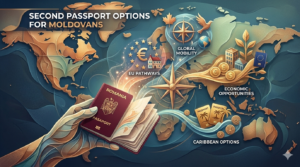
A second passport for Moldovan citizens refers to obtaining citizenship outside Moldova, commonly in countries like Romania, Italy, Portugal, or other EU and mobility-focused destinations to improve travel freedom and economic opportunity.
It is typically pursued through ancestry, residency, or naturalization pathways that expand access beyond Moldova’s limited passport strength.
Este artículo trata:
- Does Moldova accept dual citizenship?
- Why are so many people leaving Moldova?
- What is the best second passport to have?
- How strong is a Moldovan passport?
- What are the advantages and disadvantages of dual citizenship?
Principales conclusiones:
- Moldova permits multiple citizenships, enabling legal second passports.
- Romania is the most strategic and accessible EU option for Moldovans.
- Migration of Moldovans is driven mainly by wages, work access, and EU mobility.
- Dual citizenship increases global access but can create legal complexity for Moldovans.
Mis datos de contacto son hello@adamfayed.com y WhatsApp +44-7393-450-837 si tiene alguna pregunta.
Para los visados de nómada digital o de residencia que requieran ingresos, activos o inversiones cualificadas, podemos ayudarle a estructurar soluciones de inversión adecuadas que puedan ajustarse a esos requisitos, en función de sus circunstancias.
La información contenida en este artículo es meramente orientativa. No constituye asesoramiento financiero, jurídico o fiscal, ni una recomendación o solicitud de inversión. Algunos hechos pueden haber cambiado desde el momento de su redacción.

Does Moldova allow multiple citizenships?
Yes, Moldova allows multiple citizenships under its nationality framework, meaning Moldovan citizens can legally hold more than one passport without automatically losing their original citizenship.
This is governed by Moldova’s citizenship legislation, which generally permits dual nationality through birth, descent, marriage, or naturalization abroad, and does not require automatic renunciation of Moldovan citizenship in most cases.
However, acceptance of doble nacionalidad is also influenced by the second country’s regulations, since not all states recognize or permit multiple nationalities in the same way.
This flexibility has made dual citizenship a common long-term strategy for mobility and economic opportunity among Moldovans.
Which country is best for a second passport for Moldovans?
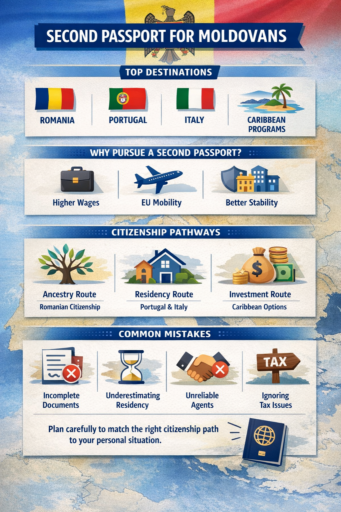
The most practical option for a second passport for Moldova includes Romania, Portugal, Italy, and select Caribbean citizenship-by-investment programs, each aligned with different goals such as EU freedom of movement, ancestry-based citizenship eligibility, long-term residency pathways, or rapid global mobility access.
- Route: Citizenship by ancestry (restoration)
- Minimum investment: None (administrative/legal fees only)
- Time required: ~6 months – 2 years (varies by case)
- Key requirement: Proof of Romanian ancestry or historical linkage
Why it’s ideal for Moldovans:
- Shared language and cultural ties make integration easier
- Fastest and most accessible EU citizenship route for eligible applicants
- Grants full EU freedom of movement, work, and residency rights
- Strong diaspora presence already established in Romania
Portugal
- Route: Residency → Naturalization
- Minimum investment: None required (residency-based; optional investment via Visado de oro routes exist but are no longer real estate-driven in the same way)
- Time required: ~5 years legal residency
- Key requirement: Legal residence and basic integration (language A2 level)
Why it’s ideal for Moldovans:
- One of the most stable EU naturalization frameworks
- Flexible residency system with relatively low stay requirements
- Strong labor mobility within Western Europe after citizenship
- Attractive for long-term relocation and family settlement
- Route: Naturalization (residency) or ancestry in limited cases
- Minimum investment: Ninguno
- Time required: ~10 years legal residency (standard naturalization)
- Key requirement: Continuous legal residence, language proficiency (B1)
Why it’s ideal for Moldovans:
- One of the largest Moldovan diaspora communities in Europe
- Strong employment opportunities in caregiving, services, and construction
- Existing social networks significantly ease integration
- Familiar migration destination for long-term workers
Caribbean Citizenship-by-Investment Programs
- Countries: Dominica, San Cristóbal y Nieves, Granada, Antigua y Barbuda, Santa Lucía
- Route: Direct citizenship through investment
- Minimum investment: ~USD 200,000–250,000+ (depending on country and family size)
- Time required: ~3–6 months
- Key requirement: Financial contribution or approved investment
Why it’s ideal for Moldovans:
- Fastest route to a second passport globally
- Visa-free access to multiple countries, including Schengen short stays (policy-dependent)
- No residency requirement in most programs
- Useful for business diversification and travel flexibility outside the EU system
Where do Moldovans immigrate to?
Moldovans primarily immigrate to European Union countries, with the largest flows going to Romania, Italy, Germany, Spain, France, and the United Kingdom.
Romania remains the top destination due to shared language and eligibility for citizenship through ancestry, making it one of the easiest routes into the EU labor market.
Italy also hosts one of the largest Moldovan communities, with estimates often ranging from over 100,000 to several hundred thousand residents, largely concentrated in northern regions and working in caregiving, construction, and service sectors.
Overall, migration patterns are strongly shaped by EU wage differences and labor demand.
For example, studies show that Italy alone accounts for a major share of Moldovan diaspora, while Romania represents roughly 40% of Moldova-born migrants within the EU due to legal and cultural proximity.
In total, estimates suggest that several hundred thousand Moldovans live abroad, and in some projections, the diaspora is around a million people when including long-term residents and workers across Europe.
Why do people leave Moldova?
People leave Moldova mainly due to economic migration pressures, with low wages and limited local job opportunities being the primary drivers.
Recent estimates from Logos Press suggest that over 30,000–40,000 Moldovans emigrate annually in search of work, and in some projections, more than a quarter of the population has experience living or working abroad.
A major pull factor is the significantly higher standard of living in the EU, especially in countries like Italy and Germany, where Moldovans can earn several times more than domestic salaries.
Rural areas are particularly affected, as much of the working-age population has relocated abroad or depends on remittances sent home, which account for a substantial share of household income and even a notable portion of GDP.
Beyond economics, migration is also driven by structural issues such as limited career progression, concerns about corruption, and long-term demographic decline.
Many young people leave for education or early career opportunities and often remain abroad due to better stability and prospects compared to the domestic market.
Overall, emigration is not a short-term trend but a sustained structural pattern shaped by income gaps, labor mobility within Europe, and long-standing development challenges.
Is Moldova’s passport strong?
The passport of Moldova is considered mid-tier in global strength, offering visa-free or visa-on-arrival access to around 120 destinations worldwide.
This includes parts of Europe, Asia, and Latin America, but it remains significantly less powerful than EU or North American passports.
Its main advantage is gradual improvement through EU alignment and visa liberalization policies, but it still ranks below most EU citizenship-based passports in terms of global mobility.
Passport Rankings Overview
| Index | Global Rank | Key Insight |
| Índice de pasaportes de Henley | 42nd | Mid-tier passport with moderate mobility, strongest access in Europe and parts of Asia |
| Índice de pasaportes de Arton Capital | 39th | Similar mid-tier positioning, slightly different scoring based on mobility freedom |
| Índice del Pasaporte Capitalista Nómada | 87th | Weaker overall due to taxation, perception, and global flexibility factors |
What is the advantage of dual citizenship?
Dual citizenship gives citizens of Moldova legal status in more than one country, allowing them to access rights, systems, and opportunities that are not available through a single nationality alone.
- Easier relocation between countries without long-term visa restrictions
- Ability to build careers in higher-income labor markets abroad
- Access to residency-linked benefits such as public healthcare and education systems
- Option to hold assets, open businesses, and manage finances across jurisdictions
- Increased resilience against political or economic instability in one country
For Moldovans, dual citizenship is often used as a structured pathway to EU integration and long-term mobility security rather than just travel convenience.
What are the downsides of dual citizenship?
Dual citizenship for citizens of Moldova can create legal and financial obligations across more than one jurisdiction, which adds complexity to long-term compliance and planning.
- Exposure to taxation rules from more than one country, depending on residency and tax treaties
- Increased administrative requirements for passports, residency registration, and legal documentation
- Possible compulsory military service obligations in certain countries
- Legal conflicts when national laws differ on issues such as inheritance, property ownership, or civic duties
- Restrictions or limitations on political participation in one or both countries
Most Common Mistakes When Applying for a Second Passport
Many applicants from Moldova face delays or refusals not because they are ineligible, but because of avoidable errors in documentation, planning, or route selection.
- Choosing the wrong eligibility pathway (for example, pursuing residency-based citizenship when ancestry-based options may be available)
- Submitting incomplete or inconsistently verified documents, especially birth and lineage records for EU ancestry claims
- Underestimating residency requirements, particularly in countries like Portugal or Italy where physical presence matters over time
- Relying on unofficial or unverified intermediaries, which can lead to incorrect filings or legal complications
- Ignoring tax residency implications after obtaining a second passport, which can create unexpected financial obligations
Most issues arise from poor preparation rather than strict legal barriers, making accurate route selection and proper documentation the most critical factors for success.
Conclusión
Second citizenship for Moldovans is primarily a response to structural economic and mobility constraints rather than a lifestyle choice.
It reflects a practical effort to access broader labor markets, stronger institutions, and more stable long-term opportunities.
The key reality is that outcomes are shaped less by destination country and more by eligibility profile.
Ancestry-based routes depend on documentation strength, residency pathways depend on time and integration capacity, and investment routes depend on financial readiness.
In reality, the most successful applications come from matching the route to what is realistically available, not what is most attractive on paper.
When that alignment is correct, second citizenship becomes a long-term mobility tool; when it is not, delays and complexity are far more likely.
Preguntas frecuentes
Is it hard to get Moldovan citizenship?
Getting Moldovan citizenship is generally straightforward if you are born in the country or have Moldovan parents.
Naturalization for foreigners is more difficult and typically requires long-term residency, language knowledge, and integration.
Why do so many Moldovans have Romanian citizenship?
Many Moldovans obtain Romanian citizenship because of historical and ancestral ties.
Large portions of the population qualify under Romania’s citizenship restoration laws, making it one of the easiest EU passports to obtain for Moldovans.
What is the new citizenship law in Moldova?
Recent updates to Moldovan citizenship regulations focus on clarifying dual citizenship rules, tightening naturalization procedures, and aligning with EU-related legal standards.
The core allowance for multiple citizenships remains unchanged.
Why do Moldovans move to Italy?
Moldovans move to Italy due to strong labor demand, especially in caregiving, construction, and service industries.
Italy also has one of the largest Moldovan diaspora communities, making integration easier through established social networks.
¿Le duele la indecisión financiera?

Adam es un autor reconocido internacionalmente en temas financieros, con más de 830 millones de respuestas en Quora, un libro muy vendido en Amazon y colaborador de Forbes.