A second passport for Costa Rica is most commonly pursued through Spain, Italy, Paraguay, Portugal, or Caribbean programs like Dominica to expand visa-free access and global mobility.
Costa Ricans can legally hold dual citizenship, making it straightforward to pursue a second nationality through descent, residency, or investment.
Esta guía cubre:
- Why do people immigrate from Costa Rica?
- Where do Costa Ricans immigrate to?
- What is the best second passport to have?
- What is the easiest second citizenship to get?
- How strong is the Costa Rica passport?
- What are the advantages and disadvantages of dual citizenship?
Principales conclusiones:
- Costa Rica allows dual citizenship with no renunciation required.
- Spain offers one of the fastest routes for Costa Ricans (around 2 years residency).
- Citizenship by descent is the cheapest and quickest route if eligible.
- Caribbean programs are fastest overall for Costa Ricans, but require investment.
Mis datos de contacto son hello@adamfayed.com y WhatsApp +44-7393-450-837 si tiene alguna pregunta.
Para los visados de nómada digital o de residencia que requieran ingresos, activos o inversiones cualificadas, podemos ayudarle a estructurar soluciones de inversión adecuadas que puedan ajustarse a esos requisitos, en función de sus circunstancias.
La información contenida en este artículo es meramente orientativa. No constituye asesoramiento financiero, jurídico o fiscal, ni una recomendación o solicitud de inversión. Algunos hechos pueden haber cambiado desde el momento de su redacción.

Can I have dual citizenship in Costa Rica?
Yes. Costa Rica fully allows doble nacionalidad, meaning you do not need to renounce your Costa Rican nationality when acquiring another.
This makes it easier to:
- Pursue naturalization abroad
- Obtain citizenship by descent
- Invest in citizenship-by-investment programs
There are no major restrictions on holding multiple passports under Costa Rican law.
Why are so many people leaving Costa Rica?
More Costa Ricans are leaving primarily due to rising living costs, limited wage growth, and unequal economic benefits despite overall national growth.
Recent developments like surging housing prices driven by tourism and inversión extranjera, along with pressure on key industries such as coffee, are making it harder for locals to maintain living standards.
While Costa Rica remains stable and attractive, some citizens choose to leave due to:
- Rising cost of living, especially housing in high-demand areas
- Limited high-paying job opportunities despite economic growth
- Desire for broader international exposure
- Access to stronger economies or education systems
This trend is not unique as many middle-income countries experience outward migration for opportunity-driven reasons, especially when economic gains are unevenly distributed.
Where do Costa Ricans migrate to?
Most Costa Ricans migrate to the United States, which hosts the largest diaspora (around 180,000 people of Costa Rican origin as of 2021 according to Pew Research Center), followed by smaller but growing communities in Spain, Canada, and nearby Panama.
Recent Datos de la OCDE also shows that about 63% of Costa Rican emigrants to developed (OECD) countries go to the United States, reinforcing its dominance as the primary destination.
Overall, roughly 150,000+ Costa Ricans (about 3% of the population) live abroad, with the majority concentrated in the US, followed by regional destinations like Panama and other parts of Latin America.
Costa Ricans typically migrate to countries with stronger labor markets or existing diaspora communities.
Spain is especially popular due to language, cultural familiarity, and the fast-track citizenship option available to Latin Americans (typically around two years of residency).
Which country is best for a second passport?
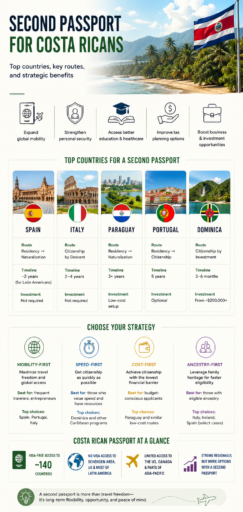
Some of the most viable Costa Rica second passport options include Spain, Italy, Paraguay, Portugal, and Dominica, offering a mix of fast-track EU access, low-cost residency pathways, and quick citizenship-by-investment options.
- Route: Residency → naturalization
- Key requirement: Legal residency; Latin Americans qualify for fast-track
- Inversión: Not required (standard residency routes available)
- Calendario: 2 years residency + processing
- Why it stands out: Fastest EU citizenship route for Costa Ricans, plus full EU rights and cultural/language alignment
- Route: Citizenship by descent (jure sanguinis)
- Key requirement: Proof of Italian ancestry (no generational limit if uninterrupted)
- Inversión: No capital investment required; only administrative, legal, and document-related costs
- Calendario: 2–4 years depending on processing
- Why it stands out: Uno de los strongest passports globally with no residency requirement if eligible
- Route: Residency → naturalization
- Key requirement: Maintain ties and physical presence in the country
- Inversión: Low-cost residency setup (no major capital required)
- Calendario: 3+ years (practical timelines may vary)
- Why it stands out: One of the most affordable pathways with a territorial tax system
- Route: Residency → citizenship
- Key requirement: Maintain legal residency status (e.g., visa programs)
- Inversión: Optional (investment visas available but not required)
- Calendario: 5 años
- Why it stands out: Strong EU passport with relatively flexible residency requirements compared to other EU countries
- Route: Citizenship by investment (CBI)
- Key requirement: Government donation or approved investment
- Inversión: Typically from ~$200,000+
- Calendario: 3-6 meses
- Why it stands out: One of the fastest and most affordable CBI programs for immediate second citizenship for Costa Rica
- Route: Naturalization or skilled work residency
- Key requirement: Long-term residence + integration (language, employment)
- Calendario: 5 años
- Why it stands out: Strong economy and high-quality public services
- Route: Residency → naturalization
- Key requirement: Continuous legal residence
- Calendario: 5 años
- Why it stands out: Geographic proximity and easier cultural integration
¿Cuál es el segundo pasaporte más fácil de obtener?
The easiest second passports for Costa Ricans are typically from countries like Italy or Ireland (citizenship by descent), Dominica and other Caribbean states (citizenship by investment), and residency-based routes in Spain or Portugal.
These jurisdictions minimize barriers such as language, residency length, or upfront qualification complexity.
- Citizenship by descent (Italy, Irlanda)
- Why easy: No relocation or investment if eligible
- Requirement: Proof of ancestry
- Calendario: 2–4 years processing
- Standout: Fastest if you qualify
- Citizenship by investment (Dominica, others)
- Why easy: No residency or language rules
- Requirement: Donation or investment as low as US$200,000
- Calendario: 3-6 meses
- Standout: Fastest guaranteed route
- Residency-to-citizenship (Spain, Portugal)
- Why easy: Low physical stay vs most EU countries
- Requirement: Legal residency maintained
- Calendario: Spain 2 years (Latin Americans), Portugal 5 years
- Standout: Strong EU citizenship outcomes
- Low-cost residency pathways (Paraguay)
- Why easy: Simple setup and low financial barrier
- Requirement: Basic residency compliance
- Calendario: Several years to citizenship
- Standout: Cheapest entry route
Is Costa Rica a strong passport?
The Costa Rican passport is a moderately strong global passport, offering visa-free or visa-on-arrival access to around 140 countries, including the Schengen Area, the UK, and most of Latin America.
| Index | Ranking | Key insights |
| Índice de pasaportes de Henley | 24th | Strong regional mobility, but limited access to major economies like the US and Canada |
| Índice de pasaportes de Arton Capital | 23rd | Higher score due to broader visa-on-arrival weighting and Latin America access |
| Índice del Pasaporte Capitalista Nómada | 54th | Penalized for tax structure, global taxation exposure, and limited investment mobility options |
The Costa Rican passport is considered strong in Latin America and parts of Europe, but less powerful in North America and Asia-Pacific compared to top-tier EU or North American passports.
However, it has limitations:
- No visa-free access to the United States
- Limited long-term residency pathways in Europe
- Fewer work and investment mobility privileges compared to EU passports
This is why some Costa Ricans explore second citizenships to expand travel freedom, business access, and global flexibility.
Why is it good to have two passports in Costa Rica?
Having two passports improves global mobility, financial flexibility, and long-term security by giving access to multiple countries’ travel rights, residency options, and legal protections.
Entre sus principales ventajas figuran:
- Expanded visa-free travel, with strong access across Latin America and parts of Europe
- Residency stability in one of Central America’s most politically stable jurisdictions
- Access to Costa Rica’s reputable healthcare system and pensionado-friendly policies
- A strategic base for US-adjacent business and lifestyle planning
It is also advisable to seek guidance from a qualified financial advisor in Costa Rica to understand tax and compliance implications of holding multiple citizenships.
Potential drawbacks to consider:
- Tax reporting complexity in some countries with citizenship-based taxation rules
- Legal and compliance obligations in both countries (filing, disclosures, military/service rules in rare cases)
- Renunciation risk in restrictive countries that do not allow dual citizenship
- Higher administrative costs for maintaining multiple passports and legal statuses
For globally mobile professionals or families, a second passport is both a strategic asset and a long-term contingency tool, but it also requires ongoing compliance management.
How to Choose the Right Second Passport Strategy
Choosing the right second passport strategy comes down to matching your goals with the most realistic legal pathway.
Costa Ricans typically fall into four main profiles: mobility-focused, speed-focused, cost-conscious, or ancestry-eligible applicants.
1. Mobility-first strategy (maximize travel freedom)
Best for: frequent travelers, entrepreneurs, and remote professionals
- Target countries: Spain, Portugal, Italy
- Focus: EU citizenship and Schengen mobility
2. Speed-first strategy (fastest route to citizenship)
Best for: applicants prioritizing time and who have the financial resources to cover the required investment
- Target countries: Dominica and other Caribbean citizenship-by-investment programs
- Focus: citizenship by investment (CBI)
3. Cost-first strategy (lowest financial barrier)
Best for: applicants focused on affordability
- Target countries: Paraguay and similar low-cost residency pathways
- Focus: residency-to-citizenship routes with minimal upfront cost
4. Ancestry-first strategy (fastest if eligible)
Best for: applicants with European or foreign lineage
- Target countries: Italy, Ireland, and select cases in Spain
- Focus: citizenship by descent
Many applicants use a hybrid approach such as securing ciudadanía por descendencia while also building a residency-based backup plan, to maximize long-term flexibility and reduce reliance on a single pathway.
Conclusión
Second citizenship for Costa Ricans is ultimately a structuring decision around mobility, access, and legal flexibility.
The strongest outcomes come from aligning eligibility, time horizon, and available resources with the right jurisdictional pathway, whether that is EU residency routes, ancestry-based citizenship, or investment programs.
Faster routes typically require capital, lower-cost routes require time, and ancestry routes depend entirely on documentation strength.
Spain and Portugal remain central for long-term EU access, Caribbean programs for speed, and Italy and Ireland for eligibility-based opportunities.
A well-designed approach often combines pathways to avoid over-reliance on a single jurisdiction and to preserve optionality as immigration rules, tax regimes, and mobility agreements continue to evolve globally.
Preguntas frecuentes
How to get a second passport as a Costa Rican?
A second passport as a Costa Rican is typically obtained through citizenship by descent, long-term residency leading to naturalization, or citizenship by investment programs in select countries.
Do you have to have your passport on you at all times in Costa Rica?
No, but you are required to carry valid identification.
For tourists, this typically means a passport, while residents can carry a national ID card.
Is Costa Rica a 2nd or 3rd world country?
Costa Rica is not classified as a 2nd or 3rd world country; it is generally considered a stable developing nation with strong democratic institutions and a relatively high quality of life in Latin America.
Where do most immigrants in Costa Rica come from?
Most immigrants in Costa Rica come from nearby countries, mainly Nicaragua, followed by Colombia and Venezuela.
This is driven by regional proximity, shared language, and Costa Rica’s relative economic and political stability.
¿Le duele la indecisión financiera?

Adam es un autor reconocido internacionalmente en temas financieros, con más de 830 millones de respuestas en Quora, un libro muy vendido en Amazon y colaborador de Forbes.