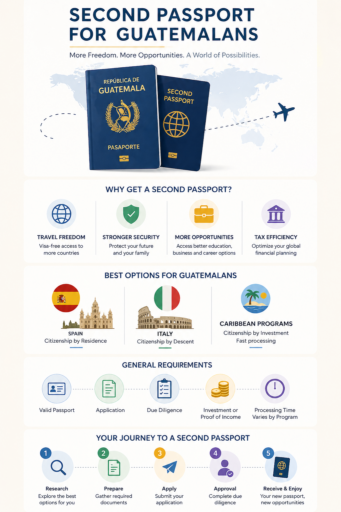
A second passport for Guatemalan citizens is most commonly obtained through Spain (fast-track naturalization), Italy (citizenship by descent), or Dominica (citizenship by investment), all while typically keeping Guatemalan nationality.
The right path is based on your timeline, budget, and whether your priority is faster processing, stronger visa access, or long-term relocation.
Este artículo trata:
- Does Guatemala offer dual citizenship?
- What is the best second passport for Guatemalans?
- Which is the easiest second passport to get?
- Where do most Guatemalan immigrants go?
- How powerful is the Guatemalan passport?
- What are the advantages and disadvantages of dual citizenship?
Principales conclusiones:
- Dual citizenship is allowed in Guatemala, but obligations may overlap.
- Spain offers one of the fastest naturalization routes for Guatemalans.
- Investment programs are fastest for Guatemala second passport, but require significant capital.
- A second citizenship for Guatemala improves mobility, but adds legal and tax complexity.
Mis datos de contacto son hello@adamfayed.com y WhatsApp +44-7393-450-837 si tiene alguna pregunta.
Para los visados de nómada digital o de residencia que requieran ingresos, activos o inversiones cualificadas, podemos ayudarle a estructurar soluciones de inversión adecuadas que puedan ajustarse a esos requisitos, en función de sus circunstancias.
La información contenida en este artículo es meramente orientativa. No constituye asesoramiento financiero, jurídico o fiscal, ni una recomendación o solicitud de inversión. Algunos hechos pueden haber cambiado desde el momento de su redacción.

Does Guatemala allow multiple citizenships?
Yes, Guatemala allows dual or nacionalidad múltiple, meaning Guatemalans can generally acquire another nationality without automatically losing their Guatemalan citizenship.
There is no universal legal requirement to renounce your original nationality when obtaining a second passport for Guatemala, especially in cases of naturalization or citizenship by descent.
However, limitations can still arise.
Some countries you apply to may require renunciation of prior citizenship, and dual citizens must comply with legal and tax obligations in both countries.
In addition, how dual nationality is recognized can depend on treaties or reciprocity between Guatemala and the other country.
Which country is best for a second passport for Guatemalans?
The best second passport options for Guatemalan citizens are typically Spain (fast-track naturalization), Italy (citizenship by descent), Paraguay (residency pathway), and Dominica (citizenship by investment), each suited to different timelines and budgets.
- Route: Residency → naturalization
- Key requirement: Legal residency for 2 years (reduced timeline for Latin Americans, including Guatemalans)
- Inversión: Low to moderate (cost of living, visa type such as work, study, or non-lucrative visa)
- Calendario: 2 years of legal residency
- Why it’s ideal for Guatemalans: One of the fastest legal paths to an EU passport, with shared language and cultural familiarity
- Route: Citizenship by descent (jure sanguinis)
- Key requirement: Proof of Italian ancestry (no generational limit if uninterrupted line)
- Inversión: Low (documentation, legal assistance if needed)
- Calendario: 2-4 years processing
- Why it’s ideal for Guatemalans: No residency requirement if eligible, and grants full EU citizenship benefits
- Route: Residency → naturalization
- Key requirement: Obtain permanent residency and maintain ties to the country
- Inversión: Low (proof of economic solvency or modest deposit)
- Calendario: 3+ years to citizenship eligibility (can vary in practice)
- Why it’s ideal for Guatemalans: One of the more accessible and lower-cost residency pathways in Latin America
- Route: Ciudadanía por inversión
- Key requirement: Government-approved donation or real estate investment
- Inversión: Typically $200,000+ (donation route for a single applicant)
- Calendario: 3-6 meses
- Why it’s ideal for Guatemalans: Fastest way to obtain a second passport with improved visa-free access, no residency required
What is the easiest second citizenship for Guatemalans?
For Guatemalan citizens, the easiest second passports are typically Italy (no strict generational limit if lineage is unbroken), Spain (only 2 years of residency required for naturalization), and Dominica or Vanuatu (citizenship possible in 2–6 months with investment starting around $130,000).
These options stand out because they remove major barriers like long residency, high complexity, or excessive waiting periods.
However, easy comes with trade-offs. Some require proving ancestry over multiple generations, others require relocation and sustained residency, and investment-based options require significant upfront capital with no physical connection to the country.
Newer programs such as Nauru y Santo Tomé y Príncipe are emerging alternatives that are considered easy due to fast processing times (often around 2–6 months), low-to-mid investment thresholds, and minimal residency requirements, but remain less established globally.
Where do people from Guatemala migrate to?
Most Guatemalan migrants go to the United States, which hosts by far the largest share.
Según Migration Policy Institute, the United States has around 1.3 million Guatemalan immigrants as of 2023, while smaller but significant flows also go to nearby and culturally linked countries.
Guatemalan migrants tend to concentrate in a few key destinations:
- United States – the dominant destination due to jobs, established communities, and remittance networks
- Mexico – often a transit route, but also a destination for temporary or regional migration
- Spain – attractive due to language, cultural ties, and faster naturalization pathways
- Canada – accessed mainly through skilled worker and temporary labor programs
These migration patterns often shape second passport strategies, especially when residency in countries like Spain can eventually lead to citizenship.
Why do so many people leave Guatemala?
People leave Guatemala primarily due to limited persistent insecurity and worsening climate-related disruptions.
Guatemala has long experienced outward migration due to a mix of economic, social, and security-related factors:
- Limited job opportunities and wage growth
- Inestabilidad política and governance issues
- Safety concerns in certain regions, including violence and organized crime
- Climate-related pressures like droughts and crop failures affecting rural incomes
- Desire for better education and healthcare access
Recent developments reinforce these trends.
Climate shocks and failed harvests continue to push rural communities to migrate, while ongoing migration flows and deportation agreements with the United States highlight how persistent and large-scale this movement remains.
Is Guatemala a strong passport?
The Guatemala passport is a mid-tier travel document, offering visa-free or visa-on-arrival access to around 130 countries, but requiring visas for major destinations like the United States and Canada.
| Index | Ranking | Key Insight |
| Índice de pasaportes de Henley | 32nd | Measures visa-free travel access; Guatemala performs mid-tier due to solid regional access but weak entry into high-income countries |
| Índice de pasaportes de Arton Capital | 32nd | Uses a mobility score model; Guatemala ranks lower due to limited access to North America and parts of Asia |
| Índice del Pasaporte Capitalista Nómada | 78th | Broader scoring system (taxation, perception, dual citizenship, global freedom); Guatemala ranks lower due to weaker economic and tax advantages despite reasonable travel access |
What benefits do I get if I have dual citizenship?
Dual citizenship for Guatemalan citizens provides expanded travel flexibility, stronger residency options abroad, and access to better economic, education, and healthcare systems outside Guatemala.
Practical advantages include:
- Expanded visa-free travel, especially when paired with an EU or Caribbean passport
- Access to new job markets, particularly across the European Union and higher-income economies
- Residency stability abroad, giving a legal fallback option in another country during political or economic uncertainty
- Access to international education and healthcare systems, often with higher quality and broader coverage than domestic options
- Greater diversificación de activos and financial flexibility, including easier international banking and cross-border planning
For Guatemalans, combining their passport with a European or Caribbean citizenship can significantly widen global access and provide a strategic safety net for mobility and long-term planning.
What are the negatives of dual citizenship?
For citizens of Guatemala, holding dual citizenship can create additional compliance burdens that require ongoing management across two different national systems.
- Possible tax obligations in more than one country, depending on residency status and foreign income rules
- Mandatory legal duties in certain jurisdictions, such as military service or civic registration requirements
- More paperwork and ongoing administration, including renewals, reporting, and maintaining compliance in both states
- Differences in legal systems, which can create conflicts in areas like taxation, inheritance, or documentation recognition
In some situations, maintaining two passports can become more complex than beneficial if the legal and financial structure is not carefully planned.
How dual citizenship affects taxes for Guatemalans
For citizens of Guatemala, dual citizenship does not automatically trigger doble imposición, but it can increase reporting requirements and planificación fiscal complexity based on where you live, work, and earn income.
In more complex cases involving cross-border assets or relocation, working with a financial advisor in Guatemala can help structure obligations more efficiently.
Unlike citizenship-based taxation systems, most tax obligations for Guatemalans are tied to tax residency rather than nationality, meaning you are generally taxed based on where you physically reside and generate income, not simply by holding a second passport.
However, complications can still arise:
- Tax residency rules differ by country, so extended stays in places like the EU or the United States may shift your tax obligations
- Foreign income reporting requirements may apply in your second citizenship country
- Dual filing obligations can occur if you maintain assets, residency ties, or income sources in more than one country
- Mismatch between tax systems and treaties can sometimes create additional paperwork, even when double taxation is technically avoided
Conclusión
Guatemala second citizenship decisions increasingly function as a form of jurisdictional diversification, choosing not just a passport, but a different legal and economic environment to anchor future opportunities.
Across all available routes, the real differentiation is not only access speed or eligibility, but the type of global positioning each option creates.
EU-based pathways tend to embed long-term residence rights and labor mobility, while Caribbean and newer investment programs prioritize rapid international access without relocation.
At the same time, the value of a second passport is highly dependent on how it is used.
A document acquired without alignment to income structure, residency plans, or mobility needs often remains underutilized, while a well-matched one can significantly expand optionality in travel, work, and financial structuring.
In that sense, the most effective approach is not selecting the strongest passport in isolation, but identifying which jurisdiction best complements an individual’s future geographic and financial direction.
Preguntas frecuentes
Is it easy to get Guatemalan citizenship?
Not particularly. Naturalization in Guatemala typically requires around 5 years of legal residency, along with language proficiency and basic integration requirements.
Does Guatemala have birthright citizenship?
Yes. Guatemala follows jus soli, meaning most people born in the country automatically acquire citizenship.
What countries won’t allow dual citizenship?
Countries such as China and India generally do not permit dual citizenship, while Japan typically requires applicants to renounce other nationalities.
What is the most powerful citizenship to have?
Citizenships from countries such as UAE, Belgium, and Singapore are often considered the strongest due to their extensive visa-free travel access and high global mobility rankings.
¿Le duele la indecisión financiera?

Adam es un autor reconocido internacionalmente en temas financieros, con más de 830 millones de respuestas en Quora, un libro muy vendido en Amazon y colaborador de Forbes.