8 Best Semiconductor ETFs
Explore the best semiconductor ETFs and find reliable investment firms offering these funds.
Si tiene alguna pregunta o desea invertir como expatriado o particular con un elevado patrimonio neto, puede enviarme un correo electrónico (advice@adamfayed.com) o utilizar estas opciones de contacto.
Introducción
Over the past ten years, the best semiconductor ETFs have provided investors with excellent returns.
Although investing in the industry can occasionally be intimidating and uncertain, it can also be quite exciting because investors have not previously reported any sizable losses.
Instead of purchasing a large number of sporadic semi-stocks, you might want to consider purchasing an exchange-traded fund (ETF) that focuses on the semiconductor industry if you think you might want to diversifique su cartera with semiconductor power.
Global supply chain disruptions caused by the COVID-19 pandemic have primarily affected semiconductor firms and sectors that depend on microchips, such as the automotive and consumer electronics industries.
Over 300 downstream economic sectors, employing over 26 million Americans, are thought to depend on semiconductors as a critical input.
The top exchange-traded funds (ETFs) that offer an opportunity to invest in this sector, along with an overview of the broader industry dynamics, are listed below.
The SIA report claims that the Estados Unidos leads the world in chip design, with American semiconductor companies accounting for about 60% of all global fabless firm sales.
However, the U.S.’s manufacturing share of the world’s semiconductor production capacity is only 12%, a significant decrease from its 37% share in 1990.
These figures have come to light as a result of the shortage crisis, and the American government has begun to take action to better position itself for future demand.
The United States passed the Senate in June. The CHIPS for America Act is funded in part by the United States Innovation and Competition Act (USICA) with $52 billion. The initiatives taken by businesses in this industry have complimented this.
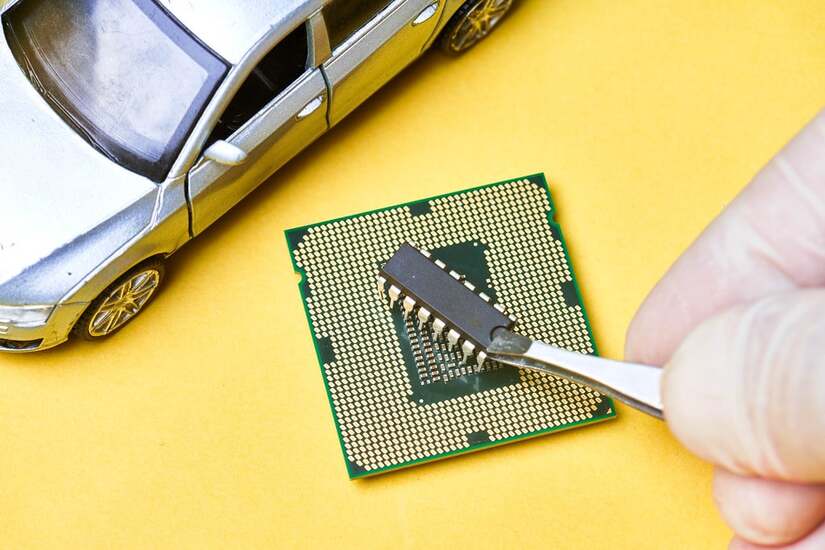
What Are Semiconductor ETFs?
An exchange-traded fund known as a “semiconductor ETF” makes investments in a group of stocks of businesses engaged in the manufacturing and selling of semiconductors.
They have two options: actively managing it or passively tracking an index’s performance in the semiconductor stock. In the same way that stocks can, semiconductor ETFs can trade whenever they want on the stock exchange.
Semiconductor ETFs are excellent long-term investments, and for most investors, even a modest allocation within a larger portfolio still makes sense.
After all, semiconductor chips are what drive computers, tablets, smartphones, cars, and other electronic devices. It’s difficult to imagine those disappearing any time soon.
Investors can choose from the best semiconductor ETFs, but it takes some intensive research to find out how they differ from one another. Most of these only own about 30 companies, and the semiconductor stock universe is quite small.
The top 10 holdings in market cap weighted ETFs account for about 60% of total assets. Even those with equal weights are still disproportionately top heavy.
The majority of these funds follow broad semiconductor stock indices, and as a result, they resemble one another somewhat. Splitting the hairs increases the importance of cost and tradeability.
On the other hand, stocks of companies that produce and design components like computer chips and other semiconductors are known as semiconductor stocks.
A pesar de la fact that they are a part of the technology sector, they are constantly evolving because of this sector’s rapid advancements.
8 Best Semiconductor ETFs
1. iShares PHLX Semi Semiconductor ETF (SOXX)
The iShares PHLX Semiconductor ETF (SOXX), a U.S.-focused fund that was established in 2001, offers exposure to businesses that develop, produce, and sell semiconductors. SOXX first followed the ICE Semiconductor Index in June 2021.
It had been following the PHLX Semiconductor Sector Index before this. With $9.02 billion in activos gestionados, it is the largest ETF in this industry. It keeps a portfolio of 30 stocks from the semiconductor and equipment industries.
En ETF has a 0.43% expense ratio and has generated returns of 38.61% so far this year.
The iShares Semiconductor ETF aims to follow an index made up of US-listed stocks. To spread out concentration and individual risk, it uses a modified market cap weighting methodology.
BlackRock Fund Prospectus pages have details on brokerage share funds. Before making a purchase, read all of the pages carefully.
Los siguientes companies are among the top ten holdings of this ETF, which together account for nearly 56.93% of the portfolio: Nvidia (NVDA), Intel (INTC), Texas Instruments (TXN), Applied Material (AMAT), Advanced Micro Devices (AMD), Qualcomm (QCOM), Marvell Technology (MRVL), Broadcom (AVGO), Xilinx (XLNX), and KLA (KLAC).
2. VanEck Vectors Semiconductor ETF (SMH)
The second-largest ETF in the sector in terms of assets under management is VanEck Vectors Semiconductor ETF (SMH).
The fund, which was established in 2011, follows the MVIS U.S. Listed Semiconductor 25 Index, a modified market capitalization-weighted index made up of the biggest and most liquid US-listed businesses engaged in the manufacture of semiconductors and related equipment.
The fund has a small 25-stock portfolio with a geographic exposure of 73.5% to the US, 14.8% to Taiwan, and almost 10% to the Países Bajos. En fund is currently managing $6.78 billion in assets at an expense ratio of 0.35%
The performance of the MVIS US Listed Semiconductor 25 Index (MVSMHTR) is closely mirrored by SMH. It is one of the biggest and most concentrated semiconductor ETFs, containing almost all of the businesses involved in the manufacture of semiconductors.
Year to date, it has generated returns of 37.5 %. An allocation of roughly 68% goes to the top stock holdings, which include companies like: Nvidia (NVDA), Micron Technology (MU), Taiwan Semiconductor (TSM), Qualcomm (QCOM), Broadcom (AVGO), Texas Instruments (TXN), ASML Holding (ASMLF), Analog Devices (ADI), Advanced Micro Devices (AMD), and Applied Materials (AMAT).

3. SPDR S&P Semiconductor ETF (XSD)
Since it is the only equally-weighted fund, the SPDR S&P Semiconductor ETF (XSD) has a greater level of diversification and may be the best option for the majority of investors. The majority of the ETFs on this list lack the mid- and small-cap companies that it includes.
The SPDR S&P Semiconductor ETF (XSD), which follows the S&P Semiconductors Select Industry Index, is the third-largest regular ETF in this market (after excluding leveraged and inverse ETFs).
The S&P Semiconductor Select Industry Index, a 40-stock equal-weighted index, is the benchmark that the ETF is intended to mimic. The ETF offers a non-concentrated industry exposure across large-, mid-, and small-cap semiconductor stocks.
With $1.47 billion in managed assets, the fund was established in 2006. The fund’s expense ratio is 0.35%, and its returns year to date are 42.69%.
There are about 41 holdings in XSD, which has an expense ratio of 0.35%. In contrast to other ETFs, its two largest holdings are First Solar and SunPower. It avoids holdings in large-cap companies that expose investors to businesses they might not otherwise consider.
The other stocks held by the fund, which is approximately 32.91% of them, are as follows: Advanced Micro Devices (AMD), Silicon Laboratories (SLAB), Nvidia (NVDA), Lattice Semiconductor (LSCC), Wolfspeed (WOLF), Ambarella (AMBA), Synaptics (SYNA), MaxLinear (MXL), and Xilinx (XLNX).
4. Invesco PHLX Semiconductor ETF (SOXQ)
Due to its potential to rank first in the future, the Invesco PHLX Semiconductor ETF (SOXQ) is an intriguing investment. Invesco Dynamic Semiconductors ETF (PSI), a 17-year-old fund with only about $500 million in assets, is already available from the company.
PSI has a slight disadvantage due to its relatively high expense ratio, but SOXQ overcomes it thanks to its 0.19% expense ratio, which is almost half that of the next closest ETF.
The SOXQ monitors the PHLX semiconductor sector index’s performance, as well as costs and the current prospectus gastos de gestión. Ninety percent of the fund’s total assets are placed in securities that are a part of the underlying index. The Nasdaq-established policies and procedures are followed by the ETF when making inversiones.
The modified market capitalization weighted index, which tracks the performance of 30 of the biggest American semiconductor companies, is followed by the ETF. As compared to its competitors, the SOXQ ETF lacks diversification.
Here are the top 10 sociedades holding in the Invesco PHLX Semiconductor ETF (SOXQ): MU (Micron Technology), ASML (ASML Holding NV – New York Shares), TXN (Texas Instruments), AMD (Advanced Micro Devices), NVDA (NVIDIA), ADI (Analog Devices), QCOM (Qualcom), NV NXPI (NXP Semiconductors), AVGO (Broadcom), and AMAT (Applied Materials).
5. Invesco Dynamic Semiconductors ETF (PSI)
Launched in 2005, the PSI ETF is a passively managed ETF. PSI has a size of $661.02 million in assets. It aims to perform at a level that is comparable to the Dynamic Semiconductor Intellidex Index.
It is intended to produce capital appreciation by assessing businesses according to their investment merit standards, which include stock valuation, fundamental growth, investment timelines, and stock valuation.
The portfolio of the ETF, which has 31 holdings, is more concentrated than those of its competitors. It is a high-risk opción de inversión with a three-year beta of 1.27 and a standard deviation of 37.39%.
Growth semiconductor stocks are the focus of the multicap fund PSI. The fund primarily holds small- and medium-cap U.S. stocks and tracks the Dynamic Semiconductors Intellidex Index.
AMAT (Applied Materials), AMD (Advanced Micro Devices), KLIC (Kulicke & Soffa Industries), TXN (Texas Instruments), INTC (Intel Corp), MU (Micron Technology), QCOM (Qualcomm), MPWR (Monolithic Power Systems), AVGO (Broadcom Inc), and LRCX (Lam Research) are the top 10 holdings of PSI.
6. Strive U.S. Semiconductor ETF (SHOC)
The most recent addition to this list, having debuted in October 2022, is the Strive U.S. Semiconductor ETF (SHOC). Its distinctive feature is that one of its goals includes a focus on corporate governance.
Strive’s website states that it ” aims to unlock value in the U.S. semiconductor sector by mandating companies to focus on profits over politics” “[t]hrough Corporate Governance practices, including voting proxy shares and proactively engaging with management teams and boards.”
This is an intriguing goal, and there is growing support for the idea that proxy voting should be more closely correlated with investor interests. Will it lead to improved performance? Will see.
7. AXS 1.25X NVDA Bear Daily ETF (NVDS)
One of the first single-stock ETFs to be introduced in 2022 is the AXS 1.25X NVDA Bear Daily ETF (NVDS). However, only the Tesla single stock ETFs appears to be making any progress.
It’s doubtful that this fund will last very long given that its assets are only $5 million. People looking for a simple way to short stocks or use leverage may find a use for this product.
8. First Trust Nasdaq Semiconductor ETF (FTXL)
Ninety percent of the ETF’s net assets are invested in stocks and depository receipts that make up the Nasdaq U.S. Smart Semiconductor Index TM, which the FTXL tracks.
The ETF is additionally intended to give exposure to US companies in the semiconductor sector that have been chosen based on their liquidity and weighted based on their cumulative score of various investing factors, such as value, volatility, and growth. It’s also important to remember that the ETF lacks diversification.
Los siguientes companies are among the top ten holdings of this ETF: SYNA (Synaptics), ADI (Analog Devices), KLAC (KLA Corp), AVGO (Broadcom), NXPI (NXP Semiconductors NV), MU (Micron Technology), TXN (Texas Instruments), ON (ON Semiconductor Corp), AMAT (Applied Materials), and AMKR (Amkor Technology).
How To Buy Semiconductor ETFs?
Similar to investing in any other ETF listed on the stock market, purchasing semiconductor ETFs is straightforward. Before you begin investing, keep in mind that there is a chance you could lose your initial investment. The various methods for purchasing a semiconductor ETF are as follows:
Use an Online Brokerage
You can buy and sell a variety of securities, including ETFs, through cuentas de corretaje. A brokerage account can be opened en línea.
Transaction fees, account minimums, and inactivity fees are typically absent from brokerage accounts. It resembles the procedure for abrir una cuenta bancaria.
Por abrir una cuenta with a Robo-advisor, you can hire someone to handle your trading if you don’t want to do it yourself. Robo-advisors will choose the best semiconductor ETFs for your portfolio when they create and manage your investment portfolio.
Place A Trade
A semiconductor ETF purchase is carried out in a manner akin to stock purchases.
You must go to the brokerage website where the stock is listed and choose “trade” if you want to trade semiconductors, which entails either buying or selling an ETF. An ETF’s ticker symbol is used to purchase it.
The trading of ETFs is simple and flexible. Expectations are for their market price to fluctuate. Investors may purchase ETFs and present them for redemption via a fund in Creation Unit Aggregation only even if ETF shares are not individually redeemable from the funds.
The effects of local and state taxes are not taken into account in the calculation of the after-tax returns, which are made in accordance with NAV and the highest federal marginal impuesto sobre la renta tarifas.
For investors who hold fund shares through tax-deferred vehicles like 401(K) plans and individual cuentas de jubilación, the after-tax reruns are irrelevant.
Reflexiones finales
Retail and institutional investors can gain extensive exposure to the semiconductor market in the USA and other nations through semiconductor ETFs.
En sociedades holding represented by the ETFs produce and sell microprocessors, memory chips, and integrated circuits.
Compared to a broad índice de mercado like the S&P 500, semiconductor stocks have shown excellent returns over the past ten years, but they also carry a higher market risk.
¿Le duele la indecisión financiera? ¿Quiere invertir con Adam?

Adam es un autor reconocido internacionalmente en temas financieros, con más de 830 millones de respuestas en Quora, un libro muy vendido en Amazon y colaborador de Forbes.