To set up a Marshall Islands company, you need to work with a registered agent, submit incorporation documents, and obtain approval from the Companies Registry.
The process is fast, offshore-friendly, and designed for non-resident business owners seeking tax efficiency and privacy.
Este artículo trata:
- What is the Marshall Islands business Act?
- How to register a company in Marshall Islands?
- How much does a Marshall Islands company formation cost?
- What are the benefits of registering a company in Marshall Islands?
Principales conclusiones:
- Non-resident companies in the Marshall Islands pay no corporate tax on foreign-sourced income.
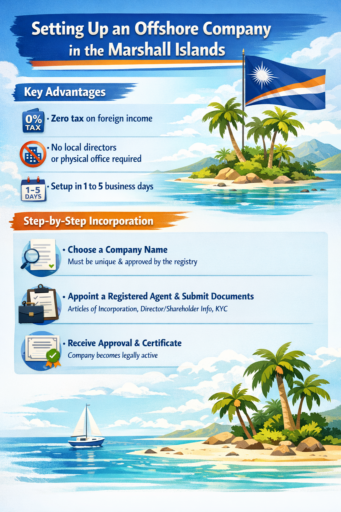
- Incorporation can typically be completed within 1 to 5 business days through a licensed agent.
- There is no requirement for local directors, shareholders, or a physical office.
- First-year setup and maintenance generally cost between $900 and $3,000.
Mis datos de contacto son hello@adamfayed.com y WhatsApp +44-7393-450-837 si tiene alguna pregunta. También ofrecemos soluciones de estructuración a medida adaptadas a su situación.
La información contenida en este artículo es meramente orientativa, no constituye asesoramiento financiero, jurídico o fiscal y puede haber cambiado desde el momento de su redacción.

What is the economy of the Marshall Islands?
En Republic of the Marshall Islands has a small, service-driven economy worth around $300 million in GDP, with services accounting for about 70% of total output.
Its economic structure is heavily influenced by external funding, particularly through agreements with the United States, which historically contributes a significant share of government revenue and public spending.
Key sectors include:
- Fishing and marine resources – a major export base supported by rich Pacific fisheries
- Agriculture (mainly copra production) – contributing nearly 20% of GDP
- Government services – the largest employer, accounting for over 30% of jobs
- Offshore financial services – including company registration and maritime operations
Despite its size and limited natural resources, the country has positioned itself as a specialized offshore hub, particularly for international business companies and ship registries, supported by its tax-neutral framework and streamlined incorporation system.
Why do companies register in Marshall Islands?
Companies register in the Marshall Islands primarily to benefit from tax neutrality, strong privacy protections, and a fast, low-maintenance incorporation process.
There are several strategic reasons why businesses choose this jurisdiction:
- Tax neutrality: Non-resident companies are not subject to corporate income tax on foreign-sourced income, allowing profits to be retained or reinvested more efficiently.
- Confidencialidad: Shareholder and director information is not publicly disclosed, providing a high level of privacy for business owners.
- Ease of setup: The incorporation process is streamlined and can typically be completed within a few business days through a registered agent.
- No local presence required: Directors, shareholders, and company operations can be entirely based outside the Marshall Islands, with no requirement for a physical office.
- Flexible corporate structures: Businesses can choose from structures like IBCs or LLCs with minimal reporting and compliance obligations.
This makes it especially attractive for:
- Holding companies: Ideal for owning shares, intellectual property, or other assets across multiple jurisdictions.
- Trading businesses: Suitable for international trading activities where transactions occur outside the Marshall Islands.
- Protección de activos structures: Commonly used to separate and protect personal or business assets from legal or financial risks.
What is the Marshall Islands companies Act?
The Marshall Islands Companies Act generally refers to the set of laws governing corporations in the jurisdiction, formally known as the Associations Law of the Republic of the Marshall Islands.
Rather than a single statute, this framework includes several key laws, most notably:
- Business Corporations Act (BCA) – governing International Business Companies (IBCs)
- Limited Liability Company (LLC) Act – governing LLC structures
- Partnership and related business laws
These laws are administered by the official corporate registry, operated by International Registries, Inc. (IRI).
Key features of the legal framework include:
- Limited liability protection: Shareholders are not personally liable for corporate debts or obligations.
- Flexible corporate structure: Companies can be structured with minimal restrictions on management and ownership.
- No local residency requirements: Directors, officers, and shareholders can be based anywhere globally.
- Minimal reporting obligations: There is no requirement to publicly file financial statements or disclose ownership details.
- Simplified compliance: Ongoing maintenance requirements are low compared to many onshore jurisdictions.
Modeled in part on Delaware corporate law, the framework provides a familiar and stable legal environment, which is a key reason the Marshall Islands remains a popular choice for offshore company formation.
How To Set Up Company in Marshall Islands
To set up a business in the Marshall Islands, you must engage a registered agent, submit the required incorporation documents, and obtain approval from the Companies Registry.
Setting up a Marshall Islands company is straightforward and typically handled entirely through a licensed intermediary.
Proceso paso a paso:
1. Elegir una estructura de empresa
Most foreign investors opt for an International Business Company (IBC) or LLC, depending on their operational and tax needs.
2. Select a company name
The name must be unique, not misleading, and approved by the registry before incorporation.
3. Appoint a registered agent
You are required to work with a licensed agent based in the Marshall Islands, who will act as the official point of contact and handle filings.
4. Prepare incorporation documents
Esto incluye:
-Articles of Incorporation
-Details of directors and shareholders
-Registered office address (provided by the agent)
As part of the requirements, you will also typically need to submit:
-Certified copies of passports for shareholders and directors
-Proof of address (e.g., utility bill or bank statement)
-Basic due diligence/KYC information as required by the agent
5. Submit the application
Your registered agent will file the documents with the Companies Registry and ensure compliance with local regulations.
6. Receive incorporation certificate
Once approved, the company is officially incorporated and can begin operations immediately.
How Much Does It Cost to Set Up a Company in Marshall Islands?
The total cost to start a company in the Marshall Islands ranges from about $900 to $3,000 USD for the first year, based on the service package and entity type chosen.
Typical costs include:
- Government registration fees, which can range from roughly $300–$650 USD for IBCs and similar amounts for LLCs.
- Registered agent and office fees, commonly $500–$900 USD or more per year.
- Professional service fees for document preparation, filing, and related compliance.
Estimated range (first‑year total):
- Basic setup: Approximately $900–$1,500 USD for a standard International Business Company (IBC).
- Full service package: $1,800–$2,800 USD including government fees, registered agent, and professional services.
Ongoing costs in subsequent years typically include:
- Annual maintenance/renewal fees: $900–$1,700 USD covering franchise tax, agent services, and substance reporting where applicable.
Additional services like nominee directors, nominee shareholders, cuenta bancaria setup assistance, or expedited processing can increase the overall cost.
How long will it take to set up a company?
Creating a company in the Marshall Islands typically takes 1 to 5 business days from submission to approval.
Standard processing usually falls within this range, while expedited services can complete incorporation in 24 to 48 hours.
Delays may occur if documentation is incomplete or if the registered agent requires additional verification for due diligence purposes.
Overall, the jurisdiction is known for its fast and efficient incorporation process, making it attractive for international business owners.
Banking and Financial Setup for Marshall Islands Companies
After incorporation, setting up banking and financial infrastructure is crucial for operating your Marshall Islands company effectively.
While the Marshall Islands itself does not have an extensive domestic banking system for non-residents, companies can open international corporate bank accounts in jurisdictions that accept offshore entities, such as Singapur, Hong Kong, or European financial hubs.
Key considerations include:
- KYC and due diligence: Banks require certified copies of passports, proof of address, and details of company directors and shareholders.
- Banking jurisdiction selection: Choose a country with strong banking privacy, stability, and services that match your business needs.
- Payment processing: Offshore companies often use multi-currency accounts or fintech solutions to handle global transactions efficiently.
- Compliance: Even with tax-neutral status, companies must comply with anti-money laundering rules and reporting obligations in the banking jurisdiction.
Proper banking setup ensures that your Marshall Islands company can operate globally with minimal friction, receive payments, and manage cash flow securely.
What is the Marshall Islands Companies Registry?
The Marshall Islands Companies Registry is the official authority that oversees all corporate activity in the jurisdiction.
It handles company incorporation, maintains corporate records, and ensures compliance with local laws.
Foreign applicants do not usually interact with the registry directly, as all filings must be submitted through a licensed registered agent.
This system allows the registry to efficiently manage offshore companies while maintaining legal and regulatory standards.
Is the Marshall Islands a tax haven?
Yes. The Marshall Islands is considered a tax-neutral jurisdicción extraterritorial, offering significant tax benefits for non-resident companies.
Key tax features include:
- No corporate income tax on foreign-sourced income, allowing companies to retain profits without local taxation.
- No capital gains tax, so asset sales and investments outside the country are not taxed locally.
- No withholding taxes, enabling smooth cross-border payments to shareholders and foreign entities.
- No VAT or sales tax, reducing the administrative burden on offshore operations.
However, companies must still comply with international regulations, including:
- OECD transparency standards, which require disclosure of beneficial ownership to avoid illicit activity.
- Anti-money laundering rules, ensuring that companies meet global compliance obligations when conducting financial transactions.
This combination of low local taxation and compliance with global standards makes the Marshall Islands a popular choice for offshore business formation.
Choosing Between IBC and LLC Structures
When setting up a Marshall Islands company, you must choose between an International Business Company (IBC) or a Limited Liability Company (LLC), as the choice determines management structure, liability, and operational flexibility.
Both structures offer flexibility, limited liability, and offshore tax benefits, but they serve slightly different purposes.
Diferencias clave:
- Liability and management:
- IBCs are typically managed by directors and are suited for holding assets, investments, or international trading.
- LLCs provide more flexible management options and member-controlled operations.
- Use cases:
- IBCs are ideal for holding companies, international trading businesses, and structured financial operations.
- LLCs work well for smaller ventures, joint ventures, or businesses where members want direct management control.
- Cumplimiento e información:
- Both structures require minimal reporting to the Companies Registry, but LLCs can have simpler internal governance documentation.
Conclusión
The Marshall Islands offers a clear framework for non-resident businesses to operate with flexibility, limited liability, and tax neutrality.
Incorporation is straightforward, but the long-term advantages depend on strategic decisions, including selecting the appropriate company structure and establishing effective banking arrangements.
Maintaining compliance with both local and international regulations is essential to preserve the jurisdiction’s benefits and avoid potential legal or financial pitfalls.
For businesses seeking global reach, understanding these operational and regulatory nuances allows them to optimize efficiency, protect assets, and manage risk effectively.
Ultimately, a Marshall Islands company can serve as a versatile tool, but only when paired with careful planning and informed management.
Preguntas frecuentes
Can I become a citizen of Marshall Islands?
Yes, you can become a citizen of the Marshall Islands, but only through birth, descent, or rare naturalization.
Citizenship cannot be obtained through investment or company ownership.
Is Marshall Islands a rich or poor country?
The Marshall Islands is a developing country with limited natural resources and a small domestic economy.
Its economy relies heavily on external aid, primarily from the United States, to support government services and public spending.
Which country is the easiest to open an offshore company?
Countries like the Marshall Islands, British Virgin Islands, Seychelles, and Belice are known for fast and straightforward offshore company registration.
The easiest choice hinges on your priorities, such as tax treatment, privacy, and banking access.
How much is the minimum wage in Marshall Islands?
En national minimum wage in the Marshall Islands is approximately $4.50 USD per hour for government and private sector employees as of 2026.
¿Le duele la indecisión financiera?

Adam es un autor reconocido internacionalmente en temas financieros, con más de 830 millones de respuestas en Quora, un libro muy vendido en Amazon y colaborador de Forbes.