Setting up a company in the UAE involves choosing between a free zone or mainland structure, securing the appropriate license, registering your business, and completing visa and banking requirements.
The process varies based on ownership goals, target market, and budget.
Este artículo trata:
- How to open a company in UAE free zone?
- How to open mainland company in UAE?
- How much does it cost to set up a free zone company in UAE?
- Can a foreigner start a company in Dubai?
Principales conclusiones:
- Free zones offer 100% foreign ownership with simplified setup.
- Mainland companies can operate across the UAE and access local markets.
- Setup costs range from AED 5,750–40,000+ for free zones and AED 15,000–60,000+ for mainland companies.
- Foreigners can legally own and run businesses in most sectors, including many mainland activities.
Mis datos de contacto son hello@adamfayed.com y WhatsApp +44-7393-450-837 si tiene alguna pregunta. También ofrecemos soluciones de estructuración a medida adaptadas a su situación.
La información contenida en este artículo es meramente orientativa, no constituye asesoramiento financiero, jurídico o fiscal y puede haber cambiado desde el momento de su redacción.

What is a UAE company?
A UAE company is a legally registered business entity incorporated under the laws of the United Arab Emirates for commercial, professional, or industrial activities.
It must obtain a government-issued trade license and comply with federal and emirate-level regulations before operating.
Companies in the UAE can be established either in the mainland or within designated free zones, each with distinct legal frameworks, ownership rules, and licensing requirements.
Depending on the structure chosen, a UAE company may trade locally across the Emirates, operate internationally, or both.
UAE companies benefit from a business-friendly tax environment, strategic geographic access to global markets, and world-class infrastructure that supports regional and international growth.
Setting Up a Company in UAE Free Zone
Setting up a company in a UAE free zone means incorporating your business within a designated economic zone that allows 100% foreign ownership, zero corporate taxes (subject to applicable federal rules), and simplified business setup procedures.
To set up a company in a UAE free zone, the steps typically include:
- Selecting the right free zone for your business activity.
- Choosing a business structure (e.g., Free Zone Establishment, Free Zone Company).
- Applying for a trade license.
- Submitting necessary documents, such as passport copies, business plans, and proof of address.
- Leasing an office space or opting for a virtual office offered by the free zone.
- Opening a corporate bank account.
Free zones are ideal for businesses targeting international trade, IT services, consulting, e-commerce, and other specialized sectors.
What is the difference between free zone company and free zone establishment?
A free zone company has multiple shareholders, while a free zone establishment has only one shareholder.
The main distinction between the two structures lies in ownership composition and scalability.
A Free Zone Company (FZCO/FZ LLC) is formed by two or more shareholders and is suited for partnerships, joint ventures, or businesses planning to expand ownership over time.
It provides greater flexibility when bringing in additional investors, subject to the rules of the specific free zone.
A Free Zone Establishment (FZE) is incorporated with a single shareholder, either an individual or a corporate entity.
It is typically ideal for solo entrepreneurs, independent consultants, or small businesses that do not require shared ownership.
Both structures allow 100% foreign ownership and operate under the regulations of the chosen UAE free zone.
How to set up a mainland company in the UAE?
To open a mainland company in the UAE, you must register your business with the relevant emirate’s Department of Economic Development (DED) and obtain a mainland trade license that permits you to operate anywhere in the country.
Setting up a mainland company allows businesses to operate across the entire UAE without geographic restrictions.
The process involves:
1. Choose your legal structure: Decide the appropriate entity type, most commonly a Limited Liability Company (LLC), based on your business activity and ownership plans.
2. Confirm ownership requirements: Secure a UAE national as a local sponsor where required, noting that many sectors now allow 100% foreign ownership.
3. Obtain initial government approval: Apply for preliminary approval from the Department of Economic Development (DED) in the relevant emirate.
4. Register your business identity: Reserve the trade name and draft and notarize the Memorandum of Association.
5. Secure your license and office: Obtain the mainland trade license and complete office space registration to finalize incorporation.
Mainland companies are suitable for businesses targeting the local UAE market, retail operations, and government contracts.
How much does it cost to set up a company in the UAE?
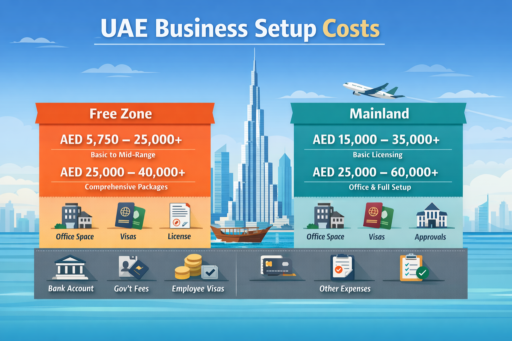
Starting a business in the UAE costs between AED 5,750 and AED 60,000 in the first year, covering free zone or mainland setups, office space, visas, and licensing requirements.
- Free zone company: AED 5,750 – AED 25,000+ for basic to mid-range setups, with more comprehensive packages reaching AED 25,000–AED 40,000+.
- Mainland company: AED 15,000 – AED 35,000+ for basic licensing and approvals, with total first-year costs often AED 25,000–AED 60,000+ including office, visas, and other requirements.
Additional costs may include corporate cuenta bancaria setup, visa processing, mandatory office space, and regulatory or government fees.
Can you own 100% of a company in the UAE?
Yes, foreigners can own 100% of a company in the UAE and legally start a business in most sectors. In free zones, full foreign ownership has long been permitted.
Recent legal reforms have also expanded 100% foreign ownership to many mainland business activities, significantly reducing the need for a local sponsor in most industries.
The UAE actively encourages foreign investment, allowing entrepreneurs of any nationality to establish companies either in free zones or on the mainland, subject to licensing requirements, regulatory approvals, and the chosen business activity.
What is the cheapest business to start in the UAE?
The cheapest businesses to start in the UAE are usually service‑based or online companies set up under budget free zone licenses, where entry‑level costs are far lower than mainland incorporation.
You don’t need large office space, and many free zones offer zero‑visa or flexi‑desk packages that help keep initial costs down.
Typical entry cost ranges:
- Zero‑visa trade licenses: from around AED 4,888 – AED 6,000+ for basic free zone packages (e.g., Ajman NuVentures, SRTIP, SHAMS).
- Basic free zone license: commonly AED 5,750 – AED 12,000+ per year depending on the free zone and activity.
- First‑year setup with one visa and flexi‑desk: often AED 15,000 – AED 30,000+ including licensing, office solutions, and visa costs in affordable zones.
Examples of affordable business types:
- Freelance consulting – Licenses from approximately AED 5,000–6,000+, ideal for professionals and advisors.
- E‑commerce trading – Can be incorporated with entry‑level free zone licenses starting around AED 5,000–8,000+.
- Digital marketing services – Fits within the lower end of free zone package pricing.
- IT services or software development – Budget form free zone setups often start around AED 7,500–12,000+.
These options are cost‑effective because many free zones allow virtual offices or flexi‑desk solutions, and you can defer visa costs until later if you don’t need immediate residencia.
Business Activity and Licensing Nuances in the UAE
The type of business activity determines the license required and the jurisdiction where a company can be established in the UAE.
Each emirate and free zone has specific regulations that dictate which activities are permitted, how licenses are classified, and the flexibility for expansion or diversificación.
Consideraciones clave
- Activity Determines License Type: UAE licenses are generally categorized as commercial, professional, industrial, or e‑commerce. For example, consultancy or IT services usually fall under a professional license, while trading requires a commercial license. The license type affects which free zones or mainland structures are eligible.
- Sector-Specific Restrictions: Certain industries, such as finance, healthcare, education, and legal services, are tightly regulated and may require additional approvals from relevant government authorities. Mainland incorporation is often necessary for activities requiring direct interaction with local clients or government contracts.
- Combination of Activities: Some free zones allow multiple activities under a single license, while mainland companies may require separate licenses for each distinct business activity. Choosing compatible activity combinations can reduce costs and simplify compliance.
- High-Demand Sectors with Licensing Ease: Startups often prioritize sectors with fewer regulatory hurdles and strong growth potential. Examples include e‑commerce, digital marketing, IT services, and consultancy, which are widely supported by free zones and offer flexible licensing.
- Future Scalability: The initial activity choice impacts future expansion opportunities. Selecting a license that accommodates additional activities or international operations can prevent the need for restructuring or re-licensing as the business grows.
Understanding these nuances ensures that the company structure aligns with the intended operations, compliance requirements, and long-term growth strategy, providing both operational flexibility and legal security.
Conclusión
Launching a business in the UAE involves both strategic planning and regulatory compliance.
The decision between a free zone and a mainland structure shapes market reach, partnership opportunities, and long-term scalability.
Free zones offer cost efficiency and full foreign ownership, while mainland companies provide direct access to local clients and government contracts.
Success in the UAE is determined by aligning the business structure with growth objectives and operational needs.
Careful selection of jurisdiction, license type, and ownership model establishes a fundación for sustainable growth, regional connectivity, and international expansion.
Preguntas frecuentes
What are free zones in the UAE?
Examples of free zones include Dubai Multi Commodities Centre (DMCC) for trade and fintech, Dubai Internet City (DIC) for IT and digital media, and Jebel Ali Free Zone (JAFZA) for logistics and manufacturing.
These are specific designated areas in the UAE with their own regulatory authorities, offering benefits like 100% foreign ownership and tax exemptions.
What is the richest job in the UAE?
Some of the highest-paying jobs in the UAE include CEO, investment banker, surgeon, and petroleum engineer, reflecting the country’s strong finance, healthcare, and oil sectors.
Is it expensive to live in UAE?
Living in the UAE can be expensive, particularly in Dubai and Abu Dhabi due to high rent and schooling costs.
Tax-free salaries and competitive wages often offset these expenses, making it manageable for many residents.
¿Le duele la indecisión financiera?

Adam es un autor reconocido internacionalmente en temas financieros, con más de 830 millones de respuestas en Quora, un libro muy vendido en Amazon y colaborador de Forbes.