Las perspectivas de inversión para el primer trimestre de 2026 abren un panorama de inversión turbulento pero lleno de oportunidades, en el que las decisiones estratégicas podrían marcar la diferencia entre fuertes ganancias y un potencial desaprovechado.
Los inversores se enfrentan a una combinación de oportunidades de crecimiento, volatilidad de los mercados y cambios en las tendencias mundiales.
Este artículo trata:
- ¿Cuáles son las perspectivas de mercado para el primer trimestre de 2026 en acciones, bonos y divisas?
- ¿En qué invertir en el primer trimestre de 2026?
- ¿Cuáles son las perspectivas de los mercados emergentes para 2026?
Principales conclusiones:
- Los mercados emergentes ofrecen un mayor recorrido al alza, mientras que los desarrollados ofrecen una estabilidad respaldada por las políticas.
- Los bonos ofrecen ingresos estables; la tecnología, la IA, la energía verde y la sanidad lideran el crecimiento.
- Las macrotendencias, los tipos de interés y la geopolítica determinarán las oportunidades y los riesgos.
- Diversificar entre mercados desarrollados y emergentes para equilibrar crecimiento y estabilidad.
Mis datos de contacto son hello@adamfayed.com y WhatsApp +44-7393-450-837 si tiene alguna pregunta.
La información contenida en este artículo es meramente orientativa. No constituye asesoramiento financiero, jurídico o fiscal, ni una recomendación o solicitud de inversión. Algunos hechos pueden haber cambiado desde el momento de su redacción.

¿Cuáles son las perspectivas de inversión para 2026?
En perspectivas de inversión para 2026 sugiere un fuerte potencial de crecimiento en algunos sectores como la tecnología y las energías renovables, mientras que se espera que los valores refugio tradicionales, como los bonos, ofrezcan rendimientos más conservadores.
Los inversores se enfrentan a un año de contrastes en 2026.
La volatilidad de los mercados sigue siendo una realidad, por lo que la diversificación es más importante que nunca.
¿Cuáles son las perspectivas de los mercados emergentes en 2026?
La previsión para mercados emergentes en 2026 es positiva pero muy diferenciada, con algunas economías posicionadas para obtener resultados significativamente superiores, mientras que otras se enfrentan a vientos estructurales en contra.
Se prevé que este mercado registre una sólida expansión del PIB en torno a los 3,9% en 2026, superando a los mercados desarrollados y reflejando una mayor actividad de consumo e inversión en regiones clave.
India, en particular, sigue destacando, con crecimiento sostenido por encima de 6% gracias a la expansión de la industria manufacturera, los servicios digitales y el aumento de las exportaciones.
El crecimiento de China se está moderando, pero sigue contribuyendo significativamente a los resultados regionales.
Los mercados de renta variable de las economías emergentes también están ganando tracción: los analistas de Goldman Sachs Esperamos que el índice MSCI Emerging Markets siga subiendo, respaldado por un crecimiento de los beneficios superior al de muchos países desarrollados.
Se prevé que los beneficios de las principales economías emergentes crezcan en torno a la decena, lo que subraya el impulso de los beneficios en la renta variable de los mercados emergentes.
Entre los motores estructurales del crecimiento figuran:
- Mayor crecimiento de los beneficios en los sectores tecnológico, de consumo discrecional y financiero.
- Perspectivas de relajación monetaria a medida que la inflación se estabiliza y los bancos centrales de algunos países se plantean recortes de tipos.
- Mejora de la calidad crediticia y atractivos rendimientos de carry en los mercados de renta fija y divisas.
- La diversificación del comercio y de la cadena de suministro impulsa las exportaciones más allá de los mercados tradicionales.
Dicho esto, los riesgos siguen siendo importantes para los resultados de 2026: los diferenciales de inflación, la volatilidad idiosincrásica de las divisas y las presiones geopolíticas podrían ralentizar el inversión flujos.
Además, las regiones con instituciones más débiles o dependientes de las exportaciones son más sensibles a los vientos contrarios mundiales.
En general, se espera que los mercados emergentes crezcan más deprisa que la mayoría de las economías avanzadas, impulsados por una sólida demanda interna, el crecimiento de los beneficios y unas tendencias políticas favorables.
Qué significa esto para los inversores:
Los mercados emergentes ofrecen un potencial de mayor crecimiento y diversificación, pero su éxito dependerá de una cuidadosa selección de países y sectores, haciendo hincapié en las economías que muestren marcos políticos estables, una fuerte demanda interna y reformas coherentes.
Perspectivas de inversión en los mercados desarrollados
Las perspectivas para los mercados desarrollados en el primer trimestre de 2026 son estables pero desiguales, con un crecimiento generalmente más lento que en las economías emergentes y unos rendimientos condicionados por los niveles de los tipos de interés, la dinámica de la inflación y el liderazgo sectorial.
Los inversores mundiales observan de cerca EE.UU., Europa y Japón, donde la estabilidad fiscal y los mercados de capitales maduros proporcionan anclajes defensivos, pero la expansión económica es más comedida.
Puntos clave para el primer trimestre de 2026:
- Estados Unidos: Se prevé un crecimiento del PIB de 2,4% en 2026, por encima de otras economías desarrolladas, aunque la fortaleza se concentra en unos pocos sectores, como la tecnología y los servicios, lo que hace que las ganancias generales sean desiguales.
- Europa: Se espera que el crecimiento de las economías europeas desarrolladas se sitúe en torno a 1,4% en 2026, respaldado por la estabilización de la demanda interna y los mercados laborales, mientras que los riesgos geopolíticos y los costes de la energía pueden crear oportunidades selectivas.
- Japón: Se prevé un crecimiento del PIB real de 0,7% en 2026, lo que refleja una demanda interna modesta y un comercio exterior débil, aunque ciertos sectores como la tecnología y las exportaciones ofrecen focos de potencial.
Posicionamiento en el mercado:
Los mercados desarrollados están registrando subidas moderadas de la renta variable, y es probable que los sectores vinculados a la inteligencia artificial, la automatización industrial y la atención sanitaria obtengan mejores resultados, mientras que las áreas defensivas, como los bienes de consumo básico y los servicios públicos, proporcionan estabilidad a los ingresos.
Los mercados de renta fija de estas regiones siguen ofreciendo rendimientos más elevados que en años anteriores, lo que favorece la construcción de carteras equilibradas.
Qué significa esto para los inversores:
Mientras que los mercados emergentes pueden ofrecer un mayor crecimiento, los mercados desarrollados proporcionan estabilidad, liquidez y previsibilidad política.
El 1T 2026 favorece la asignación selectiva, combinando renta variable en sectores estructuralmente fuertes con renta fija orientada a la renta, para gestionar el riesgo sin sacrificar la rentabilidad.
¿Cuáles son las tendencias recientes de los mercados financieros?
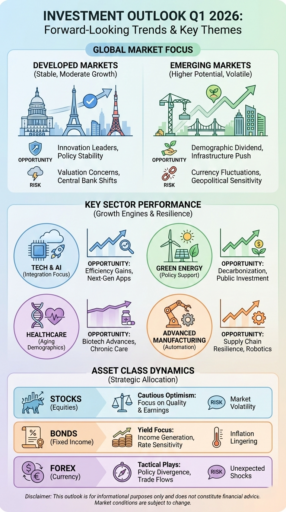
Tendencias recientes en los mercados financieros a principios de 2026 se definen por una concentración de la renta variable impulsada por la IA, unos tipos de interés estructuralmente más altos, una inversión sostenible más disciplinada y una mayor influencia geopolítica en los flujos de capital.
Estos cambios están modificando la forma en que los inversores distribuyen el capital. acciones, y activos alternativos.
Entre las principales tendencias que configurarán los mercados financieros a principios de 2026 figuran las siguientes:
- Concentración impulsada por la tecnología y la IA: La inteligencia artificial, la automatización y la infraestructura en la nube siguen impulsando el crecimiento de los beneficios, pero las ganancias se concentran en un grupo más reducido de empresas y sectores, lo que aumenta la dispersión del mercado.
- Recalibración de los tipos de interés, no ciclos de relajación: Los bancos centrales están manteniendo los tipos en niveles estructurales más elevados, reajustando las expectativas de la renta fija y variable y dando mayor importancia a los ingresos y a la solidez de los balances.
- Pasar del bombo y platillo de los ASG a los fundamentos de los ASG: La inversión sostenible se está alejando de las etiquetas ESG generales para centrarse en proyectos con un claro respaldo normativo, rentabilidad y flujos de caja cuantificables.
- Fragmentación geopolítica y realineación comercial: Los cambios en la política comercial, la preocupación por la seguridad energética y la reestructuración de la cadena de suministro regional influyen en los resultados del sector y en la estabilidad del mercado.
¿Cuál es la situación actual de la Bolsa?
A principios de 2026, los mercados mundiales de renta variable registran ganancias moderadas con un comportamiento sectorial desigual, lo que refleja una transición de amplios repuntes a un liderazgo concentrado y una fortaleza selectiva.
Los analistas prevén que el S&P 500 registre este año rendimientos de dos dígitos bajos o medios, impulsados por el persistente crecimiento de los beneficios y la inversión de capital en temas clave como la inteligencia artificial.
Perspectivas del mercado:
En Perspectivas del S&P 500 para 2026 proyecta unas ganancias de ~10%, como crecimiento de los beneficios estimado en 13-15% contribuye a apuntalar las valoraciones a pesar de las incertidumbres macroeconómicas.
¿Qué valores ganarán terreno a principios de 2026?
El interés de los inversores se centra en empresas con beneficios duraderos, ventajas de escala vinculadas a la IA y posicionamiento estructural, más que en movimientos técnicos a corto plazo.
Entre las tendencias actuales en materia de liderazgo figuran:
- Nombres de IA e infraestructura de datos, donde la demanda de computación a hiperescala apuntala los márgenes y el gasto de capital.
- Líderes del sector tecnológico cuyos sólidos beneficios se ven reforzados por la aceleración de la adopción de la IA en todos los sectores.
- Innovadores sanitarios y biotecnológicos, impulsados por los avances clínicos y el renovado interés por las fusiones y adquisiciones.
- Valores de servicios públicos e infraestructuras de energías limpias que se benefician de la demanda de transición energética y de entornos de tipos de interés favorables a la renta variable orientada al rendimiento.
Qué significa esto para los inversores:
En el primer trimestre de 2026, el mercado bursátil no experimenta un repunte generalizado, sino más bien tímidas ganancias ancladas en el crecimiento de los beneficios y el liderazgo temático.
Este entorno recompensa a los inversores que dan más importancia al posicionamiento sectorial y a los fundamentales que a la exposición a índices amplios, especialmente a medida que los mercados digieren las señales de riesgo macroeconómico y la evolución de las expectativas políticas.
¿Debo retirar mi dinero de la Bolsa ahora mismo?
Para la mayoría de los inversores a largo plazo, sacar dinero de la bolsa a principios de 2026 no suele ser aconsejable.
Las fluctuaciones del mercado a corto plazo son normales, y salirse por completo aumenta el riesgo de perder ganancias a largo plazo impulsadas por el crecimiento de los beneficios y la capitalización.
Lo más eficaz es adaptar las decisiones a su horizonte de inversión y tolerancia al riesgo.
En lugar de reaccionar ante la volatilidad, muchos inversores se benefician de mantener la exposición al tiempo que diversifican entre sectores y clases de activos, lo que ayuda a gestionar el riesgo sin sacrificar el potencial de rentabilidad a largo plazo.
¿Qué está haciendo ahora el mercado de bonos?
A principios del primer trimestre de 2026, el mercado de renta fija se encuentra en un periodo de recalibración y elevados rendimientos, con la deuda pública y corporativa reflejando un entorno de tipos de interés más altos y más largos que está configurando los rendimientos y el posicionamiento de los inversores.
Rendimientos y valoraciones:
Bono público estadounidense de referencia Los rendimientos han subido hasta finales de 2025 y principios de 2026, con el **Tesoro a 10 años en torno al rango 4,2%, uno de los niveles más altos vistos desde 2025.
Esto indica que los rendimientos a largo plazo se han revalorizado ante la persistencia de las expectativas de inflación y la incertidumbre de la política monetaria.
Las previsiones de rendimiento a largo plazo sugieren que los bonos del Tesoro estadounidense a 10 años podrían situarse por encima de 4% de media hasta 2026, mientras que se prevé que otros bonos soberanos de mercados desarrollados, como los bunds alemanes, mantengan rendimientos elevados en relación con los últimos años.
Bonos del Estado:
La deuda pública sigue siendo un activo defensivo básico, que ofrece rendimientos absolutos más elevados que a principios de la década e ingresos atractivos para los inversores a largo plazo mientras los bancos centrales calibran su política.
Sin embargo, los precios son sensibles a los cambios en las expectativas de tipos y a los datos macroeconómicos.
Bonos de empresa:
La deuda de las empresas despierta el interés de los inversores.
El estrechamiento de los diferenciales de crédito y la fuerte demanda de los inversores han mantenido atractivos los rendimientos, con los EE. crédito con grado de inversión Los diferenciales se han situado recientemente en niveles históricamente bajos (alrededor de 0,73 puntos porcentuales sobre los bonos del Tesoro).
Es el más bajo desde finales de los noventa, lo que refleja la confianza en el crédito empresarial incluso en medio de la volatilidad.
Aunque los diferenciales pueden ampliarse modestamente a medida que evolucione el ciclo crediticio, muchos estrategas de renta fija esperan que los bonos corporativos ofrezcan un exceso de rentabilidad positivo en 2026, especialmente en los vencimientos intermedios (3-7 años), donde el riesgo de renta y duración se equilibran favorablemente.
Qué significa esto para los inversores:
El mercado de bonos en el primer trimestre de 2026 se ve mejor a través de la lente de los ingresos y la diversificación, no sólo de la revalorización de los precios.
Los mayores rendimientos hacen que las rentabilidades nominales sean más atractivas que en los últimos años de tipos bajos, pero la sensibilidad a las expectativas de tipos de interés y a los datos macroeconómicos significa que el posicionamiento, en bonos del Estado de calidad para la defensa y bonos corporativos para el rendimiento, sigue siendo clave.
¿Es inteligente invertir en bonos ahora mismo?
Sí, para inversores centrados en los ingresos y preocupados por el riesgo, bonos son una asignación inteligente a principios de 2026.
Con los rendimientos en máximos de varios años, la deuda pública y los bonos corporativos de alta calidad ofrecen unos ingresos y una diversificación más atractivos que en gran parte de la década pasada.
Los bonos pueden ayudar a estabilizar las carteras en medio de la volatilidad de la renta variable, sobre todo para los inversores que dan prioridad a un flujo de caja previsible y a la preservación del capital.
Dicho esto, la incertidumbre sobre los tipos de interés sigue siendo un riesgo a corto plazo, y nuevos ajustes de la política monetaria podrían seguir presionando los precios de los bonos.
En consecuencia, muchos inversores se decantan por bonos de duración corta a intermedia y por créditos de mayor calidad para equilibrar el potencial de ingresos con la sensibilidad a los tipos.
¿Cuál será la tasa de crecimiento del PIB en 2026?
Se prevé que el crecimiento del PIB mundial se sitúe en torno al 3,0-3,3% en 2026, lo que refleja una economía mundial resistente que sigue expandiéndose moderadamente a pesar de las presiones inflacionistas, las tensiones comerciales y las incertidumbres políticas.
Según la Fondo Monetario Internacional’Según las últimas Perspectivas de la Economía Mundial, se espera que la economía mundial crezca en torno a 3,3% en 2026, apoyada por la inversión tecnológica y la adaptación de las cadenas de suministro.
Se prevé que las economías avanzadas crezcan a un ritmo más lento, mientras que los mercados emergentes mantendrán tasas de crecimiento más elevadas.
Esto contribuye de forma desproporcionada a la producción mundial y ofrece oportunidades potenciales a los inversores que buscan exposición al crecimiento.
¿Cuál es la mejor economía en estos momentos?
A principios de 2026, las economías más fuertes son Estados Unidos e India, apoyadas por un crecimiento impulsado por la innovación, una demanda interna resistente y ventajas estructurales.
Estas economías están superando a sus homólogas en un entorno mundial más lento al combinar el aumento de la productividad con la estabilidad política.
Estados Unidos sigue liderando gracias a la tecnología, la IA y la profundidad de los mercados de capitales, mientras que India destaca como una economía de alto crecimiento que se beneficia de la demografía, la expansión de la fabricación y la infraestructura digital.
Algunas economías europeas también siguen siendo competitivas gracias a su disciplina fiscal y su fortaleza industrial.
¿En qué sector es mejor invertir ahora?
A principios de 2026, la tecnología y la inteligencia artificial seguirán siendo los sectores de inversión más fuertes, mientras que la sanidad, la energía verde y la tecnología financiera también ofrecerán oportunidades atractivas.
Estos sectores se benefician de factores estructurales a largo plazo más que de ciclos económicos a corto plazo.
- Tecnología e IA: Impulsado por la innovación continua, la automatización y el aumento de la productividad en todos los sectores.
- Energía verde e iniciativas ESG: Acelerado por los mandatos de sostenibilidad, el gasto en infraestructuras y las políticas de transición energética.
- Sanidad y biotecnología: Apoyado por el envejecimiento de la población, los canales de innovación y la demanda de servicios médicos.
- Tecnología financiera: Beneficiarse de la transformación digital, la innovación en los pagos y la adopción de fintech.
Dicho esto, el rendimiento sectorial puede variar significativamente en función de la geografía, la valoración y la tolerancia al riesgo individual, y ningún sector es adecuado para todos los inversores.
Principales riesgos a tener en cuenta en el primer trimestre de 2026 y cómo prepararse
El primer trimestre de 2026 presenta varios riesgos clave que podrían afectar a la rentabilidad de inversiones como la renta variable y la renta fija. Los inversores deben seguir de cerca estos factores para posicionar eficazmente sus carteras.
1. Tensiones geopolíticas
- Las disputas comerciales, los conflictos regionales y las sanciones podrían perturbar las cadenas de suministro, especialmente en los sectores energético, tecnológico y manufacturero.
- Impacto: Volatilidad sectorial selectiva; los mercados emergentes pueden sufrir oscilaciones más acusadas.
- Preparación: Considere la posibilidad de diversificar globalmente, mantener la exposición a economías políticamente estables y limitar la concentración en regiones de alto riesgo.
2. Riesgos de tipo de cambio
- El dólar estadounidense podría debilitarse ligeramente, mientras que algunas divisas de mercados emergentes podrían obtener mejores resultados debido a los flujos de capital y a los fundamentos del crecimiento.
- Impacto: La volatilidad de las divisas puede afectar a los rendimientos de los inversores con exposición en el extranjero.
- Preparación: Cubrir la exposición a divisas de forma selectiva y vigilar los diferenciales de tipos de interés que determinan las oscilaciones de las divisas.
3. Presiones sobre los tipos de interés y la inflación
- La subida de los tipos a largo plazo sigue siendo un tema central, que afecta a los precios de los bonos, a los valores que pagan dividendos y a los sectores sensibles a los tipos.
- La inflación puede persistir de forma desigual en las distintas regiones, influyendo en los rendimientos reales y en el poder adquisitivo.
- Preparación: Inclinar las carteras hacia bonos de duración corta a intermedia, diversificar entre sectores y centrarse en activos con poder de fijación de precios o resistencia a la inflación.
4. Concentración del mercado y volatilidad sectorial
- Los sectores de tecnología e inteligencia artificial siguen a la cabeza, pero se concentran en menos empresas, lo que aumenta la sensibilidad a las sorpresas en los beneficios o a los cambios normativos.
- Preparación: Equilibre las posiciones de alto crecimiento con sectores defensivos como los servicios públicos, la sanidad o la renta fija de alta calidad para mitigar las caídas.
Conclusión
A medida que avanzamos hacia el primer trimestre de 2026, el panorama del mercado no se está configurando mediante subidas generalizadas, sino mediante una fortaleza selectiva y un rendimiento diferenciado.
El aumento de los rendimientos, el liderazgo sectorial en tecnología e inteligencia artificial y la divergencia en la dinámica de las divisas ponen de relieve el cambio de las ganancias fáciles a la asignación disciplinada.
En este entorno, el tradicional libro de jugadas de la sincronización del mercado tiene menos utilidad; la verdadera ventaja está en comprender dónde son más sólidos los fundamentos, qué economías están estructuralmente favorecidas y qué segmentos ofrecen un crecimiento duradero respaldado por los beneficios y el apoyo de las políticas.
Para los inversores, esto significa dar prioridad a la calidad sobre la amplitud.
Sectores de alto crecimiento con claros impulsores de la demanda, exposición selectiva a mercados emergentes y orientación a los ingresos. renta fija pueden coexistir en una cartera bien pensada, diseñada para sortear la volatilidad sin sacrificar el potencial a largo plazo.
En esencia, el 1T 2026 premia la precisión frente al impulso, y las estrategias de mayor éxito serán las que integren la visión macroeconómica con un posicionamiento disciplinado y orientado al futuro, en lugar de movimientos reaccionarios.
Preguntas frecuentes
¿Cuáles son las perspectivas de inversión para HSBC Q1 2026?
Las Perspectivas de Inversión de HSBC para el primer trimestre de 2026 ven un apoyo continuado a la renta variable respaldado por unos beneficios sólidos, especialmente de la innovación vinculada a la IA, un enfoque multiactivo diversificado que incluye bonos y alternativas de calidad, y oportunidades de diversificación atractivas en los mercados estadounidense y asiático.
El banco hace hincapié en equilibrar la exposición a la renta variable con estrategias de rentas y en la ampliación más allá de la megatecnología a otros sectores y geografías.
¿Cuál fue el comportamiento del mercado bursátil en el primer trimestre de 2025?
En el primer trimestre de 2025, los principales índices bursátiles terminaron a la baja -el S&P 500 cayó alrededor de -4,6% y el Nasdaq retrocedió en torno a -10,4%- en medio de la incertidumbre macroeconómica y la rotación sectorial.
La energía y los sectores defensivos, como la sanidad y los bienes de consumo básico, registraron ganancias, mientras que la tecnología y los bienes de consumo discrecional fueron los más débiles.
¿Cuáles son los 5 activos circulantes?
Las acciones, los bonos, los bienes inmuebles, las materias primas y las divisas suelen considerarse activos corrientes para los inversores.
¿Cuáles son los dos principales tipos de mercados?
Los dos tipos principales de mercados son el mercado primario, en el que se emiten nuevos valores y los inversores aportan capital directamente a los emisores, y el mercado secundario, en el que los valores existentes se negocian entre inversores sin que intervenga la empresa emisora.
¿Le duele la indecisión financiera?

Adam es un autor reconocido internacionalmente en temas financieros, con más de 830 millones de respuestas en Quora, un libro muy vendido en Amazon y colaborador de Forbes.