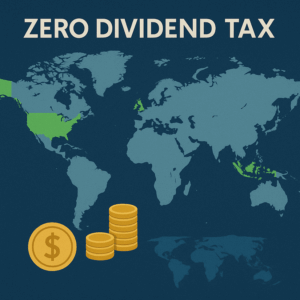
Dividend taxation varies significantly across the globe, with some jurisdictions offering zero tax on dividend income while others impose substantial rates.
This variance creates opportunities for investors to optimize their returns through strategic investment in tax-friendly locations.
Understanding which countries have no dividend tax can significantly impact investment decisions, especially for high-net-worth individuals and multinational corporations seeking to maximize after-tax returns on their investments.
Si desea invertir como expatriado o particular con un elevado patrimonio neto, que es en lo que estoy especializado, puede enviarme un correo electrónico (hello@adamfayed.com) o WhatsApp (+44-7393-450-837).
Esto incluye si busca una segunda opinión o inversiones alternativas.
Algunos hechos podrían cambiar desde el momento de la redacción. Nada de lo aquí escrito constituye asesoramiento financiero, jurídico, fiscal o de ningún tipo, ni una invitación a invertir.

What Is Dividend Tax?
Dividend tax is a levy imposed on the distributions of profits that companies make to their shareholders.
A dividend represents a return given by a company to its shareholders from the profits earned in a particular financial year.
From a taxation perspective, dividends constitute income in the hands of the shareholders, which would typically be subject to income tax in most jurisdictions.
The structure of dividend taxation varies globally, with some countries imposing tax at the corporate level when profits are distributed.
For others, it is taxed at the shareholder level when dividends are received.
In some instances, taxation is applicable at both levels.
This creates what tax experts refer to as economic double taxation, where the same income is effectively taxed twice.
Prior to 2020, India employed a Dividend Distribution Tax (DDT) system where companies paid a 15% tax on dividends distributed, while shareholders received the dividends tax-free.
However, this system was abolished in the 2020 budget, shifting the taxation burden to shareholders.
What Is Dividend Withholding Tax?
Dividend withholding tax represents a mechanism where the entity paying dividends retains a portion of the dividend amount.
The entity, then, remits it directly to tax authorities on behalf of the recipient.
This system serves as a collection method to ensure tax compliance, particularly for cross-border dividend payments.
In the United States, for example, foreign persons receiving US-source dividends are generally subject to a 30% withholding tax on the gross amount.
This withholding is required by law and must be implemented by withholding agents making fixed, determinable, annual, or periodical (FDAP) payments to foreign persons.
Withholding agents can apply reduced rates if the beneficial owner certifies eligibility based on either domestic tax code provisions or applicable tax treaties.
The United States has established numerous bilateral income tax treaties specifically to prevent double taxation and tax evasion.
While the standard US withholding rate for dividends is 30%, treaty benefits can reduce this significantly.
For instance, Australian residents may qualify for a reduced 15% rate or even 5% for qualifying direct dividends.
Are Dividends GST-Free?
Goods and Services Tax (GST) or Value Added Tax (VAT) typically applies to the supply of goods and services, rather than passive investment income such as dividends.
As confirmed by the Inland Revenue Authority of Singapore, dividends paid in cash, whether from local or foreign companies, are not subject to GST because they do not represent goods or services provided.
This GST exemption for dividends represents a consistent approach across most tax jurisdictions worldwide.
The fundamental reason is that dividend distributions represent a share of company profits rather than payment for goods or services rendered, placing them outside the scope of consumption taxes like GST or VAT.
Are Foreign Dividends Tax-Free?
Foreign dividends are rarely completely tax-free, though the taxation method varies widely across jurisdictions.
Double taxation frequently occurs when dividends are taxed both in the country where the distributing company is based and in the shareholder’s country of residence.
To mitigate this problem, many countries have established Double Taxation Avoidance Agreements (DTAAs).
These bilateral treaties allow investors to claim relief from double taxation by:
- Exempting foreign dividends from domestic tax
(O)
- Providing credits for taxes already paid abroad
En OECD Model Tax Convention (MTC) addresses this issue in Article 10, which deals specifically with dividend taxation.
This article acknowledges that parent companies and their subsidiaries aren’t completely independent parties and thus limits the maximum withholding tax that can be applied.
Under this model, the dividend recipient’s country may tax the dividend, while the source country (where the distributing entity resides) has limited taxing rights.
For investors receiving significant foreign dividends, treaty benefits can substantially reduce tax burdens.
For example, the OECD Model typically provides for a reduced withholding rate of 5% if the recipient holds at least 25% of the shares in the distributing company for at least 365 days.
For other dividends, a 15% withholding tax rate generally applies.
How To Get Dividends Tax-Free?
There are several legal approaches to minimizing or eliminating dividend taxation:
Utilizing tax exemption thresholds
Some countries offer tax exemptions up to certain limits. For instance, in India, dividends are exempt from tax up to Rs 5,000.
Investing through tax-advantaged accounts
Many countries offer retirement or investment accounts with special tax status.
Leveraging double taxation treaties
Strategic use of double taxation agreements can reduce or eliminate withholding taxes on cross-border dividend payments.
Relocating to tax-friendly jurisdictions
High-net-worth individuals sometimes establish tax residency in countries with favorable dividend tax treatment.
Corporate structuring
Multinational enterprises can structure their corporate holdings to take advantage of jurisdictions with preferential dividend tax treatment.
It’s worth noting that after India abolished its Dividend Distribution Tax in 2020, companies are no longer obligated to pay this tax.
Instead, the dividend income is now taxable in individual investors’ hands, though TDS (Tax Deducted at Source) applies at 10% for dividend payments exceeding ₹5,000.
Which Countries Do Not Tax Dividends?
Several countries offer zero or minimal taxation on dividend income, making them particularly attractive for investors seeking to maximize returns:
Singapur
Singapore employs a single-tier corporate tax system where dividends are exempt from taxation at the shareholder level.
Only the corporate tax rate applies, and shareholders receive dividends completely tax-free.
Other noteworthy tax incentives and schemes in Singapore include:
- Pioneer Tax Incentive:
Exempts qualifying high-tech projects from tax for 5–15 years to anchor leading-edge activities.
- Development & Expansion Incentive:
Grants reduced rates – 5%, 10%, or 15% – or up to 40 years on profits from new or expanded high-value operations.
- Investment Allowance:
Allows up to 100% deduction of capital expenditure, capped at SGD 10 million, for automation and other qualifying projects over five years.
- Enterprise Innovation Scheme (EIS):
Offers 400% tax deductions or cash payouts on R&D, IP registration/licensing, employee training, and collaborative innovation, capped per activity.
- Financial Services Incentives:
Concessionary rates from 5% to 15% for fund managers, treasury centres, and other high-value-added financial activities
Estonia
Similar to Singapore, Estonia taxes profits at the corporate level but exempts shareholders from it. Other noteworthy tax incentives of Estonia include:
- Deferred Profit Tax:
Undistributed profits, active as well as passive, are exempt from CIT until distributed, effectively promoting reinvestment.
- Reduced Distribution Rate:
Companies making regular distributions pay a 14% CIT (14/86 of dividends) on amounts up to the average of the preceding three years.
- No Local Taxes:
Estonia imposes no municipal or local income taxes, simplifying compliance for resident companies.
Caribbean nations
Several Caribbean jurisdictions, including the Bahamas, St. Lucia, and Antigua & Barbuda, impose zero taxes on dividends, profits, or any other types of income.
Other tax advantages in the Caribbean nations that are worth considering include:
- Bahamas
No taxes on corporate earnings, capital gains, personal income, sales, inheritance, or dividends for residents, corporations, partnerships, trusts, and individuals.
- St Lucia
Up to 15-year corporate tax holidays for approved manufacturers based on local value-added levels.
- Antigua y Barbuda
International Business Corporations benefit from a 50-year exemption on most forms of income, including dividends, interest, and royalties
Mónaco
This microstate offers complete tax exemption on dividends, making it an attractive location for high-net-worth individuals.
Some other tax benefits offered in Monaco are:
- No Personal Income Tax:
Resident individuals (excluding French nationals) pay no income tax.
- Zero Wealth & Property Taxes:
No wealth tax, property tax, or inheritance tax for direct heirs
Emiratos Árabes Unidos (EAU)
The UAE provides complete tax exemptions on dividends, appealing to investors looking to optimize returns and grow wealth.
UAE also offers other tax benefits such as:
- Free Zone 0% Corporate Tax:
Qualifying Free Zone Persons enjoy a 0% CT rate on qualifying income, with a 9% rate only on non-qualifying activities.
- No Personal Income Tax or Withholding Tax:
Dividends and salaries are tax-free, enhancing after-tax returns for investors and expatriates
Islas Caimán
Known as a tax haven, the Cayman Islands impose no tax on dividends received by residents. The Cayman Islands also offers:
- No Direct Taxes:
Corporations face no income, capital gains, withholding, or other taxes.
- Exempted Company Registration:
Entities carrying on business abroad can register as exempted companies, retaining full tax exemption status
Countries with low dividend tax
Grecia:
Greece maintains the EU’s lowest dividend tax rate at just 5% (alongside Bulgaria).
This rate is particularly appealing compared to countries like the United States and the United Kingdom, where dividend tax rates can reach up to 40%.
In Greece, other tax benefits include:
- New residents can elect an alternative flat tax on foreign-source income for up to 15 years
- Special alternative taxation for employees and business income for transferees since 2020 to attract talent and investment
Hong Kong:
With its territorial tax system, Hong Kong offers favorable treatment for dividend income, with minimal taxation in many circumstances. Hong Kong is also popular for:
- Income from services rendered outside Hong Kong may be fully exempt from profits tax upon successful claim
- Hong Kong imposes no CGT or VAT, and offers a two-tiered profits tax rate (8.25% on first HKD 2 million of profits) to support SMEs
Turkey (for new equity):
Turkey applies an Allowance for Corporate Equity (ACE) system that can result in zero corporate tax liability at the assumed 4% rate of return, effectively eliminating dividend tax for new equity investments.
Turkey also provides:
- Deduction for the normal return on new equity finance, mitigating debt bias and lowering the effective cost of equity
- Grants customs duty and social security exemptions for export-oriented projects under the 2023 growth strategy
Brazil:
As one of the largest economies in Latin America, Brazil offers competitive dividend tax rates that attract significant foreign investment. Brazil is also renowned for:
- Excise and sales tax waivers for manufacturers exporting goods to promote competitiveness
- Federal tax breaks (PIS, Cofins, IPI, import duties) for IT infrastructure projects using 100% renewable energy
Grenada:
Dividend tax in Grenada can range from 0% to 15%, offering potential advantages for certain investors. Grenada also offers:
- 100% tax incentives up to 15 years, duty waivers on building materials, equipment, and raw materials, plus R&D and training credits
- Graduated property transfer tax reductions and up to 100% withholding tax waivers on financing costs for qualifying investments
It’s important to note that holding a passport from a low-tax jurisdiction doesn’t automatically make one a tax resident.
The tax benefits mentioned apply only to individuals who are also tax residents of these countries.
Conclusión
The global landscape of dividend taxation offers significant opportunities for investors to legally minimize their tax burden.
Countries like Singapore, Estonia, and various Caribbean nations provide complete exemptions from dividend taxes.
Whereas, jurisdictions such as Greece offer substantially reduced rates compared to major economies like the United States or the United Kingdom.
For international investors, understanding these variations in dividend taxation can significantly impact after-tax returns.
Strategic investment in countries with favorable dividend tax regimes, coupled with proper use of double taxation agreements, can legally minimize tax liabilities while maximizing investment returns.
However, investors should remain cautious about potential regulatory changes.
This is because global tax policies continue to evolve with initiatives aimed at preventing tax base erosion and profit shifting.
Additionally, establishing tax residency in low-tax jurisdictions typically requires substantial physical presence and genuine economic connections.
This cannot be achieved by merely obtaining citizenship or formal documentation.
Dividend planificación fiscal presents legitimate opportunities for optimization.
Therefore, investors should seek professional advice tailored to their specific circumstances, ensuring compliance with applicable tax laws while taking advantage of favorable jurisdictions and treaty benefits.
¿Le duele la indecisión financiera?

Adam es un autor reconocido internacionalmente en temas financieros, con más de 830 millones de respuestas en Quora, un libro muy vendido en Amazon y colaborador de Forbes.