How to Retire in Iceland
Si desea invertir como expatriado o particular con un elevado patrimonio neto, que es en lo que estoy especializado, puede enviarme un correo electrónico (advice@adamfayed.com) o WhatsApp (+44-7393-450-837).
Introducción
Iceland is becoming a more and more popular destination for retirees who are moving overseas to live out the rest of their lives.
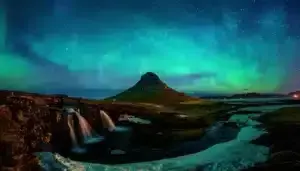
Iceland’s legendary natural beauty, rich history, and profusion of English speakers make it a desirable travel destination even if it is more expensive than places like Mexico or South America. In addition to the natural beauty of Iceland, many are drawn there by the tranquility and security that the people of Iceland experience.
There are numerous ways to apply for residence in Iceland as a prospective retiree. A parental reunification permit may be requested if you are above 67 and have an adult child who resides in Iceland. Additionally, there is a hazy category of visas for people with special ties to Iceland. You might also be able to apply for a residence permit based on a justifiable and unique reason.
Naturally, if you are a citizen of member state of the Unión Europea (EU) or European Economic Area (EEA), you do not need to worry about these constraints; instead, you should focus on the practical issue of providing for yourself during retirement. As a retiree, you will need to be able to demonstrate that you have the resources to sustain yourself throughout your retirement because you won’t be working.
Note that given the relatively high living expenses in Iceland, moving to the country will be expensive.
How to Retire in Iceland: Visas
Where you are from will determine how simple it is for you to relocate to and retire in Iceland. Iceland can be entered without requiring any particular documentation for citizens of the EU, EEA, and European Free Trade Association (EFTA) countries.
Up to three months of employment and residence are permitted for citizens of such countries before they must register with Registers Iceland, the main official civil registry for Iceland. The procedure is undoubtedly more challenging for inhabitants of other nations, though.
How to Retire in Iceland: Can US citizens move to Iceland?
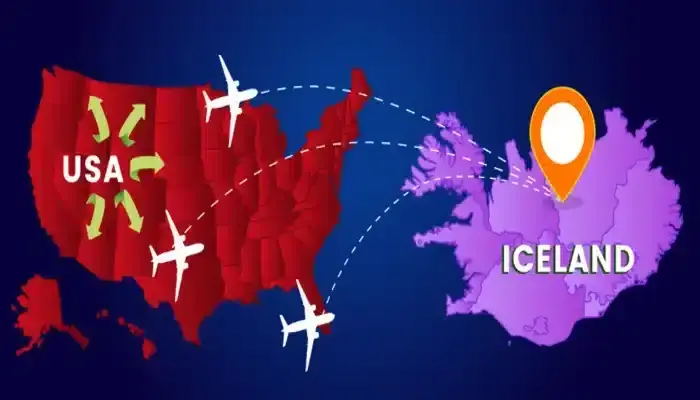
It is feasible for US citizens to reubicar to Iceland, but the country has a fair amount of restrictions to those who wish to do so.
The Directorate of Immigration must be contacted if you intend to stay for more than three months in order to apply for a residence visa. Admission is also contingent upon your justification for staying in the country. Being a competent worker, student, volunteer, au pair, or wanting to rejoin with a family member, such as a spouse, child, or aged parent are examples of common justifications. Residency is taken into account on an individual basis in specific situations.
A number of fundamental requirements must be met before applying for any type of residency visa. First, you need to demonstrate that you can live independently in Iceland without receiving government assistance. You must demonstrate that you can spend a minimum of about 2,000 US dollars per month to sustain yourself if you are a retired couple.
You will need to provide proof that you have a place to live before traveling to Iceland, and you might also be required to provide a copy of your criminal history. You shouldn’t be involved in any cases that could land you behind bars for longer than three months.
Additionally, you’ll need to agree to a required medical checkup and be ready to give immigration extra information, including your passport and evidence of seguro de enfermedad that is accepted in Iceland.
Last but not least, not everyone should choose marriage (and we do not advocate getting married merely for practical reasons), but it can be an option for residence. With nationalized healthcare and relatively generous parental leave, Iceland can be a great place to start a family if you do manage to fall in love with a local.
If you intend to remain in Iceland for an extended period of time – such as in the case of retirement – you will also need to apply for a kennitala, or national ID number. In comparison to other nations, your kennitala will be utilized in almost every facet of life in Iceland.
When you make a purchase at the store, sign up for a library card, acquire a bus pass, or purchase a gym membership, for example, you can be asked for your kennitala. Citizens of other Nordic nations, like those who reside in the EU, EEA, or EFTA, and those who do not dwell in any of these areas are divided into three main categories under registration rules.
Those merely fall under minimum requirements; there will be additional specifications for each sort of residence permit. Eventually, you’ll require a visado de residencia permanente in Iceland if you plan to retire there, which you can apply for after four years of continuous living within the country.
You must have been issued a different permission for the previous four years in order to apply for a residencia permanente permit. It could be helpful to speak with a lawyer to sift through all the requirements and determine the exact residence permit you could be qualified for.
How to Retire in Iceland: Housing
For new immigrants, it might be challenging to break into the property market. Global attention in hotels and construction has caused Icelandic capital Reykjavik to boom over the past 15 years, increasing the precio de los inmuebles.
Iceland’s population has been expanding quickly over the past few years too, but home construction has not kept up, creating a housing scarcity. Icelanders also have a tendency to own their homes, hence there aren’t many rental properties available.
Rent will obviously vary by location, but because of transportation and employment options, it typically makes sense for expatriados to relocate to the capital region.
Well, you can find cheaper accommodations, but in that case, be prepared for less than ideal conditions and dealing with roommates.
How to Retire in Iceland: Weather
Even if it does not really live up to its moniker, Iceland has plenty of frigid weather in the fall and winter. In the fall, temperatures will often be in the 30s Fahrenheit range, but in the winter, they can drop as low as -20 degrees coupled with plenty of snow and wind. If you plan to spend your retirement years in Iceland, you should surely expand your cold-weather wardrobe and get some high-quality boots.
Thankfully, Iceland doesn’t have a year-round winter. There are four distinct seasons in the nation, and while summer highs can reach the high seventies, you should generally anticipate temperatures to stay in the fifties.
The renowned Midnight Sun can be viewed during the summer. Due to its proximity to the North Pole, Iceland enjoys uninterrupted sunlight during that summer solstice. Around the winter solstice, the opposite is true, and there is little sunlight every day of the winter.
How to Retire in Iceland: Healthcare
All citizens who are registered as residents in Iceland are eligible for universal healthcare. However, to qualify, you must have lived in the area for at least half a year. Before you can get your residency permit, you must buy seguro de enfermedad that will last for at least the first six months.
You can pick between healthcare clinics, hospitals, and other medical institutions if you need to get medical attention. Although they are often less expensive than hospitals, clinics lack the resources to handle urgent medical crises. Hospitals are set up for emergencies, but if you need to visit a doctor for anything else, you’ll need a referral. Primary care services are provided by hospitals, which also occasionally hire experts.
There are various medical facilities across the nation, which are all subsidized by the government. Iceland does not have any private hospitals.
How to Retire in Iceland: Cost of living
Icelanders tend to follow a few practices to help them avoid the steep prices. One of the most important is to limit your driving whenever you can because gas is so expensive. If you’re retiring in Iceland, think twice about bringing your automobile and instead go for cheap flights and public transit.
El total mensual coste de la vida in Iceland for one person can hit roughly 156,736 kronur ($1,112) on average, excluding rent, according to global cost of living data aggregator Numbeo.
On the other hand, it can cost 577,422 kronur for a family of four per month, exclusive of rent.
A meal at an inexpensive restaurant in Iceland is estimated to cost 1,500 kronur, while a mid-range restaurant can charge nearly 14,335 kronur for a three-course meal for two.
Renting a one-bedroom apartment within Iceland’s city center costs about 199,737 kronur per month and 161,028.5 kronur outside that area.
The costs for buying apartment within and outside Iceland’s city center can reach 733,376.5 kronur and 545,585 kronur per square meter, respectively.
So as to maintain the same level of living as you can with $9,100 in New York, you must have about $5,752 in Icelandic capital Reykjavik.
If your pension or moderate income enables you to have a greater monthly budget, you may be able to anticipate living comfortably in Iceland.
How to Retire in Iceland: Best Places to Live
If you want to retire in Iceland, there won’t be many towns and cities for you to pick from. Check out the top locations that attract expats from around the world, as listed below, to help you narrow down your options.
Reykjavik
Reykjavik, the capital, has the largest population. You’re more likely to locate recognizable international goods and institutions, as well as other Americans or expat communities. Even if it results in a higher cost of living, some people also desire the city’s thriving nightlife and cosmopolitan atmosphere.
Akureyri
This harbor town is ideal for you if you appreciate being in the outdoors and taking part in outdoor activities. There are numerous chances for you to hike, ski, ride a horse, go fishing, or explore the nearby mountains and meadows.
Hafnarfjörður
This town is a fantastic area to reside if you work in the travel and tourist sector. It is one of the most well-liked atracciones turísticas in Iceland, which hosts a number of annual festivals and cultural events. Hafnarfjörður is also known as the birthplace of rock and roll.
Kópavogur
This town, which is currently undergoing tremendous development, has the largest population after Reykjavik.
How to Retire in Iceland: Living in the Capital
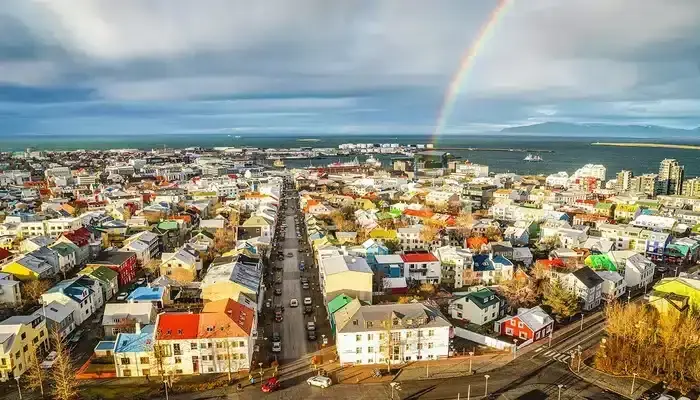
Reykjavik, one of the smallest capitals in Europe, combines the charm of a small town with the global dynamism of a larger city.
You can take advantage of the trendy restaurants and shopping areas, enjoy the nightlife, and strike up a discussion with complete strangers in a café. Both locals and visitors are amiable and laid back. Additionally, some people would describe the city as having a hipster vibe.
Reykjavik is surrounded by breathtaking nature, and the most of the buildings adhere to traditional Icelandic style rather than skyscrapers.
If you’re seeking for lodging, prepare to pay for high prices, particularly in the upscale downtown area. If you’re looking for something more reasonably priced, though, there are also some available options for that.
The ability to still embrace nature is one of the greatest things about residing in Reykjavik. Just 30 miles, or about 50 km, separate you from the National Park’s hiking and fishing trails. Meanwhile, a hot spring valley, which is 3 miles away and has the largest geothermal pool, is home to numerous walking routes along the shoreline.
How to Retire in Iceland: The Good
When it comes to weighing the advantages and disadvantages of living in Iceland, there isn’t much room for debate when it comes to the nation’s stunning natural surroundings.
Iceland is actually fairly distinctive in terms of its landscapes and geography, even though it is typically regarded as a member of the greater community of Nordic countries.
You may see some of the 130 volcanoes that make up the nation, many of which are still active, as well as vast lava fields and bubbling geysers. There are also glaciers and even rolling green hills.
Skiers, snowshoers, and other winter sports fans wishing to retire in Iceland are in for a treat because of the icy interior of the island.
Furthermore, Iceland is far enough north in comparison to many of its somewhat more southerly Nordic neighbors that viewing the Northern Lights is considerably more possible.
For those who enjoy the ocean and are thinking about moving to Iceland, the country’s distant position means that marine life can be found there in a far more untamed and unspoiled state than in Europe or the UK.
Living in Iceland means you’ll not only be surrounded by the natural beauty of the country, but you’ll also be surrounded by some of the friendliest, most hospitable people on the planet.
Icelanders place a lot of value on their families, and this extends to how they see their neighbors, including those who may have immigrated more recently than others who may have been in Iceland for centuries.
Additionally, English is largely spoken throughout the country, which is good news for British or American expats considering a move to Iceland. When it comes to integrating oneself once they arrive in Iceland, those from English-speaking nations will have an advantage.
But if you intend to stay in Iceland for a long time, you should make an effort to learn the language too.
Danish is also essentially a universal language among Iceland’s native population, in addition to the local language.
How to Retire in Iceland: The Bad
Iceland’s cost of living is unfortunately relatively high, just like that of its Nordic neighbors.
In terms of food, foreigners who reside in Iceland frequently lament the lack of variety and poor quality of the country’s cuisine when compared to that of the US, the UK, or the majority of the rest of the European Union. Icelandic expats claim that even the cheese and meat you could buy at the supermarket are of poor quality.
Of course, Icelanders have access to a lot of fresh fish, yet it seems that fresh fish is frequently out of reach for most people’s budgets.
Furthermore, Icelanders, like their Nordic neighbors, have access to first-rate social services, medical services, and government help on a variety of fronts. The drawback is that you don’t get anything for cheap, which means that taxes are quite high.
And we aren’t simply talking about taxes on your income. Keep in mind that this is an island nation where the majority of goods must be imported. Therefore, almost everything you purchase in a store of any kind will come with extra expenses to cover import duties.
That holds true even if you are one of those individuals who is dependent on placing orders on Amazon or Alibaba; frequently, the import duties on the items you order might be on par with or even more expensive than the price of the actual stuff.
How to Retire in Iceland: Saving for Your Retirement
Saving for retirement is a commitment that typically takes decades to fully pay off, whether you plan to retire in Iceland or elsewhere.
You must first choose the lifestyle you want for your retirement, though, before you can begin the process. Once you’ve made that choice, you can work out how much you’ll need to save in order to make your plan a reality. Once you have a goal in mind, even a rough one, it will be much simpler to start saving seriously.
You most likely qualify for a Social Security benefit of some kind if you’ve worked in the US. Additionally, if you work for the government or are a teacher, you might receive a pension at some point in your retirement.
But you’ll still need to put money aside to augment such income. A 401(k) plan or an individual retirement account (IRA) are the two most popular ways to do this. Take into account that a 401(k) plan is only accessible through your employer.
Making sure you start early is the most important aspect of investing for retirement. If you start saving early in life, compound interest will work in your favor throughout your career, so you won’t need to save as much because your money will generate income along the road.
Nevertheless, it’s never too late to save for your future and try to be as financially equipped as possible. Knowing your ways around investing can help you grow your income as well as looking into passive ways to accumulate riqueza.
¿Le duele la indecisión financiera? ¿Quiere invertir con Adam?

Adam es un autor reconocido internacionalmente en temas financieros, con más de 830 millones de respuestas en Quora, un libro muy vendido en Amazon y colaborador de Forbes.