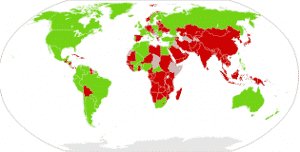
An increasing number of people are looking for dual citizenships, often because of tax and financial reasons.
Yet some countries don’t allow dual citizenships. This article will discuss which countries do.
Si desea invertir en soluciones especializadas para expatriados o tiene alguna pregunta, no dude en póngase en contacto conmigo o utiliza la función WhatsApp que aparece a continuación.
Introducción
Born in the country – got her citizenship? Not always. Moved to another country – now you have two passports? In this article we will talk about some features of the laws on citizenship of different countries.
The modern lifestyle often requires people to stay outside their home country for a long time. Knowing with which countries dual citizenship is allowed is quite relevant for such citizens. How to get an additional passport in order to fully enjoy the rights of a resident of another country, and not break the law at home?
There are states that do not want to lose their citizens, for example, Iran. According to the Civil Code of this country, it is almost impossible to renounce Iranian citizenship. And its receipt in many cases does not depend on the will of the person: anyone whose father is an Iranian citizen is automatically considered to have Iranian citizenship. And it doesn’t matter where he was born and where this person lives – in Iran or not.
The rules for women are spelled out in a separate paragraph in the code – it is even more difficult for them to renounce Iranian citizenship, because a woman must have the same citizenship as her husband.
And if an Iranian living in Germany obtains the citizenship of the Federal Republic of Germany, in almost all cases the Iranian is left to him. According to the Federal Statistical Office of the Federal Republic of Germany, in 2018, 3,080 Iranians received German citizenship, while none of them had to surrender an Iranian passport.
But Iran is far from the only state that prevents the withdrawal from its citizenship. There are about 40 of them. Among them are such countries, from which it would seem that this should not be expected, for example, Argentina. In 2018, all 155 Argentines who received German citizenship also retained their Argentine passports. Other states with the strictest rules for accepting and renouncing citizenship include Afghanistan, Eritrea, Nigeria and Syria.
Features of dual citizenship
A person who has issued an additional passport has the right to apply for the status of a bipatrid if there is a special agreement between his homeland and the future country of residence.
The legal status of subjects who have obtained dual citizenship allows them to fully preserve the rights and obligations of residents of both states. But some of them are carried out with priority in the place of permanent residence, for example, military service.
Legal restrictions
For the most part, the state allows an additional passport. The restriction covers a narrow circle of citizens, including civil servants. In addition, the status is usually assigned to people who have lived in the territory of the state for several years.
Origin or place of birth
There are two basic principles that govern the eligibility for citizenship. In the United States, for example, a territorial principle is adopted, known as Jus soli (Latin – “land right”): all children born in the territory of this state have the right to obtain American citizenship.
Germany and China adhere to a different principle. Both states operate on the basis of Jus sanguinis (Latin – “blood law”), which takes into account the origin of the child: citizenship of the Federal Republic of Germany is acquired not by those who were born in one of the 16 federal states, but by those who have at least one of the parents who have German citizenship.
But in Germany, in addition to this, there is a naturalization procedure – foreign citizens can obtain German passports, also permitted – with restrictions – a second citizenship. But in China, it would be extremely difficult for an ethnic non-Chinese to obtain a second citizenship, and dual citizenship in the PRC is legally prohibited.
If a citizen of the Russian Federation wants to obtain citizenship of the Federal Republic of Germany, who meets the criteria for starting the naturalization procedure, he must, as a rule, renounce Russian citizenship before that – now it is not allowed to have two passports. But those who already have them can keep them.
European passport paradise
Since 2007, Germany has allowed citizens of the EU, as well as Switzerland, to obtain German citizenship while retaining the previous one. And in other European states, such dual European citizenship is legalized – either in full or with restrictions.
As follows from the 2011 census, almost 4.3 million people live in Germany who, in addition to German, have another citizenship. 690 thousand citizens of Germany have Polish passports, 570 thousand – Russian, 530 thousand – Turkish. These figures are based on data from regional citizen registration offices. However, many people do not report their second citizenship, so the statistics provided may not be accurate.
Israeli-Palestinian features
The complicated relationship between Israel and the Palestinian National Authority has given rise to many specific features regarding citizenship. One of them affects Germany.
For example, Palestinians who have acquired German citizenship and who are simultaneously listed in the Palestinian register of persons or have a Palestinian identification number (ID) are prohibited from entering Israel. Meanwhile, all other citizens of Germany can enter Israel without a visa. Entry to the West Bank of the Jordan River is available for such Palestinians with German citizenship only through Jordan.
In Israel itself, there is another unusual rule concerning citizenship. In 1950, two years after the formation of the Israeli state, it was decided that wherever Jews lived, they all had the right to immigrate to Israel and acquire Israeli citizenship. This law even today enables those Jews who are persecuted, in whatever country it may happen, to become a citizen of Israel and live in safety. Recently, amid an increase in anti-Semitic incidents in France, many French Jews have taken advantage of this opportunity.
In which countries is it allowed to have second passports?
Obtaining a second passport is a goal set by reasonable and prudent people. Realizing the real situation in the world, having one passport, even in the most advanced country in the world, is more of a limiting factor than a liberating one.
Several years ago, Jim Rogers (a famous financier, billionaire, one of the most influential investors in the world, creator of his own international commodity index RICI.
Graduated from Yale and Oxford Universities, taught finance at the Graduate School of Business at Columbia University) predicted that by 2020 year for wealthy people, the so-called High Net Worth Individuals, it will be simply reckless to have only one passport. But judging by the development of events in the world, it is reckless to not own a legal second citizenship and a passport right now.
Some have compared owning a single passport today to trying to haul a huge load with just one rope. Unfortunately, the environment, interference from the manufacturers of this rope (passport) and so on very much interfere with the enjoyment of the process of pulling out even the most valuable cargo.
However, having received at his disposal another 1 or more passports, a person becomes more independent from the circumstances and decisions of the government of only one state.
Today you can already hear about the moments when the government of a developed state, be it the United States or the United Kingdom, simply deprived its citizens of passports and citizenship for controversial non-payment of taxes or alimony, making them, on the one hand, not traveling, on the other, outlaw if these persons try make an attempt to leave the country after this “act”.
And there is an urgent need to leave for the funeral of a loved one, for treatment, which is available only in a certain country, during the evacuation from a tornado, finally! The absence of a second passport can kill even in an everyday situation, not to mention a meeting with terrorists with an unwanted passport, by no means a politically neutral country, in the bosom.
In addition to such a grim scenario, there are also issues of travel safety: American passport holders can be targeted by terrorists almost anywhere in the world; the owners of the Russian, sadly, can also become a target for provocations, especially against the backdrop of geopolitical events. And precisely in order to avoid such cases, it is worth thinking about obtaining a second citizenship.
It is the second, without the need to abandon the first, which means that today we are interested in states that officially allow their citizens to have dual citizenship.
Let’s go alphabetically.
Australia. It is possible to get a second Australian passport, since the document issuance system is organized at the highest level. With all this, the opportunity was left to retain all existing citizenships and receive the next, as in the naturalization mode, by marriage or by investment.
Belgium. A Belgian passport is one of the most easily accessible documents in Europe. To become a citizen of this state, you must live or have close ties with the country for only 3 years. And dual citizenship has been allowed here since 2008.
Great Britain. For more than 65 years, citizens of the British Crown can obtain dual citizenship. The only thing is that if a person owns the citizenship of some overseas territories, such as Anguilla, then upon obtaining a different third citizenship, he may lose the opportunity to obtain a British passport.
Germany. Let’s just say we are putting the country on the list a little in advance, since the proposed law is under discussion. In addition, it applies only to the younger generation, allowing young people born in Germany to foreign parents to retain both citizenship: German, acquired by birth, and parental.
Greece. The country allows its citizens to have not only Greek citizenship.
Egypt. In this African country, you can have several citizenships, but in order for everything to be in accordance with the law, the receipt of a new document must be reported to a special department. In addition, within a year, a person with a second citizenship must inform about his desire to keep an Egyptian passport. Persons with dual citizenship in Egypt are excluded from the list of conscripts, cannot study at the police and military academies, or run for the local parliament.
Israel. Israel very much welcomes all Jews who come to the promised land, allowing not only to get their passport, but also to keep the previous one. This has been used by many recently, leaving because of serious problems with the Gaza Strip and other nuances of Middle East policy.
Irlanda. The most popular program for obtaining a second passport, if you had Irish ancestors, exists in Ireland. It is clear that there are not many of them in the CIS and the countries of the former Union, but the Western community is actively using this loophole. So today there are much more Irish passports in the world than there are residents of Ireland itself.
Iceland. In 2003, she decided that it was now possible to hold dual citizenship and even allowed those who, upon receiving an Icelandic passport, had previously refused the previous document, to restore it.
Spain. Spain requires its citizens to report their second citizenship within three years. This rule does not apply to passports of Iberoamerican countries, Andorra, Philippines, Equatorial Guinea and Portugal.
Italy. Italian citizenship can be obtained without renouncing the current status, including by naturalization. Here, the citizenship restoration program is very popular if the ancestors were Italians.
Canada. The country has one of the most advanced immigration and naturalization programs. Each group of immigrants has its own number of quotas, it is strictly scheduled how many and who can be brought. Recently, however, not entirely clear changes have been outlined, but everyone is waiting for elections and certainty. At the same time, Canada still remains one of the most demanded destinations for immigration and places for obtaining second passports and allows you to have dual citizenship.
Mexico. A Mexican can be born anywhere, but will always be considered Mexican in his home country. This means that you can only enter and leave the country with a Mexican passport.
Peru. According to the basic legislation of Peru, residents of other Latin countries and Spain, having naturalized here, can retain their original citizenship. Although, in fact, dual citizenship can be allowed in more cases.
Portugal. In Portugal, you can invest and obtain resident status, and by fulfilling not such difficult conditions, you can also obtain citizenship, while retaining the previous status and the first passport.
Russia. Allows its citizens to own the passport of other countries. According to the new law, now, when obtaining foreign citizenship, it is necessary to report this to the FMS within 60 days after receiving the second passport.
Dual citizenship and second citizenship: what is the difference and what are the differences between these concepts
It is important to understand the difference between dual and second citizenship. Despite the consonance of these concepts, they carry different meanings and significant legal and legal differences.
Dual citizenship assumes that a certain agreement has been concluded between the two countries. People with dual citizenship can choose in which country to perform military service, their children receive two passports by birth. Russia has an agreement on dual citizenship only with Tajikistan (it has not been extended with Turkmenistan).
Dual citizenship implies that a person has passports of two countries, and the authorities of both countries are aware of this and at the official level recognize the rights and obligations of a person in relation to another state.
The second citizenship is that a person has passports of various countries, but in this case, the recognition of the rights and obligations of a person in relation to another state does not occur. Each of the countries considers a citizen only its subjects, and often the authorities do not even know about a person’s second citizenship, if the law does not require such disclosure.
A second citizenship can be obtained, for example, through investment programs, and certain conditions are required to obtain dual citizenship.
Benefits of dual citizenship
A person with dual citizenship has all the rights of both states, but he cannot use these rights at the same time: they work only in the country where he lives. For example, a bipatrid – a person with dual citizenship – will not receive a pension or enjoy any benefits in Russia if he currently lives in Tajikistan.
However, there are rights that can be exercised in Tajikistan – this is participation in presidential elections and in the representative bodies of the Russian Federation. At the same time, there are restrictions: you cannot hold elective positions and the office of a judge, be elected to parliament, serve in the police, special services and the prosecutor’s office.
The advantages of the position of a bipatrid include the right to travel between two countries without presenting special documentation, the ability to conduct business in both countries, as well as seeking diplomatic assistance while in a third country.
As for the obligations, they remain in relation to both states and come into force in the country of residence. If a person lives in Russia, he pays taxes here and serves in the army. Having moved to Tajikistan, he begins to pay taxes there, but his military service is no longer serving. An exception is contract service in either of the two states, even if the citizen has already served in the army.
Consequences of obtaining a second passport: what rights and obligations arise?
On August 4, 2014, a law entered into the Russian Federation, according to which citizens are obliged to notify the state of their second citizenship, and this must be done personally. Countries that grant citizenship usually do not inform the authorities of other countries.
That is, if a person for some reason decides to hide the fact of having a second passport, then the executive bodies of the Russian Federation may not find out about it. But if they find out, the citizen faces a fine and even criminal prosecution.
If a citizen has a second passport, he is obliged to maintain the status of a citizen of this country, comply with laws, and pay taxes on time. Compared to Russian taxes, fees in many EU countries seem insignificant, and in some countries they are completely absent. Under such conditions, everything is in favor of registering an enterprise or opening a business in these countries.
In order for an investor not to pay double taxes, he needs to choose a jurisdiction for paying taxes, register a residence in it, contact the fiscal service at home, provide evidence of re-registration and be removed from the register.
As for the rights of citizens who have received a second passport, they have almost all the rights of citizens of the chosen country. You can work, send your children to kindergartens and schools, use healthcare services, but the most important thing is the right to free visa-free travel across the EU and many countries of the world. In Europe, you can spend up to 90 days without registering with the migration service or the police.
Here in this article we have tried to collect all the necessary information about the countries that will allow you to have both two passports and obtain dual citizenship. Dual citizenship will always be the one in the list of wanted things, which will give you a lot of opportunities.
We hope this article can be a short but informative guide for you to orientate in future and figure out your next steps concerning the citizenship.
Lecturas complementarias
In the article below I answer the following questions:
- ¿Qué debe hacer para invertir con éxito y, de paso, ver mejoras en su vida financiera? Tampoco se trata de grandes mejoras repentinas. La respuesta a continuación explica cómo las mejoras graduales marcan una gran diferencia a largo plazo.
- ¿Qué ocurre cuando la gente tiene dinero y poder? ¿Qué les motiva? Por supuesto, depende de la persona, pero considero algunas de las principales razones por las que algunas personas adineradas donan más dinero a obras benéficas a medida que envejecen.
- What percentage of your wealth should be invested in “risky” assets, if any, and how do I define risk? Too many times people confuse volatility as risk.
- Was investing just “created” as some kind of conspiracy to make the rich get richer? I tackle this ridiculous suggestion in my last answer.
To read more click below.