Cuando se comparan las rentas vitalicias y los certificados de depósito, la principal diferencia es cómo cada uno de ellos genera ingresos y gestiona el riesgo.
Los certificados de depósito son depósitos a plazo fijo emitidos por un banco con tipos de interés fijos y capital asegurado, mientras que las rentas vitalicias son contratos de seguro diseñados para proporcionar ingresos predecibles, a menudo para la jubilación.
Este artículo trata:
- ¿En qué se diferencian las rentas vitalicias de los certificados de depósito?
- ¿Cuál es la mayor desventaja de una renta vitalicia frente a un CD?
- ¿Es una renta vitalicia una inversión segura?
- ¿Se consideran los CD inversiones seguras?
- ¿Por qué son tan altas las rentas vitalicias?
Principales conclusiones:
- Los CD ofrecen protección del principal e intereses garantizados, pero un potencial de crecimiento limitado.
- Las rentas vitalicias proporcionan mayores ingresos y protección de la longevidad, pero dependen de la solidez de la aseguradora.
- Las rentas vitalicias conllevan comisiones y una liquidez limitada; los certificados de depósito son sencillos y tienen liquidez al vencimiento.
- Muchos inversores utilizan ambos como parte de una estrategia equilibrada centrada en los ingresos.
Mis datos de contacto son hello@adamfayed.com y WhatsApp +44-7393-450-837 si tiene alguna pregunta.
La información contenida en este artículo es meramente orientativa. No constituye asesoramiento financiero, jurídico o fiscal, ni una recomendación o solicitud de inversión. Algunos hechos pueden haber cambiado desde el momento de su redacción.

¿Cuál es la diferencia entre un CD y una renta vitalicia?
La principal diferencia entre un certificado de depósito (CD) y una renta vitalicia es que un CD garantiza el interés de un depósito fijo, mientras que una renta vitalicia proporciona un flujo de pagos que puede durar toda la vida.
Un CD es un producto bancario en el que se deposita una cantidad fija durante un periodo determinado a cambio de un interés garantizado.
Su capital suele estar asegurado hasta los límites reglamentarios (por ejemplo, la FDIC en Estados Unidos).
En anualidad, es un contrato de seguro que convierte una suma a tanto alzado en un flujo de pagos, ya sea inmediatamente o en una fecha futura.
Los pagos pueden continuar durante un plazo fijo o de por vida.
A diferencia de los CD, las rentas vitalicias no están aseguradas por la FDIC, y sus garantías dependen de la solidez financiera del asegurador.
¿Por qué las rentas vitalicias pagan más que los CD?
Las rentas vitalicias pagan más que los certificados de depósito porque asumen riesgos adicionales e invierten en activos de mayor rendimiento para proporcionar ingresos garantizados.
- La compañía de seguros asume el riesgo de longevidad, lo que significa que los pagos continúan aunque el inversor viva más de lo previsto.
- Las carteras de inversión que respaldan las rentas vitalicias suelen incluir activos de mayor rentabilidad que los activos ultraseguros y de baja rentabilidad que suelen utilizarse para financiar los certificados de depósito.
- Las rentas vitalicias pueden tener horizontes de inversión más largos, lo que permite a las aseguradoras generar mayores rendimientos y repercutir parte de ellos en el rentista.
¿Son los CD mejores que las rentas vitalicias?
Los CD son mejores para las necesidades de ahorro a corto plazo o flexibles, mientras que las rentas vitalicias son mejores para la planificación de ingresos a largo plazo.
Los CD funcionan bien para los inversores que desean un lugar sencillo donde aparcar dinero durante un periodo definido o mantener fondos para objetivos a corto plazo.
Las rentas vitalicias son más apropiadas cuando el objetivo es convertir los ahorros en un flujo de ingresos previsible, sobre todo más adelante en la vida.
La mejor opción depende de si el objetivo es la gestión temporal del efectivo o la estructuración de los ingresos a largo plazo, más que la seguridad global.
¿Son las rentas vitalicias más seguras que los certificados de depósito?
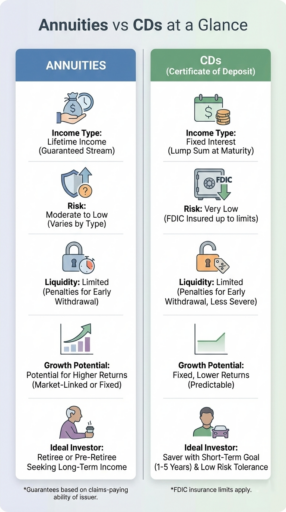
Las rentas vitalicias son más seguras para garantizar los ingresos, mientras que los certificados de depósito son más seguros para proteger el capital.
Los CD ofrecen una sólida protección del principal porque los depósitos están asegurados hasta los límites reglamentarios.
Las rentas vitalicias ofrecen seguridad de ingresos mediante garantías contractuales, pero dependen de la solidez financiera del asegurador y no del seguro de depósitos.
En la práctica, los CD protegen el capital, mientras que las rentas vitalicias protegen el flujo de caja, lo que hace que sus perfiles de seguridad sean fundamentalmente diferentes y no directamente comparables.
¿Cuáles son los pros y los contras de las rentas vitalicias frente a los CD?
En general, los CD ofrecen seguridad y sencillez a costa de una menor rentabilidad, mientras que las rentas vitalicias proporcionan mayores ingresos garantías, pero introducen límites de liquidez, comisiones y riesgo de aseguradora.
Ventajas de los CD
- El principal suele estar asegurado hasta los límites reglamentarios, lo que favorece la preservación del capital.
- El interés es fijo durante el plazo, lo que hace que los resultados sean predecibles.
- Los CD son fáciles de entender y requieren una gestión continua mínima.
Desventajas de los CD
- Los rendimientos suelen ser bajos y pueden no seguir el ritmo de la inflación.
- Las retiradas anticipadas suelen conllevar penalizaciones.
- Los CD no generan ingresos de por vida.
Ventajas de las rentas vitalicias
- Las rentas vitalicias pueden proporcionar ingresos más elevados, sobre todo a más largo plazo.
- Pueden garantizar ingresos de por vida o durante un periodo definido.
- Las rentas vitalicias ayudan a gestionar el riesgo de sobrevivir. ahorro.
Desventajas de las rentas vitalicias
- El acceso al capital está restringido, especialmente durante los periodos de rescate.
- Las comisiones y las características de los contratos pueden reducir la rentabilidad neta.
- Las garantías dependen de la solidez financiera del asegurador y no de un seguro respaldado por el Estado.
¿Debo contratar una renta vitalicia o un CD?
Elija un CD si su prioridad es preservar efectivo para un uso futuro conocido, y elija una renta vitalicia si su prioridad es convertir los ahorros en ingresos sostenidos más adelante en la vida.
Deberías tenerlo en cuenta:
- Alineación temporal: Los certificados de depósito funcionan mejor cuando los fondos se destinan a una fecha concreta, mientras que las rentas vitalicias están diseñadas para convertir los activos en pagos a largo plazo.
- Estructura de tesorería: Las rentas vitalicias generan ingresos programados, mientras que los certificados de depósito funcionan como vehículos de tenencia más que como motores de ingresos.
- Compromisos de riesgo: Los CD limitan las pérdidas pero limitan las ganancias, mientras que las rentas vitalicias aceptan la exposición del asegurador a cambio de la estabilidad de los ingresos.
- Función de cartera: Muchos inversores combinan los certificados de depósito como estabilizadores a corto plazo con las rentas vitalicias como bases de ingresos a largo plazo.
Conclusión
Las rentas vitalicias y los certificados de depósito se comparan a menudo como si uno debiera sustituir al otro, pero desempeñan funciones diferentes en el comportamiento del dinero a lo largo del tiempo.
Los CD mantienen el capital intacto y disponible, mientras que las rentas vitalicias reconvierten el capital en ingresos con una finalidad definida.
La pregunta más útil no es cuál es mejor, sino dónde importa más la certeza en el momento del depósito o en el momento del pago.
Cuando se eligen deliberadamente, cada uno de ellos puede reducir un tipo diferente de estrés financiero en lugar de competir por el mismo papel.
Preguntas frecuentes
¿Por qué a los asesores financieros no les gustan las rentas vitalicias?
Asesores financieros a veces evitan recomendar rentas vitalicias debido a las elevadas comisiones, las condiciones complejas y la liquidez limitada, que pueden reducir la flexibilidad general de la inversión.
¿Cuánto gana un CD de $100.000 en un año?
A $100.000 CD ganar 4% generaría unos $4.000 en intereses a lo largo de un año.
El importe exacto varía en función del tipo y el plazo establecidos, y los intereses suelen pagarse mensualmente, trimestralmente o al vencimiento.
¿Cuáles son las similitudes y diferencias entre las cuentas de ahorro, los certificados de depósito (CD) y las cuentas del mercado monetario?
Las cuentas de ahorro, los certificados de depósito y las cuentas del mercado monetario son productos bancarios de bajo riesgo, normalmente asegurados por la FDIC hasta los límites reglamentarios, y proporcionan intereses sobre los fondos depositados.
Las principales diferencias radican en la liquidez y la estructura de los intereses: las cuentas de ahorro son muy líquidas con tipos de interés variables, los certificados de depósito ofrecen un interés fijo durante un plazo determinado pero penalizan las retiradas anticipadas, y las cuentas del mercado monetario suelen ofrecer intereses más altos que las de ahorro al tiempo que limitan el número de transacciones.
¿Cuál es la diferencia entre renta vitalicia y FD?
Un depósito a plazo fijo o CD es un producto bancario con capital e intereses garantizados, mientras que una renta vitalicia es un contrato de seguro que proporciona un flujo de ingresos estructurado, potencialmente de por vida, y depende de la solvencia del asegurador.
¿Le duele la indecisión financiera?

Adam es un autor reconocido internacionalmente en temas financieros, con más de 830 millones de respuestas en Quora, un libro muy vendido en Amazon y colaborador de Forbes.