Cuando se comparan las rentas vitalicias con los bonos, la distinción fundamental se reduce a cómo se generan y garantizan los ingresos.
Los bonos son inversiones de deuda negociables cuyo rendimiento depende de los tipos de interés y del crédito del emisor, mientras que las rentas vitalicias son contratos de seguro creados para proporcionar ingresos predecibles, a menudo como parte de la planificación de la jubilación.
Este artículo trata:
- ¿Cuál es la diferencia entre un bono y una renta vitalicia?
- ¿Cómo genera ingresos una renta vitalicia?
- ¿Cómo generan ingresos los bonos?
- ¿Cuáles son los riesgos de las rentas vitalicias?
- ¿Existen riesgos en los bonos?
Principales conclusiones:
- Los bonos ofrecen liquidez y precios de mercado; las rentas vitalicias ofrecen garantías de ingresos.
- Las rentas vitalicias transfieren el riesgo de longevidad a las aseguradoras; los bonos, no.
- Los rendimientos de los bonos fluctúan con los tipos de interés; los pagos de las anualidades se basan en el contrato.
- Muchas estrategias de ingresos utilizan ambas en lugar de elegir una exclusivamente.
Mis datos de contacto son hello@adamfayed.com y WhatsApp +44-7393-450-837 si tiene alguna pregunta.
La información contenida en este artículo es meramente orientativa. No constituye asesoramiento financiero, jurídico o fiscal, ni una recomendación o solicitud de inversión. Algunos hechos pueden haber cambiado desde el momento de su redacción.

¿Es un bono un tipo de renta vitalicia?
Un bono no es un tipo de renta vitalicia. Aunque ambos pueden proporcionar ingresos, son instrumentos financieros fundamentalmente diferentes.
A bono es un título de deuda emitido por gobiernos, corporaciones o municipios.
Cuando compra un bono, está prestando dinero al emisor a cambio del pago de intereses y la devolución del capital al vencimiento.
En cambio, una renta vitalicia es un contrato de seguro.
Está diseñado principalmente para proporcionar ingresos, a menudo durante jubilación, inmediatamente o en una fecha futura.
Las garantías de una renta vitalicia dependen de la solidez financiera del compañía de seguros, no en los emisores del mercado.
¿Para qué sirve una renta vitalicia?
El objetivo principal de una renta vitalicia es proporcionar unos ingresos previsibles, a menudo durante un periodo determinado o de por vida.
Las rentas vitalicias suelen utilizarse en planificación de la jubilación para reducir el riesgo de sobrevivir a los ahorros.
Dependiendo del tipo, las rentas vitalicias pueden ofrecer:
- Flujos de ingresos garantizados
- Crecimiento fiscal diferido
- Protección frente a la volatilidad de los mercados
- Gestión del riesgo de longevidad
Suelen utilizarse para convertir una suma global de dinero en un flujo de caja estable a largo plazo.
¿Para qué sirve un bono?
La finalidad de un bono es generar ingresos por intereses al tiempo que se preserva el capital. Los bonos se utilizan a menudo para:
- Diversificar carteras de inversión
- Reducir la volatilidad global
- Proporcionar ingresos estables mediante el pago de cupones
- Preservar el capital en relación con la renta variable
Los bonos son muy utilizados por inversores conservadores, instituciones y jubilados que buscan ingresos sin riesgo de renta variable.
¿Cuál es la diferencia entre una renta vitalicia y un bono perpetuo?
La diferencia clave es que las rentas vitalicias están diseñadas para la planificación de ingresos, mientras que los bonos perpetuos son instrumentos de inversión con riesgo de crédito permanente.
Las rentas vitalicias suelen pagarse durante un periodo definido o de por vida, según el contrato. Una vez finalizados los pagos, puede que no quede ningún valor.
Un bono perpetuo, por el contrario, no tiene fecha de vencimiento.
Sigue pagando intereses indefinidamente, mientras el emisor siga siendo solvente.
A diferencia de las rentas vitalicias, los bonos perpetuos no ofrecen garantías respaldadas por seguros ni protección de longevidad.
¿Cuáles son las ventajas y desventajas de los bonos frente a las rentas vitalicias?
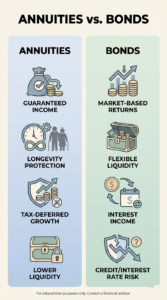
Las ventajas y desventajas de los bonos frente a las rentas vitalicias difieren principalmente en el grado de flexibilidad frente a la certeza de los ingresos que proporcionan, ya que los bonos ofrecen acceso al mercado y liquidez, y las rentas vitalicias garantías de ingresos contractuales.
Ventajas de los bonos
- Alta liquidez
La mayoría de los bonos pueden comprarse o venderse en mercados secundarios, lo que permite a los inversores acceder a su capital con relativa rapidez. - Precios transparentes
Bond prices and yields are publicly available, making it easier to evaluate value, risk, and market conditions. - Broad market availability
Bonds are issued by governments, municipalities, and corporations, offering a wide range of maturities, credit qualities, and income levels. - Potential for capital gains
Bond prices can increase when interest rates fall or when an issuer’s credit profile improves, creating opportunities beyond interest income.
Disadvantages of bonds
- Riesgo de tipo de interés
Bond prices generally decline when interest rates rise, which can reduce the market value of existing holdings. - Credit risk
There is a risk that the issuer may default or experience a credit downgrade, potentially reducing income or principal. - No lifetime income guarantee
Bonds pay interest only for a defined period and do not provide income protection if the investor outlives the investment term.
Benefits of annuities
- Guaranteed income options
Many annuities offer contractually guaranteed payments, providing predictable income regardless of market conditions. - Protection against longevity risk
Lifetime annuities ensure income continues even if the annuitant lives longer than expected. - Crecimiento fiscal diferido
Earnings inside an annuity typically grow tax-deferred until withdrawals begin, which can enhance long-term accumulation. - Predictable cash flow
Annuities can be structured to deliver fixed or formula-based payments, supporting consistent budgeting and planning.
Desventajas de las rentas vitalicias
- Liquidez limitada
Withdrawals beyond allowed limits may trigger surrender charges or penalties, especially in the early years of the contract. - Complejidad
Annuity contracts can be difficult to compare due to varying features, riders, and payout structures. - Fees and surrender charges
Some annuities carry administrative costs, rider fees, and penalties that can reduce net returns. - Dependence on insurer solvency
Annuity guarantees rely on the financial strength of the issuing insurance company rather than on market performance.
What is better, bonds or annuities?
Bonds are better for investors who want flexibility and market-based returns, while annuities are better for those who need guaranteed, long-term income.
- Bonds provide access to principal, the ability to adjust holdings with changing conditions, and potential gains from interest rate movements.
- Annuities offer structured payments for a defined period or life, delivering income certainty and protection against outliving savings.
Who is best suited for each:
- Annuities: Investors needing guaranteed payments for long-term expenses, preferring structured income without active portfolio management, seeking longevity protection, and comfortable trading liquidity for certainty.
- Bonds: Investors seeking income over a specific time horizon, wanting access to principal, comfortable with credit and interest rate risk, and preferring a more hands-on investment approach.
Many long-term strategies combine both: annuities act as income anchors, while bonds provide flexible income and capital management, helping investors balance stability with adaptability.
Conclusión
Understanding annuities vs bonds goes beyond comparing payouts. It’s about aligning investments with the uncertainties of life.
While annuities mitigate longevity and spending risk, bonds offer tools to respond to evolving markets and financial needs.
Investors who consider timing, interest rate trends, and personal life circumstances can use these instruments strategically, not just for income, but as levers to manage risk, preserve capital, and maintain optionality in an unpredictable financial landscape.
Preguntas frecuentes
Why are annuities a poor investment choice?
Annuities may be considered a poor investment choice for investors who prioritize growth, flexibility, or short-term access to funds.
High fees, surrender charges, and limited upside potential can make them inefficient compared to market-based investments for certain investors.
Which bond is paying 7.5% interest?
One real‑world example is the Belong Limited 7.5% Social Bonds due 2030, issued through RCB Bonds PLC.
These bonds pay a fixed 7.5% per annum interest, typically in two equal semi‑annual installments on 7 January and 7 July each year, and are expected to mature on 7 July 2030 (with a possible legal maturity in 2032).
These are high-risk investments, though, so financial advice is recommended.
How much does a $1,000,000 fixed annuity pay per month?
A $1 million fixed annuity may pay approximately $4,000 to $6,000 per month, based on the annuitant’s age, payout structure, and prevailing interest rates.
Actual payments vary by insurer and contract terms.
What is the primary difference between an annuity and a compound annuity?
The primary difference between an annuity and a compound annuity is timing.
A standard annuity focuses on income payouts, while a compound annuity emphasizes accumulation, where interest compounds over time before income begins.
What are the 4 types of investments?
The four main types of investments are:
1. Cash and cash equivalents
2. Bonds and fixed-income securities
3. Equities (stocks)
4. Inversiones alternativas, including real estate and commodities
Annuities often combine features of insurance and fixed-income investments but are classified separately due to their contractual nature.
¿Le duele la indecisión financiera?

Adam es un autor reconocido internacionalmente en temas financieros, con más de 830 millones de respuestas en Quora, un libro muy vendido en Amazon y colaborador de Forbes.