GIFT City frente a Dubai es, en definitiva, una comparación entre un centro financiero internacional vinculado a la India y un centro de inversión extraterritorial diversificado a escala mundial.
Para los inversores, la elección correcta depende de la exposición geográfica, la estructura fiscal, la comodidad normativa y el tipo de activos a los que desean acceder.
Este artículo trata:
- ¿Qué son las inversiones de Ciudad REGALO?
- ¿Cuáles son las mejores inversiones en Dubai?
- ¿Cuáles son las ventajas de invertir en GIFT City y Dubai?
- ¿Cuál es el tratamiento fiscal en Dubai?
- ¿Cuáles son las ventajas fiscales de la Ciudad de los REGALOS?
Principales conclusiones:
- GIFT City se adapta a los inversores centrados en la India y a los NRI que buscan una exposición regulada y fiscalmente eficiente.
- Dubai ofrece diversificación global, mercados maduros y opciones de inversión de gran liquidez.
- Los resultados fiscales en ambos centros dependen de la estructura de la inversión, no sólo de su ubicación.
- Los inversores más avispados suelen utilizar conjuntamente GIFT City y Dubai para equilibrar crecimiento y diversificación.
Mis datos de contacto son hello@adamfayed.com y WhatsApp +44-7393-450-837 si tiene alguna pregunta.
La información contenida en este artículo es meramente orientativa. No constituye asesoramiento financiero, jurídico o fiscal, ni una recomendación o solicitud de inversión. Algunos hechos pueden haber cambiado desde el momento de su redacción.

GIFT City vs Dubai en un vistazo
GIFT City funciona como el primer Centro Internacional de Servicios Financieros (IFSC) de la India, diseñado para canalizar el capital mundial hacia la India a través de un marco regulado y terrestre.
Dubai, en cambio, es un centro financiero mundial maduro con décadas de experiencia atrayendo a inversores internacionales, family offices e instituciones multinacionales.
GIFT City y Dubai se comparan cada vez más como destinos de inversión, pero responden a objetivos estratégicos diferentes.
Desde el punto de vista de la inversión, la comparación no es exactamente sobre qué ciudad es objetivamente mejor, sino más bien sobre la alineación con los objetivos del inversor.
GIFT City está estrechamente vinculada a la historia de crecimiento de la India, mientras que Dubai ofrece una amplia diversificación global y flexibilidad extraterritorial.
| Factor | Ciudad GIFT | Dubai |
| Tipo de jurisdicción | Centro Internacional de Servicios Financieros (IFSC) en India | Centro financiero extraterritorial/global con múltiples zonas francas (DIFC, ADGM) |
| Objetivo principal | Canalizar el capital mundial hacia la India y facilitar las inversiones centradas en este país. | Servir de plataforma para el capital diversificado a escala mundial y la inversión transfronteriza. |
| Entorno normativo | Marco regulador indio unificado bajo IFSCA, en evolución pero alineado globalmente | Entorno normativo maduro y reconocido internacionalmente, con protecciones establecidas para los inversores. |
| Perfiles de los inversores | NRI, inversores institucionales centrados en la India, gestores de fondos orientados al crecimiento indio | UHNWIs, family offices, inversores institucionales globales que buscan carteras diversificadas |
| Entorno monetario | Principalmente USD y otras divisas dentro del marco IFSC, posibles inversiones vinculadas al INR | Multidivisa, totalmente convertible para transacciones globales |
| Incentivos fiscales | 100 % Vacaciones en el impuesto de sociedades durante 10 de los 15 años para las entidades que cumplan los requisitos, reducción de las retenciones y exenciones para determinadas plusvalías. | No hay impuesto sobre la renta de las personas físicas; impuesto de sociedades 0 % sobre los beneficios hasta 375.000 AED, 9 % por encima; las entidades de zona franca suelen tener un impuesto de sociedades 0 %. |
| Enfoque de mercado | Activos centrados en la India, valores mundiales cotizados en IFSC, fondos vinculados a la India | Renta variable mundial, renta fija, capital riesgo, inmobiliario, sukuk, productos estructurados |
| Liquidez y profundidad de mercado | Mercado en desarrollo; en crecimiento pero limitado en comparación con Dubai | Mercados profundos y muy líquidos con amplia participación internacional |
| Lo mejor para | Inversores que buscan exposición a la India con claridad normativa y eficiencia fiscal | Los inversores dan prioridad a la diversificación mundial, las infraestructuras maduras y la flexibilidad extraterritorial |
¿Cuáles son las mejores oportunidades de inversión en este momento?
En mejores oportunidades de inversión ahora mismo en GIFT City son fondos vinculados a la India y valores mundiales cotizados en IFSC, mientras que Dubai ofrece un acceso más amplio a la renta variable mundial, los mercados privados y los activos reales.
En la Ciudad GIFT, las oportunidades están estrechamente vinculadas a la expansión de la economía y los mercados de capitales de la India, donde los inversores recurren cada vez más a fondos centrados en la India, estructuras de inversión alternativas y bolsas IFSC que se benefician de la claridad normativa y de incentivos fiscales específicos.
En Dubai, las oportunidades de inversión abarcan una amplia gama de clases de activos mundiales.
Los inversores suelen utilizar Dubai como base para desplegar capital en renta variable internacional, capital privado, capital riesgo e inmobiliario, sukuk, y productos estructurados a través de vehículos extraterritoriales bien establecidos.
En ambas jurisdicciones, las opciones de inversión siguen evolucionando a medida que madura la normativa, cambian los flujos mundiales de capital y se modifica la demanda de los inversores.
En última instancia, la mejor oportunidad depende de si el inversor da prioridad a un crecimiento centrado en la India o a una exposición diversificada a escala mundial.
Ciudad GIFT
GIFT City se posiciona como una puerta de entrada para los inversores internacionales que buscan acceder a los mercados indios de forma eficiente.
Funcionando bajo la Autoridad Internacional de Centros de Servicios Financieros (IFSCA), ofrece un marco regulador unificado que combina banca, mercados de capitales, seguros y gestión de fondos.
Desde el punto de vista de la inversión, GIFT City es especialmente atractiva para:
- Fondos de inversión alternativos (FIA) con estrategias vinculadas a la India
- Servicios de gestión de carteras (PMS) para activos mundiales y nacionales
- Fondo offshore estructuras en un marco indio terrestre
- Cotización de acciones, bonos y derivados de todo el mundo en las bolsas IFSC
El ecosistema aún se está desarrollando, pero el impulso es fuerte, sobre todo entre los ciudadanos. Inversores NRI, Las empresas, instituciones y gestores de fondos que buscan una alternativa regulada a los centros extraterritoriales tradicionales.
DUBAI
Dubai se ha consolidado desde hace tiempo como centro mundial de inversiones, apoyado por una sofisticada infraestructura financiera y múltiples zonas francas como DIFC y ADGM.
Sirve de base para los inversores que despliegan capital en Oriente Medio, Europa, África y Asia.
Los principales puntos fuertes de Dubai en materia de inversión son
- Acceso a la renta variable mundial y bono mercados
- Ecosistemas de capital inversión y capital riesgo
- Plataformas de inversión inmobiliaria y REITs
- Productos de inversión conformes a la sharia, como los sukuk
- Estructuración flexible mediante SPVs y sociedades holding
El atractivo de Dubai radica en su escala, liquidez y conectividad global, lo que la hace especialmente atractiva para los UHNWI y los inversores privados. oficinas familiares buscando la diversificación internacional.
¿Merece la pena invertir en GIFT City o en DUBAI?
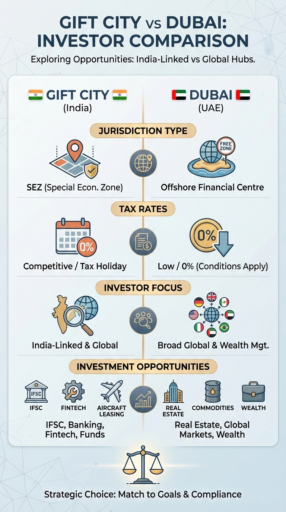
Sí, merece la pena invertir tanto en GIFT City como en Dubai: GIFT City está diseñada para canalizar el capital mundial hacia el crecimiento de la India y Dubai se ha construido para servir de plataforma de inversión diversificada a escala mundial.
GIFT City es idónea para los inversores que buscan una exposición a la expansión económica a largo plazo de la India dentro de un marco normativo alineado a escala mundial, en particular los NRI y las instituciones que persiguen estrategias centradas en la India con posibles eficiencias fiscales.
Dubai, por el contrario, atrae a los inversores centrados en una amplia diversificación internacional, mercados financieros maduros y acceso a una amplia gama de clases de activos mundiales.
Su arraigado ecosistema de inversión ofrece escala, liquidez y estabilidad operativa.
En lugar de decantarse por uno u otro, muchos inversores sofisticados utilizan GIFT City y Dubai como plataformas complementarias dentro de una estrategia diversificada. estrategia de inversión.
¿Cuáles son los riesgos de invertir en Dubai y GIFT City?
Los principales riesgos de invertir en GIFT City están relacionados con su marco normativo en evolución y su exposición al mercado centrado en la India, mientras que los riesgos de Dubai están ligados a los ciclos del mercado mundial y al cambio normativo.
En la Ciudad GIFT, los principales riesgos incluyen la evolución de la normativa a medida que el marco de la IFSC sigue madurando, una profundidad de mercado y una liquidez relativamente limitadas en comparación con centros financieros más antiguos, y el riesgo de concentración derivado de una fuerte concentración en activos indios.
En Dubai, los inversores deben tener en cuenta la exposición a la volatilidad de los mercados mundiales, los posibles ajustes reglamentarios y fiscales a medida que evolucionan las normas internacionales, y los riesgos cíclicos en sectores como el inmobiliario.
Ninguna jurisdicción es intrínsecamente de alto riesgo, pero cada una presenta diferentes formas de exposición que los inversores deben evaluar cuidadosamente en el contexto de su estrategia global de inversión.
¿Cuál es el tipo impositivo para las inversiones en Ciudad GIFT y Dubai?
En Ciudad GIFT, Las entidades que cumplan los requisitos pueden disfrutar de una exención del impuesto de sociedades de 100 % durante 10 de los 15 primeros años de actividad, con un tipo impositivo mínimo de 9 % sobre los beneficios contables cuando no se solicite la exención.
Los ingresos por dividendos pagados a inversores no residentes suelen estar sujetos a una retención en origen en condiciones favorables de alrededor del 10 %, y muchas operaciones de inversión dentro de las bolsas IFSC están exentas del impuesto sobre plusvalías o de impuestos sobre transacciones como el STT y el GST.
En Dubai (EAU), no existe el impuesto sobre la renta de las personas físicas y las ganancias de capital para particulares suelen estar exentas de impuestos; el impuesto de sociedades es de 0 % sobre los beneficios de hasta 375.000 AED y de 9 % sobre los beneficios que superen ese umbral, y las entidades de zona franca que cumplan los requisitos suelen poder mantener un tipo de 0 % sobre los ingresos que cumplan los requisitos.
Los resultados fiscales efectivos varían en función de la estructura, el tipo de activo y la situación de residencia, por lo que los inversores deben planificar con asesoramiento profesional para maximizar la eficiencia.
Conclusión
Desde el punto de vista de la inversión, GIFT City frente a Dubai no es una comparación de suma cero.
GIFT City representa el esfuerzo de la India por retener y atraer capital internacional dentro de un marco nacional regulado, mientras que Dubai sigue siendo un centro de inversión diversificado a escala mundial con un alcance inigualable.
Para los inversores, la cuestión más importante no es qué centro ganará, sino cómo la dirección reguladora, los controles de capital y la alineación geopolítica conforman la flexibilidad a largo plazo.
A nivel mundial control de las estructuras offshore y las historias de crecimiento regional divergen, los inversores que entienden el papel estratégico de cada centro, y los utilizan deliberadamente, están mejor situados para adaptarse a medida que evoluciona el panorama de la inversión.
Preguntas frecuentes
¿Cuál es la riqueza de Dubai en comparación con otras ciudades?
Dubai se cuenta entre las ciudades más ricas del mundo, situándose actualmente en el puesto 18 por el número de personas con grandes patrimonios, con unos 81.200 millonarios residentes y más de 200 centimillonarios ultrarricos.
Esto la sitúa por delante de muchas ciudades mundiales consolidadas en cuanto a concentración de riqueza y subraya su rápido ascenso como importante centro de capitales mundiales y residentes acaudalados.
¿Por qué se considera a Dubai una ciudad global?
Dubai está considerada una ciudad global por su situación estratégica, su conectividad internacional, la diversidad de su población, sus avanzadas infraestructuras y su papel como centro financiero y comercial que enlaza múltiples regiones.
¿Es GIFT City el nuevo rival de Dubai y Singapur?
GIFT City suele describirse como la alternativa emergente de la India a centros financieros consolidados como Dubai y Singapur.
Aunque todavía no es un rival directo en escala, está estratégicamente situado para servir al capital internacional centrado en la India.
¿Es mejor invertir en la India o en Dubai?
Invertir en la India es mejor para los inversores que buscan el crecimiento a largo plazo de una economía nacional en expansión, mientras que Dubai es mejor para los que priorizan la diversificación global y el acceso a mercados financieros maduros.
Cada uno de ellos responde a un objetivo de inversión distinto: India ofrece oportunidades de crecimiento y Dubai estabilidad y alcance internacional.
¿Podemos comprar terrenos en Ciudad REGALO?
No, en general los inversores no pueden comprar terrenos directamente en Ciudad GIFT.
Los terrenos son propiedad de las autoridades, que los asignan, y la mayor parte de la exposición se obtiene a través de arrendamientos a largo plazo o vehículos de inversión, en lugar de la propiedad directa.
¿Le duele la indecisión financiera?

Adam es un autor reconocido internacionalmente en temas financieros, con más de 830 millones de respuestas en Quora, un libro muy vendido en Amazon y colaborador de Forbes.