+44 7393 450837
advice@adamfayed.com
Follow on

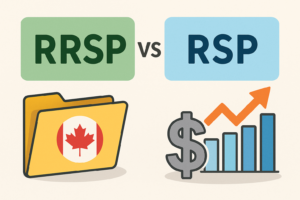
RSP vs RRSP in Canada: Key Differences, Taxes, and Benefits

Understanding the difference between RSP vs RRSP in Canada can help avoid costly mistakes and ensure you’re making the most of your investment.

Many Canadians use these terms interchangeably, but there’s an important distinction between the two.

While both are tools for saving, especially for retirement, they operate differently when it comes to taxation, contribution rules, and how they’re managed.

If you are looking to invest as an expat or high-net-worth individual, which is what I specialize in, you can email me (hello@adamfayed.com) or WhatsApp (+44-7393-450-837).

This includes if you are looking for a second opinion or alternative investments.

Some facts might change from the time of writing. Nothing written here is financial, legal, tax, or any kind of individual advice or a solicitation to invest.

This post will break down the difference between RSP and RRSP, including tax implications, registration details, and other considerations.

Discover How We Can Address Your Financial Pain Points Subscribe Free Discover Now

What is RRSP in Canada?

RSP vs RRSP in Canada - retirement plan
Photo by Kampus Production on Pexels

A Registered Retirement Savings Plan (RRSP) is a government-registered account in Canada designed to help individuals save for retirement.

Contributions made to an RRSP are tax-deductible, meaning they can reduce your taxable income for the year, offering immediate tax savings.

Additionally, investments inside an RRSP grow tax-deferred until withdrawal, allowing savings to compound more efficiently over time.

Some key features of an RRSP include:

  • Tax-deferred growth: Investment earnings such as interest, dividends, and capital gains are not taxed while they remain in the account.
  • Annual contribution limits: The contribution room is based on 18% of your earned income from the previous year, up to a maximum limit set annually by the Canada Revenue Agency (CRA). For 2024, the RRSP contribution limit is CAD 31,560.
  • CRA registration: An RRSP must be formally registered with the CRA to enjoy its tax advantages. Contributions are tracked through your CRA account to ensure compliance with limits.

RRSPs can hold a wide range of investments, including stocks, bonds, mutual funds, GICs, and ETFs, offering flexibility depending on your risk tolerance and retirement goals.

How to Register an RRSP with the CRA

When it comes to registering a Registered Retirement Savings Plan, individual account holders don’t register their RRSPs directly with the Canada Revenue Agency.

Instead, this process is handled by financial institutions (such as banks, credit unions, or investment firms) when you open an RRSP account with them.

What is the Meaning of RSP Funds?

An RSP, or Retirement Savings Plan, is a broad, non-specific term used by financial institutions to refer to retirement-related investment accounts.

In many cases, banks label RRSPs (Registered Retirement Savings Plans) simply as “RSPs” for simplicity in online banking or account statements.

However, this can cause confusion, especially for Canadians trying to track their contribution room or understand their tax obligations.

Note that not all RSPs are officially registered with the Canada Revenue Agency.

This distinction matters: an RRSP is a specific type of RSP that comes with defined tax benefits, government recognition, and contribution tracking.

Meanwhile, a generic RSP could refer to any savings account geared toward retirement without the legal or tax-deferred features of a registered account.

When reviewing your financial portfolio, always confirm whether your “RSP” is truly an RRSP, especially if you’re relying on it for tax deductions or long-term retirement planning.

Discover How We Can Address Your Financial Pain Points Subscribe Free Discover Now

Difference Between RSP and RRSP

While RSP and RRSP are often used interchangeably, there are key distinctions between the two that impact how your retirement savings are managed and taxed.

FeatureRSP (Retirement Savings Plan)RRSP (Registered Retirement Savings Plan)
TerminologyGeneral term used by banks and institutionsOfficial term under the Canadian Income Tax Act
RegistrationMay or may not be registered with CRAAlways registered with CRA
Tax BenefitsNo guaranteed tax benefitsContributions are tax-deductible; investments grow tax-deferred
Contribution RoomNot monitored by CRASubject to CRA-assigned annual limit
Withdrawal RulesVaries by account typeSpecific rules; early withdrawal may trigger taxes

RSP vs RRSP Tax Return: What You Should Know

When it comes to taxes, RRSP contributions can significantly reduce your taxable income.

This means that the more you contribute to your RRSP, the lower your income tax bill for the year.

This is one of the major tax benefits of using RRSPs as part of your retirement savings plan.

By contributing to your RRSP, you are deferring taxes until you withdraw funds, usually during retirement, when your income might be lower.

Are RSP Contributions Tax-Deductible?

In Canada, only contributions to Registered Retirement Savings Plans are eligible for tax deductions.

This means that if your “RSP” is not officially registered with the Canada Revenue Agency, your contributions won’t lower your taxable income.

Many financial institutions use the term “RSP” as a catch-all label for retirement savings products, which can lead to confusion.

Just because your account is called an RSP doesn’t guarantee it’s CRA-registered.

To confirm whether your RSP is officially recognized as an RRSP:

  • Log in to your CRA My Account to check your RRSP deduction limit and contribution history.
  • Ask your bank or advisor if your RSP is registered with the CRA.
  • Review your account paperwork for RRSP-specific language and CRA reporting details.

Mislabeling your RSP as an RRSP can have serious tax implications.

Financial institutions may mistakenly call an RRSP an “RSP” on statements or marketing materials, causing confusion about its registration status.

If the account is not properly registered with the CRA as an RRSP, it won’t qualify for the tax advantages provided by the Income Tax Act.

This means you could lose out on tax deductions and tax deferral benefits which may lead to unexpected tax liabilities and penalties when filing your returns.

RSP vs RRSP Withdrawals Tax

When it comes to withdrawals, both RRSP and RSP plans (if registered) are subject to taxation.

However, RRSPs are taxed as ordinary income when withdrawn, meaning the amount you withdraw is added to your income for that year and taxed at your marginal tax rate.

The same applies to RSPs if they are recognized by the CRA, but the taxation is dependent on the specific rules set by the institution offering them.

It’s important to consult with your financial advisor or institution to understand exactly how and when you’ll be taxed on withdrawals.

In short, contributing to an RRSP helps reduce your taxable income in the short term, but withdrawals will be taxed when you take the money out, generally in retirement.

RSP vs RRSP Canada: Conclusion

Understanding the tax benefits and risks associated with RSPs and RRSPs is crucial for optimizing your retirement savings strategy in Canada.

Make sure that any contributions to your RRSP are accurately recorded, and be mindful of the withholding taxes when you make withdrawals.

Proper management of these factors can maximize your savings and ensure you’re getting the most from your RRSP in terms of tax benefits.

Pained by financial indecision?

Adam Fayed Contact CTA3

Adam is an internationally recognised author on financial matters with over 830million answer views on Quora, a widely sold book on Amazon, and a contributor on Forbes.

Deja una respuesta

Tu dirección de correo electrónico no será publicada. Los campos obligatorios están marcados con *

This URL is merely a website and not a regulated entity, so shouldn’t be considered as directly related to any companies (including regulated ones) that Adam Fayed might be a part of.

This Website is not directed at and should not be accessed by any person in any jurisdiction – including the United States of America, the United Kingdom, the United Arab Emirates and the Hong Kong SAR – where (by reason of that person’s nationality, residence or otherwise) the publication or availability of this Website and/or its contents, materials and information available on or through this Website (together, the “Materials“) is prohibited.

Adam Fayed makes no representation that the contents of this Website is appropriate for use in all locations, or that the products or services discussed on this Website are available or appropriate for sale or use in all jurisdictions or countries, or by all types of investors. It is your responsibility to be aware of and to observe all applicable laws and regulations of any relevant jurisdiction.

The Website and the Material are intended to provide information solely to professional and sophisticated investors who are familiar with and capable of evaluating the merits and risks associated with financial products and services of the kind described herein and no other persons should access, act on it or rely on it. Nothing on this Website is intended to constitute (i) investment advice or any form of solicitation or recommendation or an offer, or solicitation of an offer, to purchase or sell any financial product or service, (ii) investment, legal, business or tax advice or an offer to provide any such advice, or (iii) a basis for making any investment decision. The Materials are provided for information purposes only and do not take into account any user’s individual circumstances.

The services described on the Website are intended solely for clients who have approached Adam Fayed on their own initiative and not as a result of any direct or indirect marketing or solicitation. Any engagement with clients is undertaken strictly on a reverse solicitation basis, meaning that the client initiated contact with Adam Fayed without any prior solicitation.

*Muchos de estos activos están siendo gestionados por entidades en las que Adam Fayed tiene participaciones personales, pero a las que no presta asesoramiento personal.

Este sitio web se mantiene con fines de marca personal y está destinado únicamente a compartir las opiniones personales, experiencias, así como la trayectoria personal y profesional de Adam Fayed.

Capacidad personal
Todos los puntos de vista, opiniones, afirmaciones, ideas o declaraciones expresadas en este sitio web son realizadas por Adam Fayed a título estrictamente personal. No representan, reflejan o implican ninguna posición oficial, opinión o respaldo de ninguna organización, empleador, cliente o institución con la que Adam Fayed esté o haya estado afiliado. Nada de lo contenido en este sitio web debe interpretarse como realizado en nombre o con autorización de ninguna de dichas entidades.

Avales, afiliaciones u ofertas de servicios
Algunas páginas de este sitio web pueden contener información general que le ayude a determinar si reúne los requisitos necesarios para contratar los servicios profesionales de Adam Fayed o de cualquier entidad en la que Adam Fayed trabaje, ocupe un cargo (como consejero, directivo, empleado o consultor), tenga una participación accionarial o financiera, o con la que Adam Fayed tenga algún otro tipo de relación profesional. No obstante, dichos servicios, ya sean ofrecidos por Adam Fayed a título profesional o por cualquier entidad afiliada, se prestarán de forma totalmente independiente a este sitio web y estarán sujetos a términos, condiciones y procesos de contratación formales distintos. Nada de lo contenido en este sitio web constituye una oferta de prestación de servicios profesionales, ni debe interpretarse como la formación de una relación de cliente de ningún tipo. Toda referencia a terceros, servicios o productos no implica aprobación ni asociación, a menos que se indique explícitamente.

*Muchos de estos activos están siendo gestionados por entidades en las que Adam Fayed tiene participaciones personales, pero a las que no presta asesoramiento personal.

Confirmo que no resido actualmente en Estados Unidos, Puerto Rico, Emiratos Árabes Unidos, Irán, Cuba ni ningún país fuertemente sancionado.

Si vive en el Reino Unido, confirme que cumple una de las siguientes condiciones:

1. Grandes patrimonios

Hago esta declaración para poder recibir comunicaciones promocionales exentas

de la restricción de promoción de valores no realizables inmediatamente.

La exención se refiere a los inversores certificados de alto patrimonio neto y declaro que reúno los requisitos para serlo porque se me aplica al menos una de las siguientes condiciones:

He tenido, durante todo el ejercicio inmediatamente anterior a la fecha que figura a continuación, unos ingresos anuales

por valor de 100.000 libras esterlinas o más. Los ingresos anuales a estos efectos no incluyen el dinero

retiradas de mis ahorros para pensiones (excepto cuando las retiradas se utilicen directamente para

ingresos en la jubilación).

Poseía, durante todo el ejercicio inmediatamente anterior a la fecha indicada a continuación, activos netos al

valor igual o superior a 250.000 libras esterlinas. A estos efectos, el patrimonio neto no incluye la propiedad que constituye mi residencia principal ni el dinero obtenido mediante un préstamo garantizado con dicha propiedad. Ni ningún derecho que me corresponda en virtud de un contrato o seguro admisible en el sentido de la Ley de Servicios y Mercados Financieros de 2000 (Actividades Reguladas) de 2001;

  1. c) o Cualesquiera prestaciones (en forma de pensiones o de otro tipo) que sean pagaderas sobre la

cese de mis funciones o en caso de fallecimiento o jubilación y a la que estoy (o mi

dependientes), o puede tener derecho a ello.

2. Inversor autocertificado

Declaro que soy un inversor sofisticado autocertificado a efectos de la

restricción a la promoción de valores no realizables inmediatamente. Entiendo que esta

significa:

i. Puedo recibir comunicaciones promocionales realizadas por una persona autorizada por

la Autoridad de Conducta Financiera que se refieren a la actividad de inversión en activos no listos para la venta.

valores realizables;

ii. Las inversiones a las que se refieran las promociones pueden exponerme a un importante

riesgo de perder todos los bienes invertidos.

Soy un inversor sofisticado autocertificado porque se da al menos una de las siguientes circunstancias:

a. Soy miembro de una red o sindicato de business angels y lo he sido durante

al menos los últimos seis meses anteriores a la fecha que figura a continuación;

b. He realizado más de una inversión en una empresa que no cotiza en bolsa en los dos años

antes de la fecha indicada a continuación;

c. Estoy trabajando, o he trabajado en los dos años anteriores a la fecha que figura a continuación, en un

profesional en el sector del capital privado, o en la provisión de financiación para

pequeñas y medianas empresas;

d. Actualmente soy, o he sido en los dos años anteriores a la fecha indicada a continuación, administrador de una empresa con un volumen de negocios anual de al menos 1 millón de libras esterlinas.

Adam Fayed no tiene su sede en el Reino Unido ni está autorizado por la FCA o la MiFID.

Adam Fayed utiliza cookies para mejorar su experiencia de navegación, ofrecer contenidos personalizados basados en sus preferencias y ayudarnos a comprender mejor cómo se utiliza nuestro sitio web. Al continuar navegando por adamfayed.com, acepta el uso que hacemos de las cookies.

Si no da su consentimiento, será redirigido fuera de este sitio, ya que dependemos de las cookies para la funcionalidad básica.

Más información en nuestro Política de privacidad.

SUSCRÍBETE A ADAM FAYED ÚNASE A INMENSA ABONADOS DE ALTO PODER ADQUISITIVO

SUSCRÍBETE A ADAM FAYED ÚNASE A INMENSA ABONADOS DE ALTO PODER ADQUISITIVO

Acceda gratuitamente a los dos libros de Adam sobre expatriación.

Acceda gratuitamente a los dos libros de Adam sobre expatriación.

Obtenga más estrategias cada semana sobre cómo ser más productivo con sus finanzas.