In the rapid digital economy of today, payment websites online are crucial modes of operation for freelancers, consumers, and businesses.
We explain in this article a comprehensive comparison of two giants in the market: PayPal vs Payoneer.
We examine their fee structure, international reach, security measures, and user experience to give you a complete, balanced view.
Si desea invertir como expatriado o particular con un elevado patrimonio neto, que es en lo que estoy especializado, puede enviarme un correo electrónico (advice@adamfayed.com) o WhatsApp (+44-7393-450-837).
Esto incluye si busca una segunda opinión o alternativas.
Algunos hechos pueden cambiar desde el momento de la redacción, y nada de lo aquí escrito constituye asesoramiento financiero, jurídico, fiscal o de cualquier otro tipo, ni una invitación a invertir.

PayPal Background
PayPal was developed in 1998 (then Confinity) by Max Levchin, Peter Thiel, and Luke Nosek, before the merger with Elon Musk’s X.com in 2000.
It was the first online payment system widely utilized and later was acquired by eBay in 2002 before once again conducting business separately in 2015.
What PayPal does
- Transferencias de fondos nacionales y transfronterizas
- Servicios de procesamiento de pagos en línea para empresas
- Programas de protección del comprador y del vendedor
- PayPal Facilidades de financiación a crédito
- Compra, tenencia y venta de criptomonedas
- Cuentas PayPal Business con funciones mejoradas
- Integración de soluciones de comercio electrónico
Payoneer Background
Payoneer was started in 2005 by Yuval Tal in New York.
The firm was founded to cater to the cross-border payment requirements of freelancers, small businesses, and digital marketplaces.
How Payoneer works
- Aceptación de pagos de más de 200 países de todo el mundo
- Facilidades de pago masivo para empresas y mercados
- Cuentas multidivisa con facilidades de recepción locales
- Tarjeta prepago Mastercard para gastos de ingresos
- Productos de capital circulante y financiación
- Soluciones de pago del IVA para empresas internacionales
- Amplia integración de mercados como Amazon, Airbnb y Upwork
Which has better rates, PayPal or Payoneer?
What does PayPal charge?
PayPal operates on a model with flat fees along with percentage fees depending on transaction type and geography.
No charge for domestic personal payments from a bank account or PayPal balance, beneficial when sending money to family and friends.
But for card-based transfers, it charges a various percentage depending on the country (e.g. 2.9% or 3.4%) with a flat fee added on top of that ($0.30 in the US).
PayPal levies withdrawal fees from bank accounts in some locations, mostly non-US and European destinations.
The platform charges extra fees for merchants on chargebacks ($20) payment disputes ($15), and record requests ($10-30).
PayPal implemented its biggest fee hike in a decade on Jan. 13, 2025. It raised processing fees on Pay Later instruments to 4.99% plus flat per-transaction fees from 3.49%. This 43% price increase makes PayPal’s buy-now-pay-later (BNPL) financing its most profitable payment method, exceeding its standard credit-card-processing fees.
Merchant opt-out options continue to be accessible via account settings, though adoption issues continue because of checkout conversion rate dependencies.
Small companies must be careful about the cumulative effect of the charges because they will significantly lower margins on low-value products.
Convenience and general acceptance come through PayPal.
Nevertheless, percentage charges, fixed charges, and foreign exchange charges put international business in a fairly high-cost situation.
Consulte Resumen detallado de las tarifas de PayPal para obtener estimaciones precisas.
What are Payoneer fees?
It is free, but Payoneer charges 29.95 USD cuota anual para todos los clientes si su cuenta está inactiva después de 12 meses (menos de 2.000 USD recibidos).
Receiving payment via Payoneer’s Global Payment Service is free when consumers pay in currencies supported by the service via local bank transfer.
Receiving payment to your Payoneer account from another user’s Payoneer balance is free; however, receiving money with debit or credit cards incur a charge of 1%~3.99%.
These options for receiving money are flexible but with different cost implications.
Payoneer withdrawals to a bank account usually incur $1.50 for in-country withdrawals (up to a threshold of 50,000 USD/GBP/EUR) and up to 3% of transaction amount for international withdrawals.
The Payoneer Mastercard for spending account balances directly charges a $3.15 ATM withdrawal fee in addition to any fees imposed by the ATM operator.
Card purchases involve a foreign transaction fee of 3.5% if purchases are being made in a currency other than the native currency of the card.
Enterprise accounts (> $1M volume) get dedicated FX hedging instruments and batch payment APIs with 0.3% conversion fees.
Investments in 2025 by the company address real-time payment capacity in 15 emerging economies, which might lower correspondent banking expenses.
Consulte Tarifas de Payoneer para obtener estimaciones precisas.
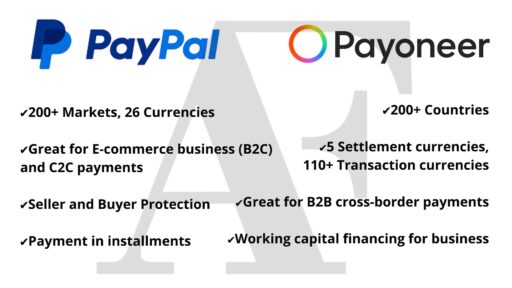
Which is better, PayPal or Payoneer?
PayPal can be used in over 200 countries and 26 currencies, so it is among the most available payment systems in the globe.
The service facilitates instant PayPal-to-PayPal transfers, while bank transfers occur within 1-3 business days.
PayPal Seller Protection helps businesses deal with fraud risk, while Buyer Protection ensures purchase protection for buyers.
The firm has expanded its services significantly to provide point-of-sale solutions through PayPal Here and QR code payments.
Payoneer is dedicated to supporting the international freelance economy and cross-border e-commerce.
Its Global Payment Service offers customers local bank-receiving accounts in various currencies. Hence, it enables them to receive payments as a local business.
This greatly lowers fees for those who receive foreign payments on a regular basis.
The Payoneer Mastercard offers access to direct funds without bank transfers, although it does have foreign transaction fees.
Conclusión
Our comparison highlights the point that both PayPal and Payoneer possess unique strengths to offer.
PayPal’s global acceptance and ease of integration with many online platforms make a strong argument for everyday transactions and e-commerce enterprises.
On the other hand, Payoneer’s cost-effective solution and customized solutions for global businesses and freelancers provide robust benefits.
Particularly for those that are involved with multiple international markets.
But ultimately, the best choice is dependent upon your individual needs and transactional habits.
As is the case with any significant financial choice, be sure to research in advance before deciding on a platform.
We hope this last comparison to be the strong foundation that will guide your decision, allowing you to choose the payment solution that best supports your strategic objectives.
¿Le duele la indecisión financiera?

Adam es un autor reconocido internacionalmente en temas financieros, con más de 830 millones de respuestas en Quora, un libro muy vendido en Amazon y colaborador de Forbes.