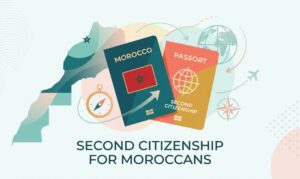
Moroccans can obtain a second citizenship in countries like Portugal or Spain without losing their Moroccan nationality.
Second citizenship offers increased travel freedom, personal security, and global opportunities.
Questo articolo tratta di:
- Why do people leave Morocco?
- Is Morocco a strong passport?
- Which country is best for second citizenship?
- Is there a downside to dual citizenship?
Punti di forza:
- Morocco allows multiple citizenships, but rules vary abroad.
- A second passport can vastly increase travel and business opportunities.
- Portugal, Spain, and Caribbean nations are top options for Moroccans.
- Dual citizenship has benefits and minor legal or tax considerations.
I miei recapiti sono hello@adamfayed.com e WhatsApp +44-7393-450-837 se avete domande.
Per i visti per nomadi digitali o di residenza che richiedono un reddito, un patrimonio o investimenti qualificati, possiamo aiutarvi a strutturare soluzioni di investimento adatte a soddisfare tali requisiti, a seconda delle vostre circostanze.
Le informazioni contenute in questo articolo hanno un valore puramente indicativo. Non costituiscono consulenza finanziaria, legale o fiscale e non rappresentano una raccomandazione o una sollecitazione a investire. Alcuni fatti potrebbero essere cambiati dal momento della stesura.

Does Morocco allow multiple citizenships?
Yes, Morocco permits dual or multiple citizenships. Moroccan nationality law does not require citizens to renounce their Moroccan nationality if they do so.
This means Moroccans can legally hold a second passport from countries such as Portugal, Spain, Malta, or others without automatically losing their Moroccan nationality.
Il Moroccan Nationality Code (Dahir No. 1-58-250 of 1958) provides the legal framework for citizenship, and it allows natural-born Moroccans to acquire foreign citizenship while retaining their Moroccan status.
However, Moroccan authorities expect citizens to inform them if they acquire another nationality.
It is important to note that while Morocco allows dual citizenship, the rules of the other country also matter.
Some countries may restrict dual nationality, require disclosure, or impose obligations such as taxation or military service.
Therefore, Moroccans considering a second citizenship should check the laws of both Morocco and the country where they seek citizenship to avoid legal or administrative complications.
Is a Moroccan passport powerful?
The Moroccan passport allows visa-free or visa-on-arrival access to 71 countries, ranking it 62nd on the Henley Passport Index 2026.
This provides moderate travel freedom, particularly across Africa, parts of the Middle East, and some European countries.
While it offers regional mobility and facilitates business or personal travel within certain areas, it is less powerful than passports from Western Europe, North America, or Asia, which allow access to over 180 countries.
Moroccans seeking greater global mobility often consider a second citizenship to expand visa-free travel, improve international business opportunities, and enhance personal security abroad.
What is the best second citizenship?
For Moroccans, the best second citizenship is one that provides strong travel freedom, financial advantages, and long-term security for themselves and their families.
Le considerazioni principali includono:
- Visa-free travel: Access to more countries without frequent visa applications.
- Efficienza fiscale: Some citizenships offer favorable tax regimes.
- Qualità della vita: Healthcare, education, and safety standards.
- Ease of acquisition: Residency, investment, or heritage-based programs.
- Inclusione della famiglia: Ability to include spouses and children.
Which country is best for a second passport?
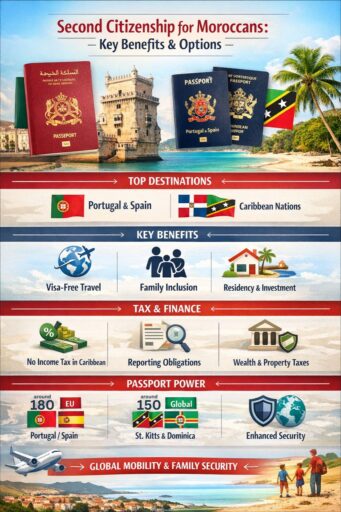
For Moroccans, top choices for a second passport include Portugal and Spain, offering EU access, strong visa-free travel, and family inclusion.
Portugal – Best for EU Citizenship & Quality of Life
A Portuguese passport grants access to one of the most powerful travel documents in the world, with visa‑free or visa‑on‑arrival access to around 180 countries, including travel throughout the EU and Schengen Area.
Portuguese citizens enjoy full EU rights along with access to high‑quality public healthcare, education, and social services.
Doppia cittadinanza is permitted, and citizenship also includes political rights such as voting and consular protection abroad.
Best paths to Portuguese citizenship:
- Residency by investment (Visto d'oro): Legal residency leading to citizenship after 5 years.
- Legal residence via work, study, or family reunification: Citizenship after 5 years of continuous residency.
- Descent o marriage: Citizenship via Portuguese parent or spouse (shorter timelines possible).
Spain – Best for Long-Term Residency
A Spanish passport is one of the world’s strongest, offering visa‑free or visa‑on‑arrival access to around 180 countries, ideal for frequent travel, business, or family visits.
As an EU member state, Spanish citizenship provides unconditional rights to live, work, and study across all EU countries, and citizens benefit from robust public services, including healthcare and education.
Spain’s cultural and linguistic connections with Morocco can also ease integration for Moroccan families settling long‑term.
Best paths to Spanish citizenship:
- Legal residence in Spain: Citizenship after 10 years of residency (2 years for Ibero-American nationals, including Moroccans).
- Marriage to a Spanish citizen: Citizenship after 1 year of marriage and residence.
- Descent: Citizenship via Spanish parent or grandparent, often with faster processing.
St. Kitts & Nevis – Fast Citizenship by Investment
St. Kitts & Nevis offers one of the fastest routes to a second passport, with citizenship available in about 4–6 months.
The passport provides visa-free or visa-on-arrival access to around 150 countries, and applicants can include spouses, children, and sometimes parents, with no physical residency requirement.
This makes it ideal for Moroccans seeking rapid global mobility.
Best paths to St. Kitts & Nevis citizenship:
- Economic contribution: Minimum US$250,000 donation to the Sustainable Island State Fund.
- Real estate investment: Minimum US$325,000 in approved development projects.
- Family inclusion: Spouses, children, and in some cases parents can be added to the application.
Dominica – Affordable and Accessible
Dominica’s citizenship by investment program offers Moroccans a relatively affordable and efficient way to obtain a second passport, typically within a few months, with no residency requirement.
A Dominican passport provides visa‑free or visa‑on‑arrival access to around 140 countries, including the EU’s Schengen Area and many other major destinations, making it a cost‑effective option for global mobility.
The program also allows dual citizenship and the inclusion of family members, and citizenship is granted for life without needing to live in Dominica.
Best paths to Dominica citizenship:
- Economic contribution: Minimum US $200,000 donation to the country’s Economic Diversification Fund.
- Government‑approved real estate investment: Minimum US $200,000 in qualifying property.
- Family inclusion: Spouses, dependent children, and certain older parents can be added to the application.
Where do most Moroccans migrate to?
Il largest Moroccan diaspora communities are mainly in France and Spain, with France hosting over 1 million Moroccans and Spain around 900,000, making them the top destinations in Europe.
European countries collectively host roughly 90 % of Moroccans living abroad, with Belgium (about 700,000) and the Netherlands (around 415,000) also being major hubs due to strong employment opportunities and family networks.
Sizable communities exist in Italy and Germany as well, often concentrated in urban areas with established Moroccan neighborhoods.
Outside Europe, Canada has a growing Moroccan population attracted by education, work opportunities, and quality of life, making it a key non-European destination for Moroccan emigrants.
Why do people immigrate from Morocco?
Many Moroccans choose to immigrate primarily for economic and professional reasons.
Afrobarometer surveys show that around 50 % of Moroccans thinking about leaving the country cite job opportunities as their main motivation, with others seeking better business prospects or escaping economic hardship.
Europe and North America are the most preferred destinations for those considering emigration.
Morocco has a long‑established diaspora, with around 5 million Moroccans living abroad, mostly in European countries such as France and Spain.
The economic gap between Morocco and more advanced economies drives many young adults to look for higher wages, better working conditions, and greater career mobility abroad.
Education is another strong factor: a significant number of Moroccans leave to pursue higher education opportunities overseas, especially when they feel limited by the options available at home.
This trend includes highly skilled professionals, such as doctors and engineers, some of whom remain abroad after training, contributing to brain drain.
Other reasons include family reunification, quality of life considerations like healthcare and public services, and in some cases the desire for greater political freedom or social opportunities.
While Morocco has made progress in economic and social development, persistent structural challenges, especially youth unemployment, continue to fuel migration aspirations.
Is there a downside to dual citizenship?
For Moroccans, dual citizenship can create tax obligations in multiple countries, along with other legal and travel-related challenges.
- Mandatory taxation or reporting in multiple countries: Some countries require citizens to report global income or pay taxes even if they reside elsewhere. This can create complex financial obligations and may require hiring a tax professional.
- Military service obligations: Certain nations mandate military service for their citizens. Dual citizenship could mean potential liability for service in both countries, depending on the laws.
- Legal complications from conflicting laws: Dual citizens may encounter situations where one country’s laws conflict with the other’s. This can affect contracts, inheritance, or personal legal matters.
- Travel restrictions or recognition issues: Some countries do not recognize dual citizenship, which can lead to visa complications or entry restrictions. It may also limit consular assistance while abroad.
Tax and Financial Planning for Moroccan Dual Citizens
For Moroccans considering a second citizenship, understanding tax obligations is a crucial strategic factor that can affect long-term pianificazione finanziaria.
In Morocco, individuals who are tax residents are subject to personal income tax on worldwide income, with progressive rates up to about 38 %, and relief may be available under double-tax treaties.
Tax policies vary widely across potential second citizenship countries, and citizenship does not automatically determine tax residency; that is usually based on where you live and spend time.
In many Caribbean citizenship‑by‑investment (CBI) jurisdictions such as St. Kitts & Nevis and Dominica, there is no personal income tax on worldwide income for non-residents, no capital gains tax, and no inheritance or imposte sul patrimonio.
European countries like Portugal and Spain tax worldwide income for residents.
Moroccans planning international investments, business activities, or retirement abroad should carefully consider how their new citizenship interacts with residency rules, local taxes, and reporting requirements.
Consulting with cross-border tax professionals can help prevent costly errors, ensure compliance, and optimize the financial benefits of a second citizenship.
Conclusione
For Moroccans, a second citizenship represents a strategic gateway to expanded personal freedom, global mobility, and enhanced family security.
Choosing the right country involves evaluating not only visa access and investment pathways but also long-term quality of life, legal protections, and opportunities for education and career growth.
While dual nationality brings significant advantages, it also requires awareness of potential tax obligations, legal complexities, and cultural integration challenges.
The decision to pursue a second citizenship reflects a proactive approach to managing uncertainty and shaping one’s future in an interconnected world.
Ultimately, the most successful second citizenship is one that aligns with personal priorities, balances risk and benefit, and provides the flexibility to navigate opportunities across borders.
Domande frequenti
What are the benefits of a Moroccan passport?
A Moroccan passport allows visa-free or visa-on-arrival access to around 80 countries and enables citizens to live and work in Morocco as well as some neighboring African nations.
It also provides cultural and economic connectivity with Europe and the Middle East.
What are the top 10 strongest passports?
Il strongest passports in 2026, according to sources like the Henley Passport Index, include Singapore, Japan, South Korea, UAE, Sweden, Belgium, Germany, Denmark, Finland, and France though rankings can differ depending on the index used.
Holders of these passports enjoy visa-free or visa-on-arrival access to the most countries globally, giving them significant travel freedom.
What are the top 10 weakest passports?
Il passaporti più deboli nel 2026 include Afghanistan, Syria, Iraq, Yemen, Pakistan, Somalia, North Korea, Nepal, Bangladesh, and Eritrea, though rankings can vary.
Holders of these passports have very limited visa-free or visa-on-arrival access, restricting international travel and mobility.
Siete afflitti dall'indecisione finanziaria?

Adam è un autore riconosciuto a livello internazionale in materia finanziaria con oltre 830 milioni di visualizzazioni di risposte su Quora, un libro molto venduto su Amazon e un contributo su Forbes.