The best offshore countries for crypto companies include the United Arab Emirates, Cayman Islands, and British Virgin Islands, all of which combine regulatory clarity, tax efficiency, and strong financial infrastructure.
These jurisdictions attract exchanges, crypto funds, and Web3 startups seeking global scalability and legal certainty.
Questo articolo tratta di:
- Where are most crypto companies incorporated?
- What countries are safe havens for crypto?
- What is the best jurisdiction for crypto companies?
- What are the challenges of offshoring?
Punti di forza:
- Regulatory clarity matters more than zero tax alone.
- The UAE, Cayman Islands, and BVI remain top offshore hubs.
- Banking access is often the biggest operational hurdle.
- Offshore success is based on compliance, substance, and long-term credibility.
I miei recapiti sono hello@adamfayed.com e WhatsApp +44-7393-450-837 se avete domande. Offriamo anche soluzioni di strutturazione su misura per la vostra situazione.
Le informazioni contenute in questo articolo hanno carattere puramente indicativo, non costituiscono una consulenza finanziaria, legale o fiscale e possono essere cambiate rispetto al momento in cui sono state scritte.

What is an offshore country?
An offshore country is a jurisdiction that provides favorable conditions for foreign businesses, investors, and individuals to operate with minimal tax obligations on income earned outside the country.
Offshore jurisdictions are commonly used for international company formation, asset protection, and global investment structures.
Key characteristics of offshore countries include:
- Low or zero taxes on foreign‑source income: Companies and individuals typically pay little to no tax on profits generated outside the jurisdiction.
- Flexible corporate structures: Offshore jurisdictions allow for simple company formation with minimal reporting requirements and the ability to hold shares privately.
- Confidentiality and privacy: Many offshore countries offer strong privacy protections for company owners, shareholders, and bank account holders.
- Ease of international business: Offshore countries often have efficient company registration processes, access to global banking, and legal systems that support cross-border transactions.
- Limited local economic integration: Offshore entities generally do not participate in the local domestic market, reducing regulatory burdens and local tax liabilities.
It’s important to note that being offshore does not mean unregulated or illegal.
Most reputable offshore jurisdictions comply with international anti-money laundering (AML) and know-your-customer (KYC) rules while providing a tax-efficient, business-friendly environment for international operations.
What Makes a Country Crypto-Friendly?
A crypto-friendly country provides the legal clarity, infrastructure, and tax treatment needed for businesses to operate confidently.
Key features include:
- Clear regulatory frameworks for digital assets and exchanges
- Licensing for VASPs, exchanges, and token issuers
- Competitive or zero corporate and capital gains taxes
- Reliable banking and fintech infrastructure
- Political and legal stability
Jurisdictions that combine these features attract crypto exchanges, Web3 startups, fondi speculativi, and token issuance platforms, creating a robust ecosystem for digital asset innovation.
What Are Crypto Companies?
Crypto companies include cryptocurrency exchanges, blockchain development firms, Web3 startups, crypto hedge funds, token issuance platforms, custody providers, and DeFi protocol teams.
These businesses operate across different segments of the digital asset ecosystem, from trading and asset management to infrastructure development and decentralized applications.
For example, exchanges facilitate buying and selling of digital assets, while custody providers secure client holdings using institutional-grade security systems.
Blockchain development firms build protocols, smart contracts, and enterprise solutions, and crypto hedge funds actively manage digital asset portfolios for investors.
Many of these companies operate globally and often adopt offshore structures to optimize taxation, regulatory positioning, and cross-border scalability.
Which Country Is Best for Crypto Business?
The United Arab Emirates and the Cayman Islands are among the top offshore jurisdictions for crypto businesses, offering clear regulations, tax efficiency, and robust financial infrastructure.
Several other offshore hubs also rank highly:
1. Cayman Islands
Strengths:
- Tax neutrality: No corporate tax on foreign‑source income.
- Investor credibility: Well recognized by institutional investors and fund managers.
- Ease of incorporation: Efficient company formation and strong legal framework.
Considerations:
- Limited local workforce; operational substance may be required.
- Banking for crypto companies can be challenging.
Best Practices:
- Partner with local law firms experienced in crypto fund structures.
- Maintain strong compliance documentation for international investors.
2. British Virgin Islands (BVI)
Strengths:
- Flexible structures: Flexible corporate setups, tax neutrality, and strong confidentiality for crypto companies.
- Crypto-friendly holdings: Popular for token issuers, holding companies, and international crypto fund structures.
- Quick incorporation: Fast and straightforward company formation process, ideal for blockchain businesses.
Considerations:
- Limited domestic banking and financial infrastructure for crypto.
- Increasing global scrutiny on offshore jurisdictions requires careful compliance.
Best Practices:
- Work with registered BVI corporate service providers to maintain good standing.
- Keep proper documentation to satisfy international investors and regulators.
3. Mauritius
Strengths:
- Efficienza fiscale: Low or zero tax on foreign-source income for IBCs.
- Legal system: English-language common law framework supports international business.
- Emerging crypto ecosystem: Growing fintech and blockchain adoption.
Considerations:
- Limited crypto-specific banking locally.
- Offshore reputation may require transparency to attract international investors.
Best Practices:
- Establish local substance with directors and office presence.
- Partner with service providers experienced in crypto structures.
4. Labuan, Malaysia
Strengths:
- Low-cost incorporation: Tax-efficient corporate structures for holding companies and funds.
- Simple licensing: Clear reporting and administration for fintech and digital asset businesses.
- International flexibility: Suitable for fund vehicles or holding companies.
Considerations:
- Smaller ecosystem compared with UAE or Singapore.
- Limited local banking and investor recognition.
Best Practices:
- Ensure operational substance to meet Labuan FSA requirements.
- Focus on fund or holding company structures for international operations.
5. Bermuda
Strengths:
- Tax neutrality: No corporate tax on foreign-source income.
- Crypto-specific regulation: Digital Asset Business Act (DABA) licenses VASPs, token issuers, and exchanges.
- Transparent legal system: Strong protections for investors and companies.
Considerations:
- High operating costs compared with some other offshore jurisdictions.
- Banking and financial services for crypto may require careful planning.
Best Practices:
- Engage local legal and compliance advisors familiar with DABA.
- Maintain clear AML/KYC processes and robust investor documentation.
6. Jersey (Channel Islands)
Strengths:
- Efficienza fiscale: No capital gains tax, low corporate tax on non-local income.
- Legal framework: Strong English common law system suitable for international business.
- Crypto fund support: Licensing available for crypto investment vehicles and token structures.
Considerations:
- Smaller local market and workforce.
- Regulatory compliance and substance requirements apply for certain structures.
Best Practices:
- Work with licensed Jersey corporate and fund service providers.
- Ensure proper documentation and operational substance for international investors.
7. Isle of Man
Strengths:
- Tax efficiency: Low corporate tax on foreign-source profits.
- Crypto regulation: Established framework for VASPs, exchanges, and blockchain projects.
- Reputation: Transparent, reputable jurisdiction with strong investor confidence.
Considerations:
- Smaller domestic workforce and financial services ecosystem.
- Compliance and reporting required to maintain licensing.
Best Practices:
- Partner with local service providers experienced in crypto company setups.
- Maintain operational substance and robust governance processes.
What Are the Benefits of Offshore Companies?
The main benefits of offshore companies for crypto businesses include tax efficiency, regulatory flexibility, and stronger protezione dei beni.
Offshore structuring can significantly reduce corporate tax exposure, especially in jurisdictions that impose zero or low corporate income tax and no capital gains tax.
In addition, some offshore countries offer clearer and more specialized crypto licensing frameworks than restrictive onshore markets.
Offshore entities can also enhance legal separation between founders and business liabilities, improving risk management.
Because crypto operations are inherently global, offshore incorporation often supports cross-border transactions, fundraising, and international expansion.
Finally, jurisdictions such as the Cayman Islands are widely recognized and accepted by institutional investors.
What Are the Challenges of Offshoring?
The main challenges of offshoring for crypto companies include banking difficulties, rising compliance costs, and evolving regulatory risks.
Securing and maintaining reliable conti bancari remains one of the biggest operational hurdles, as many financial institutions remain cautious about servicing digital asset businesses.
Regulatory frameworks for crypto continue to change rapidly, and jurisdictions that are friendly today may tighten requirements unexpectedly.
Licensing, AML, and ongoing reporting obligations can also become costly and resource-intensive.
In addition, certain offshore locations may carry reputational concerns with regulators, counterparties, or institutional investors.
Economic substance rules may further require local directors, physical offices, or demonstrable operational presence, making offshore structuring a strategic decision rather than purely a tax-driven one.
Which Country Has the Most Offshore Companies?
The British Virgin Islands and the Cayman Islands are historically among the jurisdictions with the highest number of offshore companies.
The BVI registry has reported hundreds of thousands of active companies, with estimates in recent years ranging from roughly 360,000 to over 600,000 incorporated entities under its International Business Companies framework.
The Cayman Islands, while smaller in population, hosts over 100,000 registered companies, reflecting its position as a leading offshore financial center.
Both jurisdictions are widely used for fondi di investimento, holding companies, structured finance vehicles, and increasingly, crypto-related entities due to their tax-neutral status and established legal systems.
Comparing Offshore Regions for Crypto Companies
Rather than focusing on individual countries, this comparison highlights regional trends, regulatory philosophies, and operational ecosystems that influence crypto business success.
Key Comparative Factors Across Regions
Regulatory Approach:
- Middle East (UAE): Proactive, flexible, with dedicated free zones for crypto operations; not technically offshore.
- Caribbean (Cayman, BVI, Bermuda): Tax-neutral, investor-friendly, strong fund structuring capabilities, but crypto banking access can be limited.
- Indian Ocean / Asia-Pacific (Mauritius, Labuan, Isle of Man, Jersey): True offshore jurisdictions with tax efficiency, digital-friendly administration, and emerging crypto frameworks.
- Europe (crypto-friendly alternatives – Malta, Switzerland, Gibraltar): Strict, transparent, highly credible globally, but not classic offshore jurisdictions.
Tax & Cost Efficiency:
- Caribbean and Indian Ocean offshore hubs: Lead in zero/low corporate taxes and cost-effective incorporation.
- UAE and Europe: Offer favorable structures but involve higher operational costs (Europe) or free zone-specific conditions (UAE).
Banking & Financial Infrastructure:
- UAE and Jersey/Isle of Man: Strong banking access and international connectivity.
- Caribbean and Mauritius/Labuan: Crypto banking can be more challenging, though operationally efficient for holding and fund structures.
Investor Perception & Credibility:
- Europe and UAE: Highly credible to institutional investors.
- Caribbean, Mauritius, Labuan, Bermuda: Credible for offshore fund structures, though crypto-specific ventures may require clear governance to satisfy investors.
Ease of Operational Setup:
- Caribbean and APAC offshore jurisdictions: Fast incorporation, flexible compliance, suited for token issuers, funds, and holding companies.
- Europe and Switzerland: Require more extensive substance, licensing, and reporting for regulatory compliance.
How to Choose the Right Crypto Jurisdiction
Choose a crypto jurisdiction based on regulatory clarity, tax treatment, banking access, licensing requirements, and substance obligations — not marketing claims of being crypto-friendly.
The strongest jurisdictions combine legal certainty with credible financial infrastructure.
1️. Prioritize Regulatory Certainty. Select countries with defined VASP frameworks, transparent licensing processes, and active supervisory bodies.
Established financial hubs such as Singapore and Switzerland offer high regulatory clarity, while structured offshore centers like Cayman Islands provide defined frameworks for funds and token vehicles.
2️. Assess Tax and Corporate Structure. Evaluate corporate tax rates, capital gains treatment, withholding taxes, and economic substance rules.
Jurisdictions such as British Virgin Islands and Cayman Islands are commonly used for tax-neutral holding or fund structures, while regulated hubs may offer incentives within structured free zones.
3️. Confirm Banking and Market Access. A crypto license without reliable banking is operationally weak.
Financial centers like the United Arab Emirates and Singapore provide stronger fintech ecosystems and access to international capital markets.
4. Review Substance and Compliance Requirements. Modern crypto jurisdictions require real presence — local directors, reporting, audits, and AML/KYC systems.
Choose a location where you can realistically meet these obligations without excessive operational friction.
A well-chosen jurisdiction strengthens credibility with regulators, investors, and banking partners while protecting long-term scalability.
Conclusione
Offshoring a crypto business is as much a strategic decision as a financial one.
Success favors jurisdictions that combine clear regulations, investor credibility, and operational infrastructure, rather than simply low or zero taxes.
While the UAE, Cayman Islands, and BVI remain top choices, the real differentiator is how companies navigate compliance, banking, and economic substance requirements to build long-term trust.
Offshore structures can unlock global opportunities, but only when paired with transparent governance and disciplined risk management.
Ultimately, the strongest crypto companies don’t just move offshore; they leverage it to create a resilient, credible, and scalable international operation.
Domande frequenti
Which country is best for an offshore company?
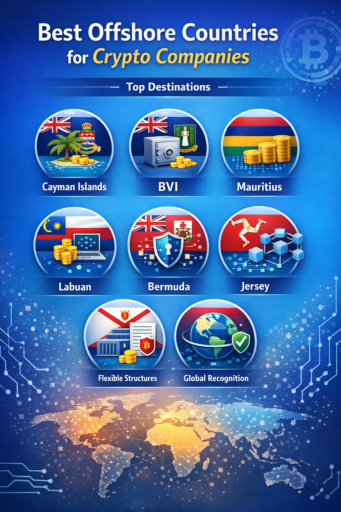
The top true offshore jurisdictions are the Cayman Islands, BVI, Mauritius, Labuan, Bermuda, Jersey, and Isle of Man, offering low taxes, flexible corporate structures, and strong international recognition.
Other jurisdictions like UAE, Malta, and Singapore provide legal credibility and business-friendly environments but are not considered true offshore.
Why are countries adopting crypto?
Many countries are adopting crypto to attract innovation, diversify their economies, and remain competitive in the digital financial sector.
What are the 5 best cryptos?
The top five cryptocurrencies by recognition and market capitalization are Bitcoin, Ethereum, BNB, Solana, and XRP.
Siete afflitti dall'indecisione finanziaria?

Adam è un autore riconosciuto a livello internazionale in materia finanziaria con oltre 830 milioni di visualizzazioni di risposte su Quora, un libro molto venduto su Amazon e un contributo su Forbes.