Canada’s tax system is built on one key principle: your residency status determines what income gets taxed and how much you owe.
Once you understand that foundation, navigating Canadian taxes from forms and deductions to credits and deadlines becomes far easier.
Questo articolo tratta di:
- Does Canada tax based on citizenship or residency?
- What taxes are charged in Canada?
- How to determine taxable income in Canada?
- Which form is required for tax filing?
- What do tax deductions mean in Canada?
- What do tax credits do in Canada?
- What are federal and provincial taxes in Canada?
- Do I still have to pay taxes if I live abroad?
- Come posso ridurre legalmente le mie tasse in Canada?
Punti di forza:
- Canada taxes primarily based on residency, not citizenship.
- Your taxable income is total income minus deductions, reduced further by credits.
- Federal and provincial taxes combine to determine your total tax bill.
- Proper planning (RRSPs, deductions, credits) can legally lower your taxes.
I miei recapiti sono hello@adamfayed.com e WhatsApp +44-7393-450-837 se avete domande.
Le informazioni contenute in questo articolo non costituiscono una consulenza fiscale e possono essere cambiate rispetto al momento in cui sono state scritte. Posso mettervi in contatto con un'assistenza fiscale esperta per la vostra situazione specifica.

Does Canada tax based on residency?
Yes, Canada taxes individuals based on residenza rather than cittadinanza.
Residents are required to report and pay tax on all income, both from inside and outside Canada.
Non-residents are generally taxed only on Canadian-source income, including employment, rental, or investimenti.
Determining residency status is essential, as it dictates which income is taxable and which tax rules apply.
What is the difference between a non-resident and a deemed non-resident of Canada?
A non-resident lives outside Canada and has severed most significant residential ties, so Canada taxes only income earned within the country.
A deemed non-resident may maintain residential ties but is considered non-resident for tax purposes because a tax treaty with another country takes precedence.
This status affects which income is taxable in Canada and which forms must be filed.
Recognizing the difference ensures proper reporting and compliance under Canadian tax law.
What are the different types of taxes in Canada?
Canada imposes taxes on income, consumption, property, and employment to fund government programs at federal, provincial, and municipal levels.
- Income tax: Levied on personal and business income, including salaries, self-employment earnings, investment profits, and pension income from RRSP, RRIFs, and other retirement plans.
- Goods and Services Tax (GST)/Harmonized Sales Tax (HST): A federal sales tax applied to most goods and services, with some provinces combining it into HST.
- Property tax: Charged by municipalities based on the assessed value of real estate, funding local services such as schools, roads, and emergency services.
- Payroll tax: Includes mandatory contributions to the Canada Pension Plan (CPP) and Employment Insurance (EI), deducted from wages to support retirement and unemployment benefits.
- Capital gains / exit tax: When individuals cease residency or sell capital assets, certain gains may be taxed under deemed disposition rules.
- Estate / inheritance tax: While Canada has no formal imposta di successione, capital gains on assets are taxed in the estate before transfer to heirs.
What is the difference between federal and provincial taxes in Canada?
Canada collects federal tax on all taxable income at uniform rates that apply across the country.
Each province or territory also levies its own tax, with rates and brackets that vary depending on the region.
Federal tax funds national programs such as healthcare and defense, while provincial or territorial tax supports local services like education, roads, and social programs.
The total tax liability is calculated by combining both federal and provincial/territorial taxes, determining the final amount owed by each taxpayer.
What tax forms do I need in Canada?
Filing taxes in Canada requires forms such as the T1 General for personal income and the T4 for employment income, with additional forms for investments, deductions, or non-residents.
The main forms include:
- T1 General: The primary form for filing individual income tax returns.
- T4: Reports employment income, including salaries, wages, and taxable benefits.
- T5: Reports investment income such as dividends, interest, and certain other investment earnings.
- Schedule forms: Used to claim deductions and credits, such as RRSP contributions, childcare expenses, and tuition.
- T2125: Statement of business or professional activities for self-employed individuals.
- T776: Statement of rental income and expenses.
- T3: Reports trust income.
- NR4: Used by non-residents to report Canadian-source income, including rental, pension, and investment income.
- T1135: Reports foreign assets over CAD 100,000 for verification purposes.
How to calculate taxable income in Canada?
Taxable income in Canada is calculated as total income minus deductions, and it determines how much tax is owed before applying credits.
The basic formula is:
Taxable Income = Total Income – Deductions
Steps:
1. Add up all sources of income: employment, self-employment, rental, and reddito da investimento.
2. Subtract allowable deductions: RRSP contributions, childcare expenses, union dues, and other eligible amounts.
3. Apply tax credits (e.g., basic personal amount, tuition, childcare) to reduce the final tax payable.
What is the difference between a tax credit and a tax deduction in Canada?
A tax deduction reduces taxable income, while a tax credit reduces the actual tax owed.
A tax deduction lowers the portion of income subject to tax, which can include Registered Retirement Savings Plan (RRSP) contributions, childcare expenses, or other eligible amounts.
For example, RRSP contributions reduce taxable income up to 18% of the previous year’s earned income, subject to the CRA’s annual limit.
Childcare expenses for daycare, a nanny, or certain educational programs are also deductible, typically claimed by the lower-income parent up to annual limits per child.
A tax credit, on the other hand, directly reduces the tax payable, dollar for dollar.
Examples include the Canada Child Benefit or tuition credits.
Because credits subtract directly from the tax owed, they are generally more valuable than deductions of the same amount.
What are the steps for filing income tax return?
Filing an income tax return in Canada involves gathering your income documents, calculating taxable income, and completing the T1 General form.
This is followed by submitting the requirements to the Canada Revenue Agency (CRA) and paying any balance owing or receiving a refund.
The process ensures all income, deductions, and credits are accurately reported under Canadian tax rules.
The steps includes:
- Gather all T-slips, receipts, and supporting documents for employment, investments, or other income.
- Determine residency status, as it affects which income must be reported and which forms apply.
- Calculate total income and deductions to determine taxable income.
- Complete the T1 General and any required schedules for deductions and credits.
- Submit the return online via NETFILE or by mail to the Canada Revenue Agency (CRA).
- Pay any balance owing or claim a refund, based on the final calculation.
What are the main tax deadlines in Canada?
Most individuals must file their personal tax return by April 30 each year, while self-employed individuals have until June 15 to submit (any balance owing is still due April 30).
Additional deadlines include quarterly installment payments on March 15, June 15, September 15, and December 15 for those who owe significant taxes, and corporate filings due within six months of a fiscal year-end.
Non-residents and trusts have separate filing dates, often aligned with the type of income or the trust’s tax year.
Meeting these deadlines ensures compliance, avoids interest or penalties, and allows sufficient time to plan and prepare taxes accurately.
Do Canadians living abroad have to pay taxes in Canada?
Canadians living abroad may still owe taxes if they are considered residents for tax purposes.
Residents who maintain significant ties to Canada such as a home, spouse, or dependents, must report and pay tax on worldwide income.
Non-residents are generally taxed only on Canadian-source income, including employment, rental, or investment income earned in Canada.
Determining residency status is essential, as it affects what income is taxable and which forms and rules apply.
Cosa succede se vivo all'estero e non presento le tasse?
Canadians living abroad who fail to file required tax returns can face penalties and interest on any unpaid taxes.
The Canada Revenue Agency (CRA) can assess taxes based on estimated income and may take collection actions, even from outside the country.
Failing to file can also result in the loss of benefits, such as the GST/HST credit or Canada Child Benefit.
Maintaining proper filings ensures compliance and protects access to government programs, even while living overseas.
How to legally pay less taxes in Canada?
Canadians can reduce their taxes by using government-approved strategies that lower taxable income or tax payable.
Key approaches include:
- Maximize RRSP and TFSA contributions to defer or shelter income from tax.
- Claim eligible deductions such as childcare expenses, tuition, and moving costs.
- Consider income-splitting strategies with a spouse or family to shift income to lower-tax brackets.
- Take advantage of provincial credits available in the province of residence.
All strategies must comply with CRA rules to avoid penalties or interest.
Comparing Taxes and Cost of Living: Canada vs the US
Canada and the United States both use progressive tax systems with federal and sub-national layers.
When comparing overall affordability, Canadians face higher tax percentages on paper but get publicly funded services such as universal health coverage and substantial social benefits that Americans must buy separately.
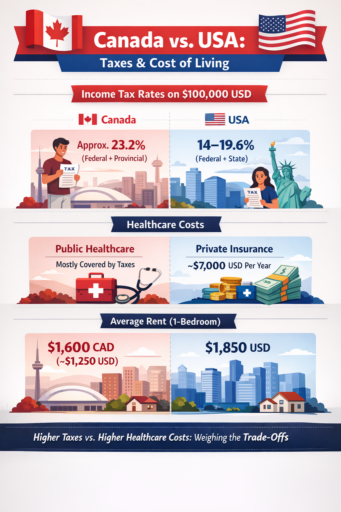
High earners pay 40–54% combined federal and provincial tax rates in certain Canadian provinces versus 24–42% in the US.
For example, Alberta is ~47% and Nova Scotia ~54%, while states with no income tax like Texas or Florida are ~24%.
At moderate income levels, around USD 100,000, effective tax rates in Canada are often modestly higher than in many US states.
However, payroll taxes and healthcare costs significantly influence overall take-home pay.
Canada’s universal healthcare system covers essential services through taxes.
In the US, private insurance premiums often cost several thousand dollars per person annually, which adds a significant expense not captured in income tax comparisons.
That is a trade-off often weighed by families and individuals considering where to live.
Conclusione
Navigating Canada’s tax system can seem complex, but understanding the interplay between residency, income types, deductions, and credits reveals opportunities to manage tax obligations strategically.
Taxes are not just a compliance requirement; they are a tool for financial planning, from optimizing retirement savings to leveraging provincial incentives.
Staying informed, keeping accurate records, and planning ahead transforms the annual tax filing from a chore into a way to protect and grow personal wealth.
Ultimately, thoughtful tax management empowers Canadians, whether at home or abroad, to make their income work smarter rather than harder.
Domande frequenti
Do non-residents pay more tax in Canada?
Sometimes. Non-residents may face withholding taxes on Canadian income without access to many deductions or credits.
What are some tax loopholes in Canada?
Some commonly used tax loopholes include certain income-splitting arrangements, claiming deductions for small business or rental expenses, and investing in preferentially taxed dividends.
These methods must be applied carefully and follow CRA rules to remain legal.
What is the most overlooked tax deduction in Canada?
Many taxpayers overlook moving expenses, particularly when relocating for work or education.
Even small deductions, when combined, can significantly reduce taxable income.
Qual è la regola del 90% in Canada?
The 90% rule means that if at least 90% of your worldwide income in a tax year comes from Canadian sources, you are eligible for non-refundable tax credits reserved for residents.
This includes the basic personal amount and other credits that can directly reduce your overall tax payable.
Is it cheaper to live in Canada or the USA?
Overall, the USA is generally cheaper than Canada because it has lower income taxes and a lower cost of living, including housing and everyday expenses.
Canada’s higher taxes are offset by publicly funded healthcare and social services, which increase overall living costs.
Siete afflitti dall'indecisione finanziaria?

Adam è un autore riconosciuto a livello internazionale in materia finanziaria con oltre 830 milioni di visualizzazioni di risposte su Quora, un libro molto venduto su Amazon e un contributo su Forbes.