
This article was updated on November 2, 2021
After speaking about how to invest in the Vietnamese Stock Market, this article will speak about how to invest in the South Korean Stock Market – the Kospi 200.
The article will also mention how to invest in South Korea more generally, including smaller companies and private businesses.
For any questions, or if you are looking to invest, then you can contact me using this form, utilising the WhatsApp function below or by emailing me (advice@adamfayed.com).
Introduzione
In just a few decades, South Korea has grown from an agricultural country to an advanced economy and exporter of automobiles and electronics. How did they manage it? Perhaps the point is that they are doing everything at lightning speed.
Speed is one of the main features of South Koreans’ mentality, and it is not surprising that it is especially noticeable in the country’s capital.
The Koreans themselves explain this phenomenon by the “Pali-Pali” culture, pronouncing this word with a tense consonant at the beginning. “Pali-pali” roughly translates to “faster, faster” and symbolizes the impatience of Koreans who try to do everything as quickly as possible and do not like to delay.
In the 60s the country’s exports increased by 30-40% per year. The courage of the economic reformers and the diligence of the workers allowed the state to make a huge leap from the export of raw materials (silk and iron ore) to manufactured products.
Then, learning virtually on the run, the nation moved on to manufacturing consumer electronics, oil tankers, and semiconductors.
According to anthropologist Kim Chung Sun, South Korea’s success as an exporting country is largely due to this very passion for speed.
Thanks to their natural haste, the Koreans managed to industrialize and achieve such a surprisingly high economic development in a very short period of time. Now South Korea is one of the influential countries, with a very strong economy and with the most famous companies in it.
That’s why many investors want to cooperate with South Korea, invest and obtain Korean companies’ stocks, because this kind of powerful country is a key to success. In this article we will talk about stocks in Korea and introduce some options on how to invest in them.

Investing in South Korean stocks
South Korea is one of the most technologically advanced economies in the world with the world’s fastest broadband speeds and a strong digital economy in commerce, education, entertainment and government.
It is home to several leading corporations including Samsung Electronics, Hyundai Motor, LG, Posco, Lotte Group, Doosan Group and others. Thanks to the numerous tax breaks that the Korean government provides to foreign investors, more than half of the Global Fortune 500 companies have invested in Korea.
On the other hand, ‘the Korean Wave’, the growing popularity of everything Korean – from fashion, cosmetics, films, music to food – is successfully conquering all corners of the world. This worldwide popularity of Korean culture creates immense business potential.
If you want to diversify your portfolio and gain access to one of the fastest growing economies in the world, Korea can provide access to some of the leading companies at the forefront of growth and technological innovation. First of all let’s see what kind of effect your investment will have on the Korean economy.
How do investments in business projects affect the economy of the country?
Until the middle of the 20th century, the priority was the agricultural direction. Over the past 60 years, economic strategy has changed significantly. By taking a course towards industrialization and high technology, the Koreans provided the country with significant macroeconomic growth.
With a small territory, modest reserves of natural resources and a limited amount of minerals, Korea relies on high-tech production, investment in business projects, and the export of goods and technologies. About 85% of the capital is concentrated in large conglomerate companies:
- LG
- Hyundai
- Samsung
- Daewoo
- SK Group
- GS Group
- Hanjin Group
- Posco
- Lotte Group
- Doosan Group
They are known all over the world bring significant income to the country and guarantee economic stability. The rest is small and medium-sized businesses.
Peculiarities of cooperation
Finding worthy partners in Korea is quite simple. The focus should be on business etiquette and language proficiency. South Korean businessmen have a high status in their country and require special treatment. It is important to show that the partnership will be very beneficial for the country.
You can use the services of intermediaries or independently connect to all kinds of startups. When starting private investment in business, it should be borne in mind that high efficiency, politeness, accuracy, adherence to principles, knowledge of the specifics of Eastern business cooperation, and the presence of connections are welcomed.
Investing in small businesses with the help of agents
Specialized cross-national sites are popular with small businesses. For a small fee, Korean intermediaries purchase a variety of goods.
They are then resold to foreign customers. Risks are minimal due to small wholesale, simple delivery, absence of a language barrier. In this segment, there are online stores of auto parts, food, cosmetics.
The Korean mentality requires the obligatory third-party representation of partners. Establishing contacts directly is not always effective.
There is a Trade Department at the Embassy in almost every country. It’s called Korea Trade-Investment Promotion Agency (KOTPA). Often it is he who acts as a reliable negotiator and quickly leads to a deal at the level of a medium or large business. A complete list of services is available on the website, services are free.
Investment in business with direct contacts
Meetings of company representatives are regularly held at business sites in different countries. They involve marketing agencies from the state departments of all 9 Korean provinces and 6 major metropolitan cities. B2B meetings promptly drive private investment in small and medium-sized businesses. Cooperation is most effective in relation to:
- 5G wireless technology
- Intelligent robots and semiconductor devices
- Eco-friendly energy sources
- Cosmetics and hygiene products
- Auto parts
When starting a business on their own, entrepreneurs who decide to make private investments may face difficulties at an intercultural or linguistic level. Usually, this is solved with the help of translators, accounting outsourcing, legal support.
Many entrepreneurs prefer private investment in business with government support. The public-private partnership system was launched in 1994. The transport and social sectors have the greatest experience in this regard. Currently, most large-scale projects are run with private equity.
How to start investing in a small business
Korea is a developed industrial state and is in the top 5 of the Doing Business 2017 rating. According to the decision of the World Bank, the country was awarded with regard to “Ease of Doing Business”. The minimum conditions make registration quite simple and quick:
- A specific list of documents
- Translation into Korean
- The term is 7-10 days
- Registered capital from 9000-10000 dollars
Business sustainability is ensured by monthly reporting and auditing once a year. The high-tech market and the unique informatization of the banking system reliably track the flow of funds and prevent fraud.
The tax burden on profits varies from 13 to 25%, VAT is 10%, and income tax is about 38%. Foreign private investment is limited in 27 industries. The limited areas also include areas with state influence:
- Nuclear power
- Banche
- Television, radio, telecommunications
- Air transportation
- Fishing industry
- Meat trade, animal husbandry
When making investments in business projects in one of the 8 free economic zones (FEZ), you can count on tax exemptions for 3-5 years. It also allows you to reduce the tax burden by up to 50% in the next 2 years. To select a launch pad, you can consider:
- Incheon
- Yellow Sea
- Busan / Jinhe
- Kwanyan Bay
- Jeonbuk
- Daegu / Gyeongbuk
- Eastern Sea
- Semangeum / Kunsan
The minimum amount of investments by foreign investors in the SEZ is $ 5 million.
The absence of bureaucracy makes private investment in business quite attractive. Many business incubators, hubs and accelerators actively support various startups. On the one hand, it is beneficial for private investors, and on the other hand, it develops industry and strengthens Korea’s position in the global market.
Why invest in the South Korean stock market?
- Valuations look lower than in the US.
- “Korean Waive” – the growing popularity of Korean brands around the world.
- Extensive domestic market with sophisticated consumers driving demand
- Technological competitiveness in shipbuilding, electronics and the fast-growing automotive industry
- A global FTA network has been created that connects the US, ASEAN and the EU.
- Geographic advantage of proximity to huge markets of China and Japan
Benefits and risks of South Korea
South Korea has a very attractive economy for international investors, given the rare combination of stability and rapid growth.
But there are also many risks that investors must consider before investing in the region, including the geopolitical risks associated with its northern neighbor and the export-related risks that could arise during a downturn.
The benefits of investing in South Korea include:
- Growing fast. South Korea’s economy is expected to grow at a rate of 3.9 to 4.2 percent per year between 2011 and 2030, as in most Next Eleven countries.
- Stable economy. South Korea’s economy is a member of the G20 as an OEDC country, with a per capita income of over $ 30,000, which means it is very stable.
The risks of investing in South Korea include:
- The South Korea Stock Market has a lot more risks than
- Geopolitical risk. South Korea is located in one of the most militarized regions in the world, with a very unstable neighbor, North Korea.
- Reliance on export. South Korea’s economy is heavily dependent on exports, which can be detrimental as the global economy contracts.
Investing in South Korean ETFs
The easiest way to invest in South Korea is through Exchange Traded Funds (ETFs), which provide instant diversification of a single security traded on the US stock exchange.
The iShares MSCI South Korea Index Fund (EWY) is the most popular South Korean ETF with a net worth of $ 2.85 billion and 106 assets as of October 2012. Although the fund’s expense ratio is only 0.59 percent, investors should be wary of 21.9 percent of Samsung Electronics; and a slight preponderance in the information sector – 32.44 percent.
Investors can also consider ETFs such as:
- First Trust South Korea AlphaDEX Fund (FKO)
- Asia Pacific Ex-Japan AlphaDEX Fund (FPA)
- FTSE RAFI Asia Pacific ex-Japan Portfolio (PAF)
Investing in South Korean ADRs
American Depository Receipts (ADRs) represent another way to invest in South Korean companies without venturing outside of the United States. These ADRs enable investors to purchase foreign companies on a U.S. stock exchange, but may not be as liquid as many other U.S. stocks, and should, therefore, be traded with some caution.
Popular South Korean ADRs include:
- KB Financial Group Inc. (KB)
- SK Telecom Co., Ltd. (SKM)
- LG Display Co., Ltd. (LPL)
*About Korea Stock Exchange (KSE)
The Korea Stock Exchange (KSE) is one of the largest derivatives exchanges in the world and the only exchange in all of Korea. It ranks 16th in the world of stock exchanges and is a member of the Federation of Asian and Oceanian Stock Exchanges.
The exchange has departments for trading stocks, futures and bonds. The Korean stock exchange can be safely considered the youngest financial project, because the general beginning of the exchange lies only in 2005, after the merger of several financial platforms, but it has a huge future.
The headquarters of the Korea Exchange is located in Busan. In addition to the main trading building, the exchange has several additional branch premises for various financial events. There is also a division in Seoul. The number of companies listed on the stock exchange is increasing every year, and today their number exceeds a thousand. Thanks to the large number of issuers and investors, the exchange’s annual turnover exceeds trillions of dollars.
Trading on the exchange is conducted using the latest automated system KRX, the main function of which is to alert and control exchange transactions. The exchange is open on weekdays from Monday to Friday, Saturday and Sunday are days off. Moscow time exchange hours are from 3:00 am to 10:00 am.
The Korean Exchange is one of the youngest exchanges in the world. She has 60 years of experience in financial organization of exchange trading. It was founded in 1953 through the integration of the Korea Stock Exchange, Korea Futures Exchange and KOSDAQ. There are 2,030 companies listed on the exchange, with a total market capitalization of $ 1.294 trillion dollars.
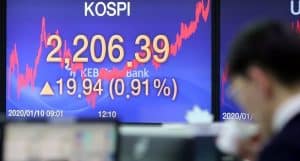
The main exchange index is KOSPI. Unlike the indices of other exchanges, it is not based on the average value of shares of large exchanges, but is calculated based on the data of all shares on the stock exchange of companies that have passed the listing. This index was calculated in 1980, replacing the previous KCSPI.
What investors need to know before investing in Korean stocks?
Investing in stocks can seem like a daunting task if you don’t know what you are doing, especially during uncertain times. You may be asking yourself, “Should I buy stocks right now?” So here’s the tidbit: Investing money doesn’t have to be as hard as rocketry. There are some simple strategies and tips you can use to invest your money in Korean stocks safely and securely. Let’s go!
- Investing in stocks is one of the many options for investing money
Stocks are a popular way to invest, but they are far from the only option. Depending on your needs, income, and when you need access to money, there are many different investment strategies you can use. These include depositing money into a savings account, buying real estate, or investing in bonds, precious metals, and foreign exchange. All of these investment strategies involve different levels of risk and return.
- Investing in stocks carries significant risks, especially in the short term
While stocks are often viewed as a safe investment strategy in the long term, and in fact aren’t risky if invested in for decades, nothing can be guaranteed.
The stock market is volatile, especially in the short term, and can fluctuate wildly between the extremes. If you want to invest your money in the short term, there are usually more reliable low-risk investment strategies.
The stock market has historically grown at an average of about 7% per year – and 10% in the US.
However, the stock market can experience dramatic ups and downs from year to year.
Even over a long period, a return on investment in the stock market is never guaranteed. Investors need to be careful when it comes to investing in the stock market and understand that nothing is a win-win.
- It is very risky to invest all your money in one corporation
You might be tempted to go for broke on a promising young company that you think could become the next Apple or Amazon.
However, investing all your money in one company is a risky proposition. It is impossible to reliably predict which companies will succeed overnight. If you guess wrong, you may lose some or all of your investment.
It is usually better to invest in indexes (the whole market – for example an index-linked ETFs) than individual stocks.
- A good risk mitigation strategy is to spread your investment
The general investment strategy is to invest in many different companies to reduce risk. This distributes your investment and protects it in the event that one company’s stock plummets. However, this strategy often includes additional brokerage fees that can reduce your profits in the long run.
- The stock market is not a money making machine (short-term)
You must have heard the story of many investors who made their fortune in the market.
Many people think that the stock market is like money making machine that can turn them into millionaires over time.
That is true in the long-term. Many millionaires have been created. from the markets, but it isn’t a get rich quick scheme.
- Don’t try to time the market, follow a disciplined investment approach
Most investors try to timing the market, which financial planners have always warned them to avoid, and thus lose their hard earned money in the process. No one can successfully and consistently time the market by catching tops and bottoms in multiple business or stock market cycles. You can invest small amounts of money over a period of time to average the market and reap benefits in the long term. Investors, who invest in the right stocks, systematically over time, are reaping unmatched returns. Hence, it is prudent to have patience and follow a disciplined investment approach, in addition to keeping the long-term big picture in mind.
- Have realistic expectations
It’s okay to hope for the “best” of your investments, but you can run into problems if your financial goals are based on unrealistic assumptions.
For example, many stocks have brought in over 100% during the big bull run of recent years. However, this does not mean that you should always expect the same returns from the stock markets. If you feel that the stocks in your portfolio are overvalued, it is best to switch to good stocks of relatively low value.
Finally, it is important to keep track of your investments and recensione them periodically, as any important event happening in any part of the world really affects our financial markets. In addition, this stock is affected by any news or financial events related to a particular stock or industry.
Conclusione
South Korea is one of the more stable markets in Asia, but investing in the stock market carried more risk than investing in the US, or a broadly diversified index like MSCI World.
Ulteriori letture
Are South Korea and Japan two tax-efficient places to live in? This is the subject of the article below.
Often it depends on several factors, including where your income is sourced from, and sometimes your nationality in the case of American expats.


Why is it that none of the big on-line Western share dealing services offer to execute transactions with the KSE?
I guess there isn’t a big demand for it yet. There are some ETFs on them though.