Recently, countries like Sweden and Canada have updated their citizenship laws, reshaping how individuals can gain, change, or maintain nationality.
These changes reflect global trends in residency requirements, investor and skilled migration pathways, and heritage‑based citizenship.
Questo articolo tratta di:
- What is citizenship strategy?
- Are there new rules for citizenship?
- What are the themes of citizenship changes?
Punti di forza:
- Citizenship laws are evolving globally, often favoring skilled migrants and investors.
- Residency, economic contribution, and security checks are central to new policies.
- Citizenship by descent is expanding in some countries (e.g., Canada).
- Global citizenship trends increasingly link nationality to economic, social, and integration value.
I miei recapiti sono hello@adamfayed.com e WhatsApp +44-7393-450-837 se avete domande.
Le informazioni contenute in questo articolo hanno un valore puramente indicativo. Non costituiscono consulenza finanziaria, legale o fiscale e non rappresentano una raccomandazione o una sollecitazione a investire. Alcuni fatti potrebbero essere cambiati dal momento della stesura.
What is Global Citizenship Strategy?
A global citizenship strategy is how a country designs its citizenship and naturalization rules to attract talent, investimento, and long-term residents while protecting national interests.
In 2026, many governments are reassessing how they balance skilled migration, investor inflows, national security, and economic growth through citizenship policy.
These strategies increasingly shape who can qualify for citizenship and under what conditions.
A global citizenship strategy often includes policies such as:
- Investment citizenship programmi
- Residency-to-citizenship pathways
- Incentives for skilled workers or entrepreneurs
- Revisions in dual citizenship regulations
For individuals, understanding global citizenship strategies is essential for planning migration, international business expansion, and long-term residence abroad.
Is There Any Change in Citizenship?
Yes, several countries are changing citizenship rules in 2026, with Europe, the Caribbean, Asia, and North America updating naturalization, investment, and dual citizenship policies.
1. EU Citizenship Changes
Svezia
Previously, Sweden allowed most foreign residents to apply for citizenship after 5 years of residence, with no formal language or civic knowledge tests required.
Under reforms taking effect in June 2026, the required residency period is being extended to 8 years, and applicants will be required to meet language proficiency and civic knowledge standards for the first time.
Additional conditions around financial self-sufficiency (at least 20,000 Swedish crowns monthly income) and conduct are also being introduced, making citizenship a final step of integration rather than an automatic outcome of long residence.
These changes mark a significant tightening of Sweden’s citizenship regime which was traditionally liberal.
Portogallo
Before the changes, Portugal allowed most foreign nationals to apply for citizenship after 5 years of legal residence, with the residency clock often starting from the date of the residence application, even before approval.
Under the 2026 updates, the required residency period is being extended to 10 years for most non-EU, non-CPLP nationals, and 7 years for EU and CPLP citizens, replacing the previous 5-year rule.
The residency timer will now start only from the date the first residence permit is issued, not from the application date, excluding long processing delays from counting.
Language requirements remain at A2 Portuguese, but enforcement of integration and legal residence continuity is becoming stricter.
These changes significantly lengthen the practical timeline to Cittadinanza portoghese for investors and long-term residents.
Spagna
Previously, Spain required 10 years of legal residence for most foreign nationals to qualify for citizenship, with shorter timelines for certain groups such as descendants of Spanish nationals.
Recently, Spain had briefly expanded fast-track citizenship for grandchildren of exiles under the Democratic Memory Law, but the application window for this route ended on October 22, 2025, and no new applications are now accepted.
Residency pathways for foreign investors, such as investment-based residency programs, are being reassessed, but investment alone still does not guarantee faster citizenship.
Administrative processing remains slow, though eligibility rules for long-term residents are now more clearly defined and consistently applied.
Germania
Previously, Germania required 8 years of lawful residence before most foreign nationals could apply for citizenship, with a 3‑year fast‑track option available for exceptionally well‑integrated individuals under the older reforms.
Starting with the modernized nationality law in June 2024, the standard naturalization residency period was reduced from 8 to 5 years for most applicants, and doppia cittadinanza became generally permitted for the first time.
However, the 3‑year fast‑track naturalization route was abolished in October 2025, making the 5‑year minimum the standard for almost all residents by 2026.
Spouses of German citizens may still qualify after 3 years of residency and 2 years of marriage under separate marriage provisions.
Language requirements remain at B1 German proficiency and applicants must pass the integration test and meet financial independence and civic loyalty criteria.
These changes balance faster access for long‑term residents with stricter integration expectations.
2. Caribbean and Latin America Citizenship Changes
Saint Kitts e Nevis
Previously, under the Sustainable Growth Fund (SGF) option, applicants could qualify for St Kitts and Nevis citizenship with a minimum contribution of USD 125,000 for a single applicant or USD 150,000 for an applicant plus spouse.
In 2026, the SGF was replaced by the Sustainable Island State Contribution (SISC), raising the minimum contribution for a single applicant to USD 250,000, with higher amounts for spouses and dependents.
Enhanced due diligence checks now apply to all applicants and dependents, including verification of source of funds and background screening.
These updates strengthen compliance with international anti-money laundering and transparency standards while maintaining the program as a route for investors seeking citizenship.
Dominica
Previously, Dominica’s Citizenship by Investment (CBI) program allowed contributions as low as around USD 100,000 under older terms.
However, in July 2024, the minimum investment was increased to USD 200,000 for a single applicant and USD 250,000 for a family of up to four under the Economic Diversification Fund option.
The minimum real estate investment remains at USD 200,000, matching regional harmonization efforts among OECS countries to standardize pricing and raise program integrity.
New 2024 regulations also established a dedicated Financial Intelligence Unit (FIU) to oversee due diligence and require mandatory interviews for all applicants aged 16 and older, strengthening background vetting and source‑of‑funds verification.
These changes reflect a shift toward higher transparency, stronger anti‑money‑laundering measures, and tighter screening while retaining Dominica’s position as a competitive CBI option.
Panama
Previously, Panama’s citizenship rules allowed long-term residents to apply for naturalization after five years of permanent residence (or three years if married to a Panamanian or with Panamanian children), with limited scrutiny of how actively applicants lived or worked in the country.
In recent years, authorities have begun applying stricter standards to what qualifies as genuine residence, focusing more closely on continuous physical presence, economic ties, and local integration.
Holding permanent residency alone is no longer sufficient if applicants cannot demonstrate real connection to Panama.
While the legal residency timelines have not changed, the practical threshold for approval has risen, particularly for applicants relying on passive or low-presence residency statuses.
3. Citizenship Changes Asia and the Pacific
Giappone
Japan continues to enforce its single‑citizenship rule, requiring applicants to renounce prior nationalities if they naturalize.
Under the current Nationality Act, most foreign residents can apply for citizenship after five years of continuous residence, coupled with good conduct and financial stability.
However, the government is planning to tighten naturalization screening in 2026.
It effectively requires a much longer period of stable residence (closer to around 10 years of actual residency), with stricter checks on tax, social insurance, and continuous presence even though the formal law may not be rewritten immediately.
These changes aim to align naturalization requirements more closely with the existing 10‑year standard for permanent residency and make approvals harder for shorter‑term residents.
Australia
Australia still requires 4 years of residence, including 12 months as a permanent resident, for citizenship.
Recent 2025–2026 reforms adjust how residency rules apply for skilled migrants working abroad, allowing the Minister to waive the 180-day presence requirement and relax post-citizenship residence obligations.
Administrative processes are also digitalized and streamlined, making compliance easier.
While eligibility thresholds remain the same, these migration-focused changes directly affect who can qualify and how efficiently citizenship is obtained.
4. North America Changes in Citizenship
Canada
Canada still requires 3 years of physical presence within the last 5 years for citizenship through naturalization, with standard language and knowledge tests unchanged.
The major 2025–2026 update affects citizenship by descent.
On December 15, 2025, Bill C‑3 eliminated the first-generation limit (FGL), allowing individuals born to Canadian grandparents—even if their parents were citizens by descent—to apply for proof of Canadian citizenship.
This change retroactively applies to anyone born before the bill came into force, effectively expanding eligibility for thousands of descendants abroad.
While naturalization rules remain stable, this migration-focused reform significantly broadens who can claim Canadian citizenship through heritage.
Stati Uniti
Il Stati Uniti continues to require 5 years of lawful permanent residence (or 3 years for spouses of US citizens) for naturalization.
While the core legal thresholds remain unchanged, recent updates have increased scrutiny on continuous residence, physical presence, good moral character, and tax compliance.
A new civics test with stricter evaluation standards was also introduced.
USCIS has also reinstated background checks and neighborhood verifications to ensure applicants demonstrate genuine ties to the country.
Dual citizenship remains permitted, but applicants must show allegiance to the US.
These migration-focused enforcement changes make the naturalization process more rigorous without altering fundamental eligibility requirements.
Common Themes Across Citizenship Changes
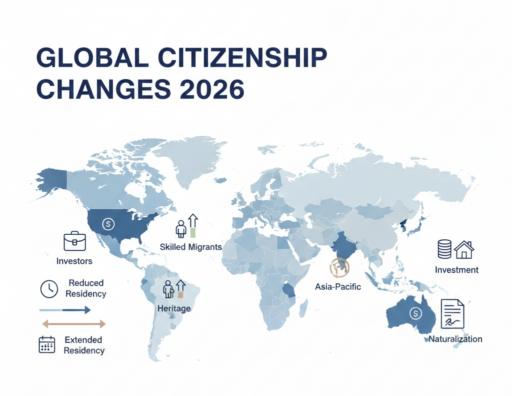
Global citizenship rules in 2025–2026 are becoming stricter, more selective, and more compliance-driven.
Governments are tightening investment routes, expanding ancestry-based claims, increasing vetting standards, and refining residency requirements to prioritize long-term national interest over fast-track outcomes.
Analyzing citizenship changes reveals several recurring themes:
- Economic Contribution Still Central – Many governments continue to prioritize investors, entrepreneurs, and high‑skilled migrants when shaping citizenship and naturalization policies. Programs linked to investment or economic ties remain prominent, even where thresholds and due diligence requirements have risen.
- Citizenship by Descent Expansion – Some countries are expanding eligibility for citizenship by heritage, as seen in Canada’s elimination of the first‑generation limit, broadening access for individuals with deeper familial connections.
- Security and Vetting Intensify – Enhanced background checks, source‑of‑funds verification, and stricter compliance reviews are becoming standard, especially for investor‑linked routes and high‑volume applications.
- Talent Retention and Selective Integration – Governments are refining pathways to citizenship to retain skilled residents and reduce incentives for low‑impact migration, often through integration requirements and residency conditions.
- Residency Duration Adjustments – Several jurisdictions are adjusting residency requirements, lengthening timelines in some cases (e.g., Sweden) and clarifying how physical presence is calculated in others (e.g., Portugal).
- Regulatory Constraints on Investment Citizenship – Legal and regulatory pressures (including EU court rulings) have led some regions to curtail or rethink traditional citizenship‑by‑investment schemes, shifting emphasis toward compliance and national interest over simple economic transactions.
Conclusione
The citizenship landscape in 2026 underscores a growing global emphasis on strategic migration, economic contribution, and integration.
Governments are no longer granting nationality automatically; instead, citizenship is increasingly viewed as a tool to attract talent, secure investment, and strengthen national resilience.
For individuals, this means that mobility, heritage connections, and careful planning are more important than ever when considering long-term residence or international opportunities.
The evolving balance between openness and selectivity suggests that citizenship will continue to reflect broader social, economic, and security priorities, rewarding those who align with national objectives while raising the bar for purely transactional or short-term pathways.
Domande frequenti
Are Dual Citizenship Increasing?
Sì, doppia cittadinanza is becoming increasingly common, even if exact numbers are hard to track.
Come Peter Spiro, law professor at Temple University, notes, most countries don’t require citizens to report multiple nationalities, but migration trends and policies show dual citizenship is increasingly popular for attracting talent, investment, and maintaining diaspora ties.
Is It Possible to Change Citizenship?
Yes, citizenship can be changed through naturalization, residency programs, marriage, investment schemes, or by renouncing a previous nationality, as allowed by the country’s legal framework.
Which Countries Do Not Allow Dual Citizenship?
Countries like Japan, Singapore, and China generally restrict dual citizenship, requiring individuals to renounce their previous nationality upon naturalization.
Are the Rights and Responsibilities of Citizenship Different from Country to Country?
Yes, the rights and responsibilities associated with citizenship such as voting, taxation, military service, and access to social benefits, vary widely across countries.
Siete afflitti dall'indecisione finanziaria?

Adam è un autore riconosciuto a livello internazionale in materia finanziaria con oltre 830 milioni di visualizzazioni di risposte su Quora, un libro molto venduto su Amazon e un contributo su Forbes.