Putting money in SRS can be worth it, but mainly for high-income earners who want to reduce taxes while investing for retirement.
For others, the benefits may be limited due to lock-in periods and withdrawal restrictions.
Questo articolo tratta di:
- What do you mean by SRS?
- What are the benefits of SRS?
- What is the downside of an SRS account?
- How should I invest my SRS money?
Punti di forza:
- SRS is most beneficial for those in higher tax brackets.
- Investment performance drives your returns, so choosing the right assets is crucial.
- Early withdrawals trigger penalties and full taxation.
- It works best as a long-term retirement and tax planning tool.
I miei recapiti sono hello@adamfayed.com e WhatsApp +44-7393-450-837 se avete domande. Offriamo anche soluzioni di strutturazione su misura per la vostra situazione.
Le informazioni contenute in questo articolo hanno carattere puramente indicativo, non costituiscono una consulenza finanziaria, legale o fiscale e possono essere cambiate rispetto al momento in cui sono state scritte.

What is SRS and how does it work?
Il Regime pensionistico complementare (SRS) is a voluntary savings scheme introduced by the Singapore government to encourage individuals to save for retirement while enjoying tax benefits.
When you contribute to an SRS account:
- Your contributions are tax-deductible, reducing your taxable income
- Your investments grow tax-deferred
- Withdrawals at retirement are partially taxable (only 50%)
SRS complements CPF, offering more flexibility in how funds are invested and used.
Where does SRS money go?
SRS contributions are initially held as cash in your SRS account with an approved bank. However, leaving it idle is rarely optimal due to low interest rates.
You can deploy SRS funds into:
- Fondi comuni di investimento
- Le scorte e ETF (via approved brokers)
- Obbligazioni e fixed deposits
- Insurance products
- REIT
The key idea is that, SRS is a wrapper; not an investment itself.
Is an SRS account worth it?
Yes, an SRS account is worth it primarily for higher-income individuals who want immediate tax relief and are prepared to invest and lock in their funds for the long term.
This is because the benefits increase significantly at higher tax brackets and with disciplined, long-term investing.
SRS is generally worth it if:
- You are in a high tax bracket (e.g., 11%–22%+), where tax savings are meaningful
- You can lock away funds until retirement without needing early access
- You actively invest the funds instead of leaving them idle, allowing compounding to work
- You want to legally reduce taxable income while building a retirement portfolio
It may not be worth it if:
- Your income tax rate is low, making the tax benefit minimal
- You need liquidity or flexibility before retirement age
- You are not comfortable investing, since idle SRS funds earn very little
- You prefer simpler or more accessible opzioni di investimento outside a locked scheme
In practice, the value of SRS comes from combining tax savings today with disciplined investing over time.
Without both, its advantages are significantly reduced.
How to invest SRS money?
You can invest your SRS funds by creating a diversified portfolio, generating steady income, targeting long-term growth, and managing risk.
1. Build a balanced portfolio: Use unit trusts or robo-advisors to diversify across equities and bonds.
2. Generate passive income: Invest in dividend-paying stocks or REITs.
3. Focus on long-term growth: Allocate to low-cost ETFs for compounding returns.
4. Stabilize your portfolio: Include bonds or fixed-income instruments to reduce volatility.
How to withdraw SRS money?
You can withdraw SRS money by contacting the bank where your SRS account is held and submitting a withdrawal request, either online through the bank’s platform or in person at a branch.
It’s recommended to plan withdrawals in advance and schedule them according to your retirement timeline to take full advantage of tax benefits.
Withdrawals are tightly regulated:
- You can start withdrawing penalty-free at retirement age
- You have a 10-year withdrawal window
- Only 50% of withdrawals are taxable
If you withdraw early:
- 100% of the amount is taxable
- A 5% penalty applies
Strategic withdrawals can significantly reduce your overall tax burden, so coordinate with your bank and, if needed, a consulente finanziario to structure withdrawals efficiently.
What are the risks of SRS investments?
When you put money in an SRS account, the main risks are limited liquidity, potential investment losses, policy changes, and missed opportunities elsewhere.
- Rischio di liquidità – Funds are locked until retirement unless you accept penalties.
- Investment risk – Returns depend on how you invest; losses are possible.
- Policy risk – Future changes in tax rules or retirement age could impact benefits.
- Opportunity cost – Your money might perform better in more flexible investment vehicles.
What is the difference between SRS and CPF?
The main difference is that SRS is a voluntary, flexible retirement scheme focused on tax planning, while CPF is a mandatory, government-backed scheme that provides structured savings and guaranteed payouts.
Although both are retirement schemes, they serve different purposes:
| Caratteristica | SRS | CPF |
| Nature | Voluntary | Mandatory |
| Flessibilità | High (investment choices) | Limited |
| Vantaggi fiscali | Immediate tax relief | No direct relief (for employees) |
| Prelievi | Flexible after retirement | Structured payouts |
| Risk | Investment-based | Government-backed |
In essence:
- CPF = stability and guaranteed structure
- SRS = flexibility and tax planning
Comparing SRS with Other Investment Options
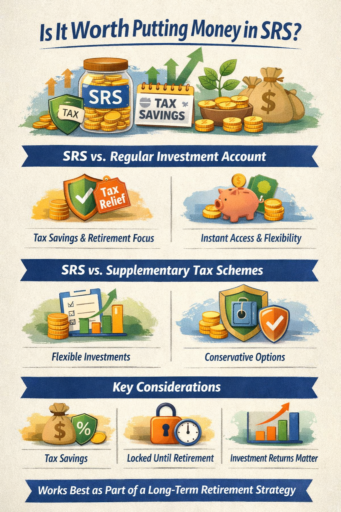
SRS is most valuable when compared to regular investment accounts and other tax-advantaged schemes because it provides tax relief and encourages disciplined, long-term retirement investing.
| Caratteristica | SRS | Regular Investment Account | Supplementary Tax Schemes |
| Contributions | Voluntary | Voluntary | Voluntary contributions into approved schemes like Supplementary CPF top-ups or approved retirement plans |
| Tax Benefit | Immediate tax relief | None | Contributions often provide tax relief up to specified limits |
| Flessibilità | High – wide investment options | Very high – any investment | Limited to approved funds or products defined by the scheme |
| Liquidità | Locked until retirement | Fully liquid | Typically restricted until retirement or scheme-specific conditions are met |
| Risk | Investment-based | Market-dependent | Generally lower-risk options approved by tax authorities, often with conservative investment choices |
| Withdrawal Tax | 50% taxable after retirement | Capital gains/tax rules apply | Usually taxable at withdrawal according to scheme rules, often structured similar to SRS |
Key insights:
- SRS vs Regular Accounts: SRS gives tax relief and encourages disciplined long-term investing, while regular accounts offer liquidity but no tax advantage.
- SRS vs Other Tax-Advantaged Schemes: SRS can complement other schemes, but its real benefit depends on contribution timing, investment strategy, and retirement planning.
- Overall: SRS works best as part of a broader, intentional retirement strategy rather than in isolation.
Conclusione
Deciding whether to put money in SRS is as much about mindset as it is about mechanics.
Its true advantage emerges when you see it not just as a tax-saving tool, but as a framework for disciplined, future-focused financial behavior.
SRS forces you to confront questions most people avoid: how to plan long-term, how to invest consistently, and how to balance risk with delayed gratification.
Ultimately, the worth of SRS isn’t measured by the account itself; it’s measured by whether it shapes smarter financial habits, encourages intentional wealth growth, and integrates seamlessly into your broader retirement strategy.
For those willing to think strategically, even a modest SRS contribution can have outsized impact over time.
Domande frequenti
How much can I deposit in my SRS account?
You can deposit up to SGD 15,300 per year if you are a Singapore citizen or PR, and up to SGD 35,700 per year if you are a foreigner.
These limits may change periodically, so it’s important to check the latest figures.
Is SRS mandatory in Singapore?
No. SRS is completely voluntary and meant to complement CPF savings.
What happens to SRS account after 10 years?
Once you begin withdrawals at retirement age, you must fully withdraw your SRS funds within 10 years.
Any remaining balance after this period may be fully taxable.
Siete afflitti dall'indecisione finanziaria?

Adam è un autore riconosciuto a livello internazionale in materia finanziaria con oltre 830 milioni di visualizzazioni di risposte su Quora, un libro molto venduto su Amazon e un contributo su Forbes.