A Cook Islands trust cannot be voluntarily dissolved by the settlor once it has been established. These trusts are designed to be irrevocable, which means the settlor gives up ownership and cannot simply unwind the structure or reclaim the assets at will.
However, dissolution is not impossible in practice. Courts in other jurisdictions, particularly the United States, have shown that legal enforcement can pressure settlors into actions that effectively terminate or dismantle the trust.
When courts order assets held in a Cook Islands trust to be repatriated, failure to comply can lead to contempt findings, fines, or even imprisonment.
This pressure could also result to the settlor agreeing to terminate the trust or return the assets.
Prefer audio? Hear why irrevocable doesn’t mean untouchable and how courts, settlor control, and compliance can affect Cook Islands trust protection.
Punti di forza:
- Settlor cannot voluntarily dissolve the trust, but courts can enforce asset repatriation.
- Excessive influence increases scrutiny and enforcement risk.
- Following legal and reporting obligations protects the trust from challenges.
- No offshore trust offers absolute immunity.
I miei recapiti sono hello@adamfayed.com e WhatsApp +44-7393-450-837 se avete domande. Offriamo anche soluzioni di strutturazione su misura per la vostra situazione.
Le informazioni contenute in questo articolo hanno carattere puramente indicativo, non costituiscono una consulenza finanziaria, legale o fiscale e possono essere cambiate rispetto al momento in cui sono state scritte.

What Makes a Cook Islands Trust Irrevocable?
Cook Islands trusts are structured to permanently separate legal ownership from beneficial ownership, with trustees holding legal title and managing assets for beneficiaries.
This structure prevents settlors from unilaterally reclaiming transferred assets, making the trust legally irrevocable once established.
The legal framework in the Cook Islands reinforces this by limiting creditor claims and restricting the settlor’s ability to interfere with the trust after formation.
These features are why Cook Islands trusts are widely used for asset protection and international estate planning.
- Trustees hold legal title while beneficiaries receive the benefits, creating a strong separation of ownership.
- Trustee discretion limits the settlor’s ability to direct or reclaim assets.
- Irrevocability is a core feature of the structure, though it does not prevent international courts from applying enforcement pressure in certain circumstances.
Can a Court Dissolve a Cook Islands Trust?
Cook Islands trusts can be terminated when courts compel compliance, particularly if a settlor or trustee disobeys lawful orders.
Courts do not dissolve trusts lightly, but they have the power to enforce repatriation of assets or other remedial measures.
In re Allen (Bankruptcy Case)
Daniel Allen transferred assets to a Cook Islands trust while litigation was already underway, as per Justia Law.
When a US bankruptcy court ordered repatriation, he argued compliance was impossible because the trustee controlled the assets.
The court rejected the defense, ruling the impossibility was self-created since the trust was established during litigation. Allen was held in contempt, and the decision was later affirmed on appeal.
BB&T v. Bellinger
After a bank demanded repayment of a large loan, the debtor transferred assets to a Cook Islands trust. A US court ordered him to request repatriation from the trustee.
He complied and requested the return of the assets, but the trustee refused under the trust terms and Cook Islands law, highlighting the jurisdictional gap between US courts and offshore trustees.
United States v. Grant
This IRS enforcement case involved assets linked to Cook Islands trusts. The court initially declined to hold the beneficiary in contempt.
However, evidence later showed Arline Grant continued directing and receiving trust distributions through family accounts, leading the court to conclude she retained effective control and had violated the repatriation order.
These cases show that irrevocable does not guarantee immunity from cross-border legal enforcement.
Courts, particularly in jurisdictions with strong enforcement mechanisms, can impose real consequences, including forced dissolution.
Voluntary Termination vs. Forced Cook Islands Trust Termination
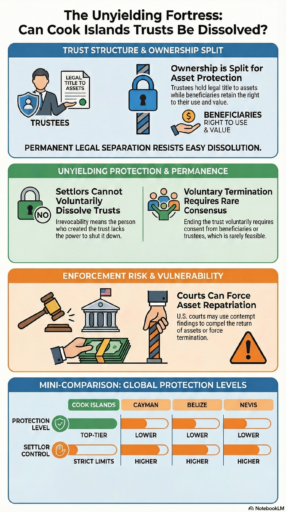
Voluntary termination of a Cook Islands trust is extremely limited, while forced Cook Islands trust termination can occur through court enforcement.
A settlor cannot generally dissolve a Cook Islands trust on their own because the structure is designed to be irrevocable.
Voluntary termination typically requires either:
- Beneficiary consent, if all beneficiaries agree to the dissolution, or
- Trustee discretion, which may be constrained by the trust deed and fiduciary duties.
In practice, these conditions are rarely met without legal consultation and formal agreements, and even then, courts may scrutinize the termination if it appears to circumvent creditor claims.
The perception that irrevocability is flexible is therefore misleading; these trusts are intended to lock in assets permanently.
How Settlor Control Affects Cook Islands Trust Enforcement
The degree of settlor influence directly affects whether a Cook Islands trust can withstand external pressure. Excessive settlor control increases scrutiny and the risk of enforcement actions.
Settlor powers that commonly trigger enforcement include:
- The ability to replace trustees or trust protectors.
- Direct involvement in trust investment or asset allocation.
- Using trust assets for personal expenses.
Even when formal powers are limited, courts may determine that non-compliance is self-created, leading to contempt findings or orders for asset repatriation.
International exchange-of-information agreements such as FATCA and CRS amplify the risk, as cross-border authorities can coordinate enforcement.
Misconceptions About Cook Islands Trust Protection and Enforcement
Many individuals overestimate the protective power of Cook Islands trusts. Believing the trust is impenetrable can be dangerous.
- Trustee refusal does not guarantee protection; courts can enforce compliance.
- Irrevocable does not mean untouchable; enforcement can lead to dissolution.
- The trust is not a shield for illegal activity; courts will override protections in cases of fraud or improper use.
Promotional materials sometimes portray Cook Islands trusts as offering near-absolute protection from creditors and legal claims.
However, court enforcement and multi-jurisdictional compliance rules show that these structures have real limitations.
Their effectiveness depends on proper planning, legal compliance, and responsible governance rather than promotional narratives about their strength.
How HNWIs Can Structure Cook Islands Trusts
High-net-worth individuals should structure Cook Islands trusts with independent trustees, limited settlor control, and full compliance with international reporting rules.
Proper design reduces legal scrutiny and strengthens the trust’s asset-protection framework.
- Trust design matters: Trustee independence, settlor powers, and clear beneficiary rights can reduce scrutiny.
- Compliance is critical: Attempting to shield assets post-claim can lead to fines, contempt, or imprisonment.
- International transparency: CRS and FATCA reporting increase the likelihood of enforcement.
- Long-term planning: Trusts should be part of a broader strategy including insurance, offshore entities, and tax planning.
The strongest asset protection occurs before any claim arises, not reactively. Once legal issues appear, even irrevocable Cook Islands trusts are vulnerable.
How to Protect Assets in Cook Islands Trust
Assets in a Cook Islands trust are protected by maintaining strict separation between the settlor and the trust assets while ensuring ongoing compliance with legal and reporting obligations.
The trust must operate as a genuinely independent structure rather than an extension of the settlor’s personal finances.
Avoid using trust assets for personal expenses, which can undermine the claim that the settlor has relinquished control.
Maintain proper documentation and accounting records to demonstrate that trustees exercise independent decision-making.
Follow international reporting obligations, including tax transparency rules that apply to cross-border financial structures.
Work with experienced trustees and legal advisors to ensure trust actions remain consistent with the trust deed and fiduciary duties.
These practices help preserve the integrity of the trust and reduce the likelihood that courts will view the structure as a tool for avoiding legal obligations.
Comparative Perspective: Cook Islands Trusts vs Other Offshore Trusts
Cook Islands trusts generally offer stronger statutory protections against creditors and foreign court enforcement than other popular offshore jurisdictions, though no trust is completely immune.
Understanding differences in legal frameworks and enforcement mechanisms is critical when choosing the right structure.
- Discretionary and asset-protection trusts are available.
- More flexible settlor involvement increases operational convenience but can expose the trust to greater scrutiny.
- Strong common-law judiciary allows effective enforcement of local creditor claims.
- Fraudulent conveyance laws can be invoked by creditors, meaning protection is not absolute.
- Strong statutory asset protection and privacy provisions.
- Spendthrift and discretionary trusts are common, but settlors can often retain more influence than in Cook Islands trusts.
- Foreign court enforcement is slower, giving more time to respond, but claims can eventually succeed.
- Judicial precedent is less established, so outcomes can be less predictable than in the Cook Islands.
- Well-regarded for privacy and creditor protection, with short statutes of limitation for enforcement.
- Trustees typically have broad discretion, which can improve protection if properly structured.
- Settlor misconduct, fraud, or post-claim transfers can still expose assets to forced repatriation.
- Enforcement mechanisms are weaker than in the Cook Islands, but protection is still limited if wrongdoing occurs.
Cook Islands trusts offer strong protection under their statutory framework and established judicial precedent.
However, courts in other jurisdictions can still enforce asset repatriation or mandate trust termination if wrongdoing or non-compliance is found.
Pensieri finali
Cook Islands trusts remain a powerful tool for international gestione patrimoniale, but they are not invulnerable.
While legally irrevocable, they can be effectively dissolved or forced to return assets through court enforcement when wrongdoing or non-compliance is involved.
Their effectiveness ultimately depends on how well the trust is integrated into a broader wealth strategy, including complementary structures such as insurance, corporate entities, and succession planning.
Thoughtful governance, proactive legal oversight, and alignment with international standards determine whether the trust fulfills its intended purpose.
For high-net-worth individuals and expats, success lies in using the trust as one component of a disciplined, long-term approach to wealth preservation rather than relying on the label of irrevocability alone.
Domande frequenti
Are Cook Islands trusts safe?
Cook Islands trusts are considered among the strongest offshore asset protection structures because local laws limit creditor claims and make foreign judgments difficult to enforce.
However, they are not completely immune from legal pressure. Courts in other jurisdictions can still compel settlors to comply with repatriation orders or face contempt penalties, which may indirectly affect the trust.
How much does a Cook Island trust cost per year?
Most Cook Islands trusts cost USD 8,000–15,000 per year, depending on complexity and trustee services.
Initial setup typically runs USD 15,000–25,000, reflecting stronger asset-protection benefits.
Can I voluntarily terminate a trust?
Voluntary termination is extremely limited. A Cook Islands trust can only be dissolved if all beneficiaries consent or the trustee agrees under the trust deed, which rarely occurs without formal legal procedures and professional advice.
Are Cook Islands trusts safe from FATCA enforcement?
No. The Foreign Account Tax Compliance Act requires financial institutions worldwide to report accounts linked to US taxpayers.
This means trust offshore may still be reported to tax authorities, increasing transparency and the likelihood of enforcement if the trust is used improperly.
What are the dangers of using a trust to protect your money?
The main risks include fraudulent transfer claims, excessive settlor control, and non-compliance with court orders.
What is the best way to leave your property to your children?
For international families, the most effective approach usually combines estate planning tools such as trusts, wills, and insurance structures.
A properly structured trust can transfer assets to children while controlling how and when distributions are made, helping protect wealth across generations.
Siete afflitti dall'indecisione finanziaria?

Adam è un autore riconosciuto a livello internazionale in materia finanziaria con oltre 830 milioni di visualizzazioni di risposte su Quora, un libro molto venduto su Amazon e un contributo su Forbes.