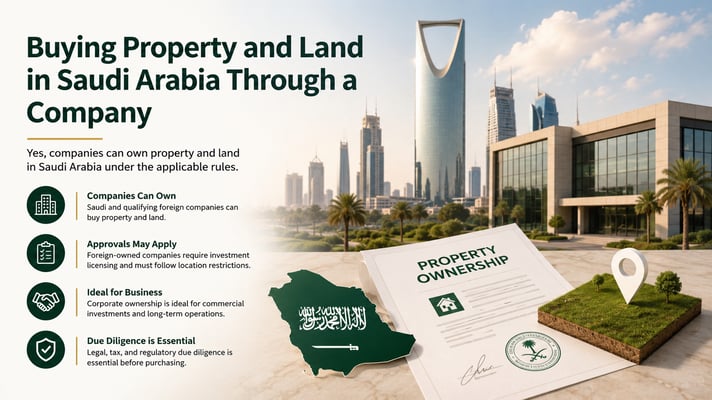
Saudi and qualifying foreign companies can buy property and land in Saudi Arabia under the updated Real Estate Ownership Law by Non-Saudis.
However, eligibility, location, property type, use, and registration requirements are all regulated.
Foreign companies must comply with the applicable ownership rules, location restrictions, and any required regulatory approvals before purchasing property.
This article covers:
- Is it worth buying property in Saudi Arabia through a company?
- Can you own land and property in Saudi Arabia as a company?
- What is the difference between a local company and a foreign company buying property and land?
- Is there any property tax in Saudi Arabia?
Key Takeaways:
- Saudi and qualifying foreign companies can buy property and land in Saudi Arabia under the applicable ownership rules.
- Foreign-owned companies must obtain any required approvals and comply with location-specific restrictions.
- A Saudi LLC is often the preferred structure for long-term commercial property ownership.
- Complete legal, tax, and property due diligence before buying property or land.
My contact details are hello@adamfayed.com and WhatsApp +44-7393-450-837 if you have any questions.
The information in this article is for general guidance only. It does not constitute financial, legal, or tax advice, and is not a recommendation or solicitation to invest. Some facts may have changed since the time of writing.
Who can buy property in Saudi Arabia?
Saudi citizens, Saudi companies, and qualifying foreign companies can buy property in Saudi Arabia, although foreign companies are subject to additional licensing requirements and ownership restrictions.
Corporate buyers commonly include:
- Saudi limited liability companies (LLCs)
- Saudi joint stock companies
- Foreign investment companies licensed to operate in Saudi Arabia
- Joint ventures between Saudi and foreign investors
Foreign companies usually acquire property when it is necessary for conducting licensed business activities, establishing offices, factories, logistics centers, hotels, or other approved commercial projects.
Certain sensitive locations, including parts of Makkah and Madinah, remain subject to special ownership restrictions.
Can a company buy property and land in Saudi Arabia?
Yes. Companies can buy both property and land in Saudi Arabia, although the rules differ based on whether the company is locally owned or foreign owned.
Foreign-owned companies licensed by the Ministry of Investment (MISA) may purchase property necessary for conducting their approved business activities.
Depending on the project, additional approvals from other government authorities may also be required.
Companies frequently purchase:
- Office buildings
- Commercial developments
- Industrial land
- Warehouses
- Hotels
- Staff accommodation
- Mixed-use developments
- Investment real estate
Buying property through a company is particularly common among multinational corporations establishing a long-term presence in Saudi Arabia.
Is it better to buy property through a company?
Buying property through a company in Saudi Arabia is generally better for commercial investments, industrial facilities, hospitality projects, and rental or development properties.
Buying personally is usually more suitable for individuals purchasing a private residence.
For foreign investors, acquiring through a company has become increasingly attractive as Saudi Arabia continues opening its real estate market under Vision 2030, including the introduction of a framework that allows eligible foreign individuals and companies to own property in approved areas.
A company structure may also be the more practical option when the property will be used for licensed business activities, such as offices, warehouses, factories, hotels, or employee accommodation.
However, buying through a company also comes with additional responsibilities.
Foreign-owned companies must comply with Saudi investment and corporate regulations, maintain the necessary licenses and registrations, and ensure the property acquisition meets the applicable ownership rules and location restrictions.
These compliance requirements are generally more extensive than those for an individual purchasing a qualifying residential property.
Local vs foreign company buying property in Saudi Arabia
A local Saudi company generally has broader and simpler rights to buy property in Saudi Arabia, while a foreign-owned company usually needs the purchase to support its licensed business activity and may require investment approval.
| Local Saudi Company | Foreign Company |
| Usually has wider access to commercial, residential, and development property | Usually limited to property connected to approved business activities |
| Typically faces fewer foreign investment approvals |
May require MISA licensing, registration under the foreign ownership framework, or other regulatory approvals |
| Often easier to deal with local banks, utilities, and government processes | May face extra documentation, reporting, and compliance checks |
| Can usually structure property ownership more directly | Must consider foreign ownership rules and location restrictions |
| Simpler for long-term local operations | More complex where the parent company, shareholders, or funds are offshore |
For foreign companies, the key question is whether the property is connected to an approved activity, such as an office, factory, warehouse, hotel, staff housing, or commercial project.
This is why many foreign investors prefer to establish or use a Saudi-incorporated company before buying property.
It can make licensing, banking, leasing, hiring, and regulatory dealings more practical, although it does not remove foreign ownership restrictions or approval requirements.
What is the foreign ownership limit in Saudi Arabia?
Saudi Arabia does not have a single foreign ownership percentage limit for companies buying property or land.
A foreign-owned company may buy real estate if it is legally eligible, properly licensed, and the property purchase is allowed under Saudi real estate ownership rules.
For company buyers, the real limits are not usually expressed as ‘foreigners can only own X%.’
The key restrictions are whether the company satisfies the applicable ownership framework, has any required MISA or regulatory approvals, and whether the property is located outside restricted areas such as Makkah and Madinah.
Saudi Arabia has also opened a dedicated portal for eligible foreign real estate ownership applications, which may create more opportunities for foreign companies and investors.
Can non-Muslims own land in Saudi Arabia?
Yes. Non-Muslims can own land in Saudi Arabia if they meet the applicable foreign ownership, residency, investment, and location requirements.
Saudi property rules focus on legal eligibility and approved locations, not the buyer’s religion.
Restrictions may still apply in specific locations regardless of the buyer’s religion.
What are the requirements to buy property in Saudi Arabia through a company?
Companies buying property in Saudi Arabia must prove that the company is legally eligible to acquire real estate, obtain any required investment or regulatory approvals, and provide documents supporting both the company and the property transaction.
Typical requirements include:
- Company registration: The company should be properly incorporated and registered in Saudi Arabia.
- Investment license (where applicable): Foreign-owned companies may require a valid MISA investment licence or other approval depending on their ownership structure, business activity, and the type of property being acquired.
- Corporate authorization: Board resolutions or shareholder approvals may be required authorizing the acquisition.
- Commercial Registration (CR): The company should hold an active Commercial Registration certificate.
- Corporate documents: Authorities may request:
- Certificate of incorporation
- Articles of association
- Commercial Registration
- Shareholder information
- Director identification
- Tax registration
- Investment license (if applicable)
- Property due diligence: Companies should verify:
- Legal ownership
- Existing encumbrances
- Zoning regulations
- Development restrictions
- Infrastructure access
- Environmental issues
- Municipal approvals
Professional legal advice is strongly recommended before completing any acquisition.
Do companies pay taxes in Saudi Arabia?
Yes. Companies buying property or land in Saudi Arabia may be subject to 5% Real Estate Transaction Tax (RETT) on the transfer. Under the updated foreign ownership framework, certain non-Saudi ownership transactions may also involve additional fees.
Foreign-owned companies generally pay 20% corporate income tax on taxable profits, while Saudi-owned companies are generally subject to 2.5% Zakat instead of corporate income tax.
Potential taxes include:
Corporate income tax (20%)
Foreign-owned companies generally pay 20% corporate income tax on their share of taxable profits.
For mixed-ownership companies, the foreign-owned portion is subject to corporate income tax, while the Saudi and GCC-owned portion is generally subject to Zakat.
Zakat (2.5%)
Saudi and GCC-owned companies generally pay 2.5% Zakat on the applicable Zakat base instead of corporate income tax.
Real Estate Transaction Tax (RETT) (5%)
Most transfers of property and land are subject to 5% Real Estate Transaction Tax (RETT), although certain transactions may qualify for exemptions under Saudi law.
Withholding tax (5%–20%)
Payments made by a Saudi company to non-residents, such as dividends, royalties, interest, or certain services, may be subject to withholding tax ranging from 5% to 20%, depending on the type of payment and any applicable tax treaty.
VAT (15%)
Saudi Arabia's standard VAT rate is 15%.
While most transfers of property and land are subject to RETT instead of VAT, VAT may still apply to certain commercial real estate transactions and related goods or services.
Companies should obtain professional tax advice before purchasing property and land to ensure the transaction is structured efficiently and complies with Saudi tax regulations.
Is Saudi Arabia a good place to buy property?
Yes, Saudi Arabia can be an attractive market for corporate property investment, particularly for businesses seeking long-term exposure to one of the Middle East's largest economies.
Several factors support investment:
- Vision 2030 infrastructure projects
- Rapid urban development
- Expanding tourism sector
- Industrial growth
- Rising demand for commercial real estate
- Large-scale economic diversification
Major investment destinations include:
- Riyadh
- Jeddah
- Dammam
- NEOM
- The Red Sea Project
- King Abdullah Economic City
The most suitable location depends on whether the company is investing in offices, logistics, hospitality, industrial facilities, or long-term rental assets.
What should companies know before buying property in Saudi Arabia?
Companies should evaluate both commercial opportunities and regulatory obligations before purchasing property in Saudi Arabia.
Important considerations include:
Confirm ownership eligibility
Ensure the company qualifies to purchase the intended property under Saudi regulations.
Review licensing requirements
Foreign investors should verify whether additional MISA or sector-specific approvals are required.
Understand restricted locations
Some cities and designated areas remain subject to special ownership rules.
Assess financing options
Commercial lending requirements differ from residential mortgages.
Plan the ownership structure
Selecting the appropriate company structure can improve operational efficiency, financing, taxation, and future exit planning.
Perform comprehensive due diligence
Review legal title, zoning, environmental risks, infrastructure, utilities, lease arrangements, and future development plans before completing the purchase.
Which company structure should you use to buy property in Saudi Arabia?
A Saudi limited liability company (LLC) is generally the best company structure for buying property in Saudi Arabia, while a foreign company or joint venture may be more suitable for certain international investments or large commercial projects.
Saudi limited liability company (LLC)
A Saudi LLC is the most common structure for businesses operating in Saudi Arabia.
It can own property, conduct business, and often provides a more straightforward framework for banking, leasing, and regulatory compliance.
Foreign company
A foreign company may buy property if it meets the applicable legal requirements and obtains the necessary approvals.
This structure is often suitable for multinational businesses expanding into Saudi Arabia without establishing a separate local subsidiary.
Joint venture
A joint venture combines Saudi and foreign investors in a single project or business.
It is commonly used for larger commercial developments where local expertise and shared investment are beneficial.
Conclusion
Saudi Arabia's property market is becoming increasingly attractive as economic reforms continue to encourage private investment and foreign participation.
For businesses acquiring commercial real estate, buying through a company often provides stronger operational flexibility, asset protection, and long-term scalability than purchasing personally.
The key is selecting the right corporate structure and ensuring the acquisition complies with Saudi investment, licensing, and real estate regulations from the outset.
FAQs
Is Saudi Arabia allowing foreigners to buy property?
Yes. Saudi Arabia allows qualifying foreigners to buy certain properties, but ownership rights are based on the buyer's residency status, nationality, intended use of the property, and applicable regulations.
Additional restrictions continue to apply in certain locations.
Is Saudi Arabia tax free for business?
No. Saudi Arabia is not completely tax free for businesses.
Based on ownership and activities, companies may be subject to corporate income tax, Zakat, withholding tax, and other transaction-based taxes.
Can you buy property in Saudi Arabia not being a resident?
Yes, non-residents may apply to buy property in Saudi Arabia under the new foreign real estate ownership framework, but approval is limited to eligible buyers and approved geographic areas.
Applications for non-Saudi ownership are handled through the official Saudi Properties portal, and special restrictions still apply in locations such as Makkah and Madinah.
Can a company buy a property in Dubai?
Yes. Companies, including foreign-owned companies, can buy property in Dubai in designated freehold areas, subject to Dubai's real estate laws and the company's legal structure.
Related Articles
- Buying Property and Land in France Through a Company
- Buying Property and Land in Portugal Through a Company
- Buying Property and Land in Italy Through a Company
- Buying Property and Land in Spain Through a Company
- Can Foreigners Buy Property and Land in Indonesia Through a Company?
- Can You Buy Property and Land in the Philippines through a Company?