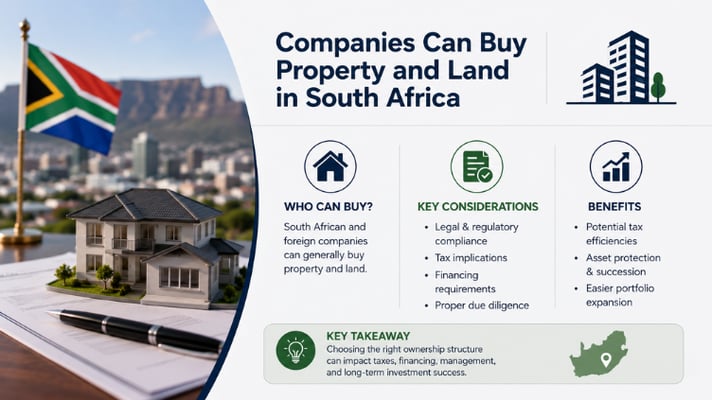
Buying property and land in South Africa through a company is generally permitted for both South African and foreign companies, subject to the country's property, corporate, tax, and exchange control laws.
Company ownership is commonly used for commercial real estate, rental portfolios, property development, and long-term investment, although it is not always the most suitable structure for every buyer.
This article covers:
- Can a foreign company own property in South Africa?
- Can a company buy a residential property in South Africa?
- Is a company or trust better for buying property in South Africa?
- Are foreign companies allowed to buy land in South Africa?
- What is the process of buying land via company?
Key Takeaways:
- Both South African and foreign companies can generally own property and land in South Africa.
- Company ownership is often best suited to commercial and investment purposes.
- Trusts may be preferable for estate planning and long-term family wealth.
- Tax, financing, zoning, and legal due diligence should be completed before purchasing.
My contact details are hello@adamfayed.com and WhatsApp +44-7393-450-837 if you have any questions.
The information in this article is for general guidance only. It does not constitute financial, legal, or tax advice, and is not a recommendation or solicitation to invest. Some facts may have changed since the time of writing.
Can a foreign company buy property in South Africa?
Yes. South Africa does not generally prohibit foreign corporate ownership of residential, commercial, industrial, or investment property.
A company incorporated outside South Africa may purchase property in its own name, while South African companies registered with the Companies and Intellectual Property Commission (CIPC) may also own property.
Foreign companies are commonly used by international investors acquiring:
- Residential investment properties
- Commercial buildings
- Office space
- Warehouses
- Hotels
- Mixed-use developments
South African companies are frequently used by local investors because they generally simplify banking relationships, financing, tax administration, and ongoing property management.
Although ownership is generally permitted, foreign companies should also consider:
- Exchange control regulations when bringing funds into or out of South Africa
- Registration and authentication of foreign corporate documents where required
- Tax obligations arising from rental income or future property sales
- Financing limitations, as some South African lenders may require higher deposits from foreign purchasers
| Foreign company | South African company |
|---|---|
| Incorporated outside South Africa | Registered in South Africa |
| May require legalized corporate documents | Local corporate documentation usually sufficient |
| Subject to exchange control considerations | Simpler local banking and administration |
| Financing may be more restrictive | Generally easier access to domestic financing |
Can a business buy a house in South Africa?
Yes. A business can purchase a house in South Africa.
Companies may acquire residential houses provided the purchase complies with applicable property, tax, and corporate laws.
Businesses commonly purchase residential property for:
- Long-term rental investments
- Short-term accommodation businesses
- Employee housing
- Executive accommodation
- Property redevelopment
- Staff relocation
However, if company-owned residential property is used privately by directors, shareholders, or employees, additional tax consequences may arise depending on how the property is provided and whether any taxable benefits are created.
Where a house is purchased purely as an investment, ownership through a company can simplify the management of rental income, expenses, and future expansion into a larger property portfolio.
How long does it take to buy a property in South Africa?
Buying South Africa property typically takes between six and twelve weeks after an offer has been accepted.
The exact time frame depends on factors such as financing approval, completion of legal due diligence, and the speed of registration at the Deeds Office.
A typical purchase involves:
- Negotiating and signing the Offer to Purchase.
- Conducting legal and property due diligence.
- Obtaining financing where required.
- Appointing a conveyancing attorney.
- Paying applicable transfer taxes and fees.
- Registering the transfer at the Deeds Office.
Transactions involving foreign companies may sometimes take longer if overseas corporate documents require notarization, apostilles, translations, or additional verification.
Is it better to buy a property through a company in South Africa?
Company ownership generally suits commercial and investment property, while personal ownership is often better for a primary residence because of simpler administration and possible primary residence capital gains tax relief.
The most suitable ownership structure depends on how the property will be used, whether it will generate rental income, the number of owners, financing requirements, and long-term tax and succession planning objectives.
Buying property personally
Buying personally is often the better option if the property will primarily be used as your home.
Advantages include:
- Simpler ownership and transfer process
- Lower ongoing administrative costs
- No annual company compliance with the Companies and Intellectual Property Commission (CIPC)
- Potential eligibility for South Africa's primary residence exclusion for capital gains tax
- Generally simpler mortgage applications for owner-occupied homes
Potential disadvantages include:
- Personal exposure to liabilities associated with the property
- Less flexibility where multiple investors are involved
- Building a larger investment portfolio may become less efficient
- Ownership changes generally require transferring the property itself
Buying property via a company
Buying through a company is often the better option when the property forms part of a business or investment strategy.
Advantages include:
- Separate legal ownership from shareholders
- Easier joint ownership between multiple investors
- Rental income and expenses can be managed within the company
- Well suited to commercial property, property development, and larger rental portfolios
- Company shares may be transferred without necessarily transferring the underlying property, potentially simplifying changes in ownership
Potential disadvantages include:
- Annual CIPC and tax compliance obligations
- Accounting and administrative costs
- Company-owned residential property generally does not qualify for the individual's primary residence capital gains tax exclusion
- Financing may require director sureties or larger deposits, particularly for smaller companies
For most owner-occupied homes, personal ownership is usually the simpler and more tax-efficient structure.
For commercial property, property development, or growing rental portfolios involving multiple investors, company ownership often provides greater flexibility, clearer ownership arrangements, and better long-term business management.
Is it better to buy property in a trust or company in South Africa?
A company is generally better for rental businesses, commercial property, and property development, while a trust is usually better for estate planning, family wealth preservation, and holding property for beneficiaries.
Companies are designed for operating businesses and commercial investments, while trusts are commonly used to manage assets for families or beneficiaries over the long term.
A company may be more suitable where the objective is:
- Running a rental property business
- Commercial property ownership
- Property development
- Joint investment between shareholders
- Building an investment portfolio
A trust may be more suitable where the objective is:
- Preserving family wealth
- Estate planning
- Protecting assets across generations
- Holding long-term family investments
- Managing assets for beneficiaries
Both structures have different tax treatment, compliance obligations, and governance requirements.
How does land ownership work in South Africa?
Land ownership in South Africa is primarily based on registered title ownership through the national deeds registration system.
Once ownership is registered in the Deeds Office, the owner generally receives legally recognized rights to use, occupy, lease, sell, or transfer the land, subject to planning laws, zoning regulations, environmental legislation, and any registered servitudes.
Common forms of property ownership include:
Freehold ownership
The owner generally owns both the land and the buildings on it, subject to applicable laws and municipal regulations.
Sectional title ownership
Ownership applies to an individual unit within a larger development together with an undivided share in the common property.
Share block ownership
Instead of owning the property directly, purchasers own shares in a company that grants occupation rights to a particular unit.
Companies may generally own all of these property interests, provided the acquisition complies with applicable legal and regulatory requirements.
Land ownership does not automatically permit any type of development.
Local zoning schemes, environmental approvals, building regulations, and municipal planning requirements may restrict how land can be used or developed.
Can I buy land through my business in South Africa?
Yes. A company can generally buy land in South Africa.
Businesses commonly acquire land for:
- Commercial developments
- Industrial facilities
- Warehouses and logistics centers
- Office developments
- Residential developments
- Agricultural operations, subject to applicable laws
- Long-term investment
Buying land through a company is often appropriate where the land will form part of a business operation or investment portfolio.
It can also simplify ownership where multiple investors are involved and separate the land from shareholders' personal assets.
Before purchasing land, companies should conduct due diligence on:
- Zoning and permitted land use
- Municipal planning restrictions
- Environmental approvals
- Access rights and servitudes
- Utility availability
- Existing title restrictions
Can foreign companies buy land in South Africa?
Yes. Foreign companies can generally purchase land in South Africa, but they should pay particular attention to exchange control rules, financing, and regulatory due diligence before completing a purchase.
Unlike a South African company, a foreign company may face additional practical considerations when acquiring land, including:
- Exchange control requirements for transferring funds into and out of South Africa
- More limited access to local mortgage finance or higher deposit requirements
- Legalization, notarization, or apostille of foreign corporate documents where required
- Tax obligations on rental income and future disposal of the property
- Compliance with local zoning, planning, and environmental regulations
Foreign companies can generally purchase:
- Residential land
- Commercial land
- Industrial land
- Development land
- Investment land
Agricultural land may involve additional regulatory or policy considerations depending on the nature of the land, its intended use, and any future legislative changes.
What is the process of buying land in South Africa as a business?
Buying land through a company generally follows the same legal conveyancing process as purchasing other types of property, with additional corporate documentation required.
A typical transaction involves the following steps:
- Identify suitable land.
- Conduct legal and technical due diligence.
- Review zoning, planning, and environmental restrictions.
- Arrange financing if required.
- Approve the purchase through a board resolution.
- Sign the Offer to Purchase.
- Appoint a conveyancing attorney.
- Pay applicable taxes and transfer costs.
- Register ownership in the company's name through the Deeds Registry.
Companies will typically need documents such as:
- Certificate of incorporation
- Company registration details
- Directors' resolution approving the purchase
- Identification documents of authorized representatives
- Tax registration details
- Proof of authority where applicable
For foreign companies, notarized, apostilled, or legalized corporate documents may also be required depending on the jurisdiction of incorporation.
What is the best way to buy property and land in South Africa?
The best way to buy South African property and land is usually personal ownership for a primary residence, company ownership for commercial or investment property, and trust ownership for estate planning or family wealth preservation.
The right structure is based on the purpose of the purchase, how the property will be financed, whether it will generate income, and whether long-term succession planning is important.
| Purpose | Structure commonly used |
|---|---|
| Primary residence | Personal ownership |
| Single investment property | Personal ownership or company |
| Rental portfolio | Company |
| Commercial property | Company |
| Property development | Company |
| Estate planning | Trust |
| Multi-generational family assets | Trust |
What taxes apply when buying property and land through a company in South Africa?
Companies buying property and land in South Africa may pay transfer duty or VAT on the acquisition, corporate income tax on rental profits, and capital gains tax when the property is sold.
Depending on the transaction, the main taxes may include:
- Transfer duty, where applicable
- VAT if the seller is a VAT vendor and the transaction qualifies
- Corporate income tax on rental profits
- Capital gains tax when the property is sold as part of the company's taxable income
Separate transaction costs may include:
- Conveyancing fees
- Deeds Office registration fees
- Municipal rates and service charges, where applicable
Does it matter if the company is a South African resident or non-resident?
Yes. A company's South African tax residency may affect its tax obligations, reporting requirements, financing, and access to double taxation treaty benefits, even though both resident and non-resident companies can generally own property and land.
A South African resident company is generally taxed on its worldwide income, while a non-resident company is generally taxed only on income sourced in South Africa, including rental income from property and gains that are taxable under South African law.
A South African resident company may also benefit from:
- Simpler local banking and administration
- Easier access to domestic financing
- More straightforward ongoing corporate compliance
A non-resident company may be more appropriate where:
- The property forms part of an international investment portfolio
- The investor already operates through an overseas holding company
- Cross-border ownership is preferred for commercial reasons
- Relief under an applicable double taxation agreement may be available
Conclusion
Purchasing property through a company is ultimately a strategic decision rather than simply a legal one.
The ownership structure chosen today can influence financing, taxation, governance, succession, and the ease of acquiring or disposing of future properties, making it an important part of the overall investment strategy rather than an administrative afterthought.
Investors who align the ownership structure with their long-term objectives from the outset are often better positioned to adapt as their South African property portfolio grows or their business needs evolve.
FAQs
Who can buy property in South Africa?
South African citizens, permanent residents, foreign individuals, South African companies, foreign companies, and trusts can generally buy property in South Africa, subject to applicable property, corporate, tax, and exchange control laws.
Can a foreigner invest in South Africa?
Yes. Foreigners can generally invest in South Africa through property, businesses, listed securities, and other investments.
Depending on the investment, exchange control regulations and other legal requirements may apply.
Can I buy a house in South Africa while living abroad?
Yes. You can generally buy a house in South Africa while living abroad, with many purchases completed remotely through a conveyancing attorney under a power of attorney.
Financing and exchange control requirements may differ for non-residents.
Is it safe to buy property in South Africa?
Yes, provided proper due diligence is completed.
Buyers should verify title through the Deeds Registry, use an experienced conveyancing attorney, and check zoning, municipal compliance, servitudes, encumbrances, and legal or financial risks before purchase.
Related Articles:
- Buying Property and Land in Portugal Through a Company
- Buying Property and Land in Spain Through a Company
- Should you buy a UK property through a company?
- Can Foreigners Buy Property and Land in Indonesia Through a Company?
- Can You Buy Property and Land in the Philippines through a Company?
- Is Buying Property in Thailand Safe? Key Risks for Foreign Buyers
- Buying Property in Saudi Arabia: Looking Into the 2025 Changes