Succession planning in Australia is the structured process of transferring business ownership and leadership while protecting legal, financial, and operational continuity.
It ensures a company can continue functioning smoothly when founders retire, exit, or pass control, and is shaped by Australian corporate, tax, and governance rules.
Este artículo trata:
- What is the succession planning process in Australia?
- What is succession planning for business owners in Australia?
- What are the advantages and disadvantages of succession planning in Australia?
- Tips for Succession Planning in Australia
Principales conclusiones:
- Most Australian businesses lack formal, documented succession plans.
- Legal, tax, and governance alignment is essential for effective succession.
- Family business succession requires formal governance and transparent communication.
- Early, continuously updated planning significantly reduces transition risks.
Mis datos de contacto son hello@adamfayed.com y WhatsApp +44-7393-450-837 si tiene alguna pregunta.
La información contenida en este artículo es meramente orientativa. No constituye asesoramiento financiero, jurídico o fiscal, ni una recomendación o solicitud de inversión. Algunos hechos pueden haber cambiado desde el momento de su redacción.

What is Succession Planning in Australia?
Succession planning involves preparing your business for leadership transitions due to retirement, death, illness, or planned sale.
It is not merely about naming a successor. Instead, it is a comprehensive strategy addressing ownership transfer, management continuity, financial arrangements, family dynamics, and legal compliance.
In Australia, a significant proportion of small and family-owned businesses lack formal succession plans, increasing risks during ownership transitions.
The average age of small business owners in Australia is 58 years, with over 50,000 exiting annually.
Yet 69% of small business owners lack a documented succession plan, creating unnecessary risk and uncertainty.
Succession planning combines three critical dimensions:
- exit readiness and business value maximization,
- personal and family gestión de patrimonios for retirement, and
- preparing the owner (and often their family) for life after the business.
Succession Planning Framework in Australia
Australia’s succession framework is shaped by state-based wills legislation, corporate law, and tax regulation.
There is no single national succession statute, so planning depends on how estate law interacts with business and ownership structures.
Recent reforms, including the Succession Act 2023 (SA), have modernized estate administration and influenced broader succession discussions.
Legal Foundation
Australia does not have a single federal succession statute. Estate succession rules are mostly set by state succession and Wills legislation, while business succession intersects with company, tax, and trust law.
The most significant recent reform is the Succession Act 2023 (South Australia), which came into effect on January 1, 2025.
This law consolidated and modernized South Australian succession laws, replacing three separate statutes governing wills, probate, administration, intestacy, and family provision claims.
Key changes include:
- Greater transparency, with certain persons now able to inspect wills before probate is granted
- A reformed family provision regime that places greater weight on the deceased’s intentions while still allowing court intervention where appropriate
The updated intestacy rules provide increased preferential entitlement for surviving spouses or domestic partners and clarify outcomes when no close relatives exist.
These reforms may influence succession planning discussions beyond South Australia.
Además, el Aged Care Act 2024 (Commonwealth) commenced in November 2025, introducing a rights-based, person-centered approach to aged care and affecting succession planning for individuals entering aged care systems.
En Voluntary Assisted Dying Act 2024 (Australian Capital Territory) came into effect on November 3, 2025, creating new considerations for end-of-life planning and estate documentation.
Such reforms expand the practical scope of succession planning beyond asset transfer into health, incapacity, and end-of-life decision frameworks.
Corporate and Trust Framework
Business succession planning varies by legal structure:
- Sole trader: Assets must be sold or transferred via a will, creating higher risk.
- Partnership: Succession relies on clear partnership agreements covering buyouts and transitions.
- Company (Pty Ltd): Share transfers can occur independently of management changes; a shareholders agreement governs exits and disputes.
- Fideicomisos: Common for family businesses; trust deeds must clearly define trustee and beneficiary succession.
Professional Compliance Requirements
Succession planning also triggers regulatory compliance obligations. Companies must update ASIC records, including director and constitutional changes, within 28 days.
In 2025, the ATO increased scrutiny of Division 7A, trusts, and restructures, affecting succession planning.
Business owners should address these compliance requirements before implementing succession plans.
Succession Planning for Business Owners in Australia
Business owner succession differs from employee succession due to concentrated financial and emotional ties to the business.
Effective planning must address retirement funding, fair valuation, ownership transfer, and operational continuity.
Key considerations include:
- Financial security: Determine retirement capital needs and funding sources, including sale proceeds, retained earnings, and superannuation planning.
- Business valuation: Obtain independent valuations to establish fair market value and avoid disputes, considering profitability, growth, and key person risk.
- Ownership transfer: Options include gradual gifting, staged sales, combined approaches, third-party sales, ESOPs, or management buyouts.
- Key person risk: Document processes, relationships, and knowledge, and develop internal capability to reduce owner dependency.
Succession Planning for Family Businesses in Australia
Family succession requires formal governance, merit-based leadership, and transparent communication.
Family businesses dominate the Australian economy but face heightened emotional and governance complexity. Without clear structures, succession disputes are common.
Core challenges include:
- Conflicting family goals and exit preferences
- Perceived unfairness in ownership and compensation
- Tension between leadership competence and family status
Best-practice solutions include:
- Establishing a family council for structured decision-making
- Creating a family business constitution outlining values, succession rules, and governance
- Defining clear employment and ownership policies
- Appointing independent directors or chairs for objectivity
- Implementing merit-based development and mentoring programs
- Starting succession discussions early and communicating decisions transparently
Succession Planning for Foreign Companies in Australia
Foreign companies face added regulatory, tax, and compliance complexity. They must manage Australian and home-country compliance simultaneously.
Foreign businesses can operate as a registered foreign branch or establish an Australian subsidiary (Pty Ltd), each with different legal, tax, and succession implications.
Key requirements and risks:
- ASIC registration, local agent or resident director requirements, and timely updates within 28 days
- Australian income tax, GST, PAYG, superannuation, and payroll compliance
- Thin capitalization and transfer pricing rules for intercompany transactions
- Division 7A risks for loans between foreign parents and Australian subsidiaries
Succession considerations:
- Ownership changes or restructures may trigger CGT or deemed dividends
- Accurate documentation and Director ID management are critical
- Cross-border estate planning must align Australian succession laws with home-country inheritance rules
Succession Planning Process in Australia
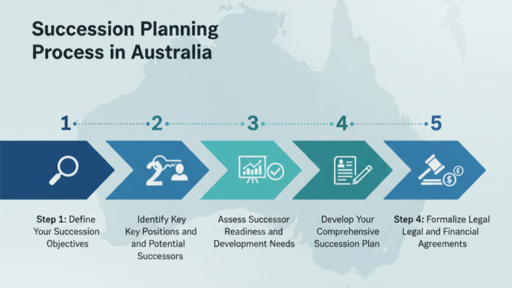
The succession planning process consists of five sequential steps: define objectives, identify key positions and successors, determine timing, develop the plan, and monitor progress.
Step 1: Define Your Succession Objectives
Begin by establishing clear goals for your succession. Ask yourself:
• Do you intend to pass the business to family members, sell to employees, or find external buyers?
• What is your personal timeline for retirement?
• What financial security do you require post-succession?
• What legacy do you want to preserve?
Understanding your vision shapes all subsequent planning decisions.
Begin succession planning as early as possible; many professionals recommend starting 5–10 years before your intended exit.
Step 2: Identify Key Positions and Potential Successors
Analyze your business to identify critical roles essential for operations and growth. For each key position, establish the competencies, skills, and experience required.
Assess current employees objectively against these criteria, identifying high-potential candidates with the capability to assume leadership roles.
Recognize that successors may come from within your organization, from family members, or from external recruitment.
Consider succession depth; never rely on a single successor for critical roles. Having multiple qualified candidates reduces risk if your primary successor becomes unavailable.
Step 3: Assess Successor Readiness and Development Needs
Determine when each potential successor will be ready to assume their role. Assess development gaps and create targeted training plans.
This might include formal education, mentoring from current leaders, rotational assignments within the company, or external professional development opportunities.
Establish clear milestones and timelines for successor development. Build accountability by regularly reviewing progress against these milestones.
Step 4: Develop Your Comprehensive Succession Plan
Document your succession strategy in a formal plan covering:
• Overall Strategy: Which succession option (family transfer, sale, management buyout, employee ownership plan) aligns with your goals.
• Ownership Transfer Method: How will shares, partnership interests, or assets be transferred? Through gifting, staged sale, buy-sell agreements, or inheritance?
• Leadership Transition Timeline: When will leadership responsibility transfer? Will it be gradual or immediate?
• Financial Arrangements: How will the buyout be funded? Through insurance, staged payments, asset sales, or vendor financing?
• Tax Planning: Incorporate strategies to manage capital gains tax, trust implications, and other relevant Australian tax considerations with professional advice.
• Family Communication Plan: How and when will you communicate succession decisions to family members and key employees?
Step 5: Formalize Legal and Financial Agreements
Succession planning requires careful attention to legal documentation and financial structure.
Essential documents include:
• Buy-Sell Agreement: Defines what happens to an owner’s shares or equity upon death, incapacity, retirement, or resignation, often funded by insurance.
• Shareholders Agreement: Covers rights and obligations of each owner, rules for share transfer, buyout procedures, and dispute resolution mechanisms.
• Company Constitution: Sets rules for appointing/removing directors, transferring shares, managing succession scenarios, and corporate governance.
• Partnership Agreement: Specifies procedures if a partner leaves, including buyout mechanisms, valuation methods, and new partner admission processes.
• Will and Estate Planning: Personal documents ensuring business intentions align with estate distribution wishes.
• Powers of Attorney: Documents allowing an individual to manage affairs if you become incapacitated. General (valid while capacity exists) and enduring (continues after loss of capacity).
• Trust Deeds: If using trusts for business structure, ensure deeds clearly address succession and trustee succession procedures.
All agreements should be drafted by experienced legal professionals to ensure enforceability when needed.
Pros and Cons of Succession Planning in Australia
Succession planning secures business continuity, protects enterprise value, and preserves wealth. However, it can be complex to implement, resource-intensive, and vulnerable to bias.
Advantages of Succession Planning
- Business Continuity: Documented plans reduce disruption during unexpected leadership transitions.
- Protecting Business Value: Clear succession increases buyer confidence and supports higher valuations.
- Family Harmony: Defined roles and transparent processes reduce disputes in family businesses.
- Wealth Preservation and Growth: Strategic planning protects family wealth, improves tax outcomes, and funds retirement.
Disadvantages of Succession Planning
- Data and Tracking Challenges: Succession planning requires structured systems to manage talent data effectively.
- Subjectivity and Bias: Favoritism can override merit, reducing fairness and morale.
- Limited External Perspectives: Over-reliance on internal candidates may restrict innovation.
- Lack of Transparency: Siloed planning erodes trust and employee retention.
- Complexity and Resource Demands: Effective plans require sustained leadership commitment and resources.
- Contingency Gaps: Plans that ignore unexpected events can quickly become ineffective.
Succession Planning Best Practices in Australia
Best practices include starting early, maintaining continuous planning, establishing formal governance structures, communicating transparently, and regularly reviewing and updating plans.
Start Early and Plan Continuously
- A common pitfall in succession planning is delaying action until triggered by unexpected events, which often forces rushed decisions and increases risks.
- Owners who delay often rush decisions, missing opportunities for value maximization, proper successor development, and tax-efficient planning.
- Begin succession planning at least 5-10 years before your intended departure.
- Treat succession planning as continuous, not a one-time project.
- Businesses change, people develop, and circumstances shift; review and update plans regularly.
Establish a Succession Planning Committee
- Don’t manage succession planning alone.
- Create a cross-functional committee including key executives, HR leaders, board members (if applicable), and potentially external advisors.
- This ensures accountability, prevents groupthink, and captures diverse perspectives.
- Rotate committee membership periodically to bring fresh perspectives.
Develop Clear, Objective Selection Criteria
- Define the competencies, skills, and qualities required for key roles using explicit criteria.
- Use performance assessments and competency frameworks to evaluate potential successors against objective standards.
- This approach reduces bias, improves fairness, and identifies qualified candidates you might otherwise overlook.
Invest in Deliberate Talent Development
- Once identified, successors require structured development.
- Provide mentoring from current leaders, rotational assignments across business functions, external training and certifications, and leadership coaching.
- Expose successors to strategic decision-making before they assume full responsibility.
- Document development plans with clear milestones and accountability.
Create Formal Governance Structures
Formalize governance through:
- Documented board or family council roles and responsibilities.
- Written policies on employment, ownership, compensation, and decision-making.
- Clear procedures for conflict resolution.
- Regular governance meetings with documented agendas and minutes.
- Involvement of independent advisors to provide objective guidance.
Governance structures prevent informal decision-making and ensure consistency across generations.
Communicate Transparently and Frequently
Lack of transparency creates uncertainty, rumors, and resentment.
Communicate succession decisions, timelines, and rationale clearly to all stakeholders:
- Family members with ownership interests.
- Key employees, depending on business continuity.
- Customers and suppliers who may worry about stability.
- Lenders and financial partners.
Address concerns openly and provide explanations for decisions.
Regular updates prevent surprises and build confidence in succession plans.
Balance Internal and External Talent
- While developing internal talent, remain open to external recruitment.
- External candidates bring fresh perspectives, new skills, and different ways of operating that can drive innovation.
- Consider hybrid approaches; promoting internal candidates while bringing external executives into supporting roles to facilitate knowledge transfer and adaptation to new approaches.
Document Everything Clearly
Write down:
- Succession plan objectives and timelines.
- Role descriptions and competency requirements.
- Identified successors and development plans.
- Agreement terms (buy-sell agreements, shareholders agreements, etc.).
- Tax and legal strategies.
- Communication plans.
Documentation creates accountability, provides continuity if planners leave, and serves as a reference for all stakeholders.
Prepare for Contingencies
- Unexpected events like sudden illness, death, or economic disruption can derail succession plans.
- Develop contingency succession plans for emergency scenarios.
- Include interim leadership arrangements, backup successors, and communication protocols if your primary succession plan becomes unexecutable.
- Regularly test contingency plans to ensure they remain viable.
Leverage Technology
Succession planning software helps track:
- Talent assessments and development progress.
- Role requirements and competency gaps.
- Succession timelines and milestones.
- Communication and task management.
Technology improves visibility, reduces manual tracking, and enables data-driven succession decisions.
Conclusión
With a large proportion of Australian businesses being family-owned and many owners nearing retirement age, proactive succession planning remains essential.
Legal changes in 2025, including South Australian succession reforms and new aged care frameworks, make up-to-date professional guidance essential.
The five-step succession process provides a structured path, from defining objectives to formalizing legal agreements.
Whether running a family business, larger company, or foreign operation in Australia, best practices support smoother transitions.
Succession planning is no longer optional for Australian business owners approaching retirement.
The combination of demographic pressure, legal reform, and economic uncertainty makes proactive transition planning a strategic necessity rather than a compliance exercise.
Although succession planning requires time and resources, leaving continuity to chance carries far greater risk.
Engaging accountants, lawyers, and business advisors early adds value through tax, legal, and valuation expertise.
Regular annual reviews ensure plans remain effective as circumstances evolve.
Preguntas frecuentes
What does a successful succession plan look like in Australia?
A successful succession plan:
• Preserves family wealth and funds owner’s retirement.
• Reduces disputes through clear policies and communication.
• Minimizes tax exposure through structured planning.
• Develops capable successors through mentoring.
• Provides clarity, alignment, and confidence.
• Is formally documented, governed, and regularly reviewed.
• Includes contingency plans for unexpected events.
What is estate planning in Australia?
Estate planning in Australia is the process of organizing how a person’s assets, debts, and legal responsibilities are managed during incapacity and distributed after death.
It involves a valid will, powers of attorney, superannuation nominations, trusts, and tax planning.
Estate planning ensures assets pass according to the individual’s wishes while minimizing disputes, delays, and unnecessary tax consequences.
What is the 7 year inheritance tax rule in Australia?
Australia does not have a 7-year inheritance tax rule because it does not impose inheritance tax or estate tax. This rule exists in the UK, where gifts may become exempt after seven years.
In Australia, gifts are generally not taxed as inheritances, but they can still affect capital gains tax, pension eligibility, and aged care assessments.
What is the 3 year rule in Australia for deceased estate?
The 3 year rule commonly refers to the capital gains tax (CGT) exemption period for inherited property.
If a deceased person’s main residence is sold within two years of death — sometimes extended by the ATO — it may qualify for a full CGT exemption.
In some estate administration contexts, a practical three-year window is used by advisors as a planning benchmark, but the formal tax rule centers on the two-year CGT concession.
¿Le duele la indecisión financiera?

Adam es un autor reconocido internacionalmente en temas financieros, con más de 830 millones de respuestas en Quora, un libro muy vendido en Amazon y colaborador de Forbes.