20 Mistakes Forex Traders Make That You Should Avoid.
It remains my belief that most retail investors should avoid forex all together due to the risks. For those interested, this article will speak about the major mistakes to avoid.
Si desea invertir como expatriado o particular con un elevado patrimonio neto, que es en lo que estoy especializado, puede enviarme un correo electrónico (advice@adamfayed.com) o WhatsApp (+44-7393-450-837).
Introducción
What are the mistakes forex traders make that you should avoid?
One of the easiest day trading markets in the world to access is the foreign exchange market (forex), which has a low entry barrier. Day trading should be accessible to anyone with just a few hundred dollars, a computer, and an internet connection.
But this ease of entry does not imply a guarantee of an immediate return. Think carefully before you invest your money because these 20 mistakes forex traders make are the main causes of failure for new forex day traders.
20 Mistakes Forex Traders Make
1. Beginning Without Any Trading Knowledge
This is one of the biggest mistakes forex traders make. Believing you can succeed in Forex trading without any experience or formal trading education is the most common error to avoid.
You’d be surprised at how many novice traders believe they are unique and capable of profiting right away. These fantasies are frequently expensive and fleeting!
Trading is a skill, and just like any other skill on earth, mastery requires time. Like any other skill, you can either learn it by doing and making mistakes, or you can shorten your learning curve by taking lessons from a professional. In reality, you require both.
The difficulty with trading is that novices frequently conflate luck and expertise. No matter how skilled they are, everyone has a nearly 50/50 chance of having a successful first trade!
This is something you would never see with a skill like chess, painting, or football, where half the newcomers thought they were experts after their first attempt. The performance actually returns to the trader’s average skill level over the long term, despite this.
If you want to outperform the vast majority of other Forex beginners, investing in a trading education that can actually help you comprehend how the markets and trading functions is essential.
Run after you can walk, not before! Learn the fundamentals first, make gradual, small steps, and give up trying to succeed with “get-rich-quick schemes.”
Putting time and money into your education in Forex trading is an investment in you.
2. Continuing Trading After a Continuous Loss
Your win rate and risk-reward ratio are two trading statistics that you should pay close attention to.
Your win rate is the percentage of trades that you win. Your win rate is 60%, for instance, if you win 60 out of 100 trades. A day trader should make an effort to keep their win rate above 50%.
The amount you win in comparison to the amount you lose on a typical trade is known as your reward-risk ratio.
Your reward-risk ratio is $75/$50=1.5 if your average losing trades are $50 and your average winning trades are $75. If the ratio is 1, you are losing more money than you are bringing in.
Day traders should maintain a reward-risk ratio that is greater than 1, ideally above 1.25. If your win rate is slightly lower and your reward-risk is slightly higher, or vice versa, you can still be profitable.
However, try to keep things straightforward and create strategies that have a better than 1.25 reward-risk ratio and are successful more than 50% of the time.
3. Trading Without a Plan
The majority of traders fail to adhere to their trading plan, if they even have one, because they are so busy trying to take advantage of the trading opportunities that the stock markets present. This is one of the mistakes forex traders make.
By the way, how professional trader approaches their daily trading is what sets them apart from a beginner.
More experienced traders will adhere to a trading plan and a routine that they have worked hard and diligently to establish, as opposed to beginning traders, who typically jump from trade to trade without a plan and trade according to feelings and whims.
You should incorporate a trading strategy into all of your trades to increase your chances of consistently making money.
You can better manage your open positions and identify trading opportunities as a result. You now know why choosing a trading strategy should be based on a successful, preferably backtested, process that has been established over time.
The key to successful trading is to stick to your plan; having a plan is not enough. When things aren’t going your way, this will make you a more seasoned trader.
4. Trading With No Funds and Risk Management Guidelines
A stop-loss order is a common oversight among novice Forex traders. It is a feature that instructs your broker to close your position once it has experienced a certain level of loss,
If you don’t use stop-loss orders, your risk is open-ended because your positions can change at any time in response to changes in the market’s price.
As a result, there is a higher chance of exaggerated losses if things don’t go your way because you aren’t capping your losing positions, leaving you open to large swings against your position.
Your trading plan must include strict money and risk management guidelines if you want your winning trades to outweigh your losing trades.
But adhering to financial and risk management guidelines involves more than just capping your losses with stop-loss orders; there are other factors to think about.
Here are some suggestions for handling money and risks:
- Whenever possible, use stop-loss and take-profit orders to limit your potential losses and gains.
- Decide on a weekly maximum loss and stop trading as soon as you hit it.
- If you trade intraday, stick to a risk-to-reward ratio of at least 1:2; if you trade swings or positions, use a ratio of at least 1:3.
- Use proper position sizing and never put more than 1% of your trading capital at risk in a single transaction.
- As soon as you start to make money, keep your risk level constant.
- When the market is going against you, avoid averaging up or down.
5. Not Using a Stop Loss
Not using a stop loss is one of the biggest mistakes forex traders make. Every day trade you make in forex should have a stop-loss order. An offset order known as a stop-loss allows you to exit a trade if the price moves in the opposite direction by a certain amount.
You have removed a significant amount of risk from your investment when you use stop-loss orders on your trades. The stop-loss keeps you from suffering uncontrollable losses if you start to lose money on a trade.
6. Redeeming Losing Positions by Averaging Down (or Up)
“Cut your losses and let your profits run,” as the saying goes.
The wise course of action is to cut your losses when you’re losing money. Many traders, however, fall short of doing so. Instead, they continue to hold onto losing positions and add more capital to them in the hopes that they will turn around.
Why would novice investors act in that manner?
They do so in the hopes that the market will turn around and move in their favor once more, allowing them to profit from their current losing positions and increase their profits.
However, in most cases, prices move against them for longer than anticipated, compounding their losses.
This common error might be slightly less risky if you’re a long-term investor, but it’s too risky if you’re a day trader using a lot of leverage in a volatile market like forex.
Don’t increase your losing positions, then!
To resist the urge to average up, open a position with the correct size and use a stop-loss (or down).
7. Increasing a Day Trade Loss
Averaging down is increasing your position (the price at which you entered the trade) as it moves in the opposite direction, in the hope that the trend will change.
It’s risky to continue with a losing trade. Price movement can go against you for a lot longer than you anticipate, increasing your loss exponentially.
Instead, place the appropriate position size in the trade and set a stop-loss. If the stop-loss is reached, the trade will be closed with a smaller loss than it otherwise would have. More risk than that should not be taken.
8. Using Too Much Leverage
Using too much leverage is one of the biggest mistakes forex traders make. Probably the most costly error new traders make is misusing and not understanding leverage. The fact that it is so poorly understood was a good reason for ESMA to intervene and cap it for EU retail traders.
It’s possible to trade with more money than you have in your trading account thanks to leverage and margin trading, which also increase your market exposure. But you only stand to gain from this if your strategy is consistently effective and your expectations are optimistic.
As a result, if you don’t have a winning strategy, leverage ends up amplifying your mistakes and losses. Leverage has the same potential to magnify both your profits and losses.
Both gains and losses are increased by leverage.
This is why, if misused and improperly managed, excessive use of leverage can quickly deplete your trading capital.
There is also a psychological component to take into account, as traders frequently behave irrationally when dealing with large positions.
By increasing the individual risk on each trade when using high leverage, you are under greater psychological pressure to perform well when trading.
9. Taking More Risks Than You Can Bear to Lose
Setting the amount of capital you are willing to risk on each trade is a crucial component of your risk management plan.
Less than 1% of a day trader’s capital should be put at risk on any given trade. This indicates that a stop-loss order terminates a trade if it incurs a trading capital loss of no more than 1%.
Accordingly, even if you lose several trades in a row, only a small portion of your capital will be lost. Nevertheless, your losses are made up if you earn more than 1% on each successful trade.
Controlling daily losses is another facet of risk management. Even if you only put 1% of your capital at risk per trade, a bad day could result in a significant loss of capital.
Your daily loss tolerance should be expressed as a percentage. You should train yourself to stop when you can afford to lose 3% in one day. If you let it, day trading can turn into an addiction. Play only with the funds you have set aside, and follow your game plan.
10. Setting Irrational Expectations
The desire to become wealthy quickly is a common motivation for new traders, which frequently leads to mistakes being made.
You must practice setting attainable goals if you want to remain disciplined and motivated. Instead of serving as a difficult but doable target, goals that aren’t actually attainable will only serve as a source of frustration and disappointment.
You should use the SMART method to set goals that are Specific, Measurable, Attainable, Relevant, and Timely if you want to make significant changes to your trading.
You can use this approach to give your financial goals structure and manageability.
11. Putting Everything on the Line to Win It Back
There will be times when you’ll be tempted to forego your risk management plan and make a much bigger trade than you usually would. There are various causes, and by tempting fate, you’ll invite her worst.
You might want to make up some of the losses since you may have had a string of unsuccessful trades. When you’re having success, it may seem impossible to lose. There will always be one trade that offers returns so good that you are prepared to almost throw everything at it.
A mistake is when you take on too much risk, and mistakes often get worse over time. In the hopes of a turnaround, traders have been known to place stop-loss orders.
Many people also become preoccupied with maintaining their margin while convincing themselves that things will change and they’ll win big.
Stay true to your 1% risk per trade and 3% risk per day rules whenever you experience this. Avoid going all in or increasing your position; instead, resist the urge and stick to your risk-management plan.
12. Predicting the News
Following scheduled economic news releases, many pairs (two correlated stocks, one long and one short) experience sharp price increases or decreases.
It would appear to be simple to profit unexpectedly by predicting the direction the pair will move and opening a position before the news is released. Not really.
Before choosing a steady direction, the price will frequently move abruptly in both directions. Accordingly, your chances of being in a significant losing trade shortly after the news release are equal to your chances of being in a winning trade.
There is yet another issue. The difference between the highest purchase price and lowest sell price, or the bid and ask price, is frequently much wider than usual in the first few seconds following the release.
If you use smaller trades to exit your position, you might not be able to find the liquidity you need to do so at the desired price.
Have a plan that allows you to enter a trade after the news release rather than trying to predict where the market will go in response to the news.
Profiting from volatility is possible without taking on all the unknown risks. This method is demonstrated by the non-farm payrolls forex strategy.
13. Choosing the Wrong Broker
Your biggest transaction will be making a deposit with a forex broker. You risk losing every penny if the investment is mismanaged, insolvent, or a trading fraud. Hence, having the wrong broker is one of the biggest mistakes forex traders make.
Choose a broker carefully. You should follow a five-step process when choosing which broker to work with. You ought to think about your goals, the services that brokers provide, and the reliability of the broker referrals you receive. Then, test the broker by making small trades at first and declining offers of bonuses in exchange for using their services.
14. Practice Trading with Big Capital
Every trader makes mistakes, and these mistakes always result in losses.
Don’t put too much money at risk on your initial trades because inexperienced traders will unavoidably make more mistakes than more experienced traders. Begin with smaller trades and gradually progress to larger ones.
In order to hone your trading strategy as much as possible before switching to the live markets, you should practice it on a risk-free demo trading account before you invest any money.
15. Consider Several Correlated Trades
Diversification is advantageous, as you may have heard. The success of your diversification strategy will depend on your knowledge, experience, and the products you are trading. Regarding diversification, Warren Buffett once remarked:
“Diversification is protection against ignorance. It makes little sense if you know what you are doing.”
If you think that diversification is important, you might be tempted to make more than one day trade at once in the belief that doing so will spread your risk. Most likely, you are making it worse.
There is a good chance that the forex pairs you see a similar trade setup in are correlated. You can see the same setup in each one because of this. Pairs that are correlated move together when they trade, so whether you win or lose on all of those trades is likely. If you lose, your loss has been multiplied by the number of trades you executed.
Make sure your day trades move independently of one another if you are making multiple trades at once.
16. Allowing Your Emotions to Control You
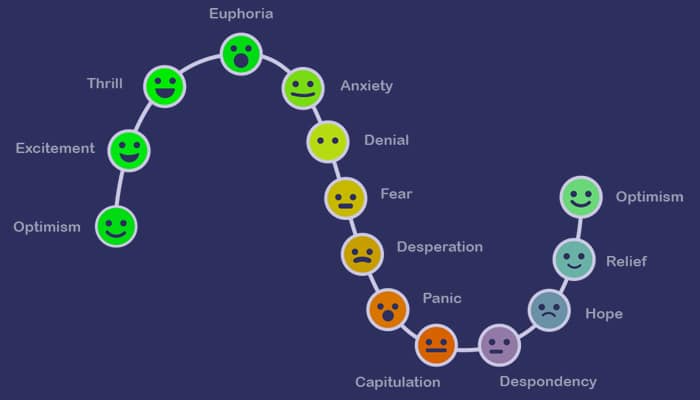
It is completely normal to experience a range of emotions while trading, including fear, greed, ecstasy, grief, and anger, to name a few. Learning to manage these emotions is a key component of becoming a successful trader.
You can never completely free yourself from emotion, and you also wouldn’t want to. Trading requires fear sometimes, just as it can be rewarding to experience the satisfaction of a profitable trade.
However, one of the biggest errors you can make when trading forex is to let your emotions rule your judgment. This is where having a well-defined trading strategy will really help you keep your composure.
Don’t let fear prevent you from making a profitable trade, and don’t let greed tempt you to trade when you shouldn’t.
Always approach each trade with as much reason as you can, and before entering the market, always ask yourself: “Does this trade satisfy my trading plan and strategy? Or am I allowing my feelings to sway my judgment?”
17. Trade Based on Economic or Fundamental Data
It is simple to get sucked into the day’s news or to develop a bias based on an article you read that claims that economic conditions are favorable or unfavourable for a specific nation or currency.
When day trading, the long-term fundamental outlook is irrelevant. No matter which way your strategy directs you to trade, your only objective is to put it into action. In the short term, both good and bad investments may experience increases.
Fundamental analysis causes you to concentrate on the wrong concepts and develop biases because fundamentals have nothing to do with short-term price movements. You can only stray from your trading strategy if you have any long-term biases.
You navigate the market with the help of your trading plan and the strategies it contains, which also serve to keep you from gambling or taking unwarranted risks.
18. Revenge Trading and Overconfidence
Traders who succumb to their emotions make these trading errors. This is one of the biggest mistakes forex traders make.
These scenarios do, however, merit their own section because they are so prevalent.
It’s simple and natural to become overconfident in your abilities after a few profitable trades. The joy you experience after making a profit can impair your judgment, lead you to stray from your trading plan, or tempt you to return to the market without performing the necessary research.
Avoid believing that a few trade wins will make you unbeatable.
The other extreme of trading errors is revenge trading, which is, once again, a perfectly natural temptation but must be avoided at all costs.
The desire to immediately return to the market after suffering a loss in an effort to recover your lost funds is known as revenge trading. Retaliation trading after losing trades can impair your ability to make decisions and frequently results in further losses, just like when you become overconfident after winning trades.
When trading, try to always maintain your objectivity. Often, the best course of action after a run of losses is to step back, take a break from trading, and figure out what went wrong before taking a chance on more losses.
19. Failure to Keep a Trading Journal
Although it may be one of the less obvious trading errors made by many novice traders, it is a crucial step in developing as a trader.
The more information you record about all of your transactions, both successful and unsuccessful, the better. Some of the inquiries you ought to answer are:
- What time did the trade start?
- When did it leave?
- What kind of instrument did you trade?
- Why did you start your business? What was your justification?
- What was the result of the transaction?
- Exactly what do you think of it?
- What could you have improved upon?
You can improve your trading abilities and perfect your trading strategy by keeping a thorough trading journal that allows you to learn from both your failures and your successes.
20. Missing Out on Bigger Gains by Taking Quick Profits
The main goal of a forex day trader is to minimize losses and maximize gains, but just as some novice traders tend to hold onto losing positions for an excessively long time, many will also reduce returns by taking profits too soon.
Although it may not seem like much of a mistake at first—you still made money on the trade—doing it repeatedly will significantly reduce your earning potential.
Sadly, this issue is more challenging to resolve than the other errors mentioned here. There are frequently good reasons to close a trade earlier than anticipated.
For example, your pair may have unexpectedly entered a consolidation phase, or new information may have come to light that completely changes the trend.
Nevertheless, a lot of traders lose money by making decisions based on emotion rather than a logical analysis of the available technical and/or fundamental indicators. Again, the best course of action is to develop and adhere to a clear, well-thought-out trading plan.
Reflexiones finales
Being a successful trader takes time and effort, but by recognizing and avoiding some of the most frequent trading errors, you will be in a stronger position than most.
Keep in mind that even the world’s most successful traders occasionally make mistakes in their trading, as they are a normal part of learning.
As a result, don’t be too afraid to make mistakes or too discouraged when they do. What matters is that you learn from your errors and take precautions to avoid repeating them in the future.
¿Le duele la indecisión financiera? ¿Quiere invertir con Adam?

Adam es un autor reconocido internacionalmente en temas financieros, con más de 830 millones de respuestas en Quora, un libro muy vendido en Amazon y colaborador de Forbes.