Succession planning in India operates within a hybrid legal framework shaped by personal inheritance laws, corporate governance rules, and evolving tax structures.
It ensures continuity, minimizes disputes, and complies with laws such as the Hindu Succession Act, Indian Succession Act, and Companies Act.
For families and business owners, the challenge is not just asset transfer, but continuity, control, and dispute prevention across generations.
Este artículo trata:
- What is the succession planning process in India?
- What is succession planning for business owners in India?
- What are the advantages and disadvantages of succession planning in India?
- Tips for Succession Planning in India
Principales conclusiones:
- A succession plan ensures continuity, trims disputes, and complies with Indian law.
- Five core steps: identify roles, assess successors, develop talent, document, review.
- Family business succession needs strategies for culture, generation, and ownership.
Mis datos de contacto son hello@adamfayed.com y WhatsApp +44-7393-450-837 si tiene alguna pregunta.
La información contenida en este artículo es meramente orientativa. No constituye asesoramiento financiero, jurídico o fiscal, ni una recomendación o solicitud de inversión. Algunos hechos pueden haber cambiado desde el momento de su redacción.

What Is Succession Planning in India?
Succession planning in India prepares leaders, assets, and businesses for smooth, legally compliant transitions.
A robust succession plan includes:
- Identification of future leaders
- Capability assessment and development
- Legal structuring for ownership transfer
- Governance mechanisms for continuity
India adds additional complexity due to:
- Multiple personal laws governing inheritance
- Family-centric ownership structures
- Overlap between ownership and management
- Tax implications on asset transfers
Regulatory recognition strengthens the need for planning:
- Listed companies: SEBI Listing Obligations (LODR 2015) require boards to establish and maintain orderly succession plans for directors and senior management.
- Private companies: Section 178 of the Companies Act, 2013 mandates a Nomination and Remuneration Committee, enhancing governance, though there is no statutory requirement for documented succession plans.
Succession planning in India is not just good practice but increasingly seen as a governance imperative, especially for family-run and listed businesses navigating legal, financial, and operational complexities.
Succession Planning Framework in India
A robust planificación de la sucesión framework integrates legal, financial, and organizational components tailored to India’s regulatory environment.
Core Legal Instruments
- Testamentos: Useful for simple estates but subject to probate delays and challenges.
- Trusts (Indian Trusts Act, 1882): Widely used by business families to avoid probate, control distributions, and protect assets.
- Family Constitutions: Non-binding but influential documents defining governance rules, values, and dispute resolution.
- Shareholder Agreements: Legally enforceable agreements governing voting rights, transfers, and exits.
Cumplimiento de la normativa
- Listed Companies: SEBI Regulation 17(4) requires boards to develop and disclose succession plans for directors and senior management, overseen by the Nomination & Remuneration Committee.
- Private Limited Companies: Companies Act Section 178 mandates a Nomination & Remuneration Committee; succession planning should be merit-based and transparent.
- Partnership Firms: Governed by the partnership deed; if silent, a partnership may dissolve on a partner’s death.
Succession Planning for Business Owners in India
Business owners should plan multiyear transitions, balancing competence, control, and financial security.
Business owners must align succession with retirement security, governance continuity, and family harmony.
Choosing the Successor
- Family successor preserves legacy but risks capability gaps.
- Professional management ensures competence but needs strong governance.
- Hybrid models are common in large Indian business groups.
Developing the Successor
- Mentorship over multiple years
- Cross-functional exposure
- Formal education
- Board participation
Transition Timeline
Gradual handovers reduce risk and preserve institutional knowledge.
Succession Planning for Family Business in India
Family business succession in India requires separating emotions from governance and proactively addressing inheritance laws.
Unique Challenges
- Blended family and business roles: Unclear authority and compensation fuel resentment.
- Sibling rivalry: Birth order often conflicts with merit-based leadership.
- Generational divide: Founders value control; successors demand structure and transparency.
Personal inheritance laws
- The Hindu Succession Act grants equal rights to daughters.
- Muslim law follows fixed Sharia shares.
- The Indian Succession Act governs others.
Solutions
- Separate ownership from management
- Use trusts to avoid fragmentation
- Create family constitutions
- Establish dispute resolution mechanisms
Succession Planning Process in India
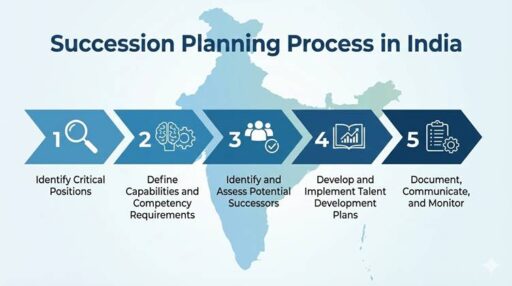
Effective succession planning follows a structured five-step cycle: identify roles, define skills, assess successors, develop talent, and document with regular reviews.
Step 1: Identify Critical Positions. Map positions essential to business continuity, including senior management and specialized roles. Plan for potential gaps.
Step 2: Define Capabilities and Competency Requirements. Establish clear criteria for what qualifications, skills, experience, and attributes are necessary for each critical position.
— List required technical, leadership, and soft skills.
— Include education, industry experience, and institutional knowledge.
— Define merit vs. family-based criteria for successors
Step 3: Identify and Assess Potential Successors. Choose internal or external candidates and categorize readiness: Ready Now, Soon, or Future.
Step 4: Develop and Implement Talent Development Plans. Create personalized learning and development plans for identified successors to close capability gaps.
Step 5: Document, Communicate, and Monitor. Formalize the succession plan in writing, communicate it to stakeholders, and establish a review mechanism.
Pros and Cons of Succession Planning in India
Succession planning improves stability and conservación del patrimonio but faces emotional, cultural, and regulatory resistance in India.
Advantages of Succession Planning
- Business continuity. Prepared successors prevent operational paralysis during sudden exits, ensuring stability in revenue, employees, and client relationships.
- Reduced disputes. Clear documentation minimizes ambiguity among heirs and stakeholders, lowering the risk of prolonged legal conflicts.
- Wealth preservation and tax efficiency. India does not impose a post-death inheritance tax (abolished in 1985), but transfers like gifts or sales during life can attract applicable taxes if not structured effectively.
- Stakeholder confidence. Employees, lenders, and investors gain confidence when leadership continuity is visibly planned.
- Values and legacy alignment. Planning allows founders to institutionalize values beyond their tenure.
Disadvantages and Challenges
- Emotional resistance. Succession planning is often seen as premature or inauspicious, especially among senior family members.
- Cultural biases. Birth order and gender biases still influence leadership choices despite merit considerations.
- Regulatory complexity. Multiple laws apply depending on religion, asset type, and business structure.
- Next-generation disengagement. Only a small minority of heirs feel obligated to join family businesses, creating leadership gaps.
Succession Planning Best Practices in India
Start early for effective succession planning in India, ideally in your 50s, and document a clear plan with primary and backup successors, timelines, and development milestones.
Separating ownership from management ensures day-to-day decisions are handled by capable leaders, while family or trusts preserve long-term value.
Build a diverse succession pipeline with ready-now, soon, and future candidates, and support them with structured mentorship, rotational assignments, and formal education.
These steps transfer knowledge, build credibility, and prepare successors for increasing responsibility.
Formal legal and financial structures—wills, trusts, shareholder agreements—combined with tax-efficient planning, safeguard wealth and ensure enforceability.
Transparent communication of the plan builds trust and reduces speculation, while regular reviews and updates keep it aligned with evolving business, family, and regulatory needs.
Contingency planning should address the 5 D’s: Death, Disability, Divorce, Disagreement, and Distress, with predefined legal, governance, and business continuity measures.
For foreign companies in India, maintain documented succession plans for local leadership, develop local talent alongside global programs, clarify decision-making authority, and include emergency triggers for expatriate exits.
Done right, succession planning strengthens the business, preserves family wealth, and equips future leaders to thrive, turning what can feel like a formal requirement into a living roadmap for sustainable growth.
Conclusión
With a massive intergenerational transfer of wealth underway, Indian businesses that neglect succession planning risk disputes, value destruction, and operational collapse.
Effective planning integrates:
- Claridad jurídica
- Leadership development
- Eficacia fiscal
- Gobernanza familiar
- Cumplimiento de la normativa
The cost of early planning is measurable, while the cost of neglect is often irreversible.
Succession planning protects businesses, families, and wealth. The best time to plan is long before transition becomes unavoidable.
Preguntas frecuentes
What are the four stages of succession planning?
Succession planning typically unfolds in four stages:
1. Assessment Stage: Identify critical roles and evaluate potential successors.
2. Development Stage: Train and mentor successors to prepare them for future responsibilities.
3. Transition Stage: Gradually hand over responsibilities and authority to the successor.
4. Stabilization Stage: Ensure the new leader is fully integrated and the business operates smoothly.
What are the two types of succession planning?
1. Emergency/Contingency Succession Plans: Address unexpected departures due to death, sudden resignation, or incapacity. These plans specify immediate interim leadership and short-term actions.
2. Long-Term/Proactive Succession Plans: Prepare for planned transitions, like retirements, with multi-year development programs for successors.
Who are the legal heirs in India?
Legal heirs depend on religion: Hindu law grants children equal inheritance; Muslim law follows Sharia shares; others follow the Indian Succession Act.
How is inheritance divided in India without a will?
Without a will, inheritance follows personal law: Hindu law divides equally among children and spouse; Muslim law follows Sharia; others under the Indian Succession Act.
How long is a Will valid after death in India?
A will remains valid after death and is executed through probate; there’s no expiration, but legal challenges may arise during administration.
¿Le duele la indecisión financiera?

Adam es un autor reconocido internacionalmente en temas financieros, con más de 830 millones de respuestas en Quora, un libro muy vendido en Amazon y colaborador de Forbes.