The Estonian Digital Nomad Visa, officially known as a long-term D-visa for remote workers, lets foreigners live in Estonia legally while working remotely for foreign companies or running online businesses.
It is designed for freelancers, entrepreneurs, and professionals seeking a flexible European base.
Este artículo trata:
- How long is the digital nomad visa in Estonia valid for?
- How to get an Estonia digital nomad visa?
- How to be eligible for a digital nomad visa?
- What are the income requirements for digital nomad visa Estonia?
- Why is Estonia a good place to live?
- What are the cons of living in Estonia?
Principales conclusiones:
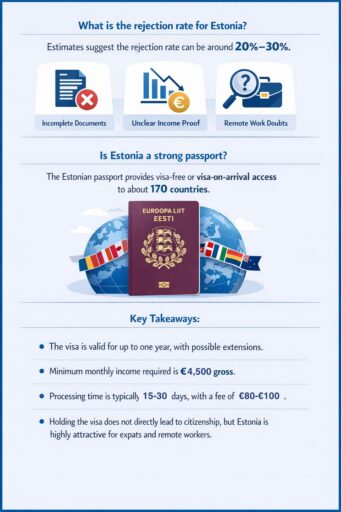
- The Estonia digital nomad visa is valid for up to one year, with the option to reapply after it expires.
- Applicants must earn at least €4,500 gross per month to qualify.
- Processing typically takes 15–30 days, sometimes up to 60 days, and the official government fee is €80–€100, with total upfront costs ranging from €500–€2,500.
- Holding the visa does not directly lead to citizenship, but Estonia offers a highly supportive environment for digital nomads, remote workers, and expats.
Mis datos de contacto son hello@adamfayed.com y WhatsApp +44-7393-450-837 si tiene alguna pregunta.
La información contenida en este artículo es meramente orientativa. No constituye asesoramiento financiero, jurídico o fiscal, ni una recomendación o solicitud de inversión. Algunos hechos pueden haber cambiado desde el momento de su redacción.

What is an Estonia digital nomad visa?
The Estonian Digital Nomad Visa, formally known as the long-term D-visa for remote workers, is a government-sanctioned program that enables foreign professionals to live in Estonia while working remotely for companies or clients outside the country.
Launched in 2020, it was introduced under Estonia’s Aliens Act and related regulations, aiming to attract international talent, boost the local economy, and position Estonia as a hub for digital innovation.
The visa is specifically intended for freelancers, entrepreneurs, and remote employees who can demonstrate a stable source of income and the ability to support themselves while residing in Estonia.
Applicants must work independently of the Estonian labor market, meaning they do not take jobs from local employees.
By offering this visa, Estonia encourages digital nomads to experience life in a highly connected, tech-forward country without the need for traditional employment.
It also allows the government to maintain clear legal oversight over foreign residents, ensuring compliance with tax and health regulations.
The program reflects Estonia’s broader e-residency and digital society initiatives, reinforcing the country’s reputation as one of the most digitally advanced nations in Europe.
How long is the digital nomad visa in Estonia valid?
The digital nomad visa in Estonia is typically valid for up to one year.
This one-year duration is designed to give remote workers enough time to settle into life in Estonia, establish routines, and explore both professional and personal opportunities.
While the visa is not automatically renewable, applicants who wish to stay longer can apply for a new digital nomad visa after the first one expires.
Each new application requires meeting the same income, employment, and documentation requirements as the original visa.
This ensures continued legal residence while maintaining compliance with Estonian regulations.
Unlike short-term tourist visas, the digital nomad visa allows long-term residence with legal recognition, giving access to essential services such as local banking, healthcare, and administrative support.
This makes it a practical option for remote workers who want to live and work in Estonia for extended periods.
How to get a digital nomad visa in Estonia?
You apply for an Estonia digital nomad visa at an Estonian embassy, consulate, or online through the official government portal by submitting proof of remote work, income, and other required documents.
1. Application submission. Complete the application online via the Estonian Police and Border Guard Board portal or at an Estonian embassy/consulate.
Make sure to fill out all sections carefully and double-check your personal and employment information to avoid delays.
2. Proof of remote work. Provide documentation showing employment for foreign companies or freelance income.
This could include employment contracts, invoices, or client agreements demonstrating that your work is performed outside Estonia.
3. Income verification. Show that your monthly earnings meet the minimum threshold.
Include bank statements, payment confirmations, or tax documents to clearly prove your income is stable and sufficient to support your stay.
4. Documentation. Submit a valid passport and proof of health insurance covering your stay in Estonia.
5. Visa fee. Pay the official government fee of €80–€100, plus any additional charges for document processing or embassy services, depending on nationality and where you apply.
Keep the payment receipt as you may need to provide it during your appointment or when submitting supporting documents.
Once all documents are verified, the Estonian Police and Border Guard Board will review your application.
How do I qualify for a digital nomad visa?
You qualify for an Estonia digital nomad visa if you earn at least €4,500 gross per month while working remotely for a foreign employer or running your own business outside Estonia.
- You must work remotely for a foreign employer or run an independent business based outside of Estonia.
- You must earn at least €4,500 gross per month, demonstrated through bank statements, contracts, or invoices.
- You must hold a valid passport with at least six months remaining before expiration.
- You must have health insurance that fully covers your stay in Estonia, including emergencies and hospitalization.
- You must be able to prove stable remote work and financial self-sufficiency to support your stay without relying on local employment.
How much is the Estonian digital nomad visa?
The Estonian digital nomad visa costs about €80–€100 in official government fees when you apply for the long‑stay (Type D) visa.
In addition to the base visa fee, most applicants should budget for several other unavoidable expenses.
Altogether, most applicants can expect total upfront costs of roughly €500–€2,500 before arriving in Estonia, with variations mainly driven by insurance coverage and travel arrangements.
- Consular or service charges: €20–€50 for processing at an embassy, consulate, or visa center.
- Document preparations: €200–€500 for things like translations, notarizations, and certified copies of contracts or legal records.
- Seguro de enfermedad: €50–€150 per month (or ~€600–€1,800 for a full 12‑month policy) that meets Estonia’s coverage requirements.
- Travel costs: €100–€400 or more for flights and transport to your embassy appointment or to Estonia itself.
- Additional incidentals: Fees for police certificates, passport photos, and courier return of documents can add another €50–€150.
How long does it take for a digital nomad visa to be approved?
Visa processing for the Estonia D visa typically takes around 15–30 days, though in some cases it can extend up to 60 days if additional document verification or embassy coordination is required.
This time frame begins once the Estonian Police and Border Guard Board receives a complete application with all supporting documents.
Submitting a thorough and accurate application helps minimize delays.
Applicants should ensure that income proofs, employment contracts, seguro de enfermedad, and identification documents are complete and properly certified.
Any missing or unclear documents can trigger requests for clarification, which may significantly extend processing times.
It’s also important to account for consular scheduling or travel time if submitting the application at an embassy or consulate outside Estonia, as appointments and document handling may add several days to the overall timeline.
By preparing all documents in advance and double-checking requirements, most applicants receive approval within the expected period and can plan their move confidently.
Does an Estonia digital nomad visa lead to citizenship?
Holding a digital nomad visa in Estonia does not directly lead to citizenship, as it is a temporary residence option intended for remote workers rather than a long-term immigration pathway.
To move toward long-term settlement, applicants typically need to switch to another residence permit, such as one based on employment, entrepreneurship, or business activities within Estonia.
These permits are designed for individuals who contribute more directly to the local economy and are therefore eligible for longer-term residency status.
Permanent residence in Estonia generally requires at least five years of continuous legal residence, along with proof of stable income, registered address, and compliance with local regulations.
Applicants must also demonstrate basic knowledge of the Estonian language and integration into society.
Citizenship is a further step beyond permanent residence and involves stricter requirements, including passing a language exam, demonstrating long-term integration, and renouncing previous citizenship in most cases, as Estonia does not broadly allow dual citizenship for naturalized individuals.
For digital nomads, this means the visa is best viewed as a short- to medium-term opportunity to live in Estonia, with the option to transition into other residency pathways if long-term settlement is the goal.
Is Estonia a good place to live as an expat?
Yes, Estonia is a good place to live as an expat, especially for nómadas digitales and remote workers seeking a tech-driven and affordable European base.
Pros of living in Estonia:
- Digital infrastructure: Estonia offers one of the most advanced e-government systems in the world, allowing residents to manage taxes, banking, and services online.
- Coste de la vida: Living expenses are generally lower than in Western Europe, particularly for housing, transportation, and daily essentials.
- International community: Cities like Tallinn and Tartu have growing expat and startup communities, making it easier to network and socialize.
- Safety and environment: Estonia is known for low crime rates, clean cities, and easy access to forests, lakes, and outdoor activities.
Cons of living in Estonia:
- Cold climate: Winters can be long, dark, and cold, which may be challenging for those used to warmer climates.
- Barrera lingüística: While many locals speak English, official processes and daily interactions may still require some knowledge of Estonian.
- Limited job market: Opportunities for local employment can be limited, especially for non-Estonian speakers.
- Small market size: As a small country, Estonia has fewer entertainment, shopping, and business options compared to larger European hubs.
Many digital nomads find Estonia ideal for balancing work and lifestyle, particularly if they value efficiency, safety, and a digitally advanced environment.
Where is the best place to live in Estonia?
The best place to live in Estonia for digital nomads is Tallinn, with other strong options including Tartu for a quieter lifestyle and Pärnu for coastal living.
Top places to consider:
- Tallinn: The capital is the most popular choice for digital nomads, offering reliable internet, coworking spaces, international communities, and a vibrant startup scene. Its Old Town, modern districts, and strong infrastructure make it ideal for both work and lifestyle.
- Tartu: Estonia’s second-largest city is known for its university atmosphere, creative culture, and lower cost of living. It is quieter than Tallinn but still provides good amenities, making it suitable for focused work and a slower pace.
- Pärnu: This coastal resort town is perfect for those who prefer a relaxed environment near the beach. It is especially attractive during summer, although it becomes quieter in winter.
- Narva: Located on the border with Russia, Narva offers a unique cultural experience and a lower cost of living. However, it is less developed for digital nomads compared to Tallinn or Tartu.
Estonia digital nomad visa vs e-Residency
The Estonia digital nomad visa allows you to live in Estonia, while e-Residency allows you to run a business there remotely without living in the country.
Although both programs are designed for location-independent professionals, they serve very different purposes and are not interchangeable.
Key differences between the Estonia digital nomad visa and e-Residency:
- Propósito: The digital nomad visa is for living in Estonia while working remotely, while e-Residency is for managing an EU-based business online without physical relocation.
- Physical presence: The digital nomad visa grants legal residence in Estonia for up to one year, while e-Residency does not provide any right to enter, live, or stay in Estonia.
- Tax implications: Digital nomad visa holders may become tax residents if they stay long enough, while e-residents are only taxed in Estonia if they operate a company that generates taxable presence there.
- Legal status: The digital nomad visa is an immigration permit, while e-Residency is a digital identity issued by the Estonian government for business and administrative purposes.
- Who it’s for: The digital nomad visa suits remote employees and freelancers who want to experience life in Estonia, while e-Residency is ideal for entrepreneurs who want to establish and manage an EU company online.
In practice, many digital entrepreneurs use both programs together.
For example, setting up a company through e-Residency while living in Estonia under the digital nomad visa.
However, each requires a separate application and serves a distinct legal function.
Conclusión
The Estonia digital nomad visa stands out not because it is the cheapest or easiest to obtain, but because it is built within one of the world’s most advanced digital ecosystems.
For remote workers who value efficiency, transparency, and a tech-first environment, Estonia offers a level of infrastructure that few countries can match.
That said, this visa works best as a strategic lifestyle move rather than a long-term immigration solution.
It suits professionals with stable remote income who want a structured, legally compliant base in Europe, especially those already operating online businesses or location-independent careers.
Ultimately, Estonia rewards those who are financially prepared, digitally savvy, and comfortable with short- to medium-term planning.
If your goal is flexibility, productivity, and access to a forward-thinking environment, it is a compelling choice; if you are seeking a direct path to permanent residency or lower entry barriers, other destinations may align better.
Preguntas frecuentes
Which country has the easiest nomad visa?
Georgia is widely considered to have one of the easiest digital nomad visas due to its simple application process and low income requirements.
Other accessible options include Portugal and Barbados, which offer clear requirements but slightly higher income thresholds.
Is it easy to get PR in Estonia?
No, getting permanent residence in Estonia is not easy, as it requires at least five years of continuous legal residence along with proof of income and basic Estonian language skills.
Applicants must also demonstrate integration and compliance with local regulations.
What is the rejection rate for Estonia?
Estimates suggest that the rejection rate for the Estonia digital nomad visa can be around 20%–30%.
Most denials occur due to incomplete documentation, unclear or inconsistent income proof, or doubts about the legitimacy of remote work.
Is Estonia a strong passport?
Yes, the Estonian passport is highly ranked, offering visa-free or visa-on-arrival access to around 170 countries, including most of Europe, North America, and parts of Asia.
¿Le duele la indecisión financiera?

Adam es un autor reconocido internacionalmente en temas financieros, con más de 830 millones de respuestas en Quora, un libro muy vendido en Amazon y colaborador de Forbes.