The most relevant options for a second passport for El Salvador include pathways connected to the United States, Spain, Italy, and select Caribbean citizenship-by-investment programs.
It is commonly pursued to improve travel freedom, security, and access to better opportunities abroad.
Este artículo trata:
- Can Salvadorans get dual citizenship?
- Why are so many people leaving El Salvador?
- Where do most Salvadorans migrate to?
- Which country is best for a second passport?
- How strong is El Salvador’s passport?
- What are the advantages and disadvantages of dual citizenship?
Principales conclusiones:
- El Salvador allows dual citizenship, making second passports legally possible for most applicants.
- The fastest El Salvador second citizenship usually comes through investment or ancestry-based routes.
- A second citizenship significantly improves travel access and long-term global flexibility.
- Passport strength matters, but strategy matters more; your second passport should match your goals.
Mis datos de contacto son hello@adamfayed.com y WhatsApp +44-7393-450-837 si tiene alguna pregunta.
Para los visados de nómada digital o de residencia que requieran ingresos, activos o inversiones cualificadas, podemos ayudarle a estructurar soluciones de inversión adecuadas que puedan ajustarse a esos requisitos, en función de sus circunstancias.
La información contenida en este artículo es meramente orientativa. No constituye asesoramiento financiero, jurídico o fiscal, ni una recomendación o solicitud de inversión. Algunos hechos pueden haber cambiado desde el momento de su redacción.

Can I have dual citizenship in El Salvador?
Yes. El Salvador allows dual citizenship under its nationality laws.
Salvadorans can acquire another nationality without automatically losing their Salvadoran citizenship, provided the other country also permits dual citizenship.
However, individuals naturalizing in El Salvador may be required to renounce their previous nationality in certain cases, depending on bilateral agreements and the country of origin.
Always check both countries’ legal frameworks before applying.
Why are people leaving El Salvador?
People are leaving El Salvador primarily due to a mix of economic pressure, long-term migration patterns, and ongoing concerns about political and human rights conditions despite recent security improvements.
Even though homicide rates have dropped significantly under the current state of emergency and mass anti-gang crackdown, international observers note that this has come alongside extended emergency powers, mass arrests, and due process and civil liberties concerns.
Recent Human Rights Watch report highlights that over 90,000 arrests have been made under emergency measures, reshaping both safety conditions and daily life in the country.
Key drivers include:
- Limited high-paying job opportunities and wage growth
- Historical and lingering concerns about gang violence, even after recent crackdowns
- Family reunification, especially with large diaspora communities already in the US.
- Education and career opportunities abroad, particularly in North America and Europe
- Access to stronger healthcare and public services outside the country
- Concerns from some observers about governance changes, long-term legal stability, and human rights under extended emergency rule
While recent data shows improved security conditions compared to previous decades, migration continues because many Salvadorans already have established networks abroad, making relocation easier and more attractive over time.
Where do people from El Salvador migrate to?
Recent estimates show that the majority of Salvadorans abroad live in the United States, which hosts roughly 85%–90% of the global Salvadoran diaspora, making it by far the dominant destination for migration, followed by Spain, Canada, and Italy as secondary hubs.
Salvadoran migration is heavily concentrated in a few key destinations:
- United States (largest Salvadoran diaspora, 2.5–2.9 million people)
- Spain (largest European destination, growing rapidly)
- Canadá
- Italia
- Mexico and other parts of Latin America
The US remains the primary destination due to established family networks, long-standing migration flows dating back to the civil war era, and strong labor market demand, especially in construction, services, and domestic work.
What is the best second passport to have for Salvadorans?
The best second passport for Salvadorans typically includes options like Spain, Portugal, Italy, Canada, and Caribbean citizenship-by-investment programs such as St. Kitts and Nevis or Dominica, based on whether the goal is EU access, fast processing, or broader global mobility.
España
- Routes: Naturalization after residency, Sephardic ancestry (limited cases), marriage
- Key requirements: Legal residence in Spain and integration requirements (language/cultural tests for most applicants)
- Inversión: No direct citizenship investment program; residency via work, study, or self-employment
- Calendario: 2 years for Salvadorans under fast-track naturalization rules for Ibero-American nationals
- Why it stands out: One of the fastest pathways to full EU citizenship for Salvadorans with Schengen Area access
- Routes: Visado de oro, D7 passive income visa, naturalization
- Key requirements: Legal residency, basic Portuguese language requirement for citizenship
- Inversión: €250,000+ (varies depending on Golden Visa structure)
- Calendario: 5 years residency before citizenship eligibility
- Why it stands out: Flexible residency rules with a clear and predictable route to EU citizenship for Salvadorans
Italia
- Routes: Ciudadanía por descendencia (jure sanguinis), residency naturalization
- Key requirements: Proof of uninterrupted Italian lineage (for descent route)
- Inversión: No investment required for citizenship by descent; only administrative and documentation costs apply. Residency-based naturalization requires standard living expenses during the stay period
- Calendario: No fixed stay for descent; 10 years for naturalization without ancestry
- Why it stands out: Italy is particularly attractive for Salvadorans with Italian ancestry, offering a direct route to EU citizenship without the long residency timelines required by most naturalization-based programs
- Routes: Express Entry (skilled migration), provincial nominee programs, family sponsorship
- Key requirements: Work experience, education, language proficiency (English/French)
- Inversión: No direct citizenship investment route; immigration fees + settlement funds required
- Calendario: 3–5 years total (permanent residency + citizenship eligibility)
- Why it stands out: Canada is a strong long-term option for Salvadorans seeking economic stability, professional opportunities, and a highly structured immigration system that can lead to one of the los pasaportes más resistentes del mundo
Caribbean citizenship programs (San Cristóbal y Nieves / Dominica)
- Routes: Citizenship by investment programs
- Key requirements: Clean background check, government approval
- Inversión: USD $200,000–$250,000+ depending on country and family size
- Calendario: 3–6 months processing
- Why it stands out: Fastest legal route to a second passport with strong visa-free travel access to Europe and beyond
What is the fastest way to get a second passport for El Salvador?
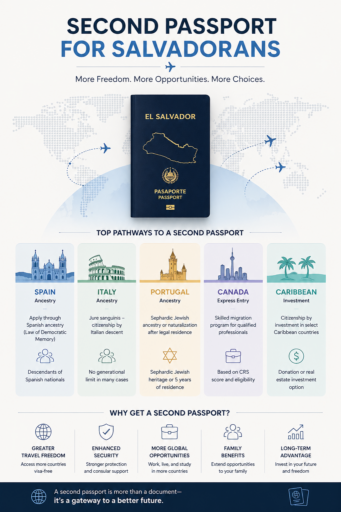
The fastest way to get an El Salvador second passport is through Caribbean citizenship-by-investment programs such as St. Kitts and Nevis or Dominica.
These can be completed in as little as 3–6 months under expedited processing.
- Ciudadanía por inversión (Caribbean programs: 3–6 months)
- Ciudadanía por descendencia (if eligible through parents or grandparents)
- Marriage-based naturalization (timeline varies by country)
- Residency-to-citizenship programs (typically 5–10 years, with some faster routes in countries like Portugal at 5 years and Spain at 2 years for select nationalities such as Latin Americans)
Among these, investment-based citizenship remains the quickest fully legal route to obtaining a second passport.
Is El Salvador a strong passport?
The Salvadoran passport is considered a mid-tier passport, offering visa-free or visa-on-arrival access to around 130 destinations, with strong regional mobility in Latin America but limited access to the EU and North America.
| Index | Ranking | Key insights |
| Índice de pasaportes de Henley | 33rd | Focuses on visa-free travel strength; Salvadoran passport ranks mid-tier due to limited Schengen, US, and Canada access |
| Índice de pasaportes de Arton Capital | 32nd | Weighs mobility score more dynamically, including visa-on-arrival; reflects slightly stronger regional mobility |
| Índice del Pasaporte Capitalista Nómada | 73rd | Broader criteria beyond travel, including tax policy, global perception, and dual citizenship friendliness, which lowers overall ranking |
What are the benefits of having a second citizenship for El Salvador?
A second citizenship for Salvadorans offers greater global mobility, improved access to stronger economies like the EU, US, and Canada, and an alternative legal residency option outside El Salvador.
- Greater travel freedom and visa-free access
- Backup residency in times of crisis
- Improved business and investment opportunities
- Tax planning flexibility (depending on jurisdiction)
- Acceso a mejores sistemas educativos y sanitarios
- Expanded lifestyle and retirement options
For many Salvadorans, it functions as a long-term strategy for security, mobility, and economic diversification.
¿Cuáles son las desventajas de la doble nacionalidad?
Dual citizenship in El Salvador can create tax exposure in multiple countries, added legal and compliance obligations, and potential conflicts between the rules of two different governments.
- Possible double taxation obligations
- Complex legal and reporting requirements
- Military or civic obligations in some countries
- Restrictions on certain government jobs
- Risk of conflicting legal responsibilities between countries
Careful planning is essential before acquiring a second nationality.
A Closer Look at Citizenship, Residency, and Golden Visas
Citizenship, residency, and golden visa programs are often part of the same long-term mobility strategy, where each stage serves a different legal and practical function.
Residency typically acts as the foundation for physical presence and integration in a country, while citizenship represents the end point that unlocks full political and mobility rights.
Golden visas sit within this structure as an accelerated entry point into residency through investment, often used to bypass traditional work or employment-based migration routes.
These pathways are frequently combined rather than chosen in isolation, especially by individuals planning multi-country mobility or long-term relocation options.
The sequencing of residency first and citizenship later is common in structured migration systems, but the timeline and requirements vary widely depending on jurisdiction.
For Salvadorans exploring second passport strategies, these mechanisms function more as interconnected tools within a broader mobility plan rather than separate standalone options.
Conclusión
Second citizenship planning for Salvadorans is ultimately driven by how different legal pathways translate into real-world mobility, settlement options, and long-term flexibility.
Short timelines, ancestry eligibility, and investment routes each serve different roles, but the decision typically comes down to how quickly and effectively a passport or residency status can support cross-border movement and life planning.
In practice, the most effective outcomes come from matching eligibility with intent, whether that is immediate travel access, gradual relocation into the EU or North America, or securing a secondary legal base for financial and personal security.
Countries with faster naturalization or investment-based systems tend to serve urgency, while residency-first systems reward long-term planning and stability.
The key consideration is sequencing. Understanding how one status leads into another, and how each stage fits into broader mobility, tax, and relocation strategies over time.
For structured planning around second citizenship, tax exposure, and cross-border wealth decisions, working with a financial advisor in El Salvador can help align legal and financial strategies before choosing a pathway.
Preguntas frecuentes
What are the passport requirements for El Salvador?
To obtain a Salvadoran passport, applicants must be Salvadoran citizens and present a valid DUI (Documento Único de Identidad), which is the national identity card used in El Salvador, along with a birth certificate, completed application form, and payment of required fees.
First-time applicants may also need additional civil registry documents depending on their record status.
Is it safe in El Salvador right now?
El Salvador is generally safer than in previous years due to strong government security crackdowns on gangs, especially in major cities and tourist areas.
However, safety levels can still vary by location and basic precautions are still recommended.
What countries can I visit with a Salvadoran passport?
A Salvadoran passport allows visa-free or visa-on-arrival access to countries such as most of Central America, Brazil, Singapore, and parts of the Caribbean, covering around 130 destinations in total.
What is the weakest passport?
En pasaportes más débiles are generally those that offer the least visa-free access, often from countries affected by conflict, limited diplomatic relations, or economic instability, such as Afganistán y Siria.
¿Le duele la indecisión financiera?

Adam es un autor reconocido internacionalmente en temas financieros, con más de 830 millones de respuestas en Quora, un libro muy vendido en Amazon y colaborador de Forbes.