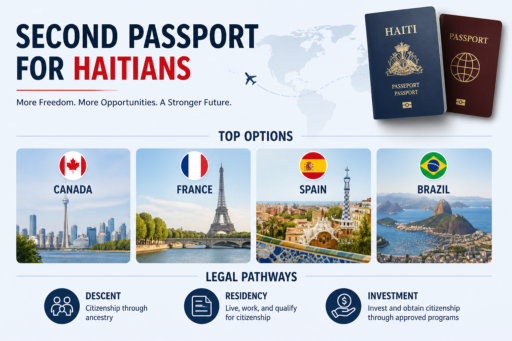
A second passport for Haiti allows Haitian citizens to legally keep their Haitian nationality while gaining citizenship in another country through descent, residency, marriage, or investment.
Haiti officially permits dual citizenship, and some of the most popular second passport options for Haitians include Canada, France, Spain, Paraguay, and Caribbean citizenship-by-investment programs such as Dominica and Saint Lucia for faster processing and stronger travel access.
Este artículo trata:
- Can you do dual citizenship in Haiti?
- What is the best country to get a second passport?
- Which country gives you the fastest citizenship?
- Why are people migrating from Haiti?
- What countries do Haitians immigrate to?
- How powerful is a Haiti passport?
Principales conclusiones:
- Haiti officially allows dual citizenship since the 2012 constitutional amendment.
- Canada, France, and Caribbean CBI programs are among the top options for Haiti second citizenship.
- Citizenship by investment is usually the fastest way to get a second passport for Haiti.
- A stronger Haiti second passport can improve travel freedom, relocation options, and financial opportunities.
Mis datos de contacto son hello@adamfayed.com y WhatsApp +44-7393-450-837 si tiene alguna pregunta.
La información contenida en este artículo es meramente orientativa. No constituye asesoramiento financiero, jurídico o fiscal, ni una recomendación o solicitud de inversión. Algunos hechos pueden haber cambiado desde el momento de su redacción.
Does Haiti allow dual citizenship?
Yes. The Haitian Constitution was amended in 2012 to allow Haitians to hold another nationality without automatically losing their Haitian citizenship.
Dual citizens can usually own property, maintain family ties, conduct business, and travel using both passports depending on the destination and legal requirements.
This change made it easier for Haitians living abroad to maintain legal and economic connections with Haiti while pursuing opportunities in another country.
However, some countries may have restrictions on dual citizenship, so it is important to verify the rules of the country where you plan to apply for citizenship.
Which country is best for a second passport?
For Haitian citizens, some of the best second passport options are Canada, France, Spain, Brazil, Paraguay, and Caribbean citizenship-by-investment countries like Dominica and Saint Lucia because they offer stronger passports, established migration pathways, and better long-term opportunities for Haitians.
- Main routes: Skilled worker programs, family sponsorship, student-to-residency pathways, refugee or humanitarian programs
- Key requirements: Language ability, education, work experience, or family sponsorship depending on the pathway
- Investment needed: No direct investment required for most immigration routes
- Calendario: 3 to 5 years or more from permanent residency to citizenship
- Why it stands out for Haitians: Strong Haitian communities in places like Quebec, French language compatibility, healthcare access, and economic opportunities
- Main routes: Residency, marriage, work permits, family reunification, or descent in some cases
- Key requirements: Long-term legal residency, language integration, and financial stability
- Investment needed: Generally no investment route required for standard naturalization
- Calendario: 5 years of legal residency before citizenship eligibility
- Why it stands out for Haitians: French-speaking environment, EU mobility, and access to European education and healthcare systems
España
- Main routes: Residency visas, employment, entrepreneurship, or family reunification
- Key requirements: Legal residency, financial means, and integration requirements
- Investment needed: No investment is required for standard residency or naturalization pathways
- Calendario: 10 years of legal residency for Haitian citizens
- Why it stands out for Haitians: Access to the EU, strong passport ranking, and high quality of life
- Main routes: Residency leading to possible naturalization
- Key requirements: Proof of income, clean criminal record, and legal residency compliance
- Investment needed: Paraguay does not have a formal citizenship-by-investment program, but applicants usually need to show financial solvency.
- Calendario: 3+ years before citizenship eligibility
- Why it stands out for Haitians: Lower cost entry point into South America and simpler residency processes compared to some countries
Brasil
- Main routes: Humanitarian residency, work permits, and long-term naturalization
- Key requirements: Legal residency and compliance with immigration rules
- Investment needed: No investment is required for the main residency pathways
- Calendario: 4 years of permanent residency
- Why it stands out for Haitians: Existing Haitian communities, labor opportunities, and more accessible residency pathways in the past decade
Programas de ciudadanía caribeña por inversión
Countries such as Dominica, Santa Lucía, Antigua y Barbuda, Granada, y San Cristóbal y Nieves offer citizenship-by-investment (CBI) programs that allow qualified applicants to obtain a second passport through a regulated financial contribution or approved investment.
- Main routes: CBI through government fund contributions, real estate investment, or approved national development funds
- Key requirements: Clean background checks, proof of legal source of funds, and approval through government due diligence screening
- Investment needed: Typically ranges from USD 200,000 to around USD 250,000+, depending on the country, investment option, and number of dependents included
- Calendario: Processing usually takes 3 to 6 months, depending on due diligence speed and application complexity
- Why it stands out for Haitians: Provides direct access to a second citizenship without long-term residency, offering improved visa-free travel and faster global mobility compared to traditional migration routes
What is the fastest way to get a second passport?
The fastest way to get a second passport is through CBI programs in Caribbean countries like Dominica, Saint Lucia, Saint Kitts and Nevis, or in smaller fast-track programs such as Vanuatu, Nauru, and Sao Tome and Principe, as well as through citizenship by descent in countries like Italy or Ireland, with some applicants qualifying in just a few months.
- Citizenship by investment (CBI)
Available in Caribbean countries such as Dominica, Saint Lucia, and Saint Kitts and Nevis- Calendario: Around 3 to 6 months
- Why it’s fast: No residency requirement and centralized processing
- Drawback: High cost and strict background checks
- Emerging or lesser-known CBI programs
Includes Vanuatu, Nauru, and Sao Tome and Principe- Calendario: Roughly 2 to 6 months depending on program and processing cycle
- Why it’s fast: Highly streamlined approval with limited residency requirements
- Drawback: Smaller passports with more limited visa-free access and less established global reputation compared to Caribbean programs
- Citizenship by descent (ancestry-based citizenship)
Common in countries like Italia y Irlanda- Calendario: About 2-4 years processing
- Drawback: Requires strong and verifiable ancestry records
- Marriage to a foreign citizen
- Calendario: Around 1 to 3+ years depending on the country
- Drawback: Requires strict proof of genuine relationship
- Fast-track residency and humanitarian routes
Includes countries like Canadá and Portugal- Calendario: About 3 to 6+ years
- Drawback: Requires physical residency and long-term integration
Where do most Haitians migrate to?
Haiti has one of the largest diaspora populations in the Caribbean, with an estimated around 1.6 million Haitians living abroad globally, and the largest concentration settled in the United States, according to Migration Policy Institute (MPI) estimates.
Other common destinations include:
- Canada (particularly Quebec, with a significant French-speaking Haitian community)
- Dominican Republic (large cross-border labor and migrant population)
- Brazil (expanded significantly after humanitarian visa policies in the 2010s)
- Chile (major destination in recent South-South migration waves)
- France (historical and language-linked migration route)
Migration trends can shift over time depending on visa policies, economic conditions, and humanitarian crises, but these countries remain the primary long-term settlement hubs for Haitians globally.
Why are so many Haitians leaving Haiti?
Haitians are leaving Haiti mainly due to escalating gang violence, political instability, economic hardship, and limited access to basic services such as healthcare and education.
Many Haitians migrate for a combination of survival and opportunity, including:
- Economic instability
- Limited job opportunities
- Political uncertainty and weak governance
- Security concerns linked to rising gang violence
- Catástrofes naturales
- Better access to education and healthcare abroad
- Family reunification in established diaspora countries
For many families, migration has become a long-term strategy for safety, stability, and financial survival rather than just opportunity-seeking.
How strong is a Haiti passport?
The Haitian passport offers visa-free or visa-on-arrival access to around 40–60 countries, placing it among the lower-ranked passports globally in terms of travel freedom.
| Index | Ranking | Key insight |
| Índice de pasaportes de Henley | 84th | Measures how many destinations can be accessed without a prior visa, using IATA data |
| Índice de pasaportes de Arton Capital | 77th | Weighs passport strength using a mobility score that includes visa-free, visa-on-arrival, and eTA access |
| Índice del Pasaporte Capitalista Nómada | 171st | Evaluates passports based not only on travel access but also tax policy, global perception, dual citizenship flexibility, and personal freedom |
Across all major rankings, the Haitian passport consistently falls in the lower tier of global mobility indexes, mainly due to limited visa-free access to Europe, North America, and parts of Asia.
What are the benefits of having a second citizenship?
A second citizenship for Haiti provides legal rights in another country, expanding travel access, residency options, financial flexibility, and long-term security beyond a single nationality.
Greater Travel Freedom
Some passports offer visa-free or visa-on-arrival access to 100+ countries, making international travel easier for work, study, or emergencies.
More Financial Flexibility
Dual citizens can often access foreign banking systems, diversify investments, and operate international businesses with fewer restrictions.
Backup Residency Option
A second passport gives an alternative place to live if conditions in the home country become unstable.
Education Opportunities
Citizenship abroad may lower tuition costs and improve access to international universities and scholarships.
Healthcare Access
Some countries provide citizens with subsidized or high-quality public healthcare systems.
Family Benefits
Citizenship can often be extended to spouses and children, securing mobility for the whole family.
Business Expansion
Entrepreneurs benefit from easier company setup, cross-border operations, and smoother international travel for business.
Is there any downside to getting dual citizenship?
Yes, holding two citizenships can create extra responsibilities and legal considerations based on the countries involved.
Possible downsides include:
- Potential tax reporting duties in one or both countries
- Compulsory military service obligations in certain jurisdictions
- More complex legal and administrative compliance across two national systems
- Requirement to file or declare assets and income in multiple countries
- Higher overall costs for applications, documentation, and legal assistance
- Limited travel or diplomatic flexibility in rare cases involving geopolitical tensions
Because rules vary widely by country, it is important to review the legal and tax implications carefully with qualified professionals before applying for a second citizenship.
Common Pitfalls Haitians Should Avoid When Applying for a Second Citizenship
Many Haitians applying for a second citizenship face delays or rejections due to avoidable errors in documentation, program selection, and legal compliance.
Los errores más comunes son:
- Submitting incomplete or inconsistent civil documents, especially for ancestry-based applications
- Choosing a fast-track program without verifying its legitimacy or global visa strength
- Underestimating total costs, including legal fees, translations, and government charges
- Failing to meet residency or physical presence requirements in residency-based pathways
- Relying on unlicensed agents or intermediaries instead of regulated immigration professionals
- Ignoring tax implications or reporting obligations tied to dual citizenship
- Not checking whether their home country or destination country restricts dual nationality in specific cases
Taking time to verify requirements and work with qualified legal or immigration professionals can significantly improve approval chances and prevent costly delays.
Conclusión
Second citizenship decisions for Haitians are ultimately shaped by eligibility, resources, and long-term mobility goals rather than a single best route.
Each pathway operates under different legal and administrative frameworks, so outcomes vary widely based on personal circumstances and documentation.
The quality of preparation and accuracy of documents often has a greater impact on approval than the chosen country itself.
Careful planning helps reduce delays and improves the likelihood of a successful application outcome.
Preguntas frecuentes
Who qualifies for a dual passport?
People who may qualify for a dual passport include those born in the country, individuals with ancestral ties, spouses of citizens, long-term residents eligible for naturalization, or applicants who meet investment requirements.
Eligibility still hinges on meeting each country’s specific legal and documentation criteria.
What are the top 3 strongest passports?
The strongest passports are typically those that offer the highest number of visa-free or visa-on-arrival destinations, with countries like Singapore, the UAE, and Germany consistently ranking near the top.
Do Haitians still have protected status?
Yes, many Haitians in the United States are currently protected under Temporary Protected Status (TPS), which allows them to live and work legally, with protections extended through 2026.
Future extensions beyond 2026 remain under government review and are subject to policy and legal decisions.