A second passport for Iranians can be obtained through citizenship-by-investment and naturalization pathways, with options including St. Kitts and Nevis, Turkey, and Armenia, offering increased global mobility and legal dual citizenship opportunities.
Many Iranians pursue it to enhance travel freedom, secure personal safety, and access better economic opportunities.
Este artículo trata:
- Can an Iranian have dual citizenship?
- Why do Iranians leave Iran?
- What is the best second passport to have?
- ¿Cuál es el segundo pasaporte más fácil de obtener?
- How strong is the Iranian passport?
Principales conclusiones:
- Iranians can hold dual citizenship, but Iran does not formally recognize it.
- Caribbean and European countries often offer the fastest paths to second citizenship.
- A second passport significantly increases travel freedom and global opportunities for Iranians.
- Dual citizenship may involve tax, legal, or military obligations depending on the countries.
Mis datos de contacto son hello@adamfayed.com y WhatsApp +44-7393-450-837 si tiene alguna pregunta.
Para los visados de nómada digital o de residencia que requieran ingresos, activos o inversiones cualificadas, podemos ayudarle a estructurar soluciones de inversión adecuadas que puedan ajustarse a esos requisitos, en función de sus circunstancias.
La información contenida en este artículo es meramente orientativa, no constituye asesoramiento financiero, jurídico o fiscal y puede haber cambiado desde el momento de su redacción.

Can Iranians have two passports?
Yes, Iranians can hold doble nacionalidad, although Iran does not formally recognize it.
This means that while the Iranian government treats you as solely an Iranian citizen, other countries may accept your second passport.
Many Iranians pursue a second passport to travel more freely, expand professional or business opportunities abroad, and secure the option to live internationally.
Having a second passport provides a legal way to access multiple countries, obtain residency, or participate in international programs, making it a common strategy for Iranians seeking long-term mobility and flexibility.
Why do Iranians want to leave Iran?
Many Iranians want to leave Iran because political repression, economic hardship, and limited freedoms have made everyday life increasingly difficult and insecure.
Ongoing domestic unrest, internet blackouts, and uncertainty tied to recent conflicts have intensified feelings of frustration and the desire for a more stable future abroad.
Iranians seek a second citizenship as a pathway to a new life beyond these challenges:
- Inestabilidad política – long‑standing repression, restrictions on free expression, and periodic crackdowns on dissent make many feel there is no clear path to reform at home.
- Economic opportunities – deepening recession, soaring inflation, and limited job prospects have left many young and skilled professionals without meaningful career futures.
- Travel freedom – an Iranian passport has visa restrictions that limit international mobility, encouraging people to seek citizenship that allows easier global access.
- Safety and personal freedom – desires for greater civil liberties, social freedoms, and the ability to raise a family in a more open environment drive emigration choices.
Which country is best for a 2nd passport?
For Iranians seeking the best second passport, Turkey and Saint Kitts and Nevis are among the most practical options.
The top choice is based on whether you want fast citizenship, visa-free travel, or a pathway to long-term residency and integration.
Key considerations when choosing a second passport
- Processing time: Some programs take months, others years.
- Visa-free access: Critical for Iranians due to limited travel with an Iranian passport.
- Investment or residency requirements: Ranges from property purchases to government contributions or naturalization through residency.
- Dual citizenship compatibility: Iran does not formally recognize dual citizenship, so the foreign country must allow it.
Citizenship-by-Investment (Fast Second Passports)
- Turquía – Offers a fast citizenship-by-investment route (property purchase starting ~$400,000) and is geographically and culturally familiar. Citizenship can be obtained in 6–8 months without residency.
- San Cristóbal y Nieves – Caribbean citizenship-by-investment program with 3–6 months processing, visa-free travel to Europe, and no residency requirement.
- Antigua y Barbuda – Offers a Caribbean citizenship-by-investment program similar to Saint Kitts and Nevis. Applicants can qualify through a government donation or real estate investment, typically receiving citizenship in 4–6 months. Visa-free access is strong, and the program allows including family members in a single application.
- Santa Lucía – Citizenship can be obtained via government contribution, real estate purchase, or business investment, with processing around 4–6 months and no physical residency required. It is popular for its simplicity and relatively low investment thresholds.
- Vanuatu – A Pacific island nation offering very fast citizenship (often 1–4 months) through a donation-based route. While visa-free access is not as extensive as Caribbean programs, it is one of the quickest options for those prioritizing speed.
Residency-to-Citizenship Pathways for Iranians
- Armenia – Allows citizenship after 3 years of residency or through investment options, with relatively straightforward procedures for Iranians due to regional proximity and easier legal processes.
- Uruguay – Naturalization requires 3–5 years of residence, but the country is politically stable, offers a safe environment, and has a flexible path to citizenship.
Alternative / Non-Standard Citizenship Programs
- Egipto – Offers citizenship through real estate purchase or significant bank deposits maintained for a period of time. While not as globally strong in travel freedom, it is appealing for regional ties and investment purposes.
- Santo Tomé y Príncipe – A newer, budget-friendly citizenship-by-investment option with processing in about 3 months. While its passport does not grant broad visa-free access, it is accessible to many applicants and includes family members.
- Sierra Leona – Provides accelerated citizenship with investment options and some visa-free travel, though its passport is generally weaker than other Caribbean or European alternatives.
Drawbacks to consider
- Limited travel freedom – Some alternative options (like São Tomé, Sierra Leone, or Vanuatu) offer fewer visa-free destinations compared with EU or Caribbean passports.
- Estabilidad política y económica – Smaller or less stable countries may affect the practical value of the passport over time.
- Cost versus benefit – Some programs require significant investment with limited added mobility or prestige.
- Eligibility checks – Due diligence and compliance requirements can be strict, particularly for Iranian nationals.
These options allow Iranians to weigh speed, cost, residency requirements, and travel benefits when selecting the second passport that best fits their personal and professional goals.
¿Cuál es el país más fácil para obtener un segundo pasaporte?
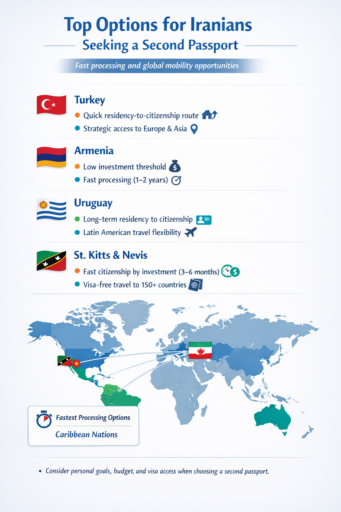
For Iranians prioritizing speed and simplicity, Saint Kitts and Nevis, Dominica, Turkey, Vanuatu, and Antigua & Barbuda are among the fastest options.
These programs are structured to grant citizenship with minimal residency requirements and well-defined investment paths.
- Vanuatu – Citizenship can be obtained in 1–4 months via a government donation. While extremely fast, its passport offers more limited visa-free travel compared with Caribbean or European options.
- Antigua y Barbuda – Citizenship is typically granted in 4–6 months through a government contribution or real estate investment. It allows family members to be included, but global mobility is slightly less than Saint Kitts and Nevis.
These alternatives provide rapid legal pathways to a second passport for Iranians who prioritize speed and administrative simplicity, even if they come with some limitations in travel freedom or global recognition.
Is an Iranian passport powerful?
No, Iran has one of the least powerful passports in the world, offering limited global mobility compared with most other nationalities.
Passport indices show this limited travel freedom clearly:
- The Henley Passport Index, based on official International Air Transport Association (IATA) data, consistently ranks Iran near the bottom in global mobility, with visa‑free or visa‑on‑arrival access to around 40 destinations, far fewer than the world’s strongest passports that allow access to 180+ countries.
- The Passport Index by Arton Capital similarly shows Iran’s mobility score as low relative to most countries, reflecting limited international access without pre‑arranged visas.
- According to the Nomad Passport Index (which weights travel, taxation, dual citizenship, freedom and perception), Iran also ranks very low — meaning Iranian passport holders face significant travel restrictions and receive lower overall passport value in multiple measures of global mobility and opportunity.
In practical terms, this means most Iranians must obtain visas in advance for travel to major economies such as the European Union, United States, Canada, Australia, and many parts of Asia and Africa.
What are the benefits of second citizenship?
Holding a second passport for Iranian citizens can significantly improve travel freedom, personal security, and global opportunities.
- Viajes sin visado – Allows entry to more countries without needing visas, simplifying international travel for work, study, or leisure.
- Oportunidades de negocio – Makes opening foreign bank accounts, forming companies, and conducting international business easier.
- Education and healthcare – Provides access to universities, scholarships, and high-quality medical services abroad.
- Seguridad y estabilidad – Offers an alternative residence in case of political unrest, economic uncertainty, or personal safety concerns.
Are there any disadvantages of having dual citizenship?
Yes, Iranians with dual citizenship may face tax obligations in multiple countries.
- Obligaciones fiscales – Some countries require reporting income or paying taxes in both nations, which can complicate finances.
- Servicio militar – Certain countries may mandate compulsory military service for citizens, even if you also hold another nationality.
- Legal conflicts – Laws in one country may not recognize your dual status, potentially causing complications with property, inheritance, or civil matters.
- Travel restrictions – Iran may treat you solely as an Iranian citizen, meaning your second passport might not be recognized for official matters or re-entry.
Planning Your Second Passport: Timing Considerations for Iranians
Changes in political stability, economic conditions, or global travel policies may influence both the ease of application and the value of a second citizenship for Iran.
So, timing can be critical for considering a second passport for Iran.
Political and economic climate in Iran
- Periods of heightened sanctions, currency volatility, or civil unrest can increase the urgency to secure alternative citizenship.
- A second passport can provide a safety net during unstable times.
CBI program updates
- Programas de ciudadanía por inversión may change requirements, costs, or processing times.
- Applying before a program increases its minimum investment or tightens eligibility can save months and reduce costs.
Visa-free access trends
- Some passports gain new visa agreements while others may lose access due to international relations.
- Tracking these changes can help maximize travel freedom for Iranians.
Personal milestones
- Consider aligning application timing with life events such as starting a business abroad, children’s education, or retirement plans, which may influence which passport option is most advantageous.
Strategically planning when to apply ensures that Iranians maximize speed, cost-efficiency, and global mobility, while minimizing potential delays or legal complications.
Conclusión
Pursuing a second passport challenges conventional boundaries of nationality and identity.
For Iranians, it’s an opportunity to diversify life options, reduce dependence on a single jurisdiction, and embrace a more globally integrated approach to career, education, and family planning.
Beyond practical benefits, it cultivates a proactive mindset, encouraging individuals to anticipate change and navigate geopolitical shifts with confidence.
Ultimately, second citizenship is not just a legal tool; it’s a strategic step toward greater flexibility, resilience, and the freedom to shape one’s own future on a global scale.
Preguntas frecuentes
Does Iran have birthright citizenship?
No. Iran generally follows jus sanguinis (citizenship by blood), meaning being born in Iran does not automatically grant citizenship if your parents are not Iranian.
Which countries can I go with an Iranian passport?
Iranians have visa-free or visa-on-arrival access to approximately 40–45 countries, including Turkey, Armenia, Georgia, and some Southeast Asian nations.
Is it true if you marry an Iranian man you become an Iranian citizen?
No, marrying an Iranian man does not automatically confer citizenship; a woman must apply and be approved by the government.
Are Iranians allowed to travel to the UK?
Yes, Iranians can travel to the UK with a valid visa, but visa requirements are strict, and approval is not guaranteed.
¿Le duele la indecisión financiera?

Adam es un autor reconocido internacionalmente en temas financieros, con más de 830 millones de respuestas en Quora, un libro muy vendido en Amazon y colaborador de Forbes.