An annuity provides guaranteed income, while an investment focuses on growth and flexibility.
The key difference between annuities and investments is predictable, stable payouts versus the potential for higher returns and control over your money.
Este artículo trata:
- What is the difference between an annuity and an investment?
- What are the advantages and disadvantages of having an annuity vs investment?
- Are annuities or investments safe if the market crashes?
Principales conclusiones:
- Annuities provide steady income and protect against outliving savings.
- Investments offer growth potential and flexibility but carry market risk.
- Combining annuities with investments can balance security and growth.
Mis datos de contacto son hello@adamfayed.com y WhatsApp +44-7393-450-837 si tiene alguna pregunta.
La información contenida en este artículo es meramente orientativa. No constituye asesoramiento financiero, jurídico o fiscal, ni una recomendación o solicitud de inversión. Algunos hechos pueden haber cambiado desde el momento de su redacción.

What is the difference between investment and annuity?
En inversión grows your money in the market, while an annuity turns a lump sum into guaranteed income.
- Inversión: Allows your funds to grow with market performance, offering flexibility and potentially higher returns. You control withdrawals but bear market risk.
- Anualidad: Converts a lump sum into a steady income stream, usually monthly or annually, often for life. The provider takes on investment and longevity risk in exchange for predictability.
In short, investments prioritize growth and control, while annuities prioritize stability and guaranteed income.
Which investment is best for retirement?
The most recommendable investment for retirement is a diversified portfolio that combines stocks, bonds, and broad-based funds to balance growth, income, and risk over time, instead of relying on one asset.
This works because no single asset consistently meets all retirement needs.
Growth-oriented investments help protect purchasing power, while income-focused assets provide stability and cash flow.
Stocks and equity funds are typically included for long-term growth and inflation protection, particularly for retirees with longer time horizons or additional income sources.
Bonds and bond funds help reduce volatility and generate steadier income, making them especially useful as retirement approaches or during drawdown years.
Fondos de inversión and ETFs simplify diversification by spreading exposure across multiple assets, sectors, and regions without requiring active management.
REITs and real estate investments can complement a portfolio by providing income and diversification, though they are usually best used as a secondary allocation rather than a core holding.
Ultimately, the specific mix should reflect individual risk tolerance, income needs, and retirement timing, but diversification remains the foundation for most successful retirement portfolios.
Is an annuity a good choice for retirement?
An annuity can be a strong choice for retirees aiming for predictable income and protection against outliving their savings.
It is particularly suitable if you:
- Want guaranteed monthly income for life
- Lack other reliable income streams
- Prefer a hands-off approach to managing market risk
However, annuities may be less flexible than other retirement strategies and often come with fees, so careful consideration of your personal situation is important.
Are annuities better than investments?
For most retirees, a combination is recommended: use an annuity for essential income and investments for growth and flexibility.
Annuities are not better than investments on their own; investments are generally better for growth, while annuities are better for assured retirement income.
- Annuities provide steady, predictable income and reduce longevity risk.
- Investments offer growth potential, flexibility, and the ability to leave assets to heirs.
This approach balances financial security with long-term wealth building, making retirement more stable and adaptable.
What are the advantages of investments vs annuity?
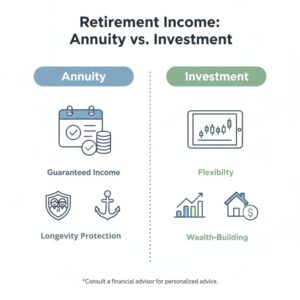
Investments excel at wealth growth and financial flexibility, whereas annuities excel at providing reliable, consistent retirement income.
Investments offer:
- Flexibility to access funds anytime
- Potential for higher returns over time
- Opportunity to grow wealth beyond guaranteed income
- Planificación patrimonial and inheritance benefits
Annuities offer:
- Dependable income
- Ensuring savings last a lifetime
- Less need to manage investments actively
What is the biggest disadvantage of an annuity vs investment?
The biggest disadvantage of an annuity is that your money is largely locked in.
Once funds are annuitized, access is limited, and withdrawing a large sum can trigger penalties.
Investments, on the other hand, remain accessible and can be adjusted or sold as needed, but they carry market risk and do not provide guaranteed income.
What happens to annuities when the market crashes?
Annuities generally continue paying guaranteed income even if the market crashes.
Fixed and immediate annuities provide set payments regardless of market performance, while variable annuities may fluctuate but often include riders that secure a minimum income.
Overall, annuities protect essential retirement income and provide stability, though growth potential is usually lower than market-based investments.
What happens to investments when the market crashes?
Investments lose value when the market crashes, exposing your portfolio to potential losses.
Stocks, bonds, and mutual funds can drop significantly, and recovery depends on market conditions, asset allocation, and your time horizon.
Compared with annuities, investments carry higher risk but also higher growth potential once markets recover, making diversification and risk management crucial.
What investments are safe in a market crash?
During a market crash, the safest investments are those that are low-risk and less tied to market fluctuations.
Options such as US Treasury bonds and bills, high-quality corporate bonds, certificates of deposit (CDs), and money market funds tend to preserve capital and provide predictable returns.
These investments act as a stabilizing component in a portfolio, helping retirees protect their savings while weathering market volatility.
Conclusión
Retirement planning is as much about strategy as it is about money.
Annuities act as a safety net, ensuring basic needs are covered, while investments serve as a growth engine, helping your wealth keep pace with inflation and lifestyle goals.
Balancing the two allows retirees to protect essential income while still capturing opportunities for financial growth, giving both security and flexibility in a changing economic landscape.
Consulting a asesor financiero can help you tailor this balance to your unique situation, ensuring your retirement plan meets your goals and mitigates risks effectively.
Preguntas frecuentes
What are the safest investments for seniors?
The safest investments for seniors are low-risk, income-focused options that preserve capital, such as US Treasury bonds and bills, high-quality corporate bonds, certificates of deposit (CDs), and money market funds.
These choices prioritize predictable returns and protection of principal over high growth.
How much does a $100,000 annuity pay per month?
A $100,000 lifetime annuity often pays roughly $400 to $600 per month, based on age at purchase, interest rates, and payout options such as single-life or joint-life coverage.
Why avoid annuities in retirement?
Retirees may avoid annuities because they limit access to a lump sum, come with fees and commissions that reduce returns, may lose purchasing power due to inflation, and offer less investment flexibility compared with market-based options.
¿Le duele la indecisión financiera?

Adam es un autor reconocido internacionalmente en temas financieros, con más de 830 millones de respuestas en Quora, un libro muy vendido en Amazon y colaborador de Forbes.