We will mainly discuss Dimensional Fund Advisors vs Vanguard in this article and touch on how the latter compares to iShares and BlackRock index funds. We will also answer some frequently asked questions, including what smart beta funds are in human terms.
Si prefiere el contenido en vídeo, a continuación encontrará un resumen del artículo.
For those that are interested in investing you can email me at advice@adamfayed.com or póngase en contacto conmigo aquí. That includes for people who want to diversify beyond Vanguard or Dimensional.
In the current market there are many assets that can beat a diversified portfolio of stocks and bonds.
La información contenida en este artículo es meramente orientativa. No constituye asesoramiento financiero, jurídico o fiscal, ni una recomendación o solicitud de inversión. Algunos hechos pueden haber cambiado desde el momento de su redacción.
Getting to Know Vanguard
Vanguard Funds History
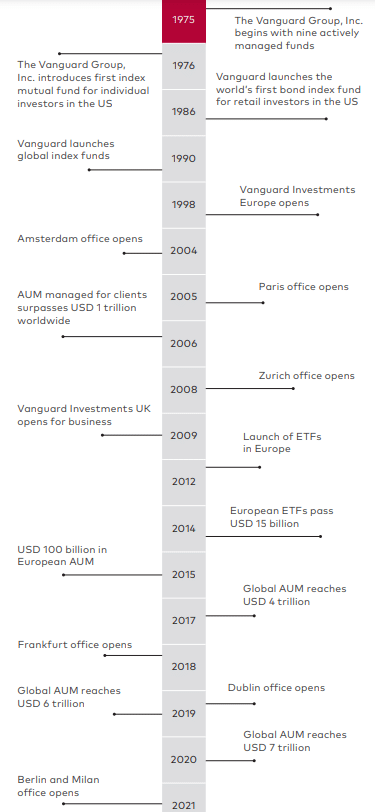
Muchos people know who Vanguard is. They are one of the biggest financial services groups in the world, with 7.6 trillion USD of global assets under management (AUM) as of Jan. 31, 2023.
Fundada por el difunto Jack Bogle en 1975, es famosa sobre todo por sus fondos indexados, que siguen un índice específico, como el S&P500 o el MSCI World.
They do offer gestionado activamente funds as well, although those funds have typically lagged their main index funds.
In the snapshot below, you’ll see a brief timeline of some key events in Vanguard’s history:
Vanguard Products and Services
Vanguard offers a comprehensive suite of investment products and services to help individuals and institutions achieve their financial objectives.
Vanguard Mutual Funds
One of Vanguard’s flagship products is their fondos de inversión, which are designed to track specific market indexes and provide a diversified portfolio of stocks or bonds at low costs. They offer both index funds and actively managed funds that seek to outperform their benchmarks.
Vanguard ETFs
In addition to mutual funds, Vanguard provides a variety of exchange-traded funds (ETFs) that offer exposure to equities, fixed income, and commodities. ETFs trade on an exchange like individual stocks and are also offered at low costs.
Vanguard Retirement Accounts
Vanguard also offers retirement accounts such as traditional and Roth IRAs, SEP IRAs, and solo 401(k) plans that help individuals prepare and save for their retirement while potentially reducing their taxes.
Vanguard Brokerage Services
For investors who want to buy and sell individual securities, Vanguard’s brokerage services offer access to third-party research and tools to make informed investment decisions.
Vanguard Financial Planning Service
The firm also delivers planificación financiera and advice services, including portfolio management, asset allocation, retirement planning, and tax planning.
Vanguard Institutional Service
Investment management services are given to institutional investors, including endowments, foundations, and pension funds, with a focus on portfolio management, investment consulting, and risk management.
Getting to Know Dimensional Fund Advisors
Dimensional Fund Advisors Background
Less people have heard of investment management company Dimensional Fund Advisors LP (DFA).
Headquartered in Texas and founded in 1981 by David Booth and Rex Sinquefield, the firm focuses on investing in a broad range of stocks that are tilted towards small-cap and value factors. Such have historically been shown to generate higher returns over time.
DFA’s funds are only available through financial advisors and institutional clients, and the company has developed a reputation for working closely with its clients to create customized investment solutions that meet their specific needs.
They have 584 billion USD in firmwide assets under management as of Dec. 31, 2022. With offices in 14 different locations globally, they are fast growing. However, in terms of size, Vanguard is still much bigger.
Dimensional Fund Products and Services
DFA’s investment products include mutual funds, exchange-traded funds (ETFs), and separately managed accounts. The company offers a range of equity and fixed income funds that are designed to provide exposure to specific market segments, such as small-cap, value, and emerging markets stocks.
DFA’s mutual funds and ETFs are only available through financial advisors and institutional clients, and the company works closely with its clients to create customized investment solutions that meet their specific needs.
The company’s investment strategies are designed to help investors achieve their long-term financial goals, while also managing risk through broad diversification and systematic rebalancing.
In addition to its investment products, DFA provides a range of research, education, and support services to its clients. The company conducts extensive research on financial markets and investment strategies, and it regularly publishes articles and whitepapers on its findings.
DFA also offers a variety of educational resources to help investors understand its investment philosophy and approach, including seminars, webinars, and online resources.
Dimensional Fund Advisors vs Vanguard: How similar are they?
Both Vanguard and Dimensional Fund Advisors are investment management companies that offer a range of mutual funds and other investment products to individual and institutional investors. They have a strong reputation in the industry and are well-known for their low fees and investor-focused approach. They also place a strong emphasis on inversión a largo plazo and encourage investors to maintain a disciplined investment strategy.
Product Offerings
Vanguard offers a range of mutual funds and ETFs that track major market benchmarks, as well as actively managed funds that seek to outperform those benchmarks. In contrast, Dimensional Fund Advisors offers a range of mutual funds and ETFs that are designed to provide exposure to specific market segments, such as small-cap, value, and mercados emergentes stocks.
Disponibilidad
Vanguard’s products are widely available to individual investors through its website, as well as through a range of third-party brokerages and financial advisors. Dimensional Fund Advisors’ products are only available through financial advisors and institutional clients. The company also works closely with its clients to create customized investment solutions that meet their specific needs.
Investment Approach
Vanguard’s investment idea is based on low-cost, passive investing. The company believes in investing in broad market index funds that track the performance of major market benchmarks such as the S&P 500, with a focus on minimizing costs and taxes.
In contrast, Dimensional Fund Advisors’ investment idea is based on the efficient market hypothesis, which posits that markets are generally efficient and that it is difficult to consistently outperform them through stock picking or market timing.
Instead, DFA seeks to capture higher expected returns by investing in a broad range of stocks that are exposed to certain systematic factors, such as small size, low relative price, and profitability. These factors revealed higher yields in the long term.
Do note that both Vanguard and Dimensional Fund Advisors are known for their passive investing strategies, although there are some differences in the way they implement these strategies.
The main difference is that DFA focuses more on value and small caps, and claim to use superior technology.
This is sometimes known as a “smart beta ETF” or index funds. It follows an index so it is passive but also considers many factors in picking stocks within the index.
Before our probe into smart beta, let’s first discover active and passive investing.
Active Investing
Active investing is an approach in which an investment manager tries to beat the market by selecting individual securities that they believe will outperform their benchmark. The goal of active investing is to generate higher returns than the market average.
However, active investing can be expensive due to the research and management costs associated with it, and it is often difficult to outperform the market consistently over time.
Traditional fund managers (“active managers”) try to beat the stock market by picking specific stocks or sectors that will outperform – they are seeking alpha.
En otras palabras, le cobran más que los fondos indexados, para intentar batir al índice.
La mayoría de los fondos activos han fracasado históricamente en esta misión, al menos a largo plazo. Muchos gestores activos pueden batir, y de hecho lo hacen, al S&P500 durante un periodo de 2 o incluso 5 años, pero tienen dificultades durante 20 años o más.
In 2022, active managers experienced their “best underperformance,” according to Índices S&P Dow Jones. This was because only 51% of large-cap active managers trailed the S&P 500 in the first half of 2022, which is significantly lower than the 68% average underperformance since 2009.
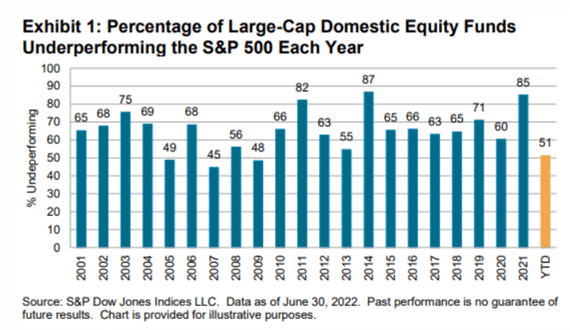
“Historically, beating the benchmark is very tough,” Anu Ganti told CNBC. Ganti is Dow Jones’ senior director for index investment strategy.
“And finally, we’ve seen the recovery in value after decades of underperformance,” Ganti said.
Passive Investing
Passive investing is an approach in which an investment manager seeks to replicate the performance of a market index or benchmark by investing in a representative sample of the securities that make up that index. The goal of passive investing is to achieve broad market exposure at a low cost, without trying to outperform the market.
Passive ETFs have gained popularity in recent years due to its low costs and the growing evidence that many active managers fail to outperform their benchmarks over the long term.
In comparison to active funds, index funds or passive investment funds, are merely trying to get the market average – a small cost for getting access to that fund.
What is Smart Beta then?
Smart Beta, on the other hand, is somewhere in the middle. It is a hybrid of active and passive investing that seeks to capture higher expected returns by investing in securities that exhibit certain systematic factors or “betas,” such as value, momentum, low volatility, or quality. Smart beta strategies use rules-based methods to select securities based on these factors, rather than relying on individual security selection.
Smart beta strategies are intended to offer the potential for higher returns than traditional passive investing, without the higher costs associated with active management. It is also relatively cheap like the passive funds but isn’t quite as passive as pure index investments.
Sin embargo, se diferencian en que utiliza algoritmos informáticos para tratar de aprovechar las ineficiencias del mercado. Así que batir al mercado, no desde el toque humano, sino con la tecnología.
Advocates of smart beta claim it is the best of both worlds: the low costs of passive funds with the brains of an active fund.
In addition, supporters of these funds claim that smart beta gives investors a better risk-adjusted performance. In case they won’t always beat the market, they will give you a better performance relative to the volatility of the fund. In other words, they might fall less when the general market is down.
Otro argumento es que el mercado estadounidense está muy ponderado a favor de las mayores empresas por capitalización, como Apple, Amazon y Netflix, que tienen valoraciones superelevadas.
Así que, según los defensores del smart beta, pueden añadir valor eligiendo, ponderando y reequilibrando estratégicamente las selecciones de valores que se incorporan al índice.
So, it isn’t a purely weighted index fund and this can reduce risks.
Nevertheless, they are not without their own dangers and drawbacks, and their performance can vary depending on market conditions.
Because of this, there is a discernible difference between Vanguard and DFAs, as opposed to index funds like iShares, BlackRock, and others that frequently offer performance and fee structures that are nearly comparable to Vanguard’s.
DFA typically charges 0.15% extra for the funds annually versus Vanguard or iShares.
Do these differences affect Vanguard and dimensional fund advisors performance?
Las ADF no existen desde hace tanto tiempo como para sacar conclusiones concretas. Dentro de otros 30 años, tendremos una mejor idea de la realidad de sus pretensiones de ofrecer un rendimiento superior.
However, in the last 10-12 years, Vanguard has often beaten dimensional fund advisors performance marginally. Even where DFA has come out on top, the difference is marginal, and only for a few years.
| Año | Index – Benchmark | DFA Large Cap | Vanguard S&P |
| 2019 | 27.6% | 27.59% | 27.56% |
| 2018 | -4.38% | -4.43% | -4.42% |
| 2017 | 21.83% | 21.73% | 21.78% |
| 2016 | 11.96% | 11.90% | 11.93% |
| 2015 | 1.38% | 1.38% | 1.35% |
| 2014 | 13.69% | 13.53% | 13.63% |
| 2013 | 32.39% | 32.33% | 32.33% |
| 2012 | 16.00% | 15.82% | 15.98% |
| 2011 | 2.11% | 2.10% | 2.09% |
| 2010 | 15.06% | 15.00% | 14.91% |
| 2009 | 26.46% | 26.62% | 26.49% |
Por ejemplo, la cartera DFA U.S. Large Company, que es similar al índice S&P500 de Vanguard. Según las estadísticas siguientes, DFA ha batido a Vanguard algunos años, y se ha quedado atrás durante otros periodos:
In some ways as well, the above figures are not a completely fair example because the DFA fund tilt their focus to small caps, which have done better long term.
In recent years, the performance of small-cap and large-cap indices has been mixed.
Así que DFA large cap vs Vanguard S&P500 no es una comparación exacta de manzanas contra manzanas. Es más como manzanas contra manzanas y con algunas naranjas en la misma cesta.
Si ampliamos la búsqueda por categorías a fondos de pequeña capitalización, de gran capitalización internacional y de otras categorías, observamos que Vanguard supera ligeramente a DFA con ratios de gastos más bajos, y también menor volatilidad.
Hardly a huge advantage, but it does show that beating Vanilla index funds isn’t easy on a consistent basis.
Don’t small caps usually beat large caps?
Las pequeñas capitalizaciones han batido a las grandes en los últimos 100 años, aunque depende del horizonte temporal que se elija.
Por ejemplo, las empresas de pequeña capitalización batieron drásticamente a las de gran capitalización en la Gran Depresión, pero también han ido a la zaga de las de gran capitalización durante otros periodos.
What are the upsides and downsides of investing in Dimensional Fund Advisors vs Vanguard?
Here are some of the potential pros and cons of investing in Vanguard and Dimensional:
Vanguard Pros
- Low Costs: Vanguard is known for its low expense ratios and is often seen as a leader in the low-cost investing movement.
- Diversification: Vanguard offers a wide range of funds that provide exposure to various clases de activos, allowing investors to build diversified portfolios.
- Passive Investing: Vanguard’s funds are designed to track market indices, which can be beneficial for investors who want broad market exposure without the risks of active management.
- Accessibility: Vanguard’s funds are widely available, making it easy for investors to access them through financial advisors or directly through Vanguard.
Vanguard Cons
- Limited Customization: Vanguard’s passive investing approach means that investors have limited control over their investment strategy, which may not be ideal for some investors with specific goals or preferences.
- Market Volatility: Vanguard funds are designed to track market indices, which means that they will experience market volatility, potentially leading to significant losses during market downturns.
DFA Pros
- Factor-Based Investing: DFA’s investment strategy is based on academic research and focuses on factors that have been shown to drive higher returns over time.
- Access to Premium Factors: DFA’s funds offer exposure to premium factors like size, value, and profitability that have historically generated higher returns.
- Diversification: Like Vanguard, DFA offers a range of funds that provide exposure to various asset classes.
DFA Cons
- Limited Availability: DFA funds are primarily offered through financial advisors, and not all advisors have access to them, limiting accessibility for some investors.
- Higher Minimum Investments: Many DFA funds have higher minimum investment requirements compared to some other mutual funds or ETFs.
Preguntas frecuentes
Esta sección responderá a algunas preguntas frecuentes (FAQ) que no se han tratado ya en el artículo.
¿Se pueden comprar asesores de fondos dimensionales en línea?
You can’t currently DIY invest DFM (discretionary fund manager) investments. You need to go through an advisory firm. The reason is to stop “hot money” coming in and out, like what happened to Vanguard in 2009 and during previous desplome de las bolsas.
Los gestores de fondos quieren que la gente compre y mantenga, lo que suponen que es más probable que ocurra a través de empresas de asesoramiento.
Esta afirmación tiene algo de cierto. Diversos estudios han demostrado que los inversores que invierten en fondos indexados siguen intentando tomar el tiempo de los mercados.
Esto contribuye a resultados como los que se muestran a continuación:
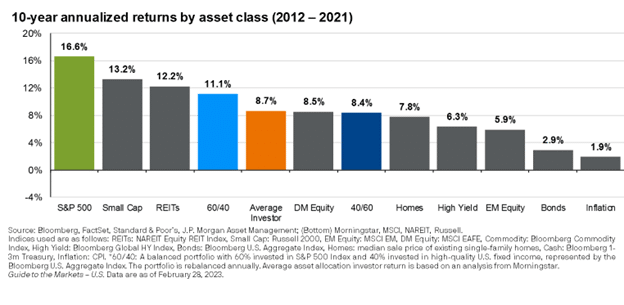
Personalmente he perdido la cuenta del número de personas que he conocido, que han dejado de invertir debido a Trump, Brexit y varios otros acontecimientos políticos.
¿Qué le parece Vanguard en comparación con iShares y otros fondos indexados?
Lo más interesante es que, si comparamos Vanguard con los ETF de iShares, el rendimiento también es muy similar. Lo mismo ocurre con los fondos indexados de BlackRock o HSBC (Reino Unido).
Ultimately most index funds these days are relatively similar, with the exception of these “smart beta” ones like from DFA.
So, investing with Vanguard over iShares won’t give you a huge advantage.
¿Qué opina Jack Bogle de la beta inteligente?
The father of low-cost investing Jack Bogle, was unimpressed before his death with the idea that Vanguard, Dimensional Fund Advisors, or any other firm, could beat the traditional index fund with smart beta tactics.
Comentó que el valor y las pequeñas capitalizaciones obtendrán mejores resultados durante ciertos periodos de tiempo, pero eso no hace probable un rendimiento superior a largo plazo.
Si la beta inteligente gana, la beta tonta pierde por la misma cantidad. Esto significa que la estrategia A puede funcionar para el inversor A, pero la estrategia B puede no funcionar para el inversor B.
What is most interesting about Bogle’s analysis is that he contended that these funds don’t help improve risk-adjusted performance in the long term – one of the key arguments proponents of smart beta use.
Vincent Deluard, global macro strategist for INTL FCStone, also had some strong arguments, as per the video aquí. As he mentioned, specific smart beta funds can outperform for a short period, but that isn’t a good reason in isolation to invest.
¿Qué mide Beta?
La beta mide la volatilidad de un activo. Por ejemplo, si se utiliza el S&P500 como proxy, la beta es uno.
Una acción con una beta de 3 tiene una rentabilidad que varía tres veces más que el mercado general, ya sea positiva o negativa.
Why is it easier to beat a small cap index than the S&P 500?
El S&P500 es principalmente dinero institucional. No era así en los años 50 o 60, cuando los inversores medios eran profesores, médicos y otras personas que a menudo operaban en función de sus emociones.
Now most owners are institutional – including banks and fondos de alto riesgo. Small caps, especially in mercados emergentes, have less institutional investors.
Eso no significa que en EE.UU. y el Reino Unido los índices de pequeña capitalización sean muy diferentes a los de los mercados más grandes, como el S&P500.
Small cap indexes has been driven by institutional money as the 2017 graph below shows, which is still true to this day.
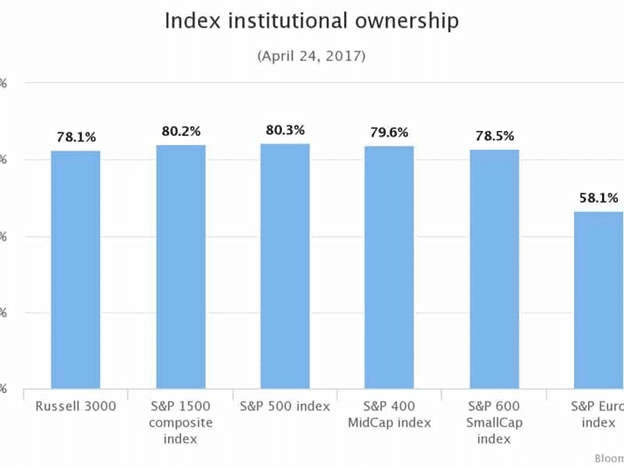
Así que batir un índice de pequeña capitalización puede ser ligeramente más fácil que uno de gran capitalización, pero también se ha vuelto más difícil.
This trend has also lead to a situation where even great investors, like Warren Buffett, are struggling to beat the market.
¿Son iguales la mayoría de los fondos smart beta?
No todos los fondos smart beta son iguales. Dimensional Fund Advisors es solo una opción.
Each smart beta fund has its own methodology, bias and smart beta index to track, so they can vary significantly in terms of their investment objectives, underlying rules, and portfolio holdings.
For example, one smart beta fund may aim to generate higher returns by investing in companies with strong fundamentals, while another may focus on companies with low volatility or high dividend yields. Some smart beta funds may track a single factor, such as value or momentum, while others may track a combination of multiple factors.
Are these a bubble?
I have written elsewhere to be cautious about this hype surrounding burbujas. Ninguna de estas estrategias de inversión ha alcanzado aún niveles de burbuja.
¿Qué le parece el rendimiento durante el mercado bajista de 2020?
Many of the large caps have global revenue like Amazon, Netflix and Apple, and are better suited at adapting to a remote and digital world. In fact, Netflix and some of the large caps had seen increased revenue, as more people stayed at home during the lockdowns.
Dimensional Fund Advisors vs Vanguard: Final Verdict
Hay muchas cosas buenas sobre algunos de estos fondos beta inteligentes, incluidos los asesores de fondos dimensionales.
Es cierto, por ejemplo, que las estadísticas muestran que los inversores DIY en Vanguard e iShares, pierden frente al mercado general que están siguiendo. Con demasiada frecuencia, compran caro y venden barato.
El hecho de que DFA sólo acepte a través de asesores podría suponer un contrapeso.
Sin embargo, aún no hay pruebas suficientes para afirmar que DFA sea una forma superior de invertir. Hasta ahora no han logrado batir a Vanguard, iShares y otros fondos indexados.
They are good funds, but that doesn’t mean the technology will help you beat an iShares or Vanguard Fund.
Overall, the choice between Dimensional Fund Advisors vs Vanguard ultimately depends on your individual needs and preferences. Vanguard may be a good choice if you’re seeking a low-cost, passive investing strategy, while Dimensional Fund Advisors may be a better fit if you’re looking for a more active, evidence-based approach.
However, it’s important to note that past performance is no guarantee of future results, and you should carefully consider their own risk tolerance and investment goals before choosing an investment strategy.
In reality, whether you buy a Vanguard, iShares, BlackRock or HSBC fund (for UK investors) really won’t make much difference in terms of performance.
The key things are investing for the long term, how much you invest, and asset allocation.
So, for now I would avoid the hype surrounding “smart beta ETFs.”
Incluso si tienen una ligera posibilidad de superar el rendimiento a largo plazo, mi dinero seguiría estando en un pequeño exceso de rendimiento para los fondos indexados más vainilla de Vanguard e iShares.
Si tienes curiosidad, podrías probar a tener una pequeña asignación vinculada a DFAs, y ver cómo se comportan en relación con Vanguard a largo plazo.
¿Le duele la indecisión financiera?

Adam es un autor reconocido internacionalmente en temas financieros, con más de 830 millones de respuestas en Quora, un libro muy vendido en Amazon y colaborador de Forbes.