External asset managers in Zurich are independent professionals or firms that manage client portfolios while holding assets with third-party banks.
They provide tailored investment strategies, risk management, and wealth planning for high-net-worth individuals, families, and international investors seeking Swiss stability.
Este artículo trata:
- How does an external asset manager work?
- Is Zurich a business hub?
- Who regulates financial services in Switzerland?
- What is the annual management fee for Zurich?
- Who are the clients of external asset managers?
Principales conclusiones:
- Zurich offers a stable, well-regulated environment for wealth management.
- External asset managers provide independence and access to global markets.
- Asset managers earn via management fees, performance fees, and advisory services.
- Risk management and compliance are crucial challenges for both managers and clients.
Mis datos de contacto son hello@adamfayed.com y WhatsApp +44-7393-450-837 si tiene alguna pregunta. También ofrecemos soluciones de estructuración a medida adaptadas a su situación.
La información contenida en este artículo es meramente orientativa, no constituye asesoramiento financiero, jurídico o fiscal y puede haber cambiado desde el momento de su redacción.

Why is Zurich a financial hub?
One of the main reasons why Zurich is considered a financial hub is its status as a center for wealth management and banca privada.
Several factors contribute to its prominence:
- Estabilidad política y económica
Switzerland is known for neutrality, strong rule of law, and economic resilience. - Strong Banking Infrastructure
Zurich hosts global banks, boutique private banks, and specialized financial institutions. - Regulatory Credibility
Switzerland maintains a well-developed regulatory framework that enhances investor confidence. - Skilled Talent Pool
The city attracts experienced portfolio managers, risk specialists, and financial engineers. - Global Client Base
Zurich serves European, Middle Eastern, Asian, and Latin American investors.
This ecosystem creates a natural environment for external asset managers in Zurich to thrive.
Who are external asset managers?
External asset managers (EAMs) are independent firms or professionals that oversee client investment portfolios.
They act as trusted advisors, providing specialized expertise while the client’s assets remain with third-party banks.
- Make investment decisions on behalf of clients through discretionary management
- Provide tailored advice and strategic planificación de inversiones
- Collaborate with both Swiss and international banks for asset custody
- Offer bespoke gestión de patrimonios solutions aligned with client goals
In Zurich, EAMs often cater to international investors, entrepreneurs, and oficinas familiares who value autonomy and personalized management over standard in-house bank services.
How are asset managers regulated?
Swiss asset managers are regulated under the Financial Institutions Act (FinIA). Oversight is conducted by FINMA (Swiss Financial Market Supervisory Authority).
Key regulatory requirements include:
- Licensing under FinIA
- Membership in a supervisory organization (SO)
- Capital adequacy requirements
- Anti-money laundering compliance
- Risk management and internal controls
This framework enhances credibility while maintaining Switzerland’s competitiveness as a wealth center.
How much do asset managers make in Zurich?
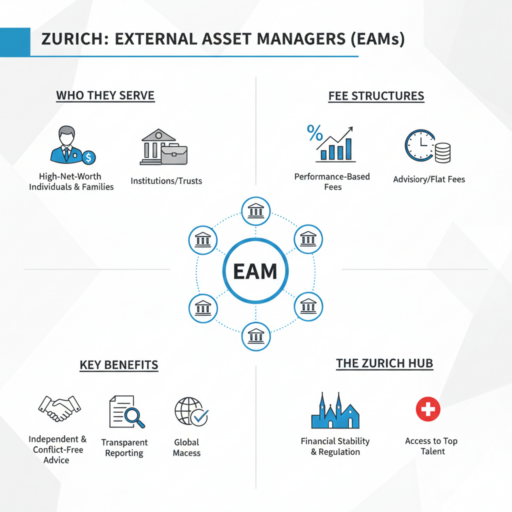
External asset managers in Zurich earn between CHF 120,000 and CHF 400,000 per year, with top partners or firm owners earning significantly more, based on assets under management (AUM).
Compensation varies based on firm size, client base, and performance structure.
La estructura típica incluye:
- Base salary (for employed managers)
- Percentage of assets under management (AUM)
- Performance fees (if applicable)
Estimated annual compensation:
- Junior portfolio managers: CHF 120,000–180,000
- Senior asset managers: CHF 200,000–400,000+
- Partners or firm owners: potentially much higher, depending on AUM
EAM firms typically charge clients:
- 0.5%–1.5% annual management fee
- Additional performance fees (commonly 10%–20% of gains above a benchmark)
Who uses asset managers in Zurich?
Particulares con grandes patrimonios, families, and international investors are the primary clients of Zurich asset managers.
- High-net-worth individuals (HNWIs)
- Ultra-high-net-worth families
- Entrepreneurs after liquidity events
- International investors seeking Swiss jurisdiction
- Oficinas familiares
- Fundaciones y fideicomisos
Clients may use Zurich-based or offshore managers capable of serving the region, particularly those with experience in global markets and expatriate or offshore structures.
What are the benefits of asset management in Zurich?
Choosing an external asset manager in Zurich brings clients the advantage of Swiss stability and strong regulatory oversight, along with independent, tailored investment solutions.
- Independence
EAMs are not tied to a single bank’s product shelf, allowing them to choose the best investment solutions for each client. This independence enables a truly customized approach to wealth management. - Custodian Flexibility
Clients’ assets remain with reputable Swiss or international banks, providing security and transparency. This also allows managers to coordinate with multiple custodians to optimize investment strategy. - Strong Regulatory Environment
Swiss oversight ensures that asset managers operate under strict compliance and risk management standards. This regulatory framework enhances investor protection and confidence. - Reputation and Stability
Switzerland’s financial sector is globally recognized for reliability and discretion. Zurich-based managers benefit from this reputation, which reassures both local and international clients. - Access to Global Markets
Zurich managers have the expertise and networks to invest across renta variable, bonos, alternatives, and structured products worldwide. This access allows clients to diversify portfolios beyond local markets.
What are the challenges in asset management in Zurich?
Despite Zurich’s stability and reputation, external asset managers face challenges such as regulatory costs, market competition, and currency risks.
- Regulatory Costs
Compliance with the Swiss Financial Institutions Act (FinIA) and other regulations increases operational expenses for asset managers. Firms must invest in compliance teams, reporting systems, and ongoing audits to meet these requirements. - Margin Pressure
Fee compression is a global trend affecting the wealth management industry, and Zurich is no exception. Managers must balance competitive pricing with maintaining profitability, especially for smaller EAMs. - Competition
Zurich’s market is highly competitive, with both large multinational banks and boutique independent firms vying for clients. Differentiating services and demonstrating value are essential to retain and attract clients. - Cross-Border Restrictions
Serving clients in the EU and other jurisdictions requires careful navigation of local regulatory rules. EAMs must ensure compliance with cross-border investment, tax, and reporting laws to avoid penalties. - Currency Exposure
The strength of the Swiss franc can impact international portfolio performance, particularly for assets denominated in other currencies. Managers need to implement effective currency risk strategies to protect client returns.
Zurich vs. Other Financial Hubs: Why EAMs Excel Here
Zurich competes with global wealth management centers such as London, Singapore, and Dubai, but it offers a distinct environment for gestores de activos that sets it apart.
- Unlike London, where Brexit has introduced regulatory uncertainty and higher taxes for some clients, Zurich benefits from a predictable, stable regulatory and tax framework that attracts long-term investors.
- Compared with Singapore, Zurich offers stronger legal protections and a more established international reputation for discretion and financial stability.
- While Singapore excels in tech-driven financial services and regional market access in Asia, Zurich remains the preferred choice for clients seeking a mature, conservative, and globally trusted banking environment.
- Dubai is often chosen for its tax advantages and rapid growth, but it lacks the deep, experienced talent pool and long-standing regulatory credibility that Zurich provides.
- Additionally, Zurich’s robust infrastructure and proximity to European markets give EAMs and clients both operational efficiency and seamless access to global investment opportunities.
In essence, while other hubs may compete on innovation, growth, or tax incentives, Zurich distinguishes itself as a hub where regulation, trust, and mature financial infrastructure combine to create a reliable backdrop for managing substantial and complex portfolios.
Conclusión
Zurich’s external asset management landscape illustrates how independence, expertise, and global reach converge in one of the world’s most stable financial centers.
The city’s strong regulatory framework, skilled talent pool, and international client base create opportunities for tailored, high-quality wealth management solutions.
However, navigating regulatory complexity, market competition, and currency risks requires careful strategy and disciplined risk management.
Choosing an EAM in Zurich is not just about accessing financial services; it is about leveraging the city’s unique combination of stability, discretion, and professional excellence to grow and preserve wealth over the long term.
Preguntas frecuentes
How do asset managers make money?
Asset managers earn primarily through annual management fees based on client assets and performance-based fees tied to investment returns.
They may also charge advisory fees, with overall revenue growing as assets under management and portfolio performance increase.
¿Cuál es un ejemplo de activo externo?
An external asset typically refers to holdings like stocks, bonds, or investment funds that are kept outside a primary bank or institution but managed by an independent professional.
What are the 4 types of risk in risk management?
In portfolio management, the four primary risks typically include:
Riesgo de mercado – Volatility in asset prices
Riesgo de crédito – Counterparty default risk
Riesgo de liquidez – Inability to sell assets quickly
Operational Risk – Failures in systems, processes, or governance
¿Le duele la indecisión financiera?

Adam es un autor reconocido internacionalmente en temas financieros, con más de 830 millones de respuestas en Quora, un libro muy vendido en Amazon y colaborador de Forbes.