Overseas founders can open a UK business bank account, but banks usually require verified identity, company documents, and evidence the business is genuinely operating or planning to operate.
In most cases, overseas founders must provide company registration documents, disclose beneficial ownership, verify directors and shareholders, and show proof of business activity or planned operations in the UK.
Questo articolo tratta di:
- How are banks regulated in the UK?
- Can I have a bank account in the UK if I don’t live there?
- Can I open a bank account in the UK online?
- What documents do I need to open a business bank account in the UK?
Punti di forza:
- Non-resident founders can open UK accounts, but approval is stricter than for residents.
- Banks must comply with AML and KYC regulations, increasing scrutiny for overseas founders.
- Fintech platforms may allow remote account opening without visiting the UK.
- Applications are rejected due to lack of UK presence, unclear ownership, or weak business documentation.
I miei recapiti sono hello@adamfayed.com e WhatsApp +44-7393-450-837 se avete domande. Offriamo anche soluzioni di strutturazione su misura per la vostra situazione.
Le informazioni contenute in questo articolo hanno carattere puramente indicativo, non costituiscono una consulenza finanziaria, legale o fiscale e possono essere cambiate rispetto al momento in cui sono state scritte.

Can a UK non-resident have a UK bank account?
Yes, a UK non-resident can have a Conto bancario nel Regno Unito, but the process is more complex than for UK residents.
Most traditional UK banks prefer applicants who have a UK residential address or a strong connection to the country, such as:
- A UK resident director
- A UK business presence
- A local address for the company
- Evidence of trading in the UK
For overseas founders who do not live in the UK, banks may require additional verification and documentation to meet regulatory requirements.
This is why many non-resident entrepreneurs choose digital banks or fintech platforms that support remote onboarding.
However, approval is never guaranteed, as banks evaluate each application based on risk, ownership structure, and expected business activity.
What regulations do UK banks have to comply with?
UK banks must comply with strict financial regulations designed to prevent money laundering, fraud, and illicit financial flows.
Key regulatory frameworks include:
- Know Your Customer (KYC) verification
- Anti-Money Laundering (AML) compliance
- Customer Due Diligence requirements
- Ongoing transaction monitoring
These rules are enforced by the Financial Conduct Authority and the Prudential Regulation Authority.
Because overseas founders often operate from outside the UK, banks may view these accounts as higher risk.
As a result, they typically require:
- Verification of identity and beneficial ownership
- Details of the company’s activities
- Expected transaction volumes
- Proof of the business model and clients
This explains why UK banks are strict with overseas founders.
Financial institutions must demonstrate that they fully understand who owns the business and how funds will move through the account.
Can I open a UK bank account online from abroad?
Yes, some fintech banks and digital banking platforms allow overseas founders to open a UK business account remotely.
These providers use digital onboarding, allowing identity verification and document submission online.
Gli esempi includono:
Wise Business
Saggio Business is widely used by international founders because it provides multi-currency accounts with UK bank details and relatively straightforward onboarding.
Pro
- Strong international payment infrastructure
- Transparent and competitive fees
Contro
- Not a traditional bank
- Additional verification may apply for higher-risk industries
Revolut Business
Revolut Business offers modern digital banking tools with multi-currency accounts and integrations for online businesses and startups.
Pro
- Powerful mobile app and modern banking interface
- Expense management and payment integrations
Contro
- Availability for non-resident founders can vary
- Some features depend on subscription tiers
Payoneer
Payoneer is commonly used by freelancers, e-commerce sellers, and online businesses to receive international payments through local receiving accounts.
Pro
- Widely used by global marketplaces and platforms
- Supports cross-border payments and payouts
Contro
- Functions mainly as a payment platform rather than a full bank account
- Some transaction and withdrawal fees may apply
Airwallex
Airwallex focuses on cross-border businesses, offering global accounts and payment infrastructure designed for startups and international companies.
Pro
- Strong global payments and multi-currency capabilities
- Useful for international e-commerce and SaaS businesses
Contro
- Onboarding requirements can be stricter for certain regions
- Some features may require a verified business profile
These platforms may provide:
- Multi-currency accounts
- UK account numbers and sort codes
- International payment capabilities
- Online onboarding for non-residents
However, some services may still require a UK company, identity verification, or proof of business activity.
What do you need to open a business bank account in the UK?
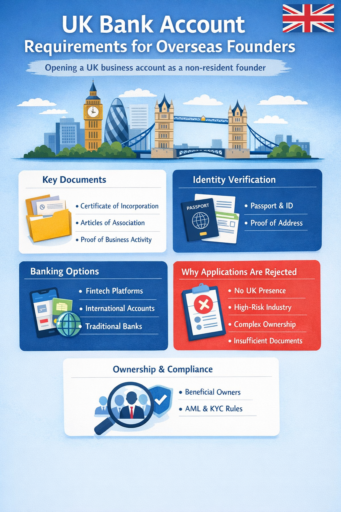
To open a UK business bank account, founders typically need company incorporation documents, identity verification for directors and owners, and information about the company’s activities and ownership structure.
Company Documents
- Certificate of Incorporation — confirms that the company is legally registered in the UK and provides the official company number.
- Articles of Association — outlines how the company is governed, including the roles of directors and shareholders.
- Company registration details from Companies House — banks use this public registry to verify the company’s status, directors, and filing records.
Identity Verification
- Passport of each director or shareholder — banks must verify the identity of individuals connected to the business under Know Your Customer (KYC) regulations.
- Proof of residential address — documents such as utility bills or bank statements help confirm where the directors or owners live.
Business Information
- Description of business activities — banks need to understand what the company does in order to assess regulatory risk and compliance obligations.
- Expected transaction volumes — this helps the bank determine how the account will be used and monitor activity for unusual transactions.
- Details of clients or suppliers — some banks request examples of customers, partners, or markets where the business operates.
Ownership and Control
Banks must also verify the ultimate beneficial owners (UBOs) of the company.
This means identifying individuals who ultimately control or benefit from the company, usually those holding 25% or more ownership or voting rights.
Additional documents may be requested depending on the risk profile of the business, particularly for non-resident founders or companies operating across multiple jurisdictions.
Which UK banks offer business accounts for non-residents?
Some UK banks, such as HSBC and Barclays, offer business accounts to overseas founders who provide the required documentation and demonstrate legitimate business activity.
Non-resident applicants may still need to attend an in-person meeting or show a meaningful UK presence.
Examples of major UK banks include:
HSBC offers international business banking and has experience dealing with non-resident founders.
- Pro: Global reach, multi-currency accounts, and robust online banking tools.
- Contro: Stringent compliance checks and in-person verification may be required; higher fees than some fintech alternatives.
Barclays provides a range of business accounts suitable for SMEs, including accounts for non-resident directors.
- Pro: Trusted UK bank with comprehensive support and additional financial services.
- Contro: Remote account opening is limited; approval can take longer due to strict regulatory checks.
Lloyds Bank allows overseas founders to apply for business accounts under certain conditions, such as having a UK company address.
- Pro: Strong local support and established business banking infrastructure.
- Contro: Non-residents often face higher scrutiny and may need to provide extensive documentation.
NatWest can accommodate non-resident business account applications, particularly for companies registered in the UK.
- Pro: Good online banking platform and additional SME resources.
- Contro: Limited remote onboarding; may require a UK resident director or a physical UK address for approval.
For these reasons, many overseas founders start with fintech providers before transitioning to traditional banks once the business establishes a stronger UK footprint.
In complex cases, working with a gestore patrimoniale or international advisor can help identify suitable banking options and structure the application process.
Why would a bank refuse to open an account in the UK?
A bank can refuse a UK business account to a non-resident founder if the company lacks a UK presence, operates in a high-risk industry, has unclear ownership, or provides incomplete documentation.
- Lack of UK presence
Banks may prefer companies that have a UK address, local staff, or evidence of business activity in the UK. - High-risk industries
Businesses in sectors such as crypto, gambling, or financial services often face stricter scrutiny due to regulatory concerns. - Complex ownership structures
If beneficial ownership is unclear or involves multiple jurisdictions, banks may reject the application. - Insufficient documentation
Missing identity documents or unclear business details can lead to rejection. - Compliance concerns
Banks must ensure full AML and KYC compliance, and any perceived risk can result in refusal.
Because banks are not required to provide detailed explanations, rejections can sometimes occur without clear feedback.
Does a UK company need a UK bank account?
A UK company does not legally require a UK bank account to exist.
However, having a UK bank account is often necessary for practical reasons, such as:
- Receiving payments from UK customers
- Paying suppliers and employees
- Managing tax obligations
- Operating through UK payment systems
Many UK-based service providers and clients expect payments through UK banking channels, which is why founders usually open a business account shortly after incorporation.
Alternatives if You Cannot Open a UK Bank Account
If a UK bank refuses your application, you can still manage your business finances using fintech platforms, international accounts, or payment processors.
These alternatives allow overseas founders to operate effectively without a traditional UK bank account while maintaining compliance and access to global payments.
Fintech and Digital Banking Platforms
Providers like Wise or Revolut Business offer multi-currency accounts with UK account details, online onboarding, and low-cost international transfers.
These accounts are ideal for startups or e-commerce businesses that need fast, flexible banking without visiting the UK, but they are not fully regulated banks, so some payment features may be limited.
Electronic Money Institutions (EMIs)
Some fintech providers operate under electronic money licenses and offer business accounts suitable for international companies.
EMIs can handle day-to-day transactions and cross-border payments, but large-scale deposits or complex corporate services may still require a traditional bank.
International Business Accounts
Entrepreneurs sometimes open accounts in other global financial hubs such as:
- Singapore
- Hong Kong
- Estonia
These accounts provide multi-currency capabilities and international payment access, making them a strong alternative if UK banks are restrictive. However, tax and compliance obligations may differ, so careful planning is required.
Payment Processors
Platforms like Stripe can allow businesses to accept payments without a traditional UK bank account.
Useful for online businesses, marketplaces, and SaaS companies, but withdrawals to UK accounts or large-scale payments may require linking to an alternative bank.
Professional Guidance for Cross-Border Banking
Opening a business bank account as a non-resident can involve complex regulatory checks, especially when ownership structures span multiple jurisdictions.
In some cases, overseas founders work with wealth managers, international corporate service providers, or cross-border banking advisors to identify suitable banking jurisdictions, fintech solutions, or international account options.
These professionals can help structure the business, prepare compliance documentation, and introduce founders to banks or financial institutions that are more accustomed to dealing with international clients.
Conclusione
Opening a UK business bank account as an overseas founder is increasingly feasible, but it requires strategic planning beyond simply submitting documents.
Success depends on demonstrating credible business activity, transparent ownership, and regulatory compliance—factors that influence both traditional banks and fintech providers.
Entrepreneurs should view banking not just as a compliance hurdle but as a tool for international growth.
Choosing the right platform, whether a traditional UK bank, a fintech, or an international account, can streamline payments, expand market reach, and reduce operational friction.
Planning your banking strategy early, documenting your business activities clearly, and understanding each provider’s risk appetite can significantly improve your chances of approval and ensure your UK company operates efficiently across borders.
Domande frequenti
Does a UK company require a UK resident director?
No. UK law does not require a company to appoint a UK resident director.
A company can be formed with directors from anywhere in the world, although banks may still prefer a UK-based director when opening a business bank account.
Can I open a UK bank account without a UK address?
It is possible, but more difficult. Many traditional banks require a UK address for identity verification or correspondence.
Fintech providers may be more flexible and allow non-resident founders to open accounts without a UK residential address.
How long does a business bank account take to open?
Opening a UK business bank account typically takes 1–10 days with fintech platforms and 2–6 weeks with traditional banks, while complex cases can take several months.
Delays are usually due to incomplete documents or additional compliance checks.
Siete afflitti dall'indecisione finanziaria?

Adam è un autore riconosciuto a livello internazionale in materia finanziaria con oltre 830 milioni di visualizzazioni di risposte su Quora, un libro molto venduto su Amazon e un contributo su Forbes.